1914: The fighting in Flanders
Battle of Nonne Bosschen
- Dates:
- 11 November 1914
- Front:
- Western Front
- Location:
- Nonne Bosschen wood and the area of the Menin–Ypres road, from Polygon Wood to Veldhoek and Herenthage woods, about 6 kilometres east of Ypres, West Flanders (Belgium)On the battle map →
- Sides:
- United KingdomJohn French, Douglas Haig, Charles Monro, Charles FitzClarenceFranceFerdinand Foch, Victor d'Urbal, Pierre DuboisGerman EmpireRupprecht, Crown Prince of Bavaria, Alexander von Linsingen, Karl von Plettenberg, Arnold von Winckler
- Result:
- British defensive victory. The Prussian Guard broke into the British line but was stopped and driven out of Nonne Bosschen wood. The Germans held only a stretch of the old British front line.
- Author:
- Łukasz Skowroń
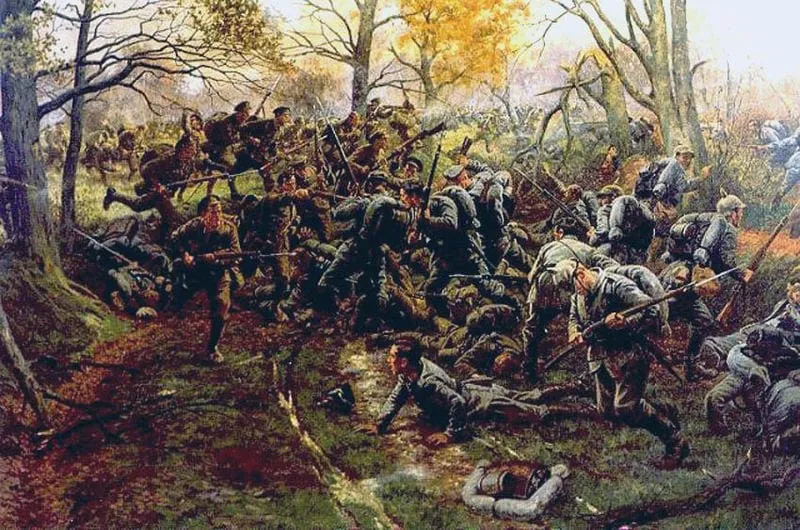
The Battle of Nonne Bosschen, fought on 11 November 1914 east of Ypres, was the last great German attack of the First Battle of Ypres. After the heaviest artillery bombardment since the fighting began, the Germans attacked on a front from Messines to Polygon Wood. They were repulsed everywhere except on one sector by the Menin–Ypres road, where a fresh, picked division made up of Prussian Guard regiments broke the line of a bled-out British brigade and pushed deep into the position. Some of the guardsmen got through Nonne Bosschen wood almost up to the British battery positions. They were stopped by the gunners’ fire, and in the afternoon a counter-attack by the 2nd Battalion, Oxfordshire and Buckinghamshire Light Infantry drove them out of the wood. The front at Ypres held.
Name and dates
The name of the battle was fixed after the war by the British Battles Nomenclature Committee. It divided the fighting at Ypres in the autumn of 1914 into the battles of Langemarck (21–24 October), of Gheluvelt (29–31 October) and of Nonne Bosschen (11 November). The British official history notes that Nonne Bosschen wood lay on the northern edge of the attack. The heaviest fighting took place south of it, in Veldhoek and Herenthage woods on both sides of the Menin road and in front of the southern edge of Polygon Wood. The name, however, marks the place where the Germans broke deepest into the British line that day.
Nonne Bosschen (today Nonnebossen) means “nuns’ woods” in Flemish. The name comes from a Benedictine convent that stood here from the 12th to the 16th century. The British also called the wood Nun’s Copse. It was a small triangular copse of oaks and chestnuts with dense undergrowth, about 6 kilometres east of Ypres, between Polygon Wood and Glencorse Wood, in what is now the municipality of Zonnebeke. This battle should not be confused with the battle of Polygon Wood, which British nomenclature distinguishes in 1917, during the Third Battle of Ypres. For the Germans the fighting of 11 November was part of the Battle of Ypern, and the General Staff history describes it as the last phase of the struggle for the town.
Background
After the crisis of 31 October the Germans did not give up on breaking the front at Ypres. In the first days of November they took the Messines–Wytschaete ridge and kept attacking east and south of the town, while the German commander-in-chief, General Erich von Falkenhayn, brought up more divisions from other sectors of the front. A composite division of the Guard Corps under Lieutenant-General Arnold von Winckler was moved to Ypres from the Arras area. It was made up of the 1st Guard Infantry Brigade of the 1st Guard Division and the 4th Guard Infantry Brigade of the 2nd Guard Division. Alongside it the Pomeranian 4th Division of II Corps, regarded as one of the best in the Prussian army, arrived at the front.
The two divisions formed a corps under General Karl von Plettenberg, commander of the Guard Corps. Together with the XV Corps of General Berthold von Deimling they became part of a new army group under General Alexander von Linsingen, which took over the front on both sides of the Menin road, from Polygon to the Comines–Ypres canal. South of it attacked the group of General Max von Fabeck. The decisive attack was planned for 10 November, but thick fog made reconnaissance impossible and Plettenberg postponed it by one day. On 10 November only the Fourth Army attacked, north of Ypres; it took Diksmuide and pushed the French at Bikschote back to the Yser canal.
Forces
Germany. On 11 November twelve and a half divisions of the Linsingen and Fabeck groups and of the left wing of the Fourth Army were to attack on a front of about 14 kilometres, from Messines to Reutel opposite Polygon Wood. The whole was directed by the commander of the Sixth Army, Crown Prince Rupprecht of Bavaria. According to the British official history, 25 battalions, at least 17,500 infantrymen, advanced on both sides of the Menin road. Winckler’s division had twelve fresh battalions, about 10,000 men. The 1st Foot Guards Regiment was commanded by the Kaiser’s son, Prince Eitel Friedrich.
The British. This sector was defended by the British I Corps of General Douglas Haig, reinforced by the remnants of II Corps. South of the Menin road stood the 3rd Division of General Frederick Wing, reinforced by battalions from other divisions of II Corps; north of it, facing the Guard, the 1st Guards Brigade of General Charles FitzClarence, and further on, in Polygon Wood, units of the 2nd Division of General Charles Monro. After three weeks of uninterrupted fighting, battalions were often a few hundred or even a few dozen men strong. FitzClarence’s brigade, made up of three Scottish battalions (Scots Guards, Cameron Highlanders and Black Watch), had just over 800 soldiers in all. According to the official history, 19 battalions and three cavalry regiments, at most 7,850 men including reserves, stood against the 25 German battalions. Artillery ammunition was short, and the trenches were shallow and barely protected by wire. To the left of the British fought the French IX Corps of General Pierre Dubois, and to the right, by the canal, the French troops of General Moussy.
Course of the fighting
The bombardment. The night of 10–11 November was quiet. At dawn there was thick fog. Soon after 6.30 a.m. the German artillery opened fire, the heaviest the British had experienced since the battle began. It lasted about two and a half hours and grew in intensity as 9 a.m. approached. The British infantry could only lie at the bottom of their shallow trenches. The positions of FitzClarence’s brigade, clearly visible from the higher Reutel ridge, suffered most.
The attack. At about 9 a.m., when the fire lifted to the rear, the German infantry advanced from the woods on both sides of the Menin road. The Pomeranians of the 4th Division, attacking south of the Guard, were shattered almost at once by rifle fire and shrapnel, and by evening had not come near the British trenches again. The 4th Guard Brigade struck along the road itself. The 4th Guard Grenadier Regiment suffered heavy losses south of it and took only part of the trenches of the Royal Fusiliers battalion. North of the road the fusilier battalion of the 2nd Guard Grenadier Regiment went through thinly held trenches and broke a few hundred metres deep into the woods around Veldhoek château. There it was caught in fire from British strongpoints and almost completely destroyed.
The breakthrough. The most dangerous was the attack of the 1st Guard Brigade, made up of the 1st and 3rd Foot Guards Regiments. At about 9 a.m. dense lines of guardsmen emerged from the fog only a few dozen metres in front of the British trenches. The officers walked with drawn swords, the men came on at a jog with their rifles in hand. The Germans went through the front line almost without firing a shot and attacked with the bayonet. The defending Scots were overwhelmed, but their resistance broke up the attackers’ formations. Most of the 3rd Regiment swung towards Polygon Wood, where the 1st Battalion, King’s (Liverpool) raked it with fire, and was repulsed. A belt of dead and wounded lay in front of the King’s trenches. The guardsmen who turned back west from the wood were in turn stopped by a strongpoint that 40 men of the Black Watch under Lieutenant F. Anderson held in the garden of a cottage at the south-western corner of Polygon Wood. The spot was later named Black Watch Corner. To the south, at Verbeek farm, the guardsmen were stopped by battalion headquarters and a few dozen men of the Black Watch.
The gunners. Between these strongpoints a gap a few hundred metres wide opened up. At about 10.15 a.m. a report reached the headquarters of the 1st Brigade that the Germans were in Nonne Bosschen wood. Several hundred guardsmen went through the wood and came out on its western edge, only 200–300 metres from the positions of the batteries of the 41st Field Artillery Brigade and the 35th Heavy Battery of the 2nd Division. There was no infantry left behind the batteries. The gunners opened fire over open sights, and gunners, cooks, signallers, brigade staff and sappers of the 5th Field Company, Royal Engineers took up rifles. A few cooks and duty sappers stormed and retook a cottage from which the Germans were firing on the guns. The guardsmen fell back into the wood, not knowing that they had been stopped by the last line of the British defence. According to the official history, a wounded German officer taken prisoner asked a battery commander where the British reserves were. He pointed to the line of guns, and when asked what lay behind them, replied: divisional headquarters.
The counter-attack. At about noon the commander of the 5th Brigade, Colonel Westmacott, ordered Lieutenant-Colonel Henry Davies, commanding the 2nd Battalion, Oxfordshire and Buckinghamshire Light Infantry, the last reserve of the 2nd Division, to clear Nonne Bosschen. The battalion, then fewer than 400 bayonets strong, moved under heavy shellfire and set off from Westhoek to attack only in the early afternoon. Accounts give different times; the official history speaks of “after two, nearly three”. Two companies entered the wood from the north-west, supported on the flanks by a company of the Northamptonshire battalion and sappers of the 5th Field Company. The Oxfordshires went through the wood at a quick pace and drove the guardsmen out, killing or capturing those who resisted. Those fleeing from the wood were shot down by men of the Northamptonshire and the Cameron Highlanders in Glencorse Wood. The battalion also retook the old support trenches of the 1st Brigade before, shortly after 3 p.m., it was halted by mistaken fire from French batteries near Frezenberg. Then heavy rain mixed with hail began to fall and darkness came. All the Germans who had gone through the British line in the morning had been killed, captured or driven back, but the old front-line trenches between the Menin road and Polygon Wood remained in their hands.
The night. General FitzClarence decided to retake the lost trenches with a night attack. It was planned first for 9 p.m., then for 1 a.m., when the moon would rise. After reconnaissance, however, Davies concluded that the Germans had dug new trenches and that an attack in the dark and mud had no chance, and he withdrew from it. Between 2 and 3 a.m. on 12 November FitzClarence, leading the Grenadier Guards and Irish Guards battalions, went forward to reconnoitre near Black Watch Corner and was mortally hit by a bullet. The attack was called off.
Losses
Of the three Scottish battalions of FitzClarence’s brigade, about 300 men were left by evening. Of the Scots Guards only the battalion headquarters and 39 men survived; the Black Watch had one officer left. The Royal Fusiliers battalion lost its commanding officer and all its officers except two second lieutenants. The 2nd Battalion, Oxfordshire and Buckinghamshire lost only 5 killed and 22 wounded in the counter-attack, whereas the 5th Field Company of sappers lost its commander, Major A. H. Tyler, and two other officers killed, as well as a quarter of its men.
German losses were very heavy, though they were never counted exactly. According to the history of the 1st Foot Guards Regiment, its two battalions lost 16 officers and more than 800 men, and the fusilier battalion of the 2nd Guard Grenadier Regiment 15 officers and about 500 men. Official German figures give for the whole of Winckler’s division for 11–20 November only 53 officers and 2,081 men, which the British official history considers an understatement. The 4th Division lost more than 2,900 men in all in November, most of them between 11 and 19 November.
Significance
The attack of 11 November was the last great attempt to break the front at Ypres. The Germans threw picked troops into it, but apart from one breach achieved nothing. The British official history points out that the two regiments of the 1st Guard Brigade were ordered to advance in diverging directions, so a gap opened between them, and above all that the Germans were unable to exploit the breakthrough. British strongpoints, artillery fire cutting the attackers off from reinforcements and counter-attacks by small reserves were enough to seal it. The fighting at Ypres went on for a few more days, but both sides were at the end of their strength. On 17 November Duke Albrecht of Württemberg halted the attacks of the Fourth Army, and on 22 November the British end the First Battle of Ypres.
The clash quickly gave rise to legend. It was repeated that the Kaiser had personally ordered the Guard to break the British line at any cost, and that the line regiments had failed where the elite was to succeed. The British official history corrects this: the Guard was only one of twelve and a half attacking divisions and broke the front on a weak sector as much by its numbers as by its quality. The British liked to recall that the 2nd Battalion, Oxfordshire and Buckinghamshire, the old 52nd Regiment of Foot, had almost a hundred years earlier, at Waterloo, broken the charge of Napoleon’s Imperial Guard. General FitzClarence, a holder of the Victoria Cross, has no known grave. His name is on the Menin Gate at Ypres. He is the highest-ranking soldier commemorated on the memorial.
Spotted a mistake?Report an error