1914: The fighting in Flanders
Battle of Langemarck (1914)
- Dates:
- 21–24 October 1914
- Front:
- Western Front
- Location:
- Around the villages of Langemarck, Poelkapelle, Bikschote and Zonnebeke, north and north-east of Ypres, West Flanders (Belgium)On the battle map →
- Sides:
- United KingdomJohn French, Douglas Haig, Henry RawlinsonFranceFerdinand Foch, Victor d'UrbalGerman EmpireAlbrecht, Duke of Württemberg, Georg von Kleist, Otto von Hügel
- Result:
- Indecisive. The British advance on Bruges was halted on the first day, but the German reserve corps, despite heavy losses, failed to break the front north of Ypres.
- Author:
- Natalia
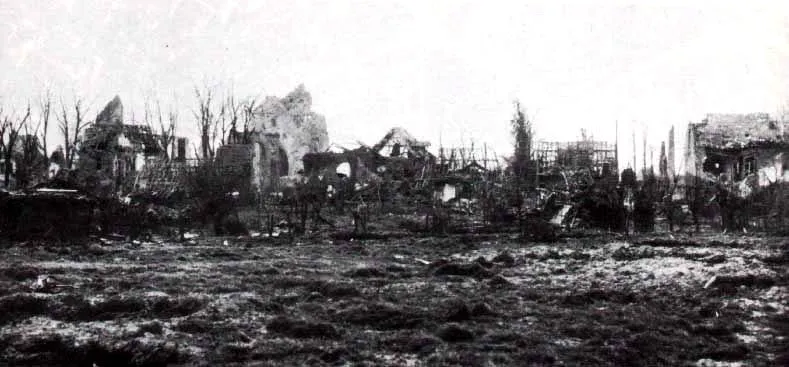
The Battle of Langemarck was fought from 21 to 24 October 1914 north and north-east of Ypres in Flanders. It was the first stage of the First Battle of Ypres. On 21 October General Douglas Haig’s British I Corps set off to attack towards Bruges, convinced that it faced at most one German corps. Instead it ran into several new German reserve corps which were themselves advancing on Ypres. The British halted on the very first day and went over to the defensive, and for the next three days they beat off attacks by young, poorly trained German soldiers, inflicting enormous losses on them. These battles, together with the later attack of 10 November, gave rise in Germany to the Langemarck myth.
Name and dates
The name and dates of the battle were fixed after the war by the British Battles Nomenclature Committee. It divided the fighting around Ypres in the autumn of 1914, which lasted from 19 October to 22 November, into several smaller battles. It named the first of them after the village of Langemarck (today Langemark, part of the municipality of Langemark-Poelkapelle), then the largest place in the Ypres area, with more than 7,000 inhabitants. The battle covered the operations of the British I Corps and of the neighbouring IV Corps of General Henry Rawlinson on an arc from Zandvoorde through Zonnebeke and Langemarck to the Ypres–Yser canal. The Germans treated this fighting as part of one great battle in Flanders and did not give it a separate name.
This battle should not be confused with the Battle of Langemarck of 16–18 August 1917, one of the stages of the Third Battle of Ypres. Langemarck is also linked with another notorious date. On 22 April 1915, at the start of the Second Battle of Ypres, the Germans used poison gas here on a large scale for the first time.
Background
By mid-October 1914 the race to the sea was coming to an end. The Belgian army had dug in on the Yser, and British troops had returned to Ypres: the 7th Division and the 3rd Cavalry Division of Rawlinson’s IV Corps. To the north of them stood French Territorial divisions and General de Mitry’s cavalry corps. On 19 and 20 October the last of the corps of the British Expeditionary Force, Haig’s I Corps, made up of the 1st and 2nd Divisions, reached Ypres from the Aisne.
The British commander-in-chief, Field Marshal John French, still believed that the German flank could be turned. Together with General Ferdinand Foch, he hoped that the Allied forces would advance east and north-east from Ypres. I Corps was ordered to march towards Thourout (Torhout) and then on to Bruges. French disregarded the reports of his own intelligence and assumed that there was at most one German corps north of Ypres.
In reality the new German 4th Army of Duke Albrecht of Württemberg was heading for Flanders. Its core consisted of four new reserve corps, the XXII, XXIII, XXVI and XXVII, formed in the first weeks of the war. Many of their men were volunteers who had joined up in August 1914, including schoolboys and students, alongside reservists and older Landwehr soldiers. Their training had lasted only a few weeks. They lacked experienced officers and NCOs, machine guns and artillery. The Chief of the German General Staff, Erich von Falkenhayn, threw these corps into an attack between the sea and Ypres, hoping that they would break through the weak Allied front and open the way to the Channel ports. In the last days before the battle their advance guards drove the French and British cavalry out of Roeselare and off the ridge at Passendale, east of Ypres.
Course of the fighting
21 October. In the morning I Corps attacked to the north-east, with the 2nd Division on the right between Zonnebeke and Sint-Juliaan, and the 1st Division on the left, from Langemarck towards Poelkapelle (PL). Because the roads and bridges were jammed with French Territorial units and refugees, the 1st Division was late reaching its start positions and the attack did not begin until after 9 a.m. The British advanced over flat but densely built-up ground, cut by streams, hedges and copses. Coming the other way to meet them were the divisions of General Otto von Hügel’s German XXVI Reserve Corps. An encounter battle followed. The British artillery had, as the official history puts it, “the targets of a lifetime”: dense lines of German infantry advancing in the open at close range.
Around midday a new threat appeared on the left flank. The 46th Reserve Division of General Georg von Kleist’s XXIII Reserve Corps was approaching through the forest at Houthulst, and the French cavalry covering the British flank was ordered to withdraw behind the canal. In the afternoon Haig halted the advance. The 1st Division had to use its reserves to cover the exposed flank on a line from Langemarck to Bikschote (PL) and the canal. By evening the front of I Corps formed a projecting salient from Zonnebeke station past Langemarck to the village of Koekuit, from where it turned west towards the canal at Steenstrate. The corps lost 982 men that day. In the evening Field Marshal French ordered all his corps to go over to the defensive and dig in where they stood. On the same day the commander-in-chief of the French army, General Joseph Joffre, announced that the French IX Corps would be sent to Ypres.
22 October. The Germans attacked along the whole arc around Ypres. The British trenches were shallow and broken, without barbed wire or a second line, but British rifle and artillery fire stopped wave after wave. On the 7th Division’s front at Zonnebeke and Becelaere the German dead and wounded lay, according to one battalion war diary, literally in heaps. In the evening the young soldiers of XXVI Reserve Corps attacked the battalions of the 5th Brigade at Langemarck. Some came within 25 metres of the trenches. The Germans’ only success came on the 1st Division’s front. At dusk they broke into gaps in the semicircular position of the 1st Battalion, Cameron Highlanders, at the Kortekeer inn (Kortekeer Cabaret), on the road from Langemarck to Bikschote, and pushed the Scots back several hundred metres. That day the Germans also drove the French out of Bikschote.
23 October. At dawn, in the fog, a composite force of five battalions under General Edward Bulfin counter-attacked. Around midday the British retook the Kortekeer inn and freed 54 captured Scots. About 550 Germans were taken prisoner, mainly from the 45th Reserve Division. Meanwhile, in the morning, the Germans attacked the village of Langemarck itself from the north. The Gloucestershire and Welch battalions repulsed the attack with rifle fire, and the men of the Gloucesters are said to have fired an average of 500 rounds each. At about 1 p.m. the attack collapsed, and the German retreat under artillery fire turned into a disorderly rout. In the evening, at dusk, XXVI Reserve Corps attacked the 2nd Division once more. The next day the French counted 740 German dead in front of the position of a single Oxfordshire battalion. On the same day the French 17th Division of IX Corps reached Ypres and relieved the 2nd Division during the night.
24 October. The French 17th Division attacked towards Zonnebeke and by evening had advanced a few hundred metres. The released 2nd Division went to the aid of the 7th Division, which was being attacked by XXVII Reserve Corps. The Germans broke through the front and got into Polygon Wood, but a counter-attack by battalions of the 2nd and 7th Divisions drove them out again. In the evening French Territorial brigades began to take over the 1st Division’s positions at Langemarck. Under fire, the relief dragged on until dawn on 25 October. With that day the British nomenclature ends the Battle of Langemarck. The weight of the fighting shifted east and south-east of Ypres, to Geluveld (PL).
Losses
The exact losses in the Battle of Langemarck itself cannot be established. The British I Corps lost 982 killed, wounded and missing on 21 October, and the 1st Division about 1,400 men in four days of fighting. German losses were many times higher. The German official history admitted that the reserve corps had suffered heavy losses and that, after the failure of the 46th Reserve Division between Bikschote and Langemarck, a breakthrough was out of the question for the time being. In some regiments losses reached, according to various studies, as much as 70 per cent of their strength. According to the notes of Colonel Fritz von Lossberg of the German Supreme Army Command, the 4th Army as a whole lost about 62,000 men by 3 November.
The Langemarck myth
On 10 November 1914, as the First Battle of Ypres was drawing to a close, XXIII Reserve Corps attacked again north of Ypres, between Bikschote and Noordschote, a few kilometres west of Langemarck. The French stopped the advance across waterlogged fields, and the Germans lost about 2,000 men. The next day, 11 November, a communiqué of the German Supreme Army Command announced that “west of Langemarck young regiments, singing ‘Deutschland, Deutschland über alles’, charged the first line of the enemy positions and took it”. This sentence, reprinted on the front pages of almost every German newspaper, gave birth to the legend.
The myth merged various episodes of the fighting in Flanders, from the bloody assaults of 21–24 October to the attack of 10 November, and Langemarck itself became their symbol. Instead of the defeat of poorly trained recruits, people spoke of the heroic sacrifice of academic youth, going to their deaths with the anthem on their lips. Historians have long since challenged this version. It is hard to imagine soldiers carrying nearly 30 kilograms of equipment singing as they ran across the sodden Flanders fields, and if there was singing, it was most likely to tell friend from foe in the darkness and confusion. Nor did students and schoolboys make up the majority of the new regiments. In the 211th Reserve Infantry Regiment, which fought at Bikschote, there were 970 volunteers, mostly aged 18–20, among roughly 2,900 men, alongside nearly 1,500 older Landwehr soldiers. By some estimates the young volunteers made up at most about 30 per cent of the German dead at Ypres.
After the war the young men killed at Ypres were spoken of in Germany as the “massacre of the innocents” (Kindermord bei Ypern). From the 1920s student and veterans’ organisations held annual Langemarck Day commemorations, and after 1933 the myth was taken over by National Socialist propaganda, which held it up to young people as a model of sacrifice. In 1936 a Langemarck Hall, dedicated to the memory of the fallen, was built at the Berlin Olympic Stadium.
The cemetery at Langemark
Near Langemark lies a German war cemetery, one of the largest from the First World War. The first burials took place here as early as 1915. In 1928 German student organisations decided to rebuild the cemetery as a memorial to the fallen youth, hence its popular name, the “students’ cemetery” (Studentenfriedhof). It was opened in its present form on 10 July 1932. More than 44,000 soldiers lie there, nearly 25,000 of them in a mass grave, the largest in any German war cemetery. Most of them fell in the autumn of 1914, but not all in the fighting at Langemarck itself. On 1 June 1940, during the campaign in the west, the cemetery was visited by Adolf Hitler, who had himself fought at Ypres in the autumn of 1914, though not at Langemarck. In 2023 the cemetery was inscribed on the UNESCO World Heritage List together with other First World War memorial sites.
Significance
The Battle of Langemarck ended British and French hopes of turning the German flank in Flanders. From 21 October the British Expeditionary Force at Ypres was on the defensive against superior forces. The battle also showed the cost of throwing half-trained soldiers into an attack against a professional army armed with rapid-firing rifles and artillery. The German reserve corps did not break the front. The fighting moved east of Ypres, where the fate of the town was decided at the end of October and in November.
Spotted a mistake?Report an error