1914: The fighting in Flanders
Battle of Gheluvelt
- Dates:
- 29–31 October 1914
- Front:
- Western Front
- Location:
- The village of Gheluvelt (Geluveld) and the Menin–Ypres road area, from Polygon Wood to Zandvoorde and Hollebeke, east and south-east of Ypres, West Flanders (Belgium)On the battle map →
- Sides:
- United KingdomJohn French, Douglas Haig, Samuel Lomax, Charles Monro, Thompson CapperFranceFerdinand Foch, Victor d'Urbal, Pierre DuboisGerman EmpireErich von Falkenhayn, Rupprecht, Crown Prince of Bavaria, Max von Fabeck, Berthold von Deimling
- Result:
- British defensive victory. The Germans took Gheluvelt, Zandvoorde and Hollebeke and drew closer to Ypres, but did not break the front.
- Author:
- Łukasz Skowroń
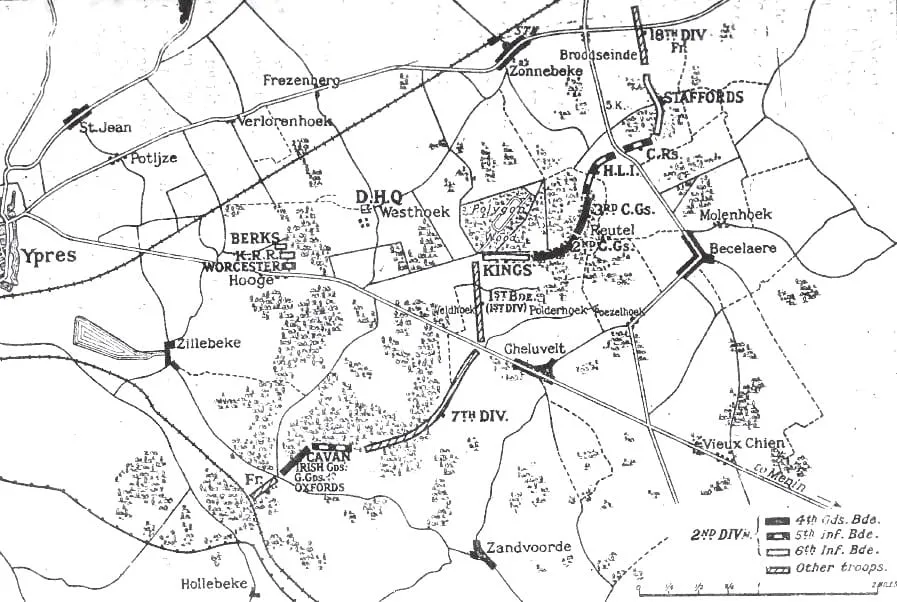
The Battle of Gheluvelt, fought from 29 to 31 October 1914 east and south-east of Ypres, was the most critical moment of the First Battle of Ypres. After the attacks of the new reserve corps north of the town had failed, the Germans formed a fresh strike group under General Max von Fabeck and threw it against the weakest sector of the front, held by exhausted British divisions and dismounted cavalry. On 29 October they took an important crossroads in front of the village of Gheluvelt, on 30 October they captured Zandvoorde and Hollebeke, and on 31 October, when Kaiser Wilhelm II arrived at Sixth Army headquarters, they broke the British line at Gheluvelt itself. A counter-attack by the 2nd Battalion, Worcestershire Regiment closed the gap. The British chronology of the war describes the day briefly: British line broken and restored.
Name and dates
The name and dates of the battle were fixed after the war by the British Battles Nomenclature Committee. It divided the fighting at Ypres in the autumn of 1914 into the battles of Langemarck (21–24 October), of Gheluvelt (29–31 October) and of Nonne Bosschen (11 November). The British official history itself pointed out that this division was artificial. From 30 October the attack of the Fabeck Group advanced on a front from Gheluvelt all the way to Messines and St. Yves, and so also covered sectors that the committee assigned to the battles of Messines and of Armentières. For this reason the official history describes them together, as a single Battle of Gheluvelt. In German accounts this fighting belongs to the Battle of Ypern, which the German General Staff dated from 30 October.
The battle took its name from the village of Gheluvelt (PL), today Geluveld, part of the municipality of Zonnebeke. In 1914 it had about 1,600 inhabitants. It lay on a ridge about 9 kilometres east of Ypres, on the road from Menin (Menen) to Ypres, which the British called the Menin Road. It was the last point in British hands from which the enemy positions to the east could be observed. About a mile and a half south-east of the village the Menin road crossed the road from Kruiseik to Poezelhoek. The British called this spot the Gheluvelt cross roads.
Background
By 24 October the British I Corps of General Douglas Haig and the 7th Division of IV Corps had repulsed the attacks of the new German reserve corps north and east of Ypres. The French then took over the northern half of the arc around the town. The British held its southern half, from Zonnebeke through Polygon Wood and Gheluvelt to Zandvoorde, and further south, as far as Messines, stood the cavalry corps of General Edmund Allenby. Field Marshal John French and General Ferdinand Foch were still planning an offensive. In the last days of October the French IX Corps and the British 2nd Division attacked towards Passchendaele, but gained only a few hundred metres at a time. Meanwhile, on 26 October, the Germans captured the 7th Division’s salient at Kruiseik.
The Chief of the German General Staff, General Erich von Falkenhayn, realised that the Fourth Army would not break the front between Ypres and the sea. On the Yser the Belgians had just begun to flood the lowland. On 27 October Falkenhayn came to the headquarters of the Sixth Army of Crown Prince Rupprecht of Bavaria and agreed with it a plan for a new attack south-east of Ypres. The attack was to be made by a force named after its commander, General Max von Fabeck, commander of the Württemberg XIII Corps: Army Group Fabeck. Its objective was the ridge from Gheluvelt to Messines, and beyond it Mount Kemmel, from which the Germans could cut off all the Allied troops at and north of Ypres.
The Germans attached enormous importance to this attack. An order of the day of 29 October, found the next day on a dead officer of XV Corps, said that the breakthrough would be of decisive importance, would end the war and would deal a decisive blow to “the most hated enemy”. It called the British, Indians, Canadians and Moroccans feeble opponents who “surrender in masses when attacked with vigour”. The soldiers were told that the Kaiser himself would watch their attacks.
Forces
Germany. The Fabeck Group consisted of the XV Corps of General Berthold von Deimling (30th and 39th Divisions), the II Bavarian Corps (3rd and 4th Bavarian Divisions), the Württemberg 26th Division and the 6th Bavarian Reserve Division, as well as a cavalry corps and several Jäger battalions. It was supported by about 260 heavy guns, including eight batteries of mortars and a 305 mm coastal mortar. North of the Fabeck Group, the XXVII Reserve Corps of the Fourth Army attacked towards Gheluvelt and Polygon Wood. According to the British official history, south of the Menin road the Germans had more than a threefold numerical superiority, and opposite the 7th Division and the British cavalry about a sixfold superiority in rifles.
The Allies. Gheluvelt and Zandvoorde were defended by the British 1st, 2nd and 7th Divisions and the 3rd Cavalry Division of General Julian Byng. The 7th Division was already below half its establishment, and cavalry squadrons averaged 80 rifles each. The British were short of artillery ammunition and heavy guns, and the trenches were shallow and had no barbed wire. To their left fought the French IX Corps of General Pierre Dubois, which detached further battalions for Haig. From 31 October the French 32nd Division of XVI Corps began to arrive.
Course of the fighting
29 October. At 5.30 a.m., in thick fog, three battalions of the Bavarian 16th Reserve Infantry Regiment, the List Regiment in which Adolf Hitler served, together with units of the 54th Reserve Division, attacked the Gheluvelt crossroads. It was held by weak battalions of Guards and Scots. Some of the cartridges turned out to be too large for the rifle chambers, and the machine guns jammed. The Germans broke into the line and shattered the 1st Battalion, Coldstream Guards and two companies of the Black Watch, and then drove the 1st Battalion, Grenadier Guards from its position south of the road. Counter-attacks recovered most of the trenches, but the crossroads remained in German hands. In the evening the commanders of the British 1st and 2nd Divisions, Generals Samuel Lomax and Charles Monro, agreed at Hooge Château that if the Germans broke through at Gheluvelt, the 2nd Division would strike their flank from the north, from Polygon Wood.
30 October. The attack of the Fabeck Group began. In the morning, after heavy shelling, the Germans took the village of Zandvoorde, held by the Household Cavalry brigade. Two squadrons of the 1st and 2nd Life Guards were surrounded in their trenches and almost wiped out. In the afternoon the Bavarians took the château and village of Hollebeke and stood about five kilometres from Ypres. The gap north-west of Zandvoorde was closed by battalions collected by Generals Edward Bulfin and Lord Cavan, and Dubois sent French battalions under General Moussy to Zillebeke. The German attack on Gheluvelt itself failed.
31 October. From dawn the German artillery shelled the British positions along the whole front. Before noon the infantry of XV Corps and the 54th Reserve Division advanced on Gheluvelt from the east and south. According to British estimates, at most two thousand men from the depleted battalions of the 1st Division held out there against at least eight German battalions. At about 11.30 a.m. the Germans broke into the village, and by about 1 p.m. they had taken all of it. The 1st Battalion, Queen’s and the 2nd Battalion, Welch Regiment were almost completely destroyed. North of the village, in the grounds of Gheluvelt Château, the remnants of the 1st Battalion, South Wales Borderers and the 1st Battalion, Scots Guards were still holding on.
At about 12.45 p.m. Lomax came to Monro’s headquarters at Hooge Château and said briefly: “My line is broken.” At about 1.15 p.m. German shells hit the château, where the staffs of both divisions had gathered. Six staff officers were killed. Lomax was badly wounded and died in April 1915, and Monro was stunned. At that very moment the counter-attack agreed two days earlier was already starting. On the orders of General Charles FitzClarence, commander of the 1st Guards Brigade, about 370 men of three companies of the 2nd Battalion, Worcestershire Regiment under Major Edward Hankey came out of Polygon Wood and ran about a kilometre across open fields under artillery fire. More than a hundred of them fell, but the rest reached the château grounds. The Bavarians of the List Regiment, who had not expected an attack, fled. The Worcesters linked up with the defenders of the grounds, and in the afternoon their patrols entered the village. The front was closed. According to various figures the battalion lost between 187 and 192 killed and wounded.
In the worst hours Haig ordered a line closer to Ypres to be held at all costs, and at 2.40 p.m. he designated another, just outside the town. Field Marshal French appeared at his headquarters; having no reserves left, he went to ask Foch for help. He met him at Poperinge and received a promise of French counter-attacks on both of Haig’s flanks the next day. After dark, on Haig’s orders, the British abandoned the ruined Gheluvelt and moved to a new line a few hundred metres west of the village. The Germans did not notice and entered Gheluvelt only in the morning. The same day, to the south, the Germans broke into Messines, and at night they attacked Wytschaete.
French help
The French took no part in the fighting for Gheluvelt itself, but without their help the British would not have held the front. General Dubois’s IX Corps attacked continuously on Haig’s left, towards Becelaere and Passchendaele, which tied down German forces north of the Menin road. During the night of 30–31 October Foch came to French’s headquarters at Saint-Omer and promised to send Haig five infantry battalions and three batteries. These were General Moussy’s troops, which at dawn on 31 October, together with the British battalions of Bulfin and Cavan, tried to retake Hollebeke Château and Zandvoorde. The same day the first battalions of the French 32nd Division began to arrive in the British cavalry sector at Saint-Éloi and Wytschaete. In the following days the French took over ever longer stretches of the front around Ypres.
Losses
There are no separate figures for losses in the Battle of Gheluvelt. The British lost several hundred men in individual battalions. On 29 October the 1st Battalion, Grenadier Guards lost 470 men and by the evening numbered only 5 officers and fewer than 200 men. The 1st Battalion, Coldstream Guards was reduced to about 80 men, and the 1st Battalion, Scots Guards lost 344 men that day. On 31 October the Queen’s and Welch battalions were destroyed, and at Hooge Château most of the staffs of two divisions were killed.
German losses were not counted separately either, but they were very heavy. The attacks of the new reserve regiments and of the divisions of the Fabeck Group broke down under the fire of British rifles, and German accounts stressed the high losses among officers. General Deimling was wounded, and the commander of the Bavarian regiment, Colonel Julius List, was killed at Gheluvelt. On 31 October, according to their own figures, the Germans took about a thousand prisoners at Gheluvelt.
Significance
The Battle of Gheluvelt was the most serious attempt to break the front at Ypres in 1914. On 31 October the Germans were closer to victory than at any other time in the battle. French later wrote that he had lived through the worst half-hour of his life. The counter-attack of a single battalion, launched in time by a brigade commander, turned the situation around, because the Germans, although they had taken the village, had no fresh forces at hand to go further.
The Germans achieved little. They took Gheluvelt, Zandvoorde and Hollebeke, and the arc of the front around Ypres shrank so much that the town came under German artillery fire from three sides. But they did not break the front, and the British and French gained time to bring up reinforcements. In the evening the Kaiser sent the Fabeck Group warm thanks, but the German official history admitted that the objective of the attack had not been reached. The fighting at Ypres went on.
Spotted a mistake?Report an error