1914: The fighting in Flanders
Battle of Messines (1914)
- Dates:
- 12 October – 2 November 1914
- Front:
- Western Front
- Location:
- The Messines–Wytschaete ridge and the Lys valley south of Ypres, West Flanders (Belgium), and the hills between Hazebrouck and Bailleul (France)On the battle map →
- Sides:
- United KingdomJohn French, Edmund Allenby, Hubert GoughFranceFerdinand FochGerman EmpireRupprecht, Crown Prince of Bavaria, Max von Fabeck, Erich von Falkenhayn
- Result:
- German success without a breakthrough. The Germans took Messines, Wytschaete and the whole ridge, but the Allies held the front before Mount Kemmel.
- Author:
- Łukasz Skowroń
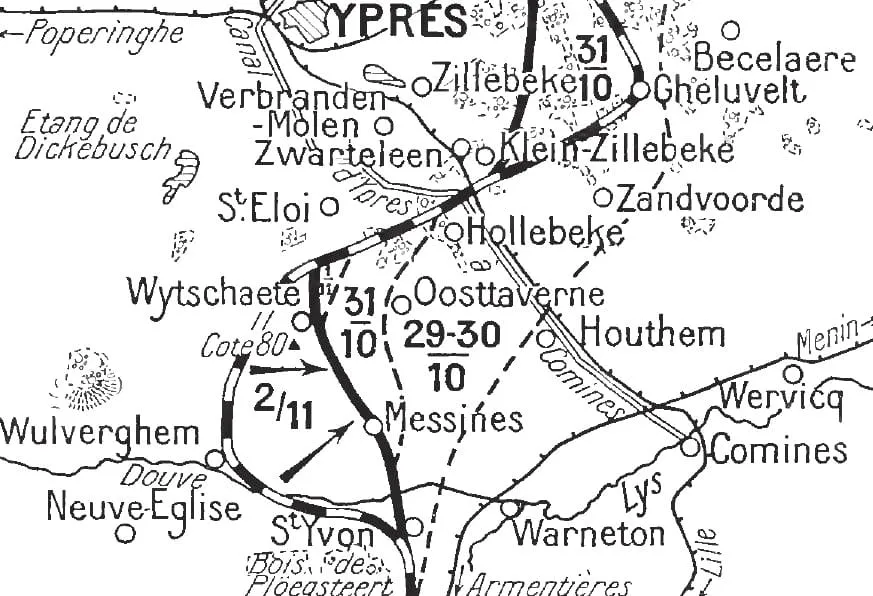
The Battle of Messines, fought from 12 October to 2 November 1914, was one of the last stages of the Race to the Sea and part of the great fighting in Flanders that brought it to an end on the North Sea coast. Its main participant on the British side was the cavalry corps of General Edmund Allenby. In mid-October the cavalrymen pushed the German cavalry off the hills of French Flanders and occupied a low ridge between Messines and Wytschaete (PL), south of Ypres. For the next two weeks, fighting dismounted like infantry, they defended it against an ever stronger enemy. At the turn of October and November, after heavy fighting in which Indian soldiers, the first volunteer battalion of the Territorial Force and the French also took part, the Germans took the ridge but failed to break through the front.
Name and dates
The name and dates of the battle, 12 October – 2 November 1914, were fixed after the war by the British Battles Nomenclature Committee. It divided the British fighting in Artois and Flanders in the autumn of 1914 into several parallel battles: La Bassée (from 10 October), Messines (from 12 October), Armentières (from 13 October) and Ypres (from 19 October). The Battle of Messines covered the sector between the small river Douve, which flows into the Lys at Warneton, and the Comines–Ypres canal. The cavalry corps of Allenby fought on this sector.
The British official history itself considered this division artificial. It pointed out that from 19 October the fighting at Armentières and Messines formed part of a single battle for Ypres, and that on 30 and 31 October the main German thrust ran across the canal that was meant to be the boundary between the battles. For this reason many accounts, including the Polish Wikipedia, describe the fighting for the Messines ridge as part of the First Battle of Ypres. German historians called the fighting on this sector the Battle of Lille until 28 October, and the Battle of Ypres thereafter. This site follows the British nomenclature, which allows the first, mobile stage of the cavalry fighting to be described separately.
This battle should not be confused with the much better known Battle of Messines of June 1917, in which the British recaptured the ridge after blowing more than a dozen huge mines under the German positions.
Terrain
West of Ypres and Bailleul runs a chain of isolated hills, from the Mont des Cats through the Mont Noir to Mount Kemmel. From the hills of Ypres a low ridge runs south, on which lie the villages of Wytschaete and Messines. It rises only a few dozen metres above the surrounding country, but on the flat Flemish plain it gives a view over the Lys valley and the rear of the enemy’s positions as far as Ypres. Whoever held it dominated the area.
The Lys, which here runs along the border between France and Belgium, was a serious obstacle for cavalry. The river is a dozen or more metres wide and too deep to ford, and its valley is cut up by ditches and marshy meadows. At this point the British official history quotes the medieval chronicler Froissart, who wrote as early as the 14th century that the Lys could be crossed only in a few places, because horses could not get near its marshy banks.
Background
At the beginning of October the British Expeditionary Force was moving from the Aisne to Flanders. On 9 October the two British cavalry divisions were combined into a cavalry corps under Allenby’s command. It was to cover the arrival of General William Pulteney’s III Corps at Hazebrouck and advance on its left flank, towards Ypres. The British Commander-in-Chief, Field Marshal John French, agreed with General Ferdinand Foch that the Allied armies would move east and outflank the Germans by passing north of Lille.
On the German side the IV Cavalry Corps of General von Hollen, consisting of three cavalry divisions, was operating in this area, with its headquarters at Bailleul. At the beginning of October its horsemen had passed through Ypres and reached as far as Hazebrouck, but had fallen back to the hills around Bailleul. Meanwhile the infantry corps of the Sixth Army of Crown Prince Rupprecht of Bavaria were arriving from the south in the Lille area.
Course of the fighting
12–14 October. On 12 October the British cavalry ran into the Germans on the Mont des Cats, a hill crowned by the buildings of a Trappist monastery. Towards evening, after hard fighting, it was taken on foot by the regiments of the 3rd Cavalry Brigade. Among the wounded whom the Germans had to leave behind was Prince Maximilian of Hesse, a nephew of Emperor Wilhelm II, who died soon afterwards. The next day, while III Corps was fighting at Meteren, the cavalry occupied the Mont Noir. On 14 October the Germans withdrew behind the Lys. The British occupied Kemmel, and then Messines and Wytschaete, where they linked up with the 3rd Cavalry Division arriving from Ypres. On that day, as the British official history stresses, an unbroken, though in the north very thin, Allied line stretched for the first time from Switzerland to the sea.
15–18 October. The cavalry tried to cross the Lys between Armentières and Menin to clear the way for a further advance. It took the villages of Houthem and Hollebeke on the canal, and on 16 October its hussars broke into Warneton but could not hold the town. The bridges were strongly defended by fresh German infantry from Württemberg, and the cavalry corps had no howitzers with which to drive the defenders out of the houses. The British therefore dug in on the left bank of the river.
19–29 October. The initiative passed into German hands. Along the whole front from La Bassée to the sea the Germans began an offensive with new corps. Allenby’s two cavalry divisions held a long sector from the Douve to the Comines–Ypres canal, manned by thin lines of dismounted cavalrymen. On 22 and 23 October the Ferozepore Brigade of the Indian Lahore Division came to their aid. Battalions of the 57th Wilde’s Rifles and the 129th Baluchis went into the trenches alongside the cavalry. They were among the first soldiers of the British Indian Army to fight in Europe.
30 October. The Chief of the German General Staff, Erich von Falkenhayn, decided to break through the front south of Ypres. As early as 27 October the decision was taken to form a new group under General Max von Fabeck, which went over to the attack on 30 October. It consisted of the II Bavarian Corps, XV Corps, the 6th Bavarian Reserve Division and the Württemberg 26th Division, supported by more than 250 heavy guns. The British had fewer than thirty at Ypres at the time. On 30 October the Germans attacked on the sector from Messines to Zandvoorde. The cavalry lost Hollebeke and had to fall back closer to the ridge.
31 October. At dawn the Württemberg 26th Division attacked Messines, defended by a dozen or so squadrons of dismounted cavalry and two companies of the 57th Rifles. The first attack was repulsed, but after heavy shelling the Germans broke into the town and pushed the defenders back from house to house, as far as the main street. At noon two infantry battalions arrived from II Corps, and the London Scottish counter-attacked on the ridge north of Messines; it was the first volunteer battalion of the Territorial Force to go into action. It numbered about 750 men, and that day it lost 321 killed, wounded and missing. On the same day at Hollebeke Sepoy Khudadad Khan of the 129th Baluchis kept his machine gun in action until all his comrades had been killed and he himself was badly wounded. He was the first soldier of the Indian Army to receive the Victoria Cross.
1 November. After midnight, by moonlight, nine battalions of the 6th Bavarian Reserve Division attacked Wytschaete, defended by about 400 cavalrymen, while at the same time the Germans struck at the ridge between Wytschaete and Messines. The village fell at about 2.45 a.m. The cavalrymen and the London Scottish held out in scattered positions, but the Germans infiltrated through the gaps between them. By morning the ridge was in German hands. The British cavalry and the arriving French 32nd Division briefly retook Wytschaete, but holding Messines once the enemy had taken the ridge to its north no longer made sense. At 9 a.m. the 1st Cavalry Division left the town unhindered and fell back to the next ridge at Wulverghem.
2 November. The Germans renewed their attack and drove the French out of Wytschaete. Meanwhile further French reinforcements were arriving, the 39th Division and General Conneau’s cavalry corps, and the French took over a large part of the sector from the exhausted British cavalry. With this day the British nomenclature ends the battle, although the fighting on this sector continued as part of the Battle of Ypres.
The 6th Bavarian Reserve Division took part in the fighting for Wytschaete. It included the 16th Bavarian Reserve Infantry Regiment, known after its first commander as the List Regiment, in which the volunteer Adolf Hitler served. The regiment went into action on 29 October at Gheluvelt, east of Ypres. At the beginning of November it was moved south, to Wytschaete and Messines, where Hitler, a regimental headquarters runner from November, spent the following months of the war.
Losses
There are no separate, reliable figures for losses in this battle, because the fighting on the Messines ridge merged seamlessly with the battles of Armentières and Ypres. By way of example, in the first days of fighting, up to 18 October, the cavalry corps lost about 175 men. In the decisive days losses were much higher. Besides the London Scottish, in the defence of Wytschaete on 1 November two infantry battalions lost about 30 per cent of their strength in a few hours. On the German side, the Württemberg 125th Infantry Regiment alone, which took Messines, had only about 200–300 men in each of its three battalions the next day.
Significance
The Battle of Messines was the first of the war in which British cavalry fought on foot in trenches like infantry for many days. Few in number and without heavy artillery, it held a long sector of the front against a many times stronger enemy. It could not hold the ridge, but it gained time for French reinforcements to arrive, and the Germans did not break through to Mount Kemmel and beyond to the rear of the defenders of Ypres.
The loss of the Messines–Wytschaete ridge had lasting consequences, however. From its slopes the Germans watched the British positions south of Ypres for two and a half years. Recapturing it was the main objective of the British offensive in June 1917.
Spotted a mistake?Report an error