Key event
Battle of Gheluvelt begins
- Category:
- Military operations
- Front:
- Western Front
- Date:
- 29 October 1914
- Author:
- Łukasz Skowroń
- Battle:
- Battle of Gheluvelt
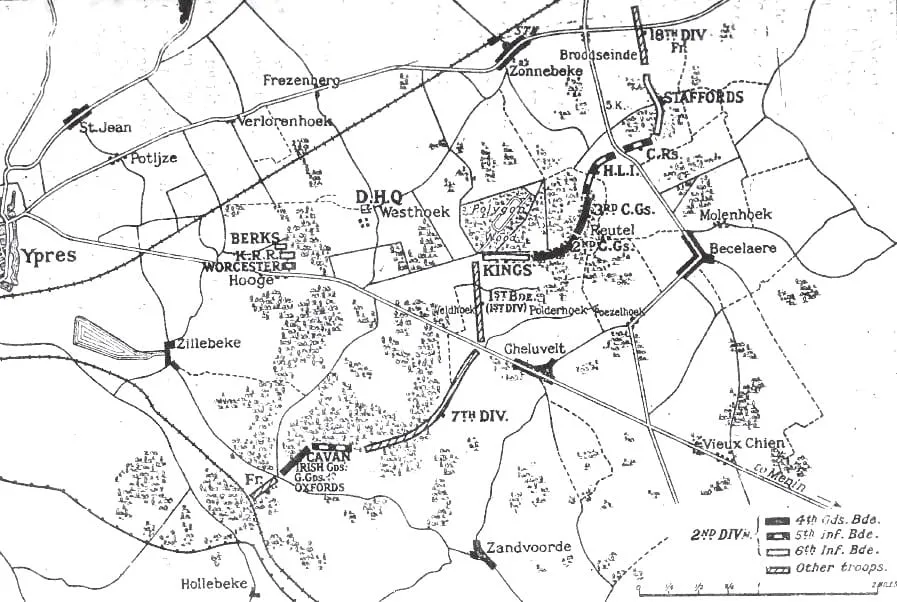
At dawn on 29 October 1914, in thick fog, German infantry struck the British positions at the crossroads by the village of Gheluvelt (PL), east of Ypres. British nomenclature dates the Battle of Gheluvelt, the second and most critical stage of the First Battle of Ypres, from this day. The Germans took the crossroads and inflicted heavy losses on the best battalions of the British Guards. This was, however, only a prelude. Behind their line a new strike group under General Max von Fabeck was just completing its concentration, and on 30 October it went over to the attack south-east of Ypres.
Fabeck’s group
Five days earlier the Battle of Langemarck had ended. The new German reserve corps had failed to break the front north and east of Ypres, and on the Yser the Belgians had begun to flood the lowland. The Chief of the German General Staff, General Erich von Falkenhayn, decided to strike elsewhere. On 27 October he came to the headquarters of the Sixth Army of Crown Prince Rupprecht of Bavaria and agreed a plan for an attack on the sector from Gheluvelt to Messines. It was to be carried out by a new army group under General Max von Fabeck, until then commander of the Württemberg XIII Corps.
Fabeck received General Berthold von Deimling’s XV Corps, the II Bavarian Corps, the Württemberg 26th Division and the 6th Bavarian Reserve Division, as well as some 260 heavy guns. His first objectives were the village of Zandvoorde and the Messines ridge, and beyond them Mount Kemmel. From there the Germans could cut off all the Allied forces in Ypres and to the north of it. By the evening of 29 October the concentration was complete. Five fresh divisions had moved up at night to within a few hundred metres of the front and no one had noticed them. British intelligence learned of them from the interrogation of prisoners only on 1 November.
The crossroads at Gheluvelt
The village of Gheluvelt, today Geluveld, lay on a ridge some 9 kilometres east of Ypres, on the road from Menin to Ypres. About a kilometre and a half south-east of it this road crossed the road from Kruiseik to Poezelhoek and Beselare. This was the junction of two British divisions. South of the road stood the 1st Battalion, Grenadier Guards, of the 7th Division; north of it, on the right flank of the 1st Division, the 1st Battalion, Coldstream Guards, reinforced by a company of the Black Watch. After weeks of fighting the Coldstream numbered barely 350 men and could not man the whole sector allotted to it. The trenches were narrow and deep, scattered in short lengths, with no communication trenches. In front of them only a single wire had been strung, hung with tins filled with pebbles that were meant to rattle when touched.
The British had been warned that the Germans would probably attack Gheluvelt at 5.30 a.m. For obscure reasons, however, the blow was expected from the south, from Kruiseik, and not along the road.
Attack in the fog
At exactly 5.30 a.m., in thick fog, three battalions of the Bavarian 16th Reserve Infantry Regiment struck along the Menin road and north of it. It was a regiment of young volunteers, known after its commander as the List Regiment, going into battle for the first time. Adolf Hitler served in it. Alongside the Bavarians the 54th Reserve Division of the XXVII Reserve Corps attacked. The Germans got within 50 metres before they were spotted. The British opened fire, but at least two machine guns jammed, and some of the cartridges proved too large for the rifle chambers. The artillery did not help, as it had only about nine shells per gun and orders to fire at the German batteries, not at the infantry. The Germans broke into the line by the road, turned north and by 6.30 a.m. had rounded up the Black Watch company and two Coldstream companies, trench by trench.
The Grenadiers south of the road, in lower-lying trenches screened by houses and gardens, saw and heard nothing. At about 6.45 a.m. the warning was judged a false alarm, and the brigade commander sent back into reserve two battalions he had sent to support the Grenadiers during the night. Half an hour later heavy fire fell on the Grenadiers, followed at once by German infantry, which had come through the gap by the road and taken them in the flank and rear. The battalion was pushed back westwards and dug in in a ditch in front of Gheluvelt. That day it lost 470 men, including its commanding officer, who was wounded and taken prisoner. By the evening it numbered 5 officers and fewer than 200 men. After 10 a.m. the same fate befell the rest of the Coldstream and the second Black Watch company. The Germans attacked them in the flank and rear, and three hundred guardsmen and Highlanders were killed or captured almost to a man. By the evening the Coldstream numbered about 80 men.
Counter-attacks
News of the disaster reached the staffs slowly, as there was no telephone link with the front line. At 9.30 a.m. the commander of the 1st Division, General Samuel Lomax, decided to recover the crossroads with a counter-attack by the 3rd Brigade, and General Douglas Haig, commander of I Corps, added two battalions from his reserve. The Queen’s, the South Wales Borderers and the Welch, supported by the Gloucestershires, the Irish Guards and reinforcements from the 7th Division, advanced under heavy fire, passing crowds of wounded and stragglers on the Menin road. They recovered almost all the lost trenches, but not the crossroads itself. At about 4 p.m., as darkness fell and no reserves remained, the generals decided to break off the counter-attack and dig in. At dusk torrential rain began. The withdrawing 2nd Battalion, Scots Guards, also came under fire from its own troops, who took it for Germans.
During the night the British dug a new line of trenches some 800 metres in front of the crossroads held by the Germans. From there the Germans could now attack Gheluvelt under cover of their artillery, whose observers had a good view from the ridge. In the morning Haig had four brigades in reserve; by the evening he had not a single intact one. That same evening the commanders of the 1st and 2nd Divisions, Generals Lomax and Charles Monro, agreed at Hooge Château, where they had their headquarters, that if the line at Gheluvelt broke, the 2nd Division would strike the German flank from the north, from Polygon Wood. Haig approved this plan.
To the north the French IX Corps of General Pierre Dubois attacked towards Passendale all day but gained little. Even so, Field Marshal John French did not grasp the danger. In the evening he reported to London that the counter-attacks had succeeded and that the success, if exploited, might prove decisive, and he ordered the advance to continue the next day.
30 October: Zandvoorde and Hollebeke
On the morning of 30 October, a cloudy, misty day, Fabeck’s group began its attack. Before the assault the German heavy artillery shelled the British positions from Gheluvelt to Messines. The main blow fell on Zandvoorde, a village on a low ridge south of Gheluvelt, held by the Household Cavalry brigade of General Julian Byng’s 3rd Cavalry Division. The shells tore apart the shallow trenches, and then the German 39th Division and three Jäger battalions advanced on the cavalrymen. Two squadrons, one from the 1st and one from the 2nd Life Guards, were surrounded and wiped out almost to a man. By noon Zandvoorde was in German hands.
The gap was closed at the last moment by battalions gathered by Generals Edward Bulfin and Lord Cavan, which dug in north-west of Zandvoorde. Further south the II Bavarian Corps drove the British cavalry from Hollebeke. At about 2.30 p.m. a squadron of dragoons left the park of the château there. The Germans now stood some five kilometres from Ypres. The attack on Gheluvelt itself failed, however, even though General Deimling personally went up to the front line to urge his men on. On the Messines ridge the Württemberg 26th Division was held up in front of fortified villages.
By the evening the British position was very serious. Haig could, as the staffs said at the time, only “patch holes” in the line, and his reserves were almost exhausted. General Dubois sent French battalions under General Moussy to Zillebeke, and during the night General Ferdinand Foch came to French’s headquarters at Saint-Omer and promised further reinforcements. No one on the Allied side yet knew that five fresh German divisions faced them. The German soldiers, meanwhile, were told that the next day their attack would be watched by the Kaiser himself.
Remember the articles you have read? Only in this browser; nothing is sent anywhere.How it works
Read ·
Spotted a mistake?Report an error
Meanwhile
(04)Elsewhere in the same days.
- 29 October 1914 · DiplomacyBritain tightens its contraband rulesOn 29 October 1914 Britain issued new contraband lists and a new order on applying the Declaration of London, replacing the August one.
- 29 October 1914 · MilitaryPrince Louis of Battenberg resigns from the AdmiraltyOn 29 October 1914 the First Sea Lord, Prince Louis of Battenberg, stepped down. He fell victim to anti-German feeling.
- 28 October 1914 · Eastern FrontRussians retake CzernowitzThe British chronicle records the Russians' return to Czernowitz on 28 October 1914. Other sources say they entered the Bukovinian capital a month later.
- 30 October 1914 · Eastern FrontRussians take StanisławówThe British chronicle records the Russian capture of Stanisławów on 30 October 1914. The town had, however, been in their hands since early September.
Related events
(04)The same battle, people or subject.
- 19 October 1914 · Western FrontFirst Battle of Ypres beginsOn 19 October 1914 a British attack on Menin ran into new German corps. This was how the First Battle of Ypres began.
- 31 October 1914 · Western FrontCritical day at YpresOn 31 October 1914 the Germans broke the British line at Gheluvelt. A counter-attack by the 2nd Worcestershire closed the gap, ending the Battle of Gheluvelt.
- 24 October 1914 · Western FrontEnd of the Battle of LangemarckOn 24 October 1914 the British drove the Germans from Polygon Wood near Ypres and the French took over north of the town. The Battle of Langemarck ended.
- 21 October 1914 · Western FrontBattle of Langemarck beginsOn 21 October 1914 the British I Corps advanced from Ypres towards Bruges. It ran into new German reserve corps and went over to the defensive that same day.