Key event
Prussian Guard attack at Nonne Bosschen
- Category:
- Military operations
- Front:
- Western Front
- Date:
- 11 November 1914
- Author:
- Łukasz Skowroń
- Battle:
- Battle of Nonne Bosschen
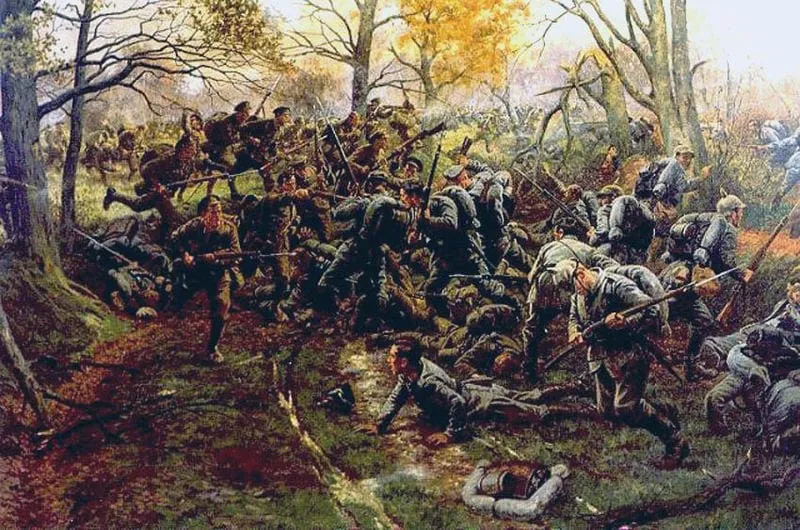
On 11 November 1914 the Germans launched their last great attack in the First Battle of Ypres. After the heaviest bombardment since the fighting began, more than a dozen divisions advanced on a front from Messines to Polygon Wood. Almost everywhere they were repulsed. Only by the road from Menin to Ypres did the elite regiments of the Prussian Guard break through the British line and push through Nonne Bosschen wood almost to the positions of the British artillery. They were stopped by gunners, cooks and sappers with rifles in their hands, and in the afternoon the 2nd Battalion, Oxfordshire and Buckinghamshire Light Infantry drove them out of the wood. The British Battles Nomenclature Committee singled out this day as a separate battle, the Battle of Nonne Bosschen.
The Guard arrives at Ypres
After the crisis of 31 October the Germans were still seeking a breakthrough east and south of Ypres. From the front near Arras they brought up a composite division of the Guard Corps under General Arnold von Winckler, formed from the 1st and 4th Guard Infantry Brigades, and alongside it the Pomeranian 4th Division of II Corps. Between 9 and 11 November both divisions took up positions on either side of the Menin road, in place of the depleted regiments of XV Corps and XXVII Reserve Corps. They formed the corps of General Karl von Plettenberg, which together with XV Corps became part of a new army group under General Alexander von Linsingen.
The attack was to take place on 10 November, but thick fog made reconnaissance impossible and Plettenberg postponed it by one day. On that day, therefore, only the Fourth Army attacked north of Ypres; it captured Diksmuide and pushed the French back to the Yser canal. The British did not know that fresh divisions now faced them. Airmen reported only movements of artillery, and the French were convinced that the main blow would fall on them, further north.
The heaviest bombardment
The night was quiet. In the morning fog hung over the fields. Soon after 6.30 a.m. the German guns opened a fire which, according to the British official history, was the most violent the British had yet experienced. The British infantry could only lie at the bottom of shallow trenches and in dugouts covered with a few planks. After three weeks of uninterrupted fighting, in mud, without hot meals or rest, many soldiers felt that the end was coming.
On the sector by the Menin road 19 exhausted battalions and three cavalry regiments were holding out, at most 7,850 men including reserves. They were attacked by 25 battalions, at least 17,500 infantrymen. The weakest point lay north of the road. About 800 metres of front there were held by General Charles FitzClarence’s 1st (Guards) Brigade, which despite its name consisted of three depleted Scottish battalions: the Scots Guards, the Cameron Highlanders and the Black Watch. Together they had just over 800 men.
The breakthrough
At about 9 a.m. the bombardment lifted to the rear. South of the road the Pomeranians of the 4th Division were shattered by rifle fire and shrapnel before they reached the British trenches. The 4th Guard Brigade, attacking along the road, took part of the trenches of a Royal Fusiliers battalion and broke into the woods around Veldhoek château, but there it stuck. Its fusilier battalion, surrounded in the dense undergrowth by fire from British strongpoints, was almost completely destroyed.
Opposite FitzClarence’s brigade the 1st Guard Infantry Brigade emerged from the fog. Dense lines came on at a jog trot, officers at their head with drawn swords. The 1st Foot Guards Regiment was commanded by the Kaiser’s son, Prince Eitel Friedrich. The guardsmen crossed the first line of trenches almost without a shot and charged with the bayonet. The Scots’ two machine guns managed to fire only one or two belts each before their crews were swept away. The Scots were overwhelmed but fought to the end, and their resistance broke up the German formations.
Most of the 3rd Foot Guards Regiment veered towards Polygon Wood, from where it was fired on by the 1st Battalion, King’s (Liverpool Regiment). No German reached the edge of the wood, and a belt of dead and wounded lay in front of the Liverpool men’s trenches. Those falling back were stopped by a strongpoint in the garden of a cottage at the corner of the wood, held by Lieutenant Anderson and 40 men of the Black Watch, later named Black Watch Corner. To the south the guardsmen were held up by Verbeek Farm, where battalion headquarters and a handful of Black Watch soldiers held out for several hours.
The last line
Between these strongpoints several hundred guardsmen passed through Nonne Bosschen wood and came out on its western edge. Only 200–300 metres further on stood the batteries of the 41st Field Artillery Brigade and the 35th Heavy Battery. Behind them there was no British infantry left. The artillerymen opened fire over open sights, and gunners, cooks, telephonists and men of the brigade staff, together with sappers of the 5th Field Company, Royal Engineers, seized rifles. A few cooks and orderly-room sappers stormed and retook a cottage from which the Germans were firing on the guns. The guardsmen fell back into the wood. They did not know that they had been stopped by the last line of British defence. A wounded German officer taken prisoner is said to have asked a battery commander where the British reserves were. He pointed to the line of guns, and when asked what lay behind them, replied: divisional headquarters.
General Douglas Haig, commander of I Corps, rode to the White Château by the Menin road and threw his last reserves into the fight. Apart from the Guard, the Germans achieved no success anywhere. Only by the Comines canal were French units pushed back to Hill 60, just a few kilometres from Ypres, but in the evening a counter-attack by French hussars restored the line there.
The Oxfordshire counter-attack
At about noon Colonel Westmacott, commander of the 5th Brigade, ordered Lieutenant-Colonel Henry Davies to clear Nonne Bosschen wood. The 2nd Battalion, Oxfordshire and Buckinghamshire Light Infantry was the last reserve of the 2nd Division and numbered fewer than 400 bayonets. Under heavy fire it moved to Westhoek, behind the wood, and only in the early afternoon, according to the official history “after 2, nearly 3 p.m.”, did two of its companies enter the wood from the north-west. They were supported on the flanks by men of the Northamptonshire battalion and by sappers.
The Oxfordshires went through the wood at a quick pace, driving the guardsmen before them and killing or capturing those who resisted. One witness compared the Germans running out of the wood to pheasants flushed by beaters. At the edge of the wood they came under fire from the Northamptonshires and Cameron Highlanders in Glencorse Wood. The battalion also retook the old support trenches and was moving on the front line when, shortly after 3 p.m., it was mistakenly shelled by French batteries near Frezenberg. Then a downpour of rain and hail began and darkness fell. The Oxfordshires lost only 5 killed and 22 wounded. In Britain it was readily recalled that the same battalion, the former 52nd Regiment of Foot, had broken Napoleon’s Imperial Guard at Waterloo.
The night and the toll
General FitzClarence decided to retake the lost trenches during the night. The attack was called off, as in the darkness, rain and piercing cold it had no chance. At about 2–3 a.m. on 12 November FitzClarence went forward to reconnoitre ahead of a column of Grenadier Guards and Irish Guards and was mortally hit by a bullet. He was the highest-ranking officer commemorated on the Menin Gate at Ypres, the memorial to the soldiers with no known grave.
Of the three Scottish battalions of his brigade about 300 men remained, of the Scots Guards only the headquarters and 39 men. The Germans lost even more. According to the history of the 1st Foot Guards Regiment its two battalions lost 16 officers and more than 800 men that day, and the fusilier battalion of the 2nd Guard Grenadier Regiment about 500 men. For all this effort the Germans gained only a stretch of the old British front line between the Menin road and Polygon Wood.
It was the last great German attack at Ypres in 1914. The fighting went on for a few more days, but both sides were exhausted. In time a legend grew up around this day, according to which the Kaiser had ordered the Guard to break the front at all costs because the line regiments had failed to do so. The British official history corrects this, noting that the Guard was only one of twelve and a half attacking divisions, and that the credit for the defence belonged to a handful of exhausted soldiers who, after three weeks of fighting, stopped the elite of the Prussian army.
Remember the articles you have read? Only in this browser; nothing is sent anywhere.How it works
Read ·
Spotted a mistake?Report an error
Meanwhile
(04)Elsewhere in the same days.
- 11 November 1914 · Middle EastSheikh ul-Islam issues fatwas on holy warOn 11 November 1914 the Sheikh ul-Islam Mustafa Hayri issued five fatwas declaring the war with Russia, Britain and France a jihad, the duty of every Muslim.
- 11 November 1914 · War at seaSinking of HMS NigerOn 11 November 1914 the German U-12 torpedoed the British torpedo gunboat Niger, serving as a minesweeper, off Deal. Most of the crew were saved.
- 10 November 1914 · Eastern FrontSecond siege of Przemyśl beginsOn 10 November 1914 the Russians again closed the ring around the fortress of Przemyśl. Some 130,000 soldiers and thousands of civilians were encircled.
- 9 November 1914 · DiplomacyAnglo-French prize conventionOn 9 November 1914 Britain and France signed a convention in London that settled whose courts would rule on ships seized by the warships of the two countries.
Related events
(04)The same battle, people or subject.
- 19 October 1914 · Western FrontFirst Battle of Ypres beginsOn 19 October 1914 a British attack on Menin ran into new German corps. This was how the First Battle of Ypres began.
- 19 October 1914 · Western FrontBritish complete their move to FlandersOn 19 October 1914 Haig's I Corps finished detraining near Hazebrouck. The whole British army, moved from the Aisne, now stood in Flanders.
- 3 October 1914 · Western FrontThe British leave the Aisne frontOn 3 October 1914 the British Expeditionary Force began secretly leaving the Aisne front. It was to move north, closer to the Channel ports.
- 2 November 1914 · Western FrontEnd of the battles of Messines and ArmentièresOn 2 November 1914 the Germans took Wytschaete from the French, who relieved the British cavalry. The battles of Messines and Armentières end.