1916: The Battle of the Somme
Battle of the Ancre
- Dates:
- 13–18 November 1916
- Front:
- Western Front
- Location:
- The Ancre valley north of Albert, on both banks of the river, from the Courcelette–Pys road west and north to Serre and Hébuterne, with the villages of Saint-Pierre-Divion, Beaumont-Hamel, Beaucourt and Grandcourt, Somme and Pas-de-Calais departments (France)On the battle map →
- Sides:
- United Kingdom and CanadaDouglas Haig, Hubert Gough, Edward Fanshawe, Claud JacobGerman EmpireRupprecht, Crown Prince of Bavaria, Fritz von Below
- Result:
- Partial British victory. The Fifth Army took Saint-Pierre-Divion, Beaumont-Hamel and Beaucourt and captured over 7,000 prisoners, but failed to take Serre or the Redan Ridge. Snow and mud ended the Battle of the Somme.
- Author:
- Łukasz Skowroń
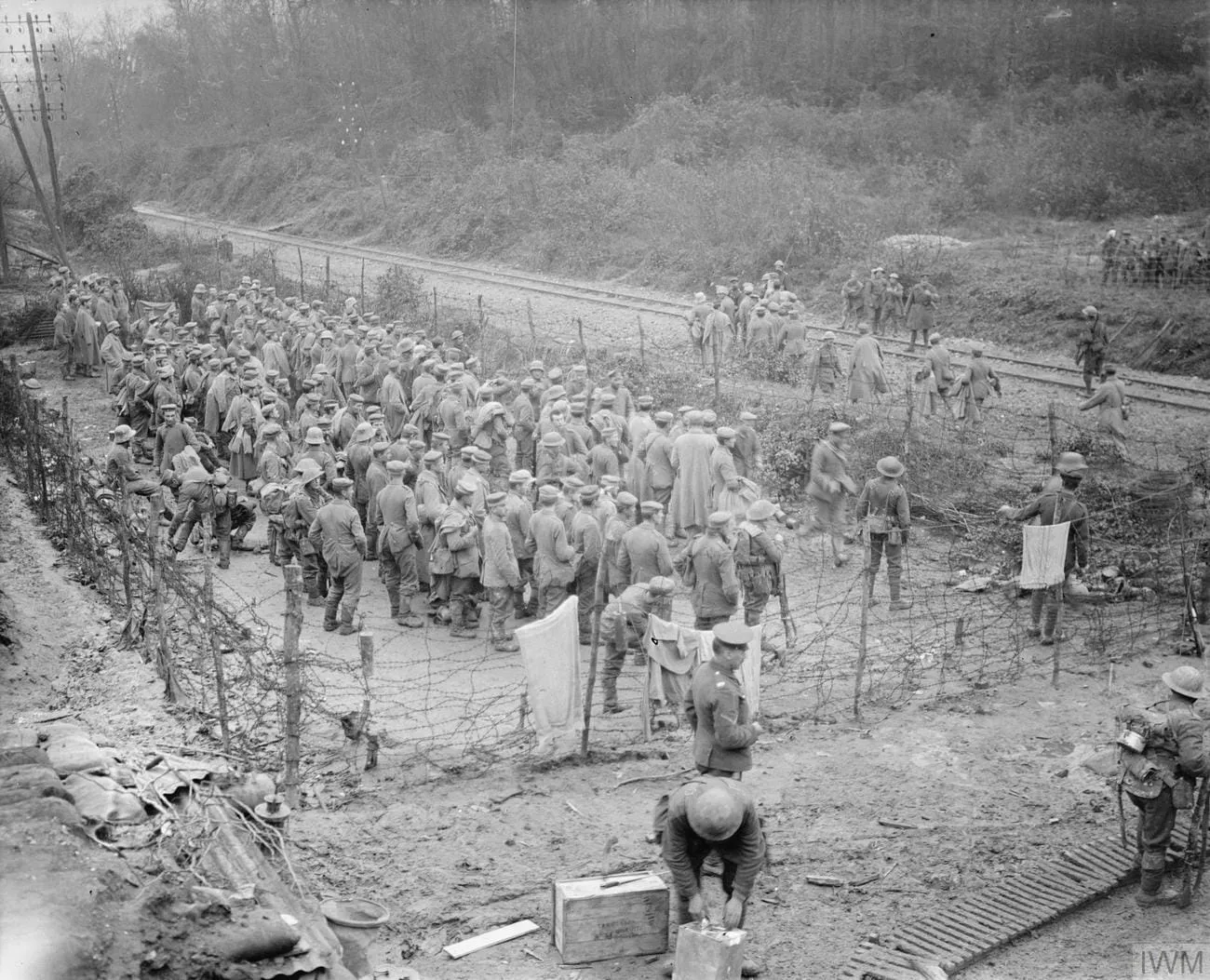
The Battle of the Ancre was the last great British attack of the Battle of the Somme. On 13 November 1916, after weeks of postponements because of rain, the Fifth Army of General Hubert Gough attacked in fog on both banks of the river Ancre. On the north bank it attacked the old German positions against which the whole northern wing of the offensive had broken on 1 July. This time the attack largely succeeded. On the south bank the 39th Division took the village of Saint-Pierre-Divion in under two hours. After a day of fighting the 51st (Highland) Division seized the ruins of Beaumont-Hamel, the village before which the Newfoundland battalion had bled to death on 1 July. The 63rd (Royal Naval) Division broke through along the river to Beaucourt and took the village the next day, and Lieutenant-Colonel Bernard Freyberg, who led its spearhead, was awarded the Victoria Cross for it. In the north, at Serre, the attack again stuck in the mud and machine-gun fire. Further attacks achieved little, and the last, on 18 November, took place in the first snowstorm of winter. With that the Battle of the Somme came to an end.
Name and dates
The name “Battle of the Ancre” and the dates 13–18 November 1916 were fixed after the war by the British Battles Nomenclature Committee. It is the last of the battles into which the committee divided the Battle of the Somme. The British official history (Miles, Military Operations France and Belgium 1916, volume II) also includes 19 November, when rain put an end to the last fighting, but we use the official dates. The Germans did not treat this fighting separately and counted it as part of the Battle of the Somme. It should not be confused with the fighting on the same river in 1918.
The battle was a direct continuation of the Battle of the Ancre Heights, which had ended two days earlier when the Canadians took the rest of Regina Trench on the night of 10/11 November. The main sources for this page are the British official history, the despatches of Douglas Haig and the German regimental histories quoted in it.
Background
At the end of September Haig planned a great attack by three armies, which was to cut off the Germans in the upper Ancre valley and open the road to Bapaume. The autumn rains washed these plans away. In October the Fourth Army bogged down at Le Transloy, and Gough’s Reserve Army, renamed the Fifth Army on 30 October, spent six weeks taking the Thiepval Ridge. All that remained of the great offensive was one attack with limited objectives: cutting off the German salient between the Albert–Bapaume road and Serre. The date of the attack was postponed from 23 October to 25 October, and then to 1, 5 and 9 November. The trenches were full of water, and until early November brigade and battalion commanders believed that an attack could not succeed in such conditions. Then they began to ask for the attack either to be carried out or called off, because the constant postponements were wearing the men out.
From 8 November there was no rain and it grew colder. On the morning of 11 November Gough, after conferring with his corps commanders, set the attack for Monday 13 November at 5.45 a.m., an hour and a half before sunrise. On 12 November, with the bombardment already under way, Haig’s chief of staff, General Launcelot Kiggell, came to Gough’s headquarters to stress that the commander-in-chief did not want a battle in “unfavourable conditions”. Gough replied that he must either attack the next day or withdraw and rest most of his troops. In the afternoon Haig came himself. According to the official history he said that a success was badly needed, as it would have a favourable effect on the situation on the Russian and Romanian fronts and would hearten opinion at home, but that he did not want to take too great a risk. After the conversation he left the decision to Gough.
The motives for the attack are disputed by historians. On 15 November the Allied commanders were to meet at Chantilly to agree plans for the following year, as they had a year earlier, and in London criticism of the heavy losses on the Somme was growing. Years later, when the official history was being written, Kiggell admitted that it was he who had suggested that a “cheap” success just before the conference would help fend off the expected attacks of David Lloyd George. Some historians therefore believe the battle was fought mainly for political effect. Others point out that after the capture of the Thiepval Ridge the British stood on the flank and in the rear of the German positions north of the river, so that giving up the attack in such a situation would have been hard to justify, and that Romania, under attack from the Central Powers, needed relief.
Forces and plan
The main attack was to be made by General Edward Fanshawe’s V Corps with four divisions: the 63rd (Royal Naval) Division by the river itself, the 51st (Highland) Division opposite Beaumont-Hamel, the 2nd Division on the ridge the British called the Redan, and the 3rd Division at Serre. They were attacking the same positions on which thousands of soldiers had fallen on 1 July, but during nineteen weeks of trench warfare the British had pushed their line forward in places, so that no man’s land was on average less than 230 metres wide. The first objective was the German first position, three and in places four lines of trenches; the second objective was the trenches on the eastern slope of the Redan Ridge and in front of Beaucourt; and the final objective was the village of Beaucourt itself. In the north one brigade of the 31st Division of XIII Corps was to cover the left flank. On the south bank General Claud Jacob’s II Corps was to drive the Germans from the remnants of their positions between the Schwaben Redoubt and Saint-Pierre-Divion and clear the river bank opposite Beaucourt.
The Fifth Army was given more artillery than the Fourth Army had had on 1 July. On the V Corps front there was one field gun to roughly every 12 metres of front and one heavy gun to every 28 metres, almost twice the density at the start of the battle. The bombardment lasted a week. To surprise the Germans, the artillery laid an hour-long barrage on their trenches every morning before dawn. The hope was that the defenders would grow used to this rhythm and on 13 November would not realise that this time the infantry would follow the fire. On 12 November the engineers fired tear gas shells from mortars onto Beaumont-Hamel, and in the evening projectors threw gas bombs onto the village and onto the ravine the British called Y Ravine. The tanks that had been brought up to the front had to be withdrawn because they sank in the mud.
On the German side the front from Grandcourt to Serre was held by the right wing of General Fritz von Below’s First Army, part of the army group of Rupprecht, Crown Prince of Bavaria. Beaumont-Hamel and the Redan Ridge were defended by the 12th Division from Upper Silesia, whose Infantry Regiments No. 62 and No. 23 had been garrisoned before the war in Cosel, Ratibor and Neisse. Opposite Beaucourt stood a regiment of the 2nd Guard Reserve Division, Serre was held by the 52nd Division, and on the south bank the 38th Division was just being relieved by the 223rd Division, brought from Alsace. The German command expected an attack on the Ancre, and as early as October Rupprecht had correctly identified in his diary the purpose of the morning barrages. The defenders hoped, however, that rain would bring the British operations to an end. Their trenches were smashed, their companies depleted, and many soldiers were sick after weeks in the mud. On the other hand they had deep dugouts in the chalk, some connected with old underground passages and hiding places dating from the Wars of Religion.
Course: 13 November
During the night the troops moved up to their positions by moonlight, but towards morning the whole battlefield was shrouded in thick fog. Visibility was a few dozen metres. At 5.45 a.m. the barrage came down and the infantry went over the top, in places amid confusion and losing direction.
South of the Ancre the II Corps attack took the Germans by surprise. Two battalions of the 19th Division seized their sector by the Grandcourt road, losing fewer than two hundred men. The 118th Brigade of the 39th Division attacked from the Schwaben Redoubt north and north-west towards the river. The Hertfordshire battalion reached its objective before 7.30 a.m. and took 150 prisoners. Meanwhile a Sherwood Foresters battalion advanced along the Ancre valley itself, clearing the dugouts cut into the high bank. At about 7.40 a.m. the Foresters, Scots of a Black Watch battalion and men from Cheshire took Saint-Pierre-Divion, capturing a battalion staff in the cellars. By 10 a.m. the British had taken the bridge by Beaucourt station and the mill. One of the three tanks that were to support the attack reached the German trenches, overturned on a dugout and kept off the Germans attacking it until infantry came to its relief. By evening II Corps had taken 27 officers and 1,300 other ranks prisoner, and its own losses were fewer than a thousand men, most of them wounded.
By the river the 63rd (Royal Naval) Division, attacking for the first time on the Western Front, took the first German trenches, but heavy flanking fire thinned out its battalions. On the right wing Lieutenant-Colonel Freyberg’s Hood Battalion, supported by the Drake Battalion, went through the German first position and at 6.45 a.m., after a quick reorganisation, took the first objective by Beaucourt station, the two attacks together capturing over a thousand prisoners. At 7.45 a.m. Freyberg moved on with about 420 men and reached the edge of Beaucourt. To his left the attack broke down in machine-gun fire from dugouts in the German support line that had survived the bombardment. Many battalion commanders were killed or wounded, and the 1st Royal Marine Battalion lost all its company commanders before it reached the German trenches. All day the division’s units fought with grenades for one pocket of resistance after another. Freyberg, twice wounded, held a narrow wedge before Beaucourt through the night, and in the evening reinforcements from the 37th Division joined him.
Beaumont-Hamel. At the very moment the barrage came down, sappers of the 252nd Tunnelling Company fired 30,000 pounds of ammonal in a new mine under the crater on Hawthorn Ridge, which had already been blown on 1 July. The explosion destroyed the platoon holding the crater. The right brigade of the 51st Division, with Gordon Highlanders and Black Watch battalions, passed east of Y Ravine and reached the first objective at 6.45 a.m., but the ravine itself, nine metres deep, with sheer sides and tunnels linking it to the trenches, held out until the afternoon. The left brigade, with Seaforth Highlanders and Argyll and Sutherland Highlanders battalions, searched for gaps in the wire in the fog and lost the cover of the creeping barrage. In the afternoon the Germans in Y Ravine began to surrender, and the Scots entered the ruins of the village and by dusk had cleared the cellars and dugouts. They captured the staffs of two battalions of Regiment No. 62. Two tanks sent to help got stuck in the mud. In the evening the 51st Division held a line on the eastern edge of the village, the objective of 1 July.
Redan Ridge and Serre. The 5th Brigade of the 2nd Division took the German first position and reached Beaumont Trench north-east of the village. To its left the 6th Brigade stuck in the mud in front of uncut wire and under fire from the redoubt the British called the Quadrilateral and the Germans the Heidenkopf. The handfuls of men who reached Frankfort Trench, the final objective, had to withdraw. At Serre the 3rd Division floundered in mud that was in places waist-deep, lost the barrage and broke into the German trenches only in small groups, where it was destroyed. On the left flank two Hull battalions of the 31st Division took the German first and second lines and held them until the afternoon despite counter-attacks, but after the failure of their neighbours they had to withdraw, losing almost 800 men. Private John Cunningham of one of these battalions was awarded the Victoria Cross. At 4.30 p.m. the command called off further attacks on Serre.
Course: 14–17 November
On the morning of 14 November the fog thinned, and a sharp, dry north-easterly wind allowed aircraft to fly. At 7.45 a.m. Freyberg, wounded again, led a mixed force from his battalions and the reinforcements straight at Beaucourt, while a King’s Royal Rifle Corps battalion of the 37th Division entered the village from the north-west. The Germans offered little resistance, and almost 500 prisoners were pulled out of cellars and dugouts. The capture of Beaucourt was reported at 10.30 a.m. At the same time a tank that had got stuck in front of German strongpoints on the ridge opened fire with its gun, and the defenders hoisted a white flag. Over four hundred of them surrendered. Freyberg, badly wounded by a shell splinter, was carried to the rear in the evening. Attacks by the 51st and 2nd Divisions on Munich and Frankfort Trenches on the Redan Ridge failed, partly because of mistakes and fire from their own artillery. That day at Beaumont-Hamel a sniper’s bullet killed a sergeant of the 22nd Battalion, Royal Fusiliers, Hector Hugh Munro, known as the writer Saki.
Meanwhile Haig had left for Paris on his way to the Chantilly conference and had forbidden further large operations until his return. On 15 November Kiggell told Gough that the commander-in-chief did not want to resume the offensive. Gough, after conferring with his corps commanders, replied that they all saw good prospects and that the men “want to attack again”, and asked for two more days of fighting. Haig agreed that evening in Paris. The next day, however, after further failed attacks on Frankfort Trench, Gough scaled down his aims. The attack on Serre was abandoned, and the main task was now the II Corps attack on Grandcourt, set for 18 November. 16 and 17 November were frosty and clear, and airmen reported that the Germans had abandoned some trenches. Gough therefore extended the objectives at the last moment, against Jacob’s protests.
Course: 18 November
On the night of 17/18 November the first snow of the winter fell. At 6.10 a.m. the infantry advanced in a blizzard that later turned to rain. The official history says that it is hard to imagine worse conditions for fighting. The dark figures of the soldiers, visible against the white background only at close range, struggled through half-frozen mud that soon thawed into a chalky slime. Snow-covered objectives were hard to recognise, and the artillery, without ground or air observation, fired according to plan, regardless of what happened to the infantry.
The 4th Canadian Division took most of the new German Desire and Desire Support Trenches on the slope beyond Regina Trench and captured over 600 prisoners, and its patrols reached Grandcourt Trench. It lost 1,250 men. Battalions of the 18th Division took part of Desire Trench. A Gloucestershire battalion of the 19th Division broke into the south-western part of Grandcourt, and a South Lancashire battalion advanced along the road from Saint-Pierre-Divion to the western edge of the village. Another battalion of the division lost its way in the blizzard, pushed deep into the German lines and was surrounded. Only about 70 of its men got back to their own lines. On the north bank the 37th Division took Puisieux Trench as far as the river. The 32nd Division’s attack on Munich and Frankfort Trenches failed. Small groups of soldiers who got through to Frankfort Trench and even to Serre were cut off and destroyed. A few dozen men of Highland Light Infantry and Border Regiment battalions, most of them wounded, held out in a dugout in Frankfort Trench for several more days. A relief attempt on 23 November failed, and the survivors were taken prisoner.
On 19 November a cold rain fell, and neither II nor V Corps was any longer capable of further attacks. The British withdrew from Grandcourt and Puisieux Trench to a line not overlooked by German positions. The Battle of the Ancre, and with it the Battle of the Somme, had come to an end.
Losses
According to the British official history, from 11 to 24 November the Fifth Army lost 23,274 killed, wounded and missing, including 6,488 missing. In the same period it took 7,183 Germans prisoner. The heaviest losses were suffered by the 63rd (Royal Naval) Division (about 3,500 men on 13–15 November), the 2nd Division (almost 3,000), the 32nd Division (2,524 from 18 to 24 November, more than half of them missing), the 3rd Division (2,400) and the 51st (Highland) Division (almost 2,200).
German losses were not compiled separately. The German official history states that on the Somme front from 1 to 18 November the Germans lost 45,000 men. Some regiments were almost destroyed. Infantry Regiment No. 144 went into the fighting at Beaucourt and Grandcourt 3,065 strong and came out with 1,256. Of the Upper Silesian Regiment No. 62, which defended Beaumont-Hamel, about 250 men remained according to its history. During the battle and just after it the Germans had to replace most of the divisions in the sector attacked, and the 223rd Division, which on the first day of the battle had been relieving the 38th, was itself replaced by another after a week.
Significance
The Battle of the Ancre brought the British their largest gains since mid-September. The Fifth Army drove up to two kilometres deep into the river valley and took three villages that the Germans had held since the start of the Battle of the Somme. The capture of Beaumont-Hamel, before which the attack had broken on 1 July, had symbolic significance. General Erich Ludendorff later called the British success of 13 November “a particularly heavy blow” in his memoirs, because the German Supreme Army Command had considered such a breakthrough of well-manned positions impossible. The poet Edmund Blunden, who fought in the 39th Division, wrote of a feat of arms that could vie with any in history. The British also showed what they had learned since July: the bombardment was denser and more accurate, the infantry followed close behind the creeping barrage, and the attack before dawn, after a barrage the Germans had grown used to, achieved surprise.
The success was, however, limited. The Germans held Serre and the Redan Ridge, so the breach covered only the lower slopes above the river. Further attacks, planned in haste and poorly coordinated, achieved little, and in the mud it was impossible to use tanks, move mortars and machine guns forward or even deliver orders. The salient won on both banks of the Ancre was a poor position for the winter, but it proved valuable when in January 1917 the Fifth Army resumed its attacks in the Ancre valley towards Bapaume.
At the Chantilly conference on 15 and 16 November Haig could point to the success on the Ancre. The Allies decided there that from the first half of February 1917 they would be ready for joint offensives on all fronts. The Germans breathed a sigh of relief that the heavy fighting of that year was finally over. Local fighting continued on the Ancre throughout the winter, but no one resumed the great Battle of the Somme.
Spotted a mistake?Report an error