Key event
Capture of Beaumont-Hamel
- Category:
- Military operations
- Front:
- Western Front
- Date:
- 13 November 1916
- Author:
- Natalia
- Battle:
- Battle of the Ancre
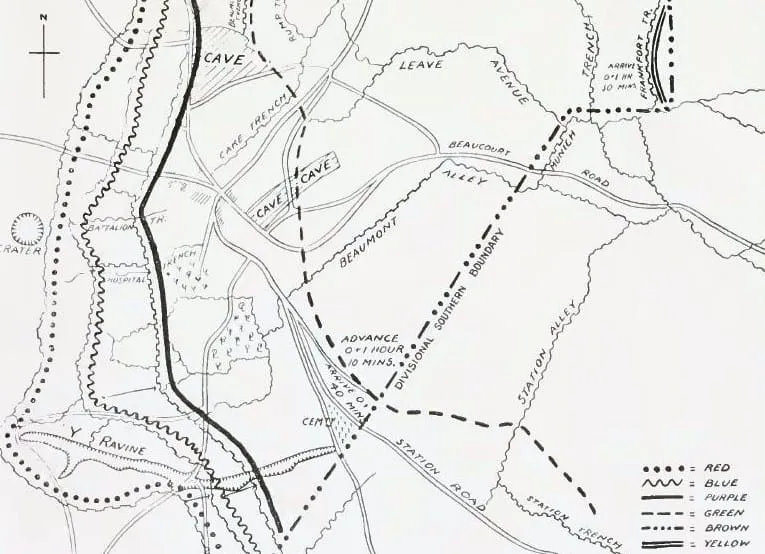
On 13 November 1916, at 5.45 a.m., in thick fog, the British Fifth Army of General Hubert Gough attacked on both banks of the river Ancre. So began the Battle of the Ancre, the last act of the Battle of the Somme. The main objective was Beaumont-Hamel, a village in a valley north of the river, which the British had fought for in vain on the first day of the battle, 1 July. This time the attack largely succeeded. By evening the Scots of the 51st (Highland) Division held the ruins of the village and the ravine in which its defenders had sheltered for four months. On the flank the 63rd (Royal Naval) Division broke through along the river as far as Beaucourt, and on the other bank the British took the village of Saint-Pierre-Divion in under two hours. Only in the north, at Serre, did the attack again founder in the mud, just as it had four months earlier.
The village not taken on 1 July
Beaumont-Hamel lay in a shallow valley between two chalk ridges, a few kilometres north of the small town of Albert. The Germans had fortified the village as early as 1914. Their trenches ran along the slopes above it, around a deep ravine which the British called Y Ravine from its shape, and across Hawthorn Ridge. In the chalk they dug deep dugouts with several exits, and in places they used old underground passages and hiding places in which local people had sheltered during the Wars of Religion in the 16th century. From these dugouts machine guns were brought up to positions sited to fire into the flanks of the attackers.
On 1 July 1916, ten minutes before the assault, sappers blew a great mine under the German redoubt on Hawthorn Ridge. The explosion, captured on film by the cameraman Geoffrey Malins, only warned the Germans, however. The defenders came out of their dugouts before the British infantry reached them. The 29th Division, veterans of Gallipoli, and the neighbouring 4th Division were mown down. At 9.05 a.m. the 1st Battalion of the Newfoundland Regiment, the only unit of the Dominion of Newfoundland on the Somme, went over the top. In roughly half an hour it lost 710 men, many of them before they had even passed their own front line. After that day the front at Beaumont-Hamel stood still. Heavy fighting went on further south, while here four months of trench warfare followed: shelling, raids and underground mine warfare.
Preparations
At the beginning of October General Douglas Haig was planning a major attack in which Gough’s Reserve Army, renamed the Fifth Army at the end of October, was also to strike north of the Ancre. The autumn rains forced the attack to be postponed again and again, from 23 October into November. For weeks the soldiers waited in flooded trenches and camps, cold and often soaked to the skin, scraping mud off the roads between times. When the rain stopped from 8 November, Gough set the attack for 13 November. The day before, Haig visited him and said that a success was badly needed because of the situation of Russia and Romania and the mood at home, but that he did not want to take too great a risk. In the background was the approaching conference of Allied commanders at Chantilly, set for 15 November.
This time the British had almost twice as many guns per kilometre of front on this sector as on 1 July, and the bombardment lasted a week. For many days the artillery laid an hour-long barrage on the German trenches every morning before dawn, so that the defenders would grow used to the rhythm and fail to recognise in it the herald of the assault on 13 November. On 12 November the sappers drenched Beaumont-Hamel and the ravine with tear-gas shells and gas bombs. The history of German Infantry Regiment No. 62, which defended the village, admitted that the gas had hit the regiment hard even before the attack. It was a regiment from Upper Silesia, garrisoned before the war in Cosel and Ratibor, part of the 12th Division from Neisse. Its companies were depleted after a fortnight or so in the mud and its men exhausted.
Fog and a mine
During the night the battalions moved up to their positions by moonlight, trudging for several hours along sodden roads. Towards morning the whole battlefield was covered by a dripping fog. Visibility was a few dozen metres at most. When the barrage came down at 5.45 a.m., sappers of the 252nd Tunnelling Company fired a new mine with 30,000 pounds of ammonal under the crater on Hawthorn Ridge blown on 1 July. This time the explosion came exactly at the moment of the assault. It destroyed the platoon holding the crater and buried the exits of neighbouring dugouts. From one of them the sappers pulled out almost sixty prisoners.
The fog proved to be both ally and enemy. The Germans could not see where the attack was coming from or in what strength, and their signal rockets were lost in the fog, so the artillery did not know where to fire. The attackers, however, lost their direction, mistook trenches and lost the barrage that was supposed to lead them. Worst of all was the mud, which slowed every step.
The Scots in Beaumont-Hamel
The 51st (Highland) Division attacked with two brigades, made up of battalions of Scottish regiments: the Gordon Highlanders, the Black Watch, the Seaforth Highlanders and the Argyll and Sutherland Highlanders. On the right two companies of Gordons crossed the German trenches, bypassed the ravine to the east and at 6.45 a.m. reached the edge of the village. The rest of the brigade, however, was held up in front of Y Ravine. The ravine, about nine metres deep, with almost vertical sides and passages leading to the trenches, was still a fortress. The Germans had sat out the bombardment there in spacious, timber-lined dugouts with electric alarm bells. Battalions from the second line joined the fight, and the outcome was now decided by small groups of soldiers forcing their way into one stretch of trench after another.
The left brigade, attacking along the road from Auchonvillers, searched in the fog for gaps in the wire south of the crater and lost men to machine-gun fire. Beyond the first line the soldiers got stuck in deep mud and lost the barrage. Only after a long fight did they take the German reserve line and enter the village. In the afternoon the Germans in the ravine began to surrender. According to the official history, it was said that this happened at the personal summons of the commander of one of the Black Watch battalions, Lieutenant-Colonel Booth. The history of Regiment No. 62 states that its I Battalion held out in the ravine until the British had worked round it on both sides, and when no counter-attack came most of the survivors surrendered. A reserve battalion entered the southern part of the village.
For most of the afternoon the Scots combed the ruins, pulling Germans out of cellars and dugouts. Two platoons led by junior officers went straight for the headquarters of two German battalions, marked on a captured map, and took them prisoner. The spoils included machine guns, mortars, searchlights, an entire armourer’s workshop, canteen stores with longed-for soda water, a piano and the defenders’ mail, which had just arrived. Two tanks sent to help got stuck in the mud. By nightfall the 51st Division held a line on the eastern edge of the village. The objective that had cost thousands of killed and wounded on 1 July was at last in British hands.
Beaucourt and Freyberg
To the right of the Scots, beside the river itself, the 63rd (Royal Naval) Division attacked. Formed in 1914 from naval volunteers and reservists, its battalions bore the names of admirals: Hood, Drake, Hawke, Nelson, Howe, Anson. The division had fought at Gallipoli, but this was its first attack on the Western Front. On its left the battalions ran into machine-gun fire from nests in the German support line that had survived the bombardment. Several battalion commanders were killed or wounded, and the 1st Royal Marine Battalion lost all its company commanders before it reached the German trenches. Only fewer than a hundred men under Lieutenant-Commander Gilliland broke through over the ridge to the first objective.
On the right the Hood Battalion, in which the poet Rupert Brooke had served before dying in 1915 on his way to Gallipoli, followed the barrage along the river. It was commanded by Lieutenant-Colonel Bernard Freyberg, brought up in New Zealand, the same man who in April 1915 had swum ashore at night in the Gulf of Saros to light flares and simulate a landing. When his men became scattered after crossing the first German position, Freyberg rallied them together with soldiers of the Drake Battalion and at 6.45 a.m. took the first objective by Beaucourt station. In the two attacks the Hood and Drake battalions took almost 1,200 prisoners. At 7.45 a.m. Freyberg led more than 400 men onwards and reached the edge of the village of Beaucourt. He wanted to storm it at once, but the divisional commander refused, as the rest of the division was still fighting behind. Freyberg, twice wounded, held a narrow, exposed salient with an open left flank throughout the day and night. The next morning, wounded for a third time, he led the assault that captured Beaucourt, and for those two days he received the Victoria Cross. In the Hood Battalion, Lieutenant-Commander Frederick Septimus Kelly, an Australian-born composer and pianist and an Olympic rowing gold medallist of 1908, was killed at Beaucourt on 13 November.
South of the river
On the other bank of the Ancre the attack went most easily. The 118th Brigade of the 39th Division struck from the Schwaben Redoubt downhill towards the river, while a battalion of the Sherwood Foresters advanced along the valley itself, clearing dugouts cut into the high riverbank. At about 7.40 a.m. the Foresters, men of the Black Watch and a Cheshire battalion took the village of Saint-Pierre-Divion, capturing a battalion headquarters in the cellars. Soon the prisoners outnumbered the attackers. One tank reached the German trenches, tipped over on a wrecked dugout and kept off the Germans attacking it until the infantry arrived. It sent its call for help by carrier pigeon. By evening II Corps had taken about 1,300 prisoners for a loss of fewer than a thousand men, most of them wounded. The poet Edmund Blunden, who fought in the 39th Division, later wrote of a feat that could rank with any known to history.
Defeat at Serre
In the north things went worse. The 2nd Division took the first German trenches on the ridge the British called the Redan, but its left brigade was held up in front of the uncut wire of the Quadrilateral redoubt and under flanking fire. At Serre, a village on a hillock in front of which the “Pals” battalions from the north of England had bled on 1 July, the 3rd Division waded through mud that in places came up to the waist. The heavy clay here dried more slowly than the chalk further south. The soldiers lost the barrage, found few gaps in the wire and broke into the German trenches only in small groups, where they were destroyed. On the left two Hull battalions of the 31st Division took the first two German lines and held them until the afternoon despite counter-attacks, but after their neighbours’ failure they had to withdraw, losing almost 800 men. Private John Cunningham of one of them twice single-handedly beat off an attack and received the Victoria Cross. At 4.30 p.m. command called off further attacks on Serre.
The day’s balance and remembrance
In the evening Gough was satisfied. South of the river and along it the attack had succeeded, Beaumont-Hamel was taken and Freyberg stood before Beaucourt. Gough judged that the next day V Corps would be able to take Beaucourt and the trenches on the Redan Ridge, but he admitted that a renewed attack on Serre would need fresh troops and careful preparation. During the night the Germans patched up the front, bringing in regiments from neighbouring sectors. Soldiers of the 121st Reserve Infantry Regiment, rushed up by lorry, could not believe that Beaumont-Hamel, which they had defended for so long, had fallen. General Erich Ludendorff later called the day in his memoirs “a particularly heavy blow”, because the German Supreme Army Command had believed that the British were no longer capable of breaking through well-manned positions.
The capture of Beaumont-Hamel did not change the course of the Battle of the Somme, which came to an end a few days later, but it carried symbolic weight. The village before which the attack had broken on 1 July fell in the last week of the battle. In 1921 Newfoundland bought the ground on which its battalion had met disaster and laid out a memorial park there, with preserved trenches and a bronze caribou, opened by Haig in 1925. Above Y Ravine, within the same park, stands the memorial of the 51st (Highland) Division with the figure of a Scottish soldier in a kilt, unveiled in 1924 by Marshal Ferdinand Foch. The plaque bears the words in Gaelic: “Friends are good on the day of battle”.
Remember the articles you have read? Only in this browser; nothing is sent anywhere.How it works
Read ·
Spotted a mistake?Report an error
Meanwhile
(04)Elsewhere in the same days.
- 15 November 1916 · DiplomacyParis and Chantilly conferencesOn 15–16 November 1916 Allied commanders at Chantilly drew up the war plan for 1917, and politicians meeting at the same time in Paris in effect adopted it.
- 15 November 1916 · Middle EastStart of the British advance on El ArishThe chronology dates to 15 November 1916 the nominal start of the march across Sinai to El Arish. There was no single event: railway and pipeline set the pace.
- 15 November 1916 · Military operationsFourth skirmish at Hafiz KorOn 15 November 1916 guns and aircraft broke up a Mohmand gathering at Hafiz Kor. The tribes had tried to hinder the building of a blockade line.
- 16 November 1916 · Balkan FrontGermans break through at Târgu JiuOn 16–17 November 1916 in the hills south of Târgu Jiu Kühne's troops routed the Romanian 1st and 17th Divisions. The road to the Oltenian plain lay open.
Related events
(04)The same battle, people or subject.
- 18 November 1916 · Western FrontEnd of the Battle of the AncreOn 18 November 1916, in the first snowstorm, Canadians and British attacked Desire Trench and Grandcourt on the Ancre. At Serre the attack failed again.
- 18 November 1916 · Western FrontEnd of the Battle of the SommeOn 18 November 1916, in the first snowstorm of winter, the British attacked on the Ancre for the last time. After four and a half months the Somme was over.
- 22 September 1916 · Western FrontEnd of the Battle of Flers–CourceletteOn 22 September 1916 the Battle of Flers–Courcelette ended. After a week of fighting in rain and mud the British were preparing to attack Morval and Thiepval.
- 1 October 1916 · Western FrontStart of the Battle of the Ancre HeightsOn 1 October 1916 the Canadians attacked Regina Trench beyond the Thiepval ridge on the Somme. Uncut wire and German marines repelled almost the whole assault.