Key event
Third Battle of Ypres begins
- Category:
- Military operations
- Front:
- Western Front
- Date:
- 31 July 1917
- Author:
- Łukasz Skowroń
- Battle:
- Battle of Pilckem Ridge
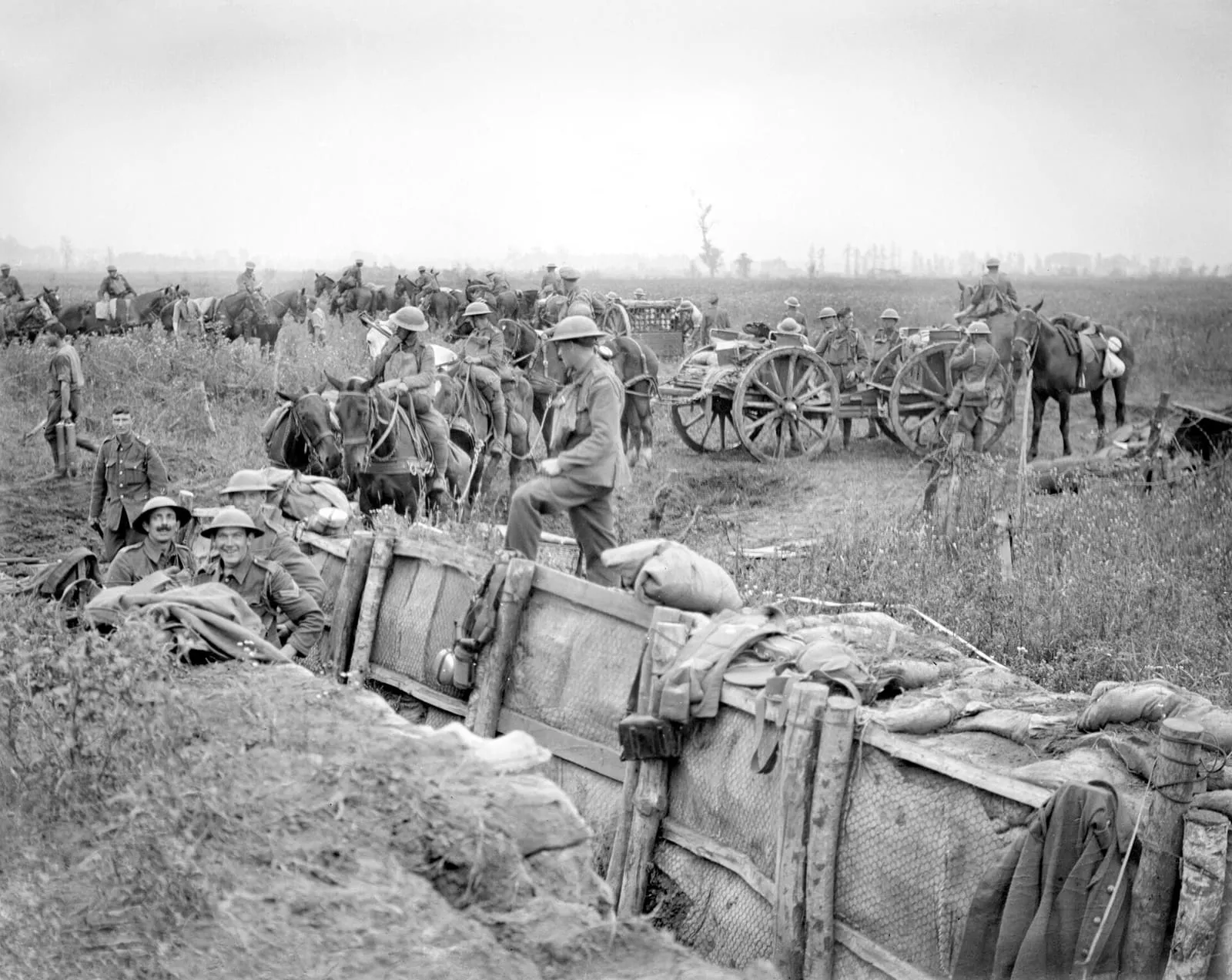
At 3.50 a.m. on 31 July 1917, in darkness under low clouds, thousands of guns opened a barrage on the front from the river Lys to the flooded meadows near Steenstraat, and behind it the infantry of the British Fifth and Second Armies and the French First Army went into the attack. So began the Third Battle of Ypres, the great offensive that Field Marshal Douglas Haig had been preparing for a year and a half and which was to drive the Germans from the ridges around Ypres, and then from the Belgian coast. The first day brought success in the north, where the Allies took Pilckem Ridge, and disappointment on the most important sector, the Gheluvelt plateau. In the afternoon the rain began that was to decide the fate of the whole campaign.
Seven weeks of waiting
Seven weeks had passed since the victory at Messines. Haig entrusted the main attack not to the victor of Messines, General Herbert Plumer, but to General Hubert Gough, commander of the Fifth Army. Throughout this time roads and light railways were built on the flat, exposed plain around Ypres, batteries were emplaced and ammunition stockpiled, and German observers on the ridges to the east saw everything. The government in London agreed to the offensive only on 20 July, after long hesitation by the prime minister, David Lloyd George, on condition that there must be no repetition of the Somme, that is, of long and costly fighting without a decision. The date of the attack was postponed twice, at the request of Gough and of the commander of the French First Army, General François Anthoine, who had not managed to get his artillery into position. The bombardment, begun in mid-July, lasted about two weeks.
Haig also had reasons to hurry. In the east the Russian army, which at the beginning of July had launched its last offensive, had been fleeing before the German-Austrian counter-stroke in Eastern Galicia since 19 July. Soon the Germans would be able to begin moving divisions to the west.
On the other side of the front the German Fourth Army of General Friedrich Sixt von Armin was waiting for the attack. The Germans were in no doubt where and roughly when the blow would fall. They had prepared a defence in depth: several lines of concrete shelters and machine-gun nests, and behind Passchendaele Ridge counter-attack divisions, ready to strike when the attackers had exhausted themselves in the defensive zone. On 27 July they abandoned their front line opposite Boezinge, and the British Guards together with the French crossed the canal that was to have been their most difficult obstacle.
Morning: success in the north
The hour of the attack was chosen so that the troops advancing from the west could see about 200 metres ahead of them while the Germans looked into darkness. The clouds, however, hung so low that it was darker than expected, and the aircraft that were to direct the artillery fire could hardly fly. On most of the front the infantry passed easily through the shattered front line. The German barrage was late and weak.
Things went best in the north. The Welshmen of the 38th Division took the village of Pilckem, and the Guards on their left reached the Steenbeek stream. The French attacked on a narrow neck of land between the canal and the flooded meadows. Their artillery had destroyed almost all the German shelters, so they advanced to timetable and with light losses, and before eleven their patrols entered Bikschote (PL). In this way they recovered most of the ground the French had lost in the first German gas attack in April 1915. Further south the 39th Division took Sint-Juliaan (St. Julien), and the Highlanders of the 51st Division reached the Steenbeek. The Scots of the 15th Division took Frezenberg, and the Lancashire Territorials the Pommern Redoubt. At about nine the German second line north of the railway to Roeselare was in British hands, and on the XIX Corps sector the reserve brigades went on towards the third line. The 164th Brigade of the 55th Division advanced furthest, nearly four kilometres.
In the ranks of the 15th Battalion, Royal Welsh Fusiliers, that morning marched Private Ellis Evans, a rural poet from Trawsfynydd who wrote as Hedd Wyn. He was hit by a shell on the slope of Pilckem Ridge and died the same day. A few weeks earlier he had sent a poem from France to the competition of the Welsh Eisteddfod. The Irish poet Francis Ledwidge was also killed that day near Boezinge.
The Gheluvelt plateau
On the right wing of the Fifth Army, on the Gheluvelt plateau by the road from Ypres to Menin, the attack went badly from the start. This was the highest and most strongly defended sector of the front, and the Germans had concentrated the most guns here. The soldiers of II Corps struggled through shattered woods full of fallen trees, wire and shell holes, and lost the creeping barrage. The 30th Division lost its direction in the darkness, and one of its battalions mistook Château Wood for Glencorse Wood and reported its objective taken. The mistake was discovered only at about nine. The British took Bellewaarde Ridge and Stirling Castle, and the 8th Division reached Westhoek Ridge, but they could get no further. The lines set for the day remained far ahead of them, and it was precisely from here that the German artillery fired into the flank of the rest of the battlefield.
In the south, in the Second Army’s sector, the New Zealanders took La Basse-Ville on the Lys after street fighting, and the 41st Division took Hollebeke and Klein Zillebeke.
Afternoon: counter-attack and rain
Around noon the German counter-attack divisions came down from Passchendaele Ridge. Reports from the front reached the British headquarters with enormous delay: mist made signalling impossible, cables were cut, and runners got stuck in the sodden ground. Soon after 1 p.m. it began to rain, and the artillery observers lost sight of the furthest forward units. At 2 p.m., behind their own barrage and with the support of aircraft, the German infantry struck at the flanks of the three British brigades that had reached the third line. Scattered and without contact with the artillery, they were pushed back or broken up and withdrew to the second line, losing up to 70 per cent of their men. The Germans retook Sint-Juliaan. Their attack was stopped only at about 6 p.m. by artillery and machine-gun fire over the flooded valley of the Steenbeek. Counter-attacks on the flanks, at Bikschote, on Westhoek Ridge and on the Second Army’s sector, were repulsed.
In the evening the rain grew heavier. It fell all night and almost without a break for the next four days. Ground churned up by weeks of shelling, its drainage ditches destroyed, turned into mud, and the stream valleys into swamps.
The day’s balance
By the end of the day the Allies had taken two, and in places three, German lines in the north and centre and had deprived the Germans of observation from Pilckem Ridge. The Fifth Army took about 45 square kilometres. Haig later reported that more than 6,000 prisoners and 25 guns had been taken. Nowhere, however, had the German defence been broken through, and the Gheluvelt plateau remained in German hands. The British official history states that from 31 July to 3 August the Fifth Army lost about 27,000 killed, wounded and missing, and the Second Army nearly 5,000. Most of these losses came not in the morning attack but in the afternoon, under fire and in the German counter-attacks. The French lost about 1,300 men that day.
Haig judged the first day a success and assured the Cabinet that the losses were small for so great a battle, especially compared with the first day on the Somme, when the army had lost nearly 60,000 men. Gough planned to renew the attack on the plateau as early as 2 August, and the second great blow on 4 August. The rain upset these plans: the next large attack began only on 16 August at Langemarck. The offensive, which was to have reached Passchendaele Ridge in a few days, lasted more than three months and went down in history as a byword for fighting in mud.
On 6 September at the Eisteddfod in Birkenhead, in the presence of Lloyd George, it was announced that the chief prize had been won by Hedd Wyn’s poem. The bardic chair, in which no one could now sit, was draped in a black cloth.
Remember the articles you have read? Only in this browser; nothing is sent anywhere.How it works
Read ·
Voices from the front
“Certainly, speaking for myself, I can say that I have never in all my life experienced such a wild exhilaration as on the commencement of a big stunt, like the last April one for example. The excitement for the last half-hour or so before it is like nothing on earth. The only thing that compares with it are the few minutes before the start of a big school match.”
“I am afraid. For the first time in this war I doubt whether we shall hold out against the superior strength. […] Verdun, the Somme, Arras are mere purgatories compared with this hell that has been drawn up here, in which one fine day the fire will be whipped up to a white heat.”
Translated · Original (de)
Mir bangt. Das erstemal daß ich in diesem Krieg Zweifel habe ob wir gegen die Übermacht bestehen werden. […] Verdun, Somme, Arras sind nur Purgatorien gegen diese aufgefahrene Hölle, in der das Feuer eines schönen Tags zur hellen Glut aufgepeitscht werden wird.
Spotted a mistake?Report an error
Meanwhile
(04)Elsewhere in the same days.
- 30 July 1917 · Eastern FrontThe Austrians retake ZaleszczykiAt the end of July 1917 the Hungarian 38th Honvéd Division took the Russian bridgehead at Zaleszczyki on the Dniester. The chronology records it under 30 July.
- 1 August 1917 · Balkan FrontEnd of the Battle of MărăștiOn 1 August 1917 Averescu called off the failed assaults on Măgura Cașinului. The Battle of Mărăști was over, and the Romanians prepared for defence.
- 1 August 1917 · DiplomacyBenedict XV's peace noteIn a note dated 1 August 1917 Benedict XV proposed disarmament, arbitration and the return of occupied lands. He called the war a "useless slaughter".
- 2 August 1917 · War at seaSeeadler wreckedOn 2 August 1917 the German sailing ship Seeadler was wrecked on the reef of Mopelia atoll in Polynesia, ending the cruise of Felix von Luckner's raider.
Related events
(04)The same battle, people or subject.
- 2 August 1917 · Western FrontEnd of the Battle of Pilckem RidgeOn 2 August 1917 downpours halted the first attack at Ypres. Gough postponed further attacks, and British losses exceeded 30,000 men.
- 16 August 1917 · Western FrontBattle of Langemarck (1917) beginsOn 16 August 1917 the British took the ruins of Langemarck near Ypres, but the Irish divisions bled at Frezenberg and the Gheluvelt plateau held out again.
- 9 October 1917 · Western FrontBattle of PoelcappelleOn 9 October 1917, after a night march through mud, the British attacked at Ypres towards Passchendaele and were repulsed. Guards and French reached Houthulst.
- 18 August 1917 · Western FrontEnd of the Battle of Langemarck (1917)On 18 August 1917 the Battle of Langemarck ended. The British broke into Inverness Copse, and Gough sought culprits for the failure, the Irish among them.