Key event
Battle of Langemarck (1917) begins
- Category:
- Military operations
- Front:
- Western Front
- Date:
- 16 August 1917
- Author:
- Łukasz Skowroń
- Battle:
- Battle of Langemarck (1917)
- Tags:
- British Expeditionary Force, Germany, France, Ireland
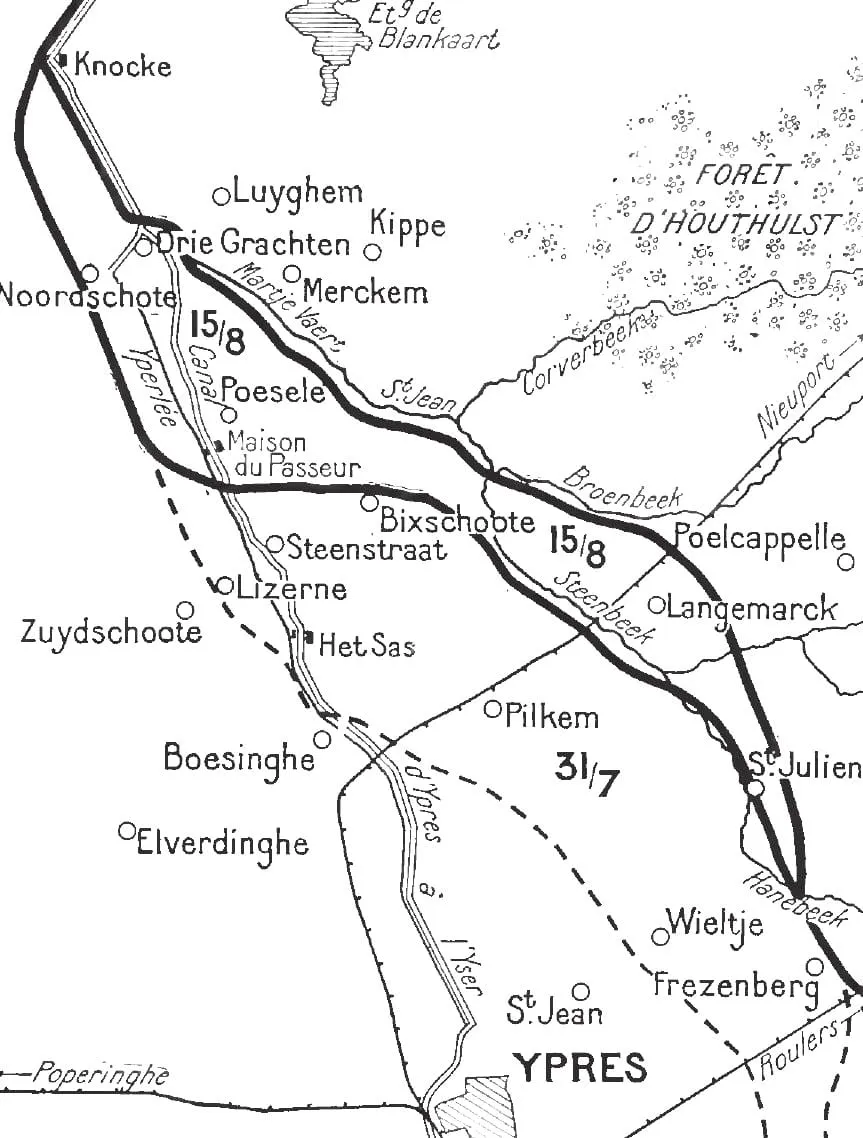
At 4.45 a.m. on 16 August 1917, after two weeks of rain and several postponements, the British Fifth Army and the French I Corps launched the second great attack of the Third Battle of Ypres. On a front from the Ypres–Menin road to the flooded meadows along the Yser, eight British and two French divisions advanced behind a creeping barrage through mud in which guns had still been sinking two days earlier. By evening the balance sheet was twofold. In the north the British had taken the ruins of the village of Langemarck, and the French the Drie Grachten bridgehead. In the centre and the south German counter-attacks had pushed the attackers back almost to where they had started, and two Irish divisions had lost thousands of men in a few hours.
Two weeks in the mud
Since the end of the fighting for Pilckem Ridge, General Hubert Gough, commander of the Fifth Army, had several times fixed and called off the next attack. On 10 August his II Corps took Westhoek Ridge on the edge of the Gheluvelt plateau, but the Germans recaptured the woods of Glencorse Wood and Inverness Copse. The attack by the whole army was put back from 14 to 15 August and, after a thunderstorm with a downpour, to 16 August. Gough was in a hurry, because at the end of the month an attack supported by a landing was to be launched on the Belgian coast, and that depended on progress at Ypres. Field Marshal Douglas Haig, who had insisted from the start on concentrating forces on the plateau, left the distribution of forces to Gough’s discretion on 15 August. Gough again attacked along the whole front.
The day before, 15 August, the Canadians had taken Hill 70 near Lens to draw German reserves away from Flanders.
The night before the attack was dry. Engineers laid wooden footbridges across the Steenbeek stream, and the infantry of the 20th Division packed into a narrow strip of ground on the far bank, a few dozen metres from the German shelters, so close that the German artillery could not fire on it without hitting its own men.
Langemarck
Things went best in the north, in the sector of Lord Cavan’s XIV Corps. The men of the 20th (Light) Division advanced in single file, skirting flooded shell holes, behind a barrage moving forward 90 metres every four minutes. The left brigade first had to take the Au Bon Gite blockhouse, on which every attack had broken since 31 July, and then the shelters by the ruined station. The right brigade went round the village from the east to cut it off from the road from Poelkapelle (PL). At about eight o’clock the ruins of Langemarck, a village the British and Germans had already fought over in October 1914, were in British hands. Before nine the division had taken a stretch of the German third position beyond it. Two of its men, Sergeant Edward Cooper and Private Wilfred Edwards, single-handedly captured concrete blockhouses, taking their garrisons prisoner, and were awarded the Victoria Cross for it.
To their left the 29th Division took the hamlet of Wijdendrift. Among its units was the regiment from Newfoundland, which a year earlier, in the first minutes of the Battle of the Somme, had lost most of its men at Beaumont-Hamel. This time the Newfoundlanders reached their final objective and also took Japan House farm. Counter-attacks made by the Germans here at about four in the afternoon were beaten off by artillery and rifle fire.
On the left wing the French of General François Anthoine waded across the floods north of Bikschote (PL) and took the Drie Grachten bridgehead at the junction of three canals, previously wrecked by artillery. On their right wing they crossed the Steenbeek and reached the Broombeek stream. By evening only two blockhouses, Les Lilas and Mondovi, were holding out against them.
The Irish at Frezenberg
In the centre, between the railway to Roeselare and Sint-Juliaan (St. Julien), XIX Corps attacked with two Irish divisions: the 16th (Irish), made up mainly of Catholics from the south, and the 36th (Ulster), made up of Protestants from the north. Two months earlier they had taken Wytschaete at Messines together. This time they went into the attack exhausted. Since the end of July they had been carrying ammunition and supplies under constant shellfire, and since 4 August they had held the front in waterlogged valleys under German observation. Before the attack they had lost about a third of their men in the front line, and the battalions of the 16th Division numbered about 330 men each instead of 750.
After a few hundred metres the attackers ran into the fortified farms on the slopes of Frezenberg Ridge: Potsdam, Vampire, Borry, Gallipoli, Somme and Pond Farm. The heavy artillery bombardment that was to destroy them had barely touched them. The men of the 36th Division got stuck on new wire and in the marsh along the Steenbeek and lost the barrage. The Irishmen of the 16th Division pressed on, and were shot in the back from the uncleared farms. “To move, to rise an inch from the mud, was death,” wrote Lieutenant Arthur Glanville of the 2nd Battalion, Royal Dublin Fusiliers. At about nine o’clock, behind heavy fire and smoke shells, Bavarian reserves and a German counter-attack division struck. The forward parties of both divisions were wiped out or taken prisoner. At about 10.15 a.m. the corps commander, General Herbert Watts, brought the barrage back to the start line. In the afternoon Gough demanded that the attack be renewed, but Watts replied that he had nothing left to attack with.
Among the dead was the chaplain of the 16th Division, the Irish Jesuit William Doyle. He was killed at Frezenberg while giving the last rites to the wounded. According to later calculations nearly 600 men of each of the two Irish divisions were killed that day. The commander of the 36th Division, General Oliver Nugent, noted that evening that the losses were very heavy and that the attack had failed all along the line.
The plateau again
On the Gheluvelt plateau the scenario of 31 July was repeated. The 56th (London) Division pushed through Glencorse Wood and reached Polygon Wood, but its neighbouring brigade broke apart while skirting mud more than a metre deep, and the 53rd Brigade was held up in front of Inverness Copse by machine-gun fire from a blockhouse that had not been destroyed. Between six and seven o’clock German infantry pushed into the gaps and surrounded the forward battalions. To their left the 8th Division crossed the Hanebeek stream on portable footbridges and took the redoubts on the Anzac spur. At 9.30 a.m. it was struck by Germans brought up behind the front in lorries. Smoke shells hid the flares with which the infantry called for the protective barrage, and the airmen failed to warn the artillery in time, so that it opened fire only after three quarters of an hour. By evening both divisions were back near their start positions.
On the plateau nothing had changed. The Germans still overlooked the whole Ypres salient from it, and that same day their artillery began shelling the new line beyond Langemarck.
Evening
At the end of the day the Fifth Army had advanced one to one and a half kilometres in the north and taken another stretch of the Wilhelm Line from the Germans, but in the centre and on the plateau it had gained almost nothing. Robin Prior and Trevor Wilson put its losses that day at about 15,000 men. The French, well supported by their artillery, lost only a few hundred. According to Gough’s later figures, the Fifth Army took about 2,100 prisoners in the whole battle.
On the German side feelings were mixed. The Crown Prince of Bavaria, Rupprecht, the army group commander, wrote that the defence rested on the plateau and Houthulst Forest as on two bastions, and that British gains between them were not dangerous. He admitted, however, that Langemarck could not be retaken. General Erich Ludendorff called 16 August another heavy blow. The fighting for the untaken farms and woods went on for two more days, and in the Fifth Army the search for culprits began.
Remember the articles you have read? Only in this browser; nothing is sent anywhere.How it works
Read ·
Spotted a mistake?Report an error
Meanwhile
(04)Elsewhere in the same days.
- 17 August 1917 · PoliticsMétin becomes under-secretary for the blockadeOn 17 August 1917 the Radical Albert Métin replaced the Catholic Denys Cochin as head of the French blockade, a crack in the "Sacred Union".
- 14 August 1917 · Asia and the PacificChina declares war on Germany and Austria-HungaryAt 10 a.m. on 14 August 1917 China proclaimed a state of war with Germany and Austria-Hungary. The proclamation was signed by President Feng Guozhang.
- 18 August 1917 · DiplomacyAgreement on Asia MinorOn 18 August 1917 Italy and Britain exchanged notes approving the Saint-Jean-de-Maurienne agreement. It was conditional on Russia's consent, never given.
- 13 August 1917 · PoliticsPassports refused for the Stockholm conferenceOn 13 August 1917 Bonar Law told the Commons that Britons would get no passports for the socialist congress in Stockholm. The conference never met.
Related events
(04)The same battle, people or subject.
- 18 August 1917 · Western FrontEnd of the Battle of Langemarck (1917)On 18 August 1917 the Battle of Langemarck ended. The British broke into Inverness Copse, and Gough sought culprits for the failure, the Irish among them.
- 9 October 1917 · Western FrontBattle of PoelcappelleOn 9 October 1917, after a night march through mud, the British attacked at Ypres towards Passchendaele and were repulsed. Guards and French reached Houthulst.
- 31 July 1917 · Western FrontThird Battle of Ypres beginsOn 31 July 1917 the British and French attacked from Ypres. They took Pilckem Ridge but stalled on the Gheluvelt plateau, and in the afternoon a downpour began.
- 2 August 1917 · Western FrontEnd of the Battle of Pilckem RidgeOn 2 August 1917 downpours halted the first attack at Ypres. Gough postponed further attacks, and British losses exceeded 30,000 men.