Key event
Battle of Messines (1917) begins
- Category:
- Military operations
- Front:
- Western Front
- Date:
- 7 June 1917
- Author:
- Łukasz Skowroń
- Battle:
- Battle of Messines (1917)
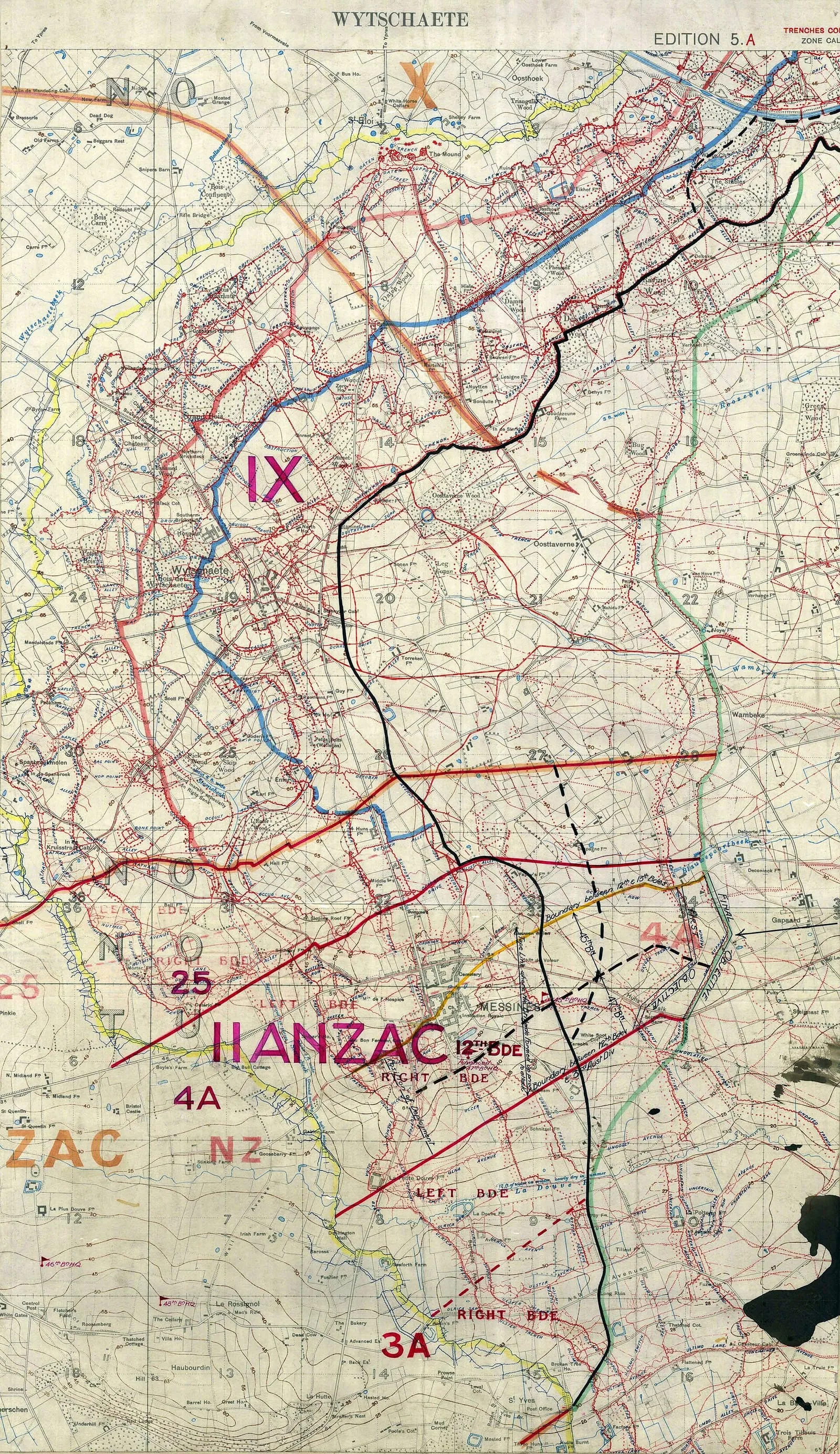
At 3.10 a.m. on 7 June 1917, when the sky in the east was barely turning grey, the ridge between Messines and Wytschaete (PL), south of Ypres, rose into the air. Within a few seconds 19 great mines, containing between them hundreds of tons of explosives, went off under the German trenches. Immediately afterwards more than two thousand British guns opened fire, and nine divisions of General Herbert Plumer’s 2nd Army went into the assault. The ridge, which the Germans had taken in November 1914 and from which for two and a half years they had looked down on the British positions, was before noon in the hands of British, Australian, New Zealand and Irish troops. In the evening reserve units descended its eastern slopes and occupied most of the German Oosttaverne Line. It was the British army’s best day on the Western Front since the beginning of the war.
The night before the battle
The attack was set for 7 June and zero hour for 3.10 a.m., when, according to the staff officers, a man could already be recognised at a hundred metres. On the evening of 6 June the chief of staff of the 2nd Army, General Charles Harington, met the war correspondents. The words he is said to have spoken then have passed into history: “Gentlemen, I don’t know whether we shall make history tomorrow, but we shall certainly change the geography.” They are often attributed to Plumer himself, and the exact wording varies from source to source.
After an evening thunderstorm the sky cleared, and a moon just past full shone all night. The infantry moved up to the jumping-off positions, in many places to trenches dug in no man’s land. At about two in the morning British aircraft began to circle over the German lines, their drone meant to drown out the tanks moving up into position. The 3rd Australian Division of General John Monash, on the southern wing, had the hardest time. The Germans, expecting an attack, drenched Ploegsteert Wood, through which its battalions were moving, with gas shells, according to reports partly with phosgene. Soldiers in masks lost their way and collapsed from exhaustion. The Australian official history (Charles Bean) estimates that the gas put at least 500 men out of action. Even so, all eight assault battalions reached the jumping-off trenches a quarter of an hour or so before zero hour.
About half an hour before dawn the British artillery, which had been pounding the ridge for a whole week, fell almost silent. The Germans, convinced that the assault was about to come, sent men to the forward posts and fired flares. According to many accounts birdsong could be heard in the silence. An Australian observer on a hill behind Ploegsteert Wood noted at 3.05: “Last five minutes. Everything must be ready now. One has the feeling that the battle is won.”
The mines explode
At 3.10 the sappers of the tunnelling companies, British, Canadian and Australian, fired the charges they had been preparing under the ridge since early 1916. Bean described how on the left, near Wytschaete, a huge mushroom-shaped bubble rose from the ground and burst, throwing a pink glow onto the low clouds, and then others went off in the same way, from right to left. Officially it was recorded that all the mines exploded within 19 seconds, although one of the sapper officers timed 45 seconds between the first and the last explosion. The most powerful charges, at St. Eloi, Maedelstede Farm and Spanbroekmolen, each contained more than 40 tons of ammonal. They were the largest mines blown in this war, much larger than the Lochnagar mine on the Somme. The sappers at Spanbroekmolen were reached only in the last days before the attack, after being cut off for three months by a German camouflet, and under Hill 60 Australian sappers listened to the end to an approaching German gallery.
The shock was so violent that some Australians, taken by surprise because the mines went off a few seconds earlier than they had expected, thought the Germans were blowing mines under their own trenches. The Germans on Hill 60, in turn, thought the explosions at Spanbroekmolen and Kruisstraat had occurred under Messines itself, far behind their line. In Lille, about 25 kilometres away, the shock was taken for an earthquake. According to popular accounts the roar was heard even in England, and the prime minister, David Lloyd George, is said to have heard it in his study in Downing Street. The correspondent Philip Gibbs wrote of “enormous columns of scarlet fire” that rose from the dark ridge, from Wytschaete and from Hill 60, and many soldiers waiting for the assault were thrown to the ground.
The mines left craters tens of metres across, and the largest more than 70 metres. Each destroyed or buried trenches over a stretch several hundred metres long, together with their garrisons. The often repeated figure of 10,000 Germans killed in that single moment is, however, an exaggeration: the historian of underground warfare Simon Jones believes that the explosions killed at most a few hundred men. Their main effect was psychological. The surviving defenders of the front line, already exhausted by a week of bombardment, were so stunned that most of them surrendered without a fight.
The assault on the ridge
Immediately after the explosions a creeping barrage moved forward, and behind it about 80,000 soldiers. Smoke and dust limited visibility to a few dozen metres, so direction was kept by compass. In the south Monash’s Australians crossed the first German lines almost without resistance. Lieutenant Garrard of the 40th Battalion reported that he had never seen men so demoralised as the Germans coming out of their concrete shelters. The New Zealanders crossed a dried-up stream at the foot of the ridge and attacked Messines, turned into a fortress with trenches around the little town, concrete strongpoints and cellars converted into shelters. By five they had surrounded the town, and by about seven they had taken all of it, capturing the commander of the defence and his staff. North of Messines the attack of the British 25th Division was helped by the explosion of a mine at Ontario Farm.
In the centre two Irish divisions advanced on Wytschaete: the 36th (Ulster), made up largely of Protestant volunteers from the north, opponents of Irish self-government, and the 16th (Irish), in which mainly Catholics from the south served, supporters of home rule. For the first time they fought side by side. A year after the Easter Rising, many Irishmen saw in this a symbol of possible reconciliation. The Ulstermen reached their second objectives at 5.30, and before noon the two divisions together cleared the ruins of Wytschaete. In the first minutes of the attack the 56-year-old Major Willie Redmond of the 6th Battalion, Royal Irish Regiment, was wounded; he was the Irish Parliamentary Party MP for East Clare and the brother of its leader, John Redmond. Stretcher-bearers of the Ulster division carried him out of no man’s land. He died the same day at a dressing station set up in the convent at Locre.
On the northern wing the Londoners of the 47th Division fought for the ruins of the White Château by the Ypres–Comines canal, which surrendered only at about 7.50 after a trench-mortar bombardment. Their attack on the great spoil heap by the canal, from which German machine guns swept the area, broke down. Apart from that spot, just a few hours after zero hour the whole ridge, from Hill 60 to St. Yves, was in British hands. Haig wrote in his report that three hours after the start of the attack the whole line of the ridge had been carried by assault.
The afternoon attack
After the capture of the ridge came a planned pause. More men crowded onto the ridge than had been expected, because losses in the first phase were much lower than anticipated, and German long-range artillery began to shell them. Plumer postponed by two hours the attack on the Oosttaverne Line at the eastern foot, set for 1.10 p.m. The message did not arrive everywhere in time, and one brigade of the 4th Australian Division lay under fire on the open slope for several hours. Meanwhile the German counter-attack divisions, the 1st Guards Reserve Division and the 7th Division, were struggling through the British shellfire. When they reached the area of the ridge it was already too late, and their attack east of Messines was broken up by artillery.
At 3.10 p.m. the barrage moved down the slope, and behind it the Australians of the 4th Division and the British 11th, 19th and 24th Divisions. At 3.45 the village of Oosttaverne was taken, and at about 4 p.m. the British entered the Oosttaverne Line east of the village, capturing two batteries of field guns. The brigades of the 24th Division took their objectives, capturing, according to English accounts, several hundred prisoners almost without loss. By evening almost the whole Oosttaverne Line had been taken. The Germans, however, held a stretch in the valley of the Blauwepoortbeek stream at the junction of the Australians and the 11th Division, as well as the spoil heap by the canal. In the evening, as the Germans gathered for a counter-attack, the British barrage also fell on the Australian 12th Brigade, which had dug in further forward than the plan provided, and some of the Australians fell back to the ridge.
The day’s balance
All the main objectives had been achieved in under twelve hours. By 4.30 p.m. more than 5,000 prisoners had passed through the British collecting points, and by the next day more than 6,400. The first day’s losses are not given separately, but they were much lower than in the great attacks on the Somme and at Arras. The British lost most men not in the assault itself but on the crowded ridge and the eastern slopes, from the fire of German artillery, especially guns placed beyond the flanks of the attack. The New Zealand Division, shelled on the exposed ridge at Messines, suffered heavily.
On the evening of 7 June Haig reported that the ridge which “for over two and a half years had dominated our positions in the Ypres salient” had been taken. The fighting to hold and round off the gains was to go on for another week. Willie Redmond’s death, meanwhile, set off important changes in Ireland: in the East Clare by-election in July his seat was won by Éamon de Valera, one of the leaders of the Easter Rising.
Remember the articles you have read? Only in this browser; nothing is sent anywhere.How it works
Read ·
A voice from the front
“We are in the middle of a concentration of guns, troops and resources of all kinds which, as the Commander-in-Chief told me a day or two ago (when he came to go over my plans in detail) exceed by 30% anything that has ever been previously known in the history of war. […] The Bosch is looking down on us form the top and holds the Western slopes - We intend to push him off.”
Spotted a mistake?Report an error
Meanwhile
(04)Elsewhere in the same days.
- 8 June 1917 · MilitaryPershing in EnglandOn 8 June 1917 General John Pershing and his staff landed at Liverpool. In London King George V received him, and the prime minister and generals began talks.
- 5 June 1917 · Italian FrontEnd of the Tenth Battle of the IsonzoOn 5 June 1917 the Austro-Hungarian counter-attack on the Karst died down. The Italians lost most of their gains at Hermada; the Tenth Isonzo battle ended.
- 9 June 1917 · Eastern FrontRussia rejects a German armistice offerOn 9 June 1917 Petrograd published its reply to a German radio message urging Russian troops to a separate armistice. Russia rejected it.
- 4 June 1917 · MilitaryDecree creating the Polish Army in FranceOn 4 June 1917 President Poincaré signed a decree creating in France an autonomous Polish army, fighting under the Polish flag.
Related events
(04)The same battle, people or subject.
- 14 June 1917 · Western FrontBattle of Messines (1917) endsOn 14 June 1917 the British 2nd Army closed up to the German Warneton Line, ending the Battle of Messines. Gough took over the main offensive from Ypres.
- 4 October 1917 · Western FrontBattle of BroodseindeOn 4 October 1917 the Anzacs took the Broodseinde ridge near Ypres, colliding in no man's land with attacking Germans. They took thousands of prisoners.
- 12 October 1917 · Western FrontFirst Battle of PasschendaeleOn 12 October 1917 Anzacs advanced in the rain on Passchendaele. By evening they were back on their old lines, and 845 New Zealanders were dead.
- 18 August 1917 · Western FrontEnd of the Battle of Langemarck (1917)On 18 August 1917 the Battle of Langemarck ended. The British broke into Inverness Copse, and Gough sought culprits for the failure, the Irish among them.