Australia · The Entente
John Monash
Commander of the 3rd Australian Division (1916–1918) and the Australian Corps (1918)
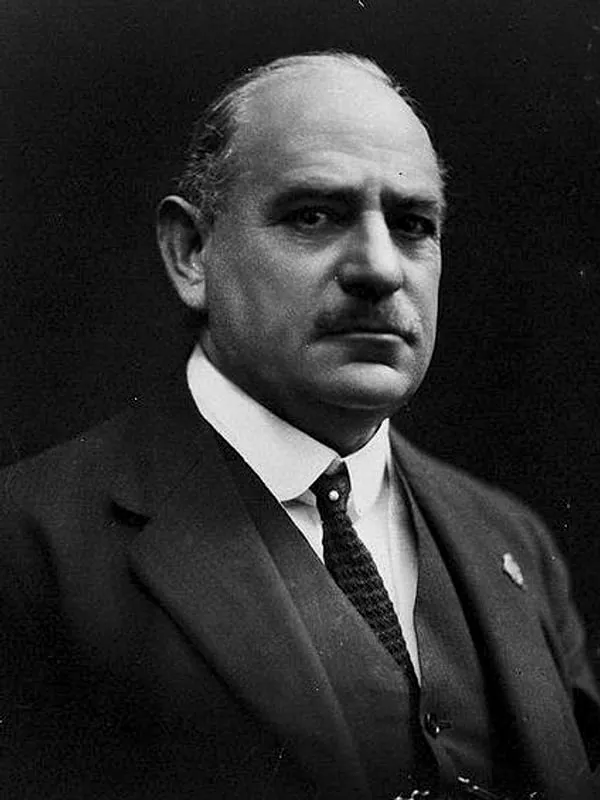
- Born:
- 27 June 1865, Melbourne (Australia)
- Died:
- 8 October 1931, Melbourne
- Author:
- Natalia
- Photo:
- autor nieznany, domena publiczna, Wikimedia Commons

Sir John Monash was not a professional soldier. Before the war he was a civil engineer, a pioneer of reinforced concrete in Australia, and soldiering was something he did after hours as a militia officer. The son of Jewish immigrants from Krotoszyn in Greater Poland, as fluent in German as in English, in 1914 he did not look like a candidate for a great commander, and he had to put up with rumours that he was a German spy. At Gallipoli he commanded a brigade without much success, and in Flanders a division that fought well. Only as commander of the Australian Corps in 1918 did he show what he could do. The battles of Hamel, Amiens and Mont Saint-Quentin, prepared with an engineer’s precision, made him in the eyes of many historians one of the finest commanders of the Western Front, and in Australia a national hero whose face is today on the hundred-dollar note.
Before the war
He was born on 27 June 1865 in Melbourne. His birth certificate gives 23 June, but biographers regard that date as a mistake. His parents, Louis and Bertha Monasch, came from Krotoszyn in the Prussian Province of Posen and had arrived in Australia a year before he was born. German was spoken at home. He spent part of his childhood in the small town of Jerilderie in New South Wales, where his father ran a shop, and then returned to Melbourne, where he was dux of Scotch College. At the University of Melbourne he took degrees in engineering, and later in arts and law.
As an engineer he built bridges and railway lines, acted as an advocate for contractors in contract disputes, and from 1894 ran his own firm. The companies he helped found popularised reinforced-concrete structures in Australia, above all Monier-system bridges. He joined the militia in 1884, while still a student, and over the years rose through every rank in the artillery and then in the intelligence corps. He studied military history and tactics diligently. In 1912 he took command of the 13th Infantry Brigade, and in 1913 he became a colonel. In 1891 he married Hannah Victoria Moss, with whom he had a daughter, Bertha.
Gallipoli
When the war broke out, Monash became chief censor in Australia, but he disliked the work and wanted a field command. In September 1914 he was given the 4th Infantry Brigade of the newly formed Australian Imperial Force. His appointment met opposition from some in the military, partly because of his German and Jewish origins, but he was backed by Generals James Legge, James McCay and Ian Hamilton. The brigade sailed for Egypt in December and joined General Alexander Godley’s New Zealand and Australian Division.
At Gallipoli the 4th Brigade, held in divisional reserve, came ashore at the end of the first day of the landing and on the following day, and then manned the most threatened sector of the Anzac beachhead, between Pope’s Hill and Courtney’s Post. The valley behind these positions was named Monash Valley. Monash proved himself a good organiser, but at home and in Cairo malicious rumours circulated that he was a German spy. In July he was promoted to brigadier-general.
In the August Battle of Sari Bair his brigade was to climb Hill 971, the highest point of the ridge, during the night of 6–7 August by a roundabout route through the Aghyl Dere valley. Poor maps, tangled ravines and Turkish resistance meant that the exhausted soldiers halted in the morning on the Damakjelik spur, convinced they were already close to their objective, although a considerable distance still separated them from it. On 8 August the attack on Hill 971 collapsed with heavy losses. Monash was later accused of having left too much to his subordinates and of losing control of his brigade. By mid-August, of about 3,350 men he had about 1,400 left. The brigade went on to fight for Hill 60, and in December it sailed from the peninsula. In his letters home Monash wrote that he had left Gallipoli among the very last, although according to historians he sailed a few hours before the last units.
Flanders: the 3rd Division
In 1916 the Australian army was moved to France. On 10 July Monash was promoted to major-general and took over the new 3rd Australian Division, which for several months he trained in England on Salisbury Plain, with an attention to detail that became his hallmark. The division reached the front at the end of 1916. In June 1917 it fought on the southern flank in the Battle of Messines, where its hardest moment came the night before the attack, when its battalions were marching to their jumping-off positions through Ploegsteert Wood, which was drenched with German gas shells. In the Battle of Broodseinde on 4 October it took all its objectives, but on 12 October, when it was to capture the village of Passchendaele, it bogged down with the New Zealanders in the mud in front of uncut wire and suffered heavy losses.
In the spring of 1918, when the Germans launched their great offensive, Monash’s division was moved from Flanders to the Somme to close the gap in front of Amiens between the Ancre and the Somme. In April and May his soldiers held the front there and pushed it forward with small operations that the Australians called “peaceful penetration”.
The Australian Corps
At the end of May 1918 General William Birdwood left for the British Fifth Army, and command of the Australian Corps, which then comprised all five Australian divisions, passed to Monash. He was promoted to lieutenant-general. The appointment was not a foregone conclusion. The Australian war correspondent and future official historian Charles Bean and the journalist Keith Murdoch lobbied for the corps to go to Birdwood’s chief of staff, General Brudenell White, and had reservations about Monash in which some historians also see prejudice about his origins. Prime Minister Billy Hughes, who came to the front at that time, was ready to reverse the decision, but after talking to officers he gave up the idea. Bean later admitted that his intervention had been “well-intentioned but ill-judged”, and that Monash had turned out to be “a much bigger man than most of us then thought”.
The first test was the Battle of Hamel. Monash and the commander of the Fourth Army, General Henry Rawlinson, decided to take the village and the wood above the Somme with the help of tanks, in order to spare the infantry. Monash ordered that the tanks be placed under the command of the infantry commanders, and he ran his conferences with commanders according to an agenda of more than a hundred items. He also assigned four companies of Americans to the attack, and when at the last moment General John Pershing ordered them withdrawn, Monash persuaded Rawlinson that it was already too late. On 4 July the infantry, sixty Mark V tanks, the artillery and aircraft, which dropped ammunition by parachute, took all their objectives. Monash wrote that it was all over in 93 minutes. Haig’s headquarters circulated an account of the battle to the whole army, and Douglas Haig himself noted that Monash “thinks out every detail and leaves nothing to chance”.
Hamel was a dress rehearsal for the Battle of Amiens. On 8 August 1918 the Australian Corps and General Arthur Currie’s Canadian Corps attacked side by side south of the Somme. Monash arranged his divisions so that fresh ones passed through the lines of those that had taken the first objectives and went on. On the first day the Australians advanced several kilometres and took almost all the lines set for them, and Erich Ludendorff called it the black day of the German army. On 12 August King George V knighted Monash on the steps of the château at Bertangles. It is often said that he was the first commander in about two hundred years to be honoured in this way by a British monarch on the field of battle.
Throughout the summer Monash drove the corps from one attack to the next, so that the Germans had no time to recover. On 30 August he put a bold plan to Rawlinson: instead of forcing the Somme right at Péronne, to cross further west and attack, straight off the march, the hill of Mont Saint-Quentin, which dominated the town. According to Monash’s account, Rawlinson joked that the Australian intended to take this fortress with three battalions, but did not stop him. On 31 August and 1 September the Australians took the hill and the town. Monash later wrote that Rawlinson more than once called this operation the finest single feat of arms of the war. On 18 September, in the Battle of Épehy, the Australians took an advanced position of the Hindenburg Line.
The Hindenburg Line
For the assault on the main line on the St Quentin Canal, where the canal ran through a tunnel under Bellicourt, Rawlinson gave Monash two American divisions of General George Read’s II Corps, because the Australian divisions were by then badly depleted. Under Monash’s plan the Americans, with tanks, were to cross over the tunnel and take the first lines, and the Australians were to pass through them and go on. On 29 September the inexperienced Americans, especially of the 27th Division, which had to start from in front of German strongpoints that had not been taken, failed to do so, and the 3rd and 5th Australian Divisions had to fight their own way to the main line. The greatest success of the day was achieved by the British 46th Division, which crossed the canal where the Germans did not expect it. The Battle of the St Quentin Canal ended with the breaking of the Hindenburg Line. The Australians fought their last action on 5 October at Montbrehain, in the Battle of the Beaurevoir Line. The exhausted corps was then withdrawn to rest and did not return to the front before the end of the war.
After the war
After the armistice Monash directed in London the repatriation and demobilisation of Australian soldiers, trying to make sure that before returning home they could study and learn a trade. In 1920 he published the book “The Australian Victories in France in 1918”, which his biographer Geoffrey Serle called propaganda, though not far from the truth. He returned to Australia in December 1919, and a few weeks later his wife died. For the last decade of his life he headed the State Electricity Commission of Victoria, which began mining brown coal in the Latrobe Valley and building power stations; he was vice-chancellor of the University of Melbourne and, from 1927, president of the Zionist Federation of Australia and New Zealand. He helped shape the Anzac Day commemorations and the war memorial in Melbourne. In 1929 he was given the rank of general. He died on 8 October 1931 in Melbourne. His funeral was the largest in Australia’s history up to that time: by estimates some 300,000 people attended. He had only “John Monash” carved on his gravestone.
Assessment
Recognition came to Monash quickly. The British historian A.J.P. Taylor called him the only general of the First World War with creative originality, and Field Marshal Bernard Montgomery considered him the best general on the Western Front. It is stressed that he understood modern war as the cooperation of infantry, artillery, tanks and aircraft, that he planned battles like great construction projects, with timetables and supply, including hot meals for the front line, and that he cared about his soldiers’ lives. His motto was said to be “feed the troops on victory”.
Some historians cool this enthusiasm. They point out that Monash commanded the corps for only five months, at a time when the German army was weakening, and that the methods he used had been worked out by the whole British Army in 1916–1917. He owed his victories in large part to excellent soldiers and staff, led by his chief of staff Thomas Blamey. It is also noted that at Gallipoli he did not distinguish himself as a field commander, that his plans at Passchendaele and on the St Quentin Canal did not always survive contact with reality, and that he wrote his memoirs and letters with an eye to his own fame. Bean, although he changed his mind about him, observed that Monash was the better the higher he rose. Despite these reservations, few commanders of this war combined so well the talent of an organiser with concern that victories should cost as little as possible.
Sources
Spotted a mistake?Report an error
Commanded in battles
(10)- 12 October 1917First Battle of PasschendaeleWestern Front
- 4 July 1918Battle of HamelWestern Front
- 8–11 August 1918Battle of AmiensWestern Front
- 21–23 August 1918Battle of Albert (1918)Western Front
- 21 August – 3 September 1918Second Battle of the SommeWestern Front
- 31 August – 3 September 1918Second Battle of BapaumeWestern Front
- 12 September – 12 October 1918Battles of the Hindenburg LineWestern Front
- 18 September 1918Battle of ÉpehyWestern Front
- 29 September – 2 October 1918Battle of the St Quentin CanalWestern Front
- 3–5 October 1918Battle of the Beaurevoir LineWestern Front
Mentioned in battles
(07)Often appears with
People who appear in the same events.