Key event
Second Battle of Bapaume begins
- Category:
- Military operations
- Front:
- Western Front
- Date:
- 31 August 1918
- Author:
- Natalia
- Battle:
- Second Battle of Bapaume
- Tags:
- Great Britain, Australia, New Zealand, Germany
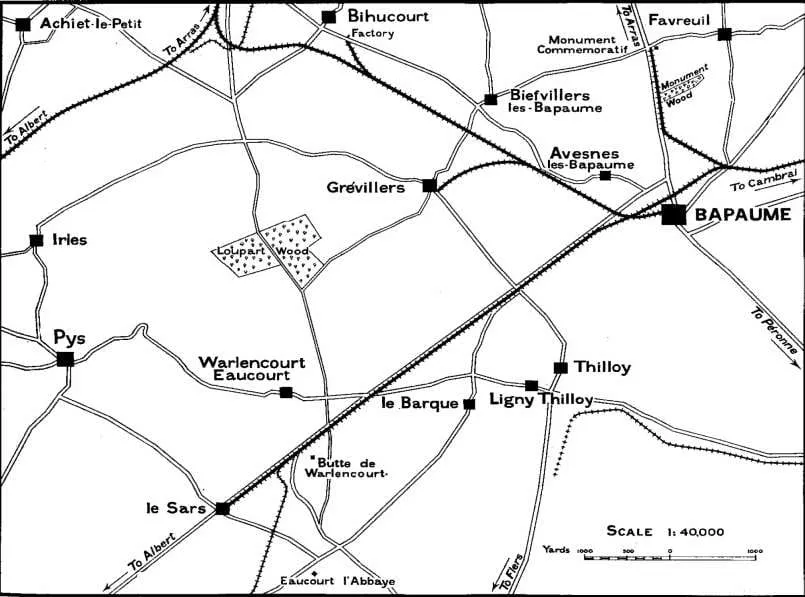
At 5 a.m. on 31 August 1918 a small Australian brigade attacked Mont Saint-Quentin, the hill commanding Péronne and the crossings of the Somme. Further north, on the hills beyond the newly recovered Bapaume, the divisions of General Julian Byng’s British Third Army were beating off German counter-attacks and preparing for the next attack. The British Battles Nomenclature Committee dates the Second Battle of Bapaume, which lasted until 3 September, from this day. The British chronology of the war places its start on 21 August, and Field Marshal Douglas Haig in his dispatch called the whole Third Army attack from 21 August to 1 September the “Battle of Bapaume”. The committee, however, assigned the fighting of the first days to the Battle of Albert and kept the name Battle of Bapaume for the last stage, in which the Germans lost the line of the Somme.
Ten days of advance
On 21 August the Third Army attacked in fog north of the Ancre, and the next day the neighbouring Fourth Army retook Albert. From 23 August both armies attacked together on a front of more than 50 kilometres, across the battlefield that had been fought over for four and a half months in 1916. During the night of 22–23 August Haig sent his army commanders a telegram in which he wrote that risks which a month earlier would have been criminal must now be taken as a duty. So the divisions pushed forward even with their flanks exposed. The Germans defended Bapaume for several days, bringing up fresh divisions, but when the front began to crack on the flanks they abandoned the town during the night of 28–29 August. In the morning the New Zealanders entered it, five months after the Third Army had given it up during the German offensive.
A line for the winter
After the withdrawal of 28 and 29 August the Germans took up a new line. South of Péronne they were protected by the Somme, and north of the town by a chain of hills through Mont Saint-Quentin, Morval and Le Transloy as far as Frémicourt east of Bapaume. According to the British official history they hoped to hold it, together with the Drocourt–Quéant line near Arras, through the winter. For the first time since 22 August their guns were no longer dispersed for delaying actions but concentrated for determined defence, and counter-attacks became more frequent and stronger.
On 29 August Marshal Foch gathered the Allied commanders and urged them to “continue the pursuit”. On his return Haig ordered the First Army, which had been fighting in the Battle of the Scarpe since 26 August, to attack the Drocourt–Quéant line, while the Third and Fourth Armies pinned down the Germans in their sectors. The Third Army was also to attack vigorously with its left wing, together with the First Army. In the Fourth Army’s sector the commander of the Australian Corps, General John Monash, put forward a bold plan on 30 August. Instead of forcing the Somme at Péronne itself, where the crossings were blocked by marshes and machine guns, he wanted to cross a few kilometres further west, at Cléry, and take Mont Saint-Quentin from the north-west. General Henry Rawlinson thought this too audacious with such weak forces, but agreed.
Mont Saint-Quentin
On 30 August the Australian 5th Brigade of the 2nd Australian Division crossed the Somme by hastily repaired crossings and by evening had occupied German trenches east of Cléry. It numbered only 70 officers and 1,250 men. The night of 30–31 August was pitch dark and the units had difficulty finding their jumping-off positions. There was no time for a normal barrage, so five brigades of field artillery and four of heavy artillery were to fire to a programme matched to the expected rate of advance. According to the British official history about 550 men went into the attack itself, with two hundred in reserve.
At 5 a.m. the Australians advanced. Facing them were parts of five German divisions, plus two regiments of the 2nd Guard Division holding the Mont Saint-Quentin sector. The attack came as a complete surprise. The centre and left battalions took the village of Mont Saint-Quentin and Feuillaucourt, and over 700 Germans were taken prisoner, more than the attackers themselves. The right wing, however, was held up by gun and machine-gun fire from Anvil Wood and the airfield north of it, and the 3rd Australian Division on the left had not yet come up. At about 7 a.m. the Germans counter-attacked from two sides with units of the 2nd Guard Division and two other divisions and drove the Australians out of the village into trenches along the Péronne–Bouchavesnes road. There they held on, beating off bombing attacks all day. In the afternoon, under flanking fire, the battalion from Feuillaucourt also fell back there.
Monash did not give up. He moved the 6th Brigade across the river, which in the afternoon passed through Cléry and occupied trenches in front of Péronne, and in the evening the 14th Brigade, which under constant fire moved in single file under cover of the steep bank. On the left the 3rd Australian Division reached the ridge near Bouchavesnes and captured several guns. Private George Cartwright of the 33rd Battalion single-handedly captured a machine gun there, killing three of its crew and taking nine prisoners, for which he received the Victoria Cross. Further still to the left the 58th and 47th Divisions of III Corps took Marrières Wood, capturing nearly 400 prisoners. By evening the three Australian divisions had a large bridgehead on the north bank of the Somme and, as the official history puts it, “a key foothold north of the town”.
The Third Army’s front
On the Third Army’s front 31 August was a quieter day. Byng issued no new orders, and V and IV Corps did not attack. Both sides, however, kept up heavy shelling. At about 5 a.m. the German artillery deluged the positions of the New Zealand Division at Bancourt and Frémicourt, taken the previous day. Half an hour later the infantry of the Saxon 12th Division and a regiment of the 4th Bavarian Division attacked. According to the New Zealand history the attack was preceded by a reconnaissance by three or four German tanks, though the histories of the German regiments show that the tanks which were to support the attack did not arrive in time. The tanks seen by the New Zealanders drove towards the cemetery but did not attack and turned back. German riflemen, whom no one had warned of their sortie, took them for British and fired armour-piercing rounds at them, and two of them got stuck on an embankment. On 2 September they fell into the New Zealanders’ hands. The German infantry pushed several New Zealand posts back a few hundred metres, but machine-gun fire and batteries firing over open sights stopped it. Two groups of about 50 Germans each, which had slipped behind the New Zealanders during the night, were captured or broken up. By 7 a.m. the lost positions had been recovered. The German history of one of the Saxon regiments admitted that the retreat after this attack was “difficult and costly”.
On the army’s left wing VI Corps failed to take Vaulx-Vraucourt, but occupied Écoust-Saint-Mein and Longatte for the second time, and XVII Corps retook most of Bullecourt, where Australians and British had fought in 1917. On the right wing the Welsh 38th Division and the neighbouring divisions of V Corps were preparing an attack for the next day on Morval, Beaulencourt and Sailly-Saillisel.
What came next
On 1 September the Australians took the positions on Mont Saint-Quentin and almost all of Péronne, and the Third Army occupied Morval, Beaulencourt, Sailly-Saillisel and the ridge beyond Bancourt. Haig regarded that day as the end of the second stage of the offensive. On 2 September the Canadians broke through the Drocourt–Quéant line, and the German command decided to withdraw its armies to the positions held before the March offensive, towards the Hindenburg Line. During the night of 2–3 September the Germans broke contact with the British along the whole front north of the Somme.
Remember the articles you have read? Only in this browser; nothing is sent anywhere.How it works
Read ·
A voice from the front
“"And so you think you're going to take Mont St. Quentin with three battalions! What presumption! However, I don't think I ought to stop you! So, go ahead, and try!--and I wish you luck!"”
Spotted a mistake?Report an error
Meanwhile
(04)Elsewhere in the same days.
- 30 August 1918 · PoliticsAssassination attempt on LeninOn 30 August 1918 Lenin was gravely wounded in Moscow; that morning Uritsky, the Petrograd Cheka chief, was killed. The Bolsheviks answered with Red Terror.
- 30 August 1918 · PoliticsMacready resigns as adjutant-generalIn late August 1918, after the London police strike, General Sir Nevil Macready gave up the post of Adjutant-General to become head of the Metropolitan Police.
- 2 September 1918 · MilitaryItalians in MurmanskOn 2 September 1918 a ship carrying Lieutenant-Colonel Augusto Sifola's Italian expeditionary corps reached Murmansk. About 1,300 men landed a day later.
- 28 August 1918 · Middle EastAction at KaakhaOn 28 August 1918 at Kaakha station in Transcaspia, Malleson's Punjabis and the Transcaspian government's troops beat off an attack by Bolsheviks from Tashkent.
Related events
(04)The same battle, people or subject.
- 3 October 1918 · Western FrontStart of the battle of the Beaurevoir LineOn 3 October 1918 the British and Australians broke the Beaurevoir Line, the Hindenburg Line's last position. Montbrehain fell, but the Germans retook it.
- 12 September 1918 · Western FrontBattle of Havrincourt beginsOn 12 September 1918 Byng's Third Army took Havrincourt and Trescault in front of the Hindenburg Line, while New Zealanders fought the elite Jäger Division.
- 8 August 1918 · Western FrontBattle of Amiens beginsOn 8 August 1918, in fog, Canadians, Australians and tanks broke the front at Amiens, taking over 15,000 prisoners. Ludendorff called it the "black day".
- 22 August 1918 · Western FrontBritish retake AlbertOn 22 August 1918 the British 18th Division crossed the Ancre and retook the ruins of Albert; III Corps wiped out the German salient between Somme and Ancre.