Key event
Battle of Amiens begins
- Category:
- Military operations
- Front:
- Western Front
- Date:
- 8 August 1918
- Author:
- Łukasz Skowroń
- Battle:
- Battle of Amiens
- Tags:
- British Expeditionary Force, Australia, Canada, tanks
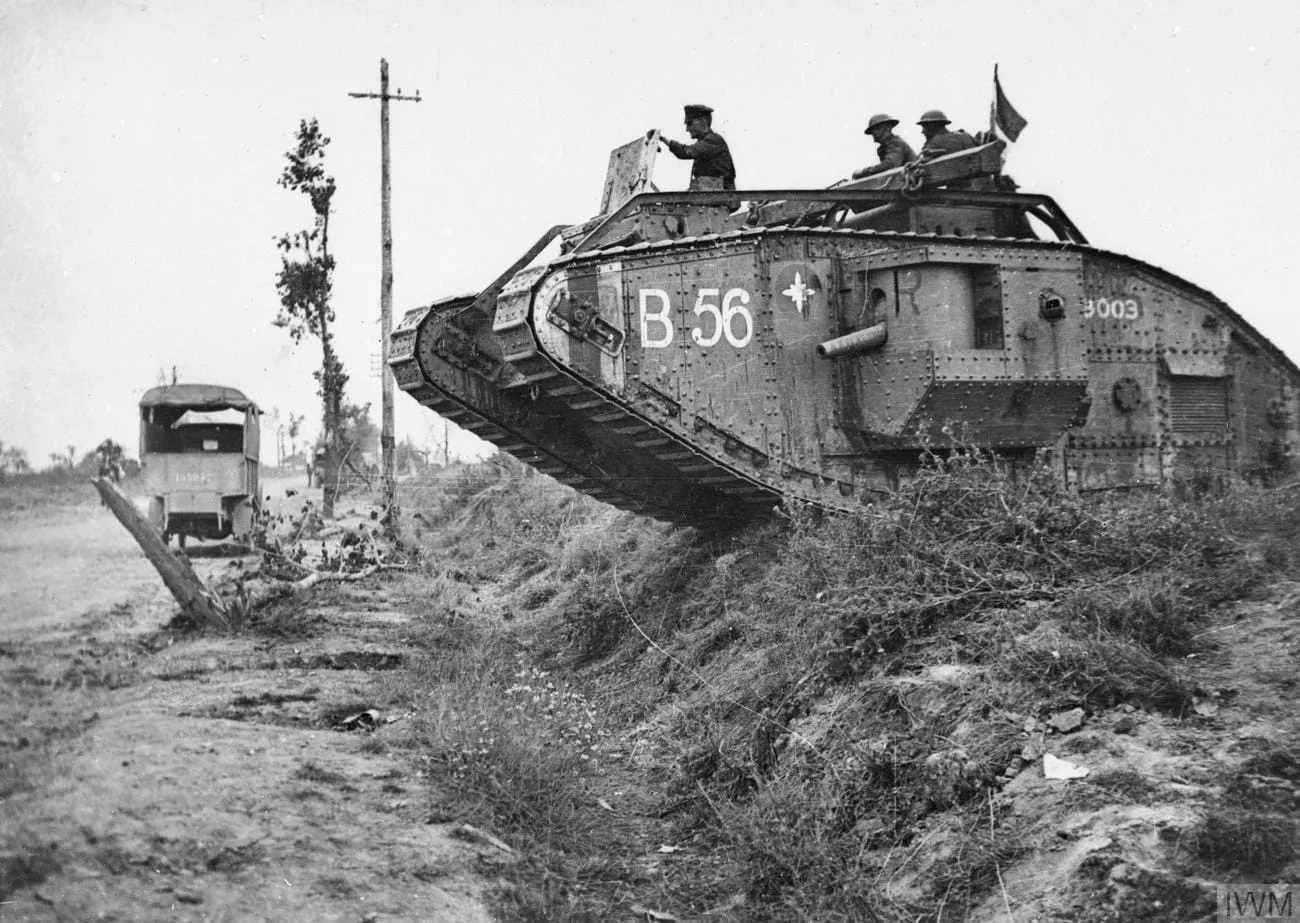
On 8 August 1918, at 4.20 a.m., more than two thousand British guns opened fire along a front of over 18 kilometres, from Morlancourt on the Ancre to the road from Amiens to Roye. At the same moment, without any preliminary bombardment, the Canadian, Australian and British divisions of General Henry Rawlinson’s British Fourth Army moved off behind a creeping barrage, and with them more than four hundred tanks. Three-quarters of an hour later, on their right flank, General Marie-Eugène Debeney’s French First Army attacked. The German Second Army was caught by surprise in the fog, and within a few hours its front between the Somme and the Avre had ceased to exist. By evening the Allies stood 11–13 kilometres further east, and their prisoner cages held more than 15,000 Germans. General Erich Ludendorff later wrote that 8 August was “the black day of the German Army in the history of this war”.
In chronologies of the war this day is sometimes described as the start of the Second Battle of the Somme and of the whole Allied offensive in Picardy. In the official British nomenclature of battles, however, the attack of 8–11 August is a separate Battle of Amiens, and the “Second Battles of the Somme, 1918” begin only on 21 August, with the Third Army’s attack at Albert.
The night before the battle
The preparations took less than two weeks and were carried out in the utmost secrecy. General Arthur Currie’s Canadian Corps, regarded as the strongest in the British Army, was brought down from Arras by night, while two of its battalions pretended in Flanders that the whole corps was heading for Ypres. On the Santerre plateau, east of Villers-Bretonneux, three corps, the cavalry, more than 500 tanks of various types and some 2,000 guns were assembled. All of them had to move into position during the last night.
On the afternoon of 7 August an order from General John Monash was read out to the Australians. “For the first time in the history of this Corps,” he wrote, “all five Australian divisions will tomorrow engage in the largest and most important battle operation ever undertaken by the Corps.” He predicted that the battle would “be one of the most memorable of the whole war” and would bring its end closer. The soldiers felt the same. According to the Australian historian Charles Bean, for the first time all the divisions of their army were going into attack together, the Canadians were alongside them, and this time they were not to be stopped short of the German guns.
The infantry moved to the start lines after midnight. At 3 a.m. a mist began to rise over the plateau, and half an hour later visibility was at most a dozen or so metres. Lost units found their assembly points by candles set in petrol tins, into which the battalion numbers had been punched. At about 3.30 a.m. the Germans opened fire on the area around the railway near Marcelcave, and for a moment it seemed they had discovered the preparations. It was, however, only covering fire for a previously planned raid by the German 148th Infantry Regiment. The Australians and Canadians waited it out in shell holes, suffering losses. The Canadian 3rd Division completed its relief of the Australians on its sector only at 4 a.m. The Canadian divisions reported readiness to attack with the codeword “Llandovery Castle”, the name of the hospital ship carrying Canadian nurses sunk by a German submarine on 27 June. The tanks moved off twelve minutes before zero hour, the noise of their engines drowned by aircraft circling over the front and by the usual harassing artillery fire.
Zero hour
At 4.20 a.m. the barrage came down. The infantry advanced close behind it, while the heavy artillery struck the German batteries, which had previously been carefully located from the air and by sound-ranging. The guns had not fired beforehand, so as not to give themselves away by registering, but their fire was accurate and most of the German artillery replied weakly or not at all. In many places the German front-line infantry were still sitting in their dugouts when the Canadians and Australians stood over them. In the dense fog tanks and infantry often lost each other, and company commanders went forward by compass. Above all, however, the fog hampered the defence: the German machine-gunners could not see their targets, and the artillery observers could not call down fire.
The hardest task fell to the Canadian 3rd Division on the right flank, attacking on both sides of the Roye road. Its brigades had to cross the valley of the marshy river Luce, over which there were only two crossings. By 7.30 a.m., nevertheless, they had taken Rifle Wood and the village of Démuin, and Corporal Harry Miner of the 58th Battalion, who despite severe wounds captured three German posts, was awarded a posthumous Victoria Cross. North of the river the Canadian 1st Division went through Hangard Wood, and the 2nd Division, advancing along the railway, took Marcelcave. Victoria Crosses were won there by, among others, Private John Croak and Corporal Herman Good of the 13th Battalion. The Australian 2nd and 3rd Divisions, attacking between the railway and the Somme, took their first objectives almost unopposed. At Warfusée and in Hamilton Wood they led hundreds of prisoners out of dugouts. Lieutenant Alfred Gaby of the 28th Battalion, who single-handedly, revolver in hand, captured a strongpoint and took 50 prisoners, earned the Victoria Cross; he was killed three days later. By about 7 a.m. the first objectives, the so-called green line, had been taken along the whole Canadian and Australian front.
At 5.05 a.m., after a 45-minute artillery bombardment, the French First Army attacked. The French had lost most of their heavy tanks on the Marne and could not count on surprise. Their XXXI Corps forced the Avre and by morning had taken Moreuil, and then Mézières, although the neighbouring corps was held up at the river.
The second wave
At 8.20 a.m. fresh divisions passed through the captured line: the Australian 5th and 4th and further Canadian brigades. The fog lifted and revealed a sight the participants remembered for the rest of their lives. Across the flat plateau, covered with ripe corn, there advanced at once lines of infantry, Mark V tanks, horse artillery batteries galloping into new positions, parties of engineers repairing the roads, long columns of cavalry and Whippet light tanks, with aircraft overhead. Bean wrote that none of the 50,000 Australians who saw it ever forgot the impression. Coming the other way were columns of prisoners, often without escort.
At about 10.15–10.40 a.m. the Australians were on the second objective, the red line, and before noon on the outer Amiens defence line, with the villages of Bayonvillers, Harbonnières and Morcourt. The Canadians reached Caix and Cayeux, and their 4th Division, with the Canadian Cavalry Brigade, went for Le Quesnel. There, however, the German 1st Reserve Division, sent in haste from a neighbouring army, stopped the attack, and the village remained in German hands that day.
Cavalry, Whippets and armoured cars
Mobile units operated ahead of the infantry. The most famous of them was the Whippet light tank “Musical Box” of the 6th Tank Battalion, commanded by Lieutenant Clement Arnold. Beyond Bayonvillers it destroyed a German field battery that had just knocked out two Mark V tanks, and then, ahead of everyone else, helped the cavalry reach the railway bridge near Harbonnières and for several hours roamed the German rear, firing on transport and troops. Finally, east of Harbonnières, it ran into a hastily assembled German detachment, was hit and burst into flames. The driver, Sergeant Carnie, was killed, and Arnold and the gunner, Ribbans, were taken prisoner.
An armoured car battalion drove along a hastily repaired road through the German lines and until midday ran amok on the Roman road to Saint-Quentin, beyond Framerville. The crews fired on transport columns, and Lieutenant Rollings entered a headquarters at Framerville, abandoned moments earlier, revolver in hand, and carried off sacks of documents, among them plans of the Hindenburg Line defences. At about 11 a.m. he sent a message by pigeon: “Enemy surrendering very freely. (…) No enemy artillery.” On the plateau beyond Harbonnières British dragoons caught a German train carrying a huge railway gun that had been shelling Amiens all summer. A British aircraft’s attack had stopped it, and its crew were taken prisoner. Australian engineers later fired up the locomotive’s boiler and hauled the gun back behind their own lines.
By midday the cavalry had occupied sections of the Amiens defence line ahead of the infantry, but there its advance stopped. Rawlinson’s order to push on towards Chaulnes and Roye reached the cavalry divisions only after 4 p.m., and by then the Germans already had a new line east of Rosières. In practice Whippets and horses could not work together: without fire the horses were faster than the tanks, and under fire the cavalry could not follow them.
North of the Somme
Things went worse for General Richard Butler’s British III Corps. Its 18th and 58th Divisions were exhausted by fighting with the Württemberg 27th Division, which had attacked at Morlancourt on 6 August, and the Germans on this sector were alert. In the fog the British battalions lost their way, and when it cleared, machine guns in the woods on the slopes and on the spur above the village of Chipilly stopped the attack. The corps took part of the wooded slopes above Sailly-Laurette, but Chipilly itself and the spur behind it remained in German hands. German guns on that spur fired across the river into the left flank of the Australian 4th Division at Cerisy and Morcourt, destroying several tanks, so that the Australians had to pull back their posts there.
In the air
In the morning the fog limited air operations, but aircraft dropped smoke bombs where the artillery could not reach and strafed columns on the roads. When airmen reported that the roads to the Somme crossings were jammed with retreating troops, General John Salmond, commander of the Royal Air Force in France, at about midday cancelled other tasks and sent the bombers, and even fighters with small bombs, against the bridges at Péronne, Brie and Saint-Christ. The Germans meanwhile brought in aircraft from the whole front, including the fighter wing Jagdgeschwader 1, Richthofen’s former wing, commanded by Hermann Göring. Great air battles broke out under the low cloud. The bridges were not cut, and the British lost 44 aircraft that day, with another 52 having to be struck off strength. The official history called 8 August “an unlucky day for the RAF”.
Evening
At about 11.30 a.m. Field Marshal Douglas Haig asked Debeney to send his cavalry forward on the right of the British cavalry and outflank the Germans at Montdidier. Debeney replied that his cavalry was too far back and the roads were jammed with infantry, and that it could not arrive before the following morning. Haig drove to Rawlinson’s headquarters at Flixecourt, told him to continue the advance towards the Roye–Chaulnes line, and in the afternoon visited a downcast Debeney, some of whose troops had let him down. At about 6 p.m. Ferdinand Foch, who two days earlier had been made a Marshal of France, came to see Haig. He heard of more than 15,000 prisoners and of most of nine German divisions shattered, and was, as was recorded, delighted.
By evening the Allies had taken almost the whole outer Amiens defence line, and the Paris–Amiens railway was out of German artillery range. The Canadians had advanced about 13 kilometres, the Australians about 11, the French about 8, and III Corps little more than 3. Some 281 officers and 12,134 men from eight divisions passed through the British prisoner cages, and the French took about 3,350 prisoners. Almost three hundred guns were captured. Fourth Army’s losses were, according to the British official history, about 8,800 men, including 3,868 Canadians and, according to various tallies, between about 2,000 and 3,000 Australians. For a success on this scale it was very little.
On the German side there was chaos. A German monograph of the 1920s wrote: “As the sun set on 8 August on the battlefield, the greatest defeat the German Army had suffered since the beginning of the war was an accomplished fact.” The front-line divisions between the Avre and the Somme had been “almost completely destroyed”, and the total losses of the Second Army were estimated at 650–700 officers and 26,000–27,000 men, more than two-thirds of them taken prisoner, and over 400 guns. Six reserve divisions reached the battlefield during the day, but they went into action piecemeal and managed only to form a new line from Plessier to the Somme.
“The black day”
Ludendorff received the first reports at the Supreme Army Command headquarters at Avesnes. The numbers of prisoners and guns were not yet exceptional in this war, but news came from the front that frightened him more than the lost ground: whole units surrendering to single horsemen and tanks, officers losing control over their men, and retreating soldiers greeting divisions going up to the front with shouts of “blacklegs” and “war prolongers”. In his memoirs Ludendorff wrote: “August 8th was the black day of the German Army in the history of this war.” He concluded that a return to the offensive was no longer possible and that the war would have to be ended.
For the Allies 8 August was the most successful day of the war on the Western Front. Surprise without registering the guns, tanks, aircraft and careful logistics, tested in July at Hamel and earlier, with less success, at Cambrai, worked on a large scale. The battle went on for three more days, with diminishing success, but from that day the Allied armies did not stop until the armistice. The period was later called the Hundred Days Offensive.
Remember the articles you have read? Only in this browser; nothing is sent anywhere.How it works
Read ·
Voices from the front
“Confused rumours begin to spread in our fighting lines. It is said that masses of English cavalry are already far behind the foremost German infantry. Men in front grow uneasy, leave the positions from which they have just beaten off strong frontal attacks, and look to the rear for the lost connection. Imagination conjures up phantoms and sees real dangers in them.”
Translated · Original (de)
Wirre Gerüchte beginnen sich in unsern Kampflinien zu verbreiten. Es wird behauptet, daß englische Kavalleriemassen schon weit im Rücken der vordersten deutschen Infanterie sich befinden. Man wird vorn bedenklich, verläßt die Stellungen, aus denen heraus man soeben noch starke feindliche Angriffe in der Front abgewiesen hat, man sucht nach rückwärts den verlorenen Anschluß. Die Phantasie zaubert Wahngebilde hervor und sieht in ihnen wirkliche Gefahren.
“Already prisoners are coming back, in little knots, in squads, in whole detachments, sometimes under guard, oftener left to their own device […]. "You Canadians have no business down here," says one in excellent English. "We were told you were in Flanders; how I would like to hang our fools of Intelligence officers!"”
Spotted a mistake?Report an error
Meanwhile
(04)Elsewhere in the same days.
- 8 August 1918 · DiplomacyBritish assurance to FinlandIn August 1918 London assured the Finns that it had no hostile intentions towards them, but that Karelia and the Murman coast were not for Britain to decide.
- 7 August 1918 · Middle EastVosugh od-Dowleh prime minister againIn early August 1918 the Shah dismissed Samsam ol-Saltaneh's government, unfriendly to the Entente. On 7 August Vosugh od-Dowleh became prime minister.
- 7 August 1918 · War at seaSinking of the Dupetit-ThouarsOn 7 August 1918 U-62 torpedoed the French armoured cruiser Dupetit-Thouars in the Atlantic as it escorted a convoy from New York. About a dozen sailors died.
- 6 August 1918 · DiplomacyBritish declaration to the peoples of RussiaIn early August 1918 Britain issued the appeal "Peoples of Russia!": the Allies came as friends and would not keep a foot of Russian soil.
Related events
(04)The same battle, people or subject.
- 11 August 1918 · Western FrontBattle of Amiens endsOn 11 August 1918 Haig halted the Amiens offensive, which had stalled on the old 1916 trenches. At Avesnes Ludendorff offered his resignation.
- 8 October 1918 · Western FrontBattle of Cambrai beginsOn 8 October 1918 the British Third and Fourth Armies and the Americans attacked between Sequehart and Cambrai. At Niergnies the Germans used captured tanks.
- 4 July 1918 · Western FrontAustralians take HamelAt 3.10 a.m. on 4 July 1918 Australians with Mark V tanks and Americans attacked Hamel on the Somme. In about 90 minutes they took the village, woods and ridge.
- 2 September 1918 · Western FrontBreaking of the Drocourt–Quéant LineOn 2 September 1918 the Canadians broke the Drocourt–Quéant Line near Arras, and at noon the German command ordered a retreat to the Hindenburg Line.