1918: The Allied counter-offensive
Battle of Amiens
- Dates:
- 8–11 August 1918
- Front:
- Western Front
- Location:
- The Santerre plateau between the Somme and the Avre, east and south-east of Amiens, from Morlancourt on the Ancre through Villers-Bretonneux, Harbonnières and Le Quesnel to Moreuil and Montdidier, Somme department (France)On the battle map →
- Sides:
- United Kingdom (with Canada and Australia), France and the United StatesFerdinand Foch, Douglas Haig, Henry Rawlinson, Marie-Eugène Debeney, Arthur Currie, John Monash, Richard Butler, Charles Kavanagh
- Result:
- Allied victory. On the first day the German front broke on a width of more than 20 km and the Allies advanced up to 12–13 km. By 11 August they had taken about 30,000 prisoners and several hundred guns and freed Amiens and the railway to Paris, but they stalled on the old trenches of 1916.
- Author:
- Łukasz Skowroń
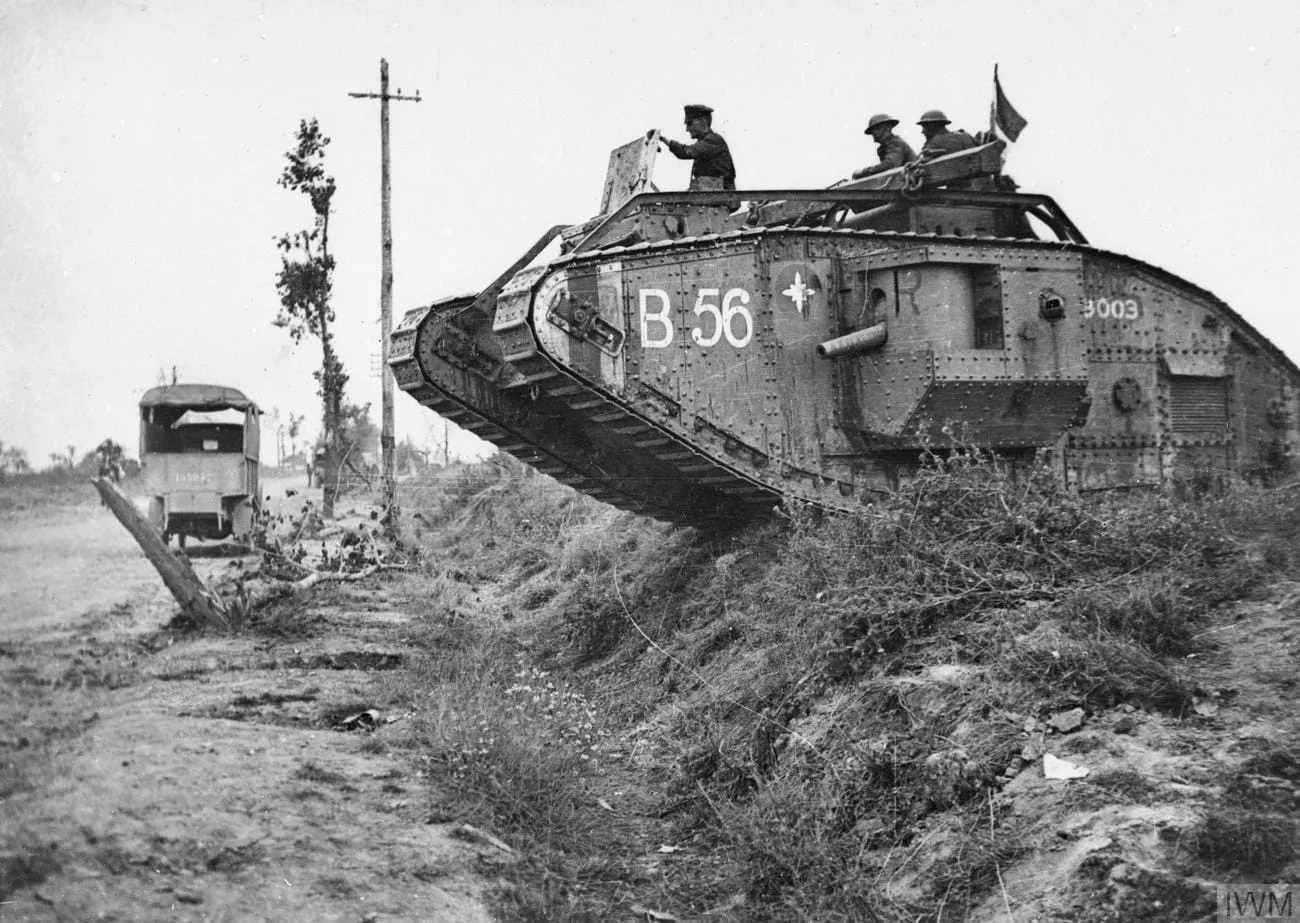
The Battle of Amiens was the first great Allied offensive of the summer of 1918 outside the Marne and one of the most important battles of the whole war. On the morning of 8 August 1918 the British Fourth Army of General Henry Rawlinson, whose main strength was the Canadian Corps and the Australian Corps, attacked in fog, without any preliminary bombardment, with more than four hundred fighting tanks, against the German Second Army east of Amiens. On its right flank the French First Army of General Marie-Eugène Debeney attacked. The Germans were taken completely by surprise. By the evening the Allies had advanced 12–13 kilometres in the centre and taken about 15,000 prisoners. General Erich Ludendorff later called 8 August “the black day of the German Army in the history of this war”. Over the following days the attack lost momentum, and on 11 August Field Marshal Douglas Haig halted it. The Battle of Amiens opened the series of Allied victories later called the Hundred Days Offensive.
Name and dates
The British Battles Nomenclature Committee calls it the Battle of Amiens and dates it 8–11 August 1918. Haig in his dispatch gave 8–12 August, and the Polish Wikipedia 8–13 August, counting the local fighting that went on for several more days. We keep to the official dates: on the evening of 11 August Haig agreed to break off the offensive, and the further fighting at Damery, Parvillers and Lihons was merely an adjustment of the line. The French describe the operations of their First and Third Armies on the southern flank as a separate battle of Montdidier, lasting until 15 August. In the British classification the Battle of Amiens is a separate battle and not part of the Second Battles of the Somme, which began on 21 August, although many accounts describe the whole advance of August and early September as a single offensive. Times are given in British time, and figures chiefly from the British official history (James Edmonds, Military Operations France and Belgium 1918, vol. IV, 1947), the Canadian (G.W.L. Nicholson, 1962) and the Australian (Charles Bean, vol. VI, 1942).
Background
In the spring of 1918, in Operation Michael, the Germans came within artillery range of Amiens. The city was the most important railway junction between the British and French armies, and the main line from Paris to Amiens came within reach of German guns. The last attempt to approach the city was repulsed by the Australians and British in April at Villers-Bretonneux. Since then the front on the Santerre plateau had been quiet, but the Germans held a forward salient there between the Somme and the Avre, from which their artillery shelled Amiens.
The idea of attacking at this point came from Rawlinson. On 5 July, the day after the successful Australian attack on Hamel, he proposed to Haig a larger operation east of Villers-Bretonneux, and on 17 July he presented the plan in writing. He wanted to carry it out with British troops alone, with the Canadian Corps as reinforcements, and proposed 10 August as the date. Meanwhile Mangin’s counter-offensive at Soissons on 18 July reversed the situation along the whole front. On 24 July General Ferdinand Foch, Allied commander-in-chief since April, gathered Haig, Pétain and Pershing at his headquarters at Bombon near Melun and presented to them a plan for a series of limited attacks intended to free the most important lateral railway lines. One of them was precisely the line from Paris to Amiens. On 28 July Foch issued the formal order: the attack was to “free Amiens and the Paris–Amiens line”, defeat the Germans between the Somme and the Avre and push “as far as possible in the direction of Roye”. The French First Army, instead of merely covering the flank, was to attack together with the British and for the duration of the operation came under Haig’s orders. Foch, spurred by the successes on the Marne, also brought the date forward by two days, to 8 August.
Preparations and deception
The preparations were carried out in strict secrecy. The boundary between the armies was moved about 6 kilometres south, to the Amiens–Roye road. The Australians, by extending their sector, screened the Canadians, who were to assemble behind them. From 1 August all movements of troops and transport eastwards took place at night, and the air force made sure that nothing unusual could be seen from the air. Slips headed “Keep your mouth shut” were pasted into the soldiers’ pay books, reminding them that a prisoner should give only his name and rank. Even senior Canadian officers learned the objective only in the last days of July, and the soldiers were told they were going to Ypres.
To divert the Germans’ attention, two Canadian battalions (the 4th Canadian Mounted Rifles and the 27th Battalion) with wireless stations and casualty clearing stations were sent on 29 July to Flanders, to the front at Kemmel, where they transmitted false messages, and the air force stepped up its activity there. Near Arras preparations for an attack on Orange Hill continued to be feigned, and a concentration of tanks was simulated in the Saint-Pol area. The main body of the Canadian Corps set off south from the Arras area on 30 July, by train and bus, loaded and unloaded in darkness. German intelligence noticed the disappearance of two Canadian divisions but did not draw the right conclusions. The Second Army staff regarded reports of tanks massing as “a product of imagination or nervousness”, and Ludendorff in an order of 4 August assured the troops that they could await any enemy attack “with the greatest confidence”.
Several events before the battle caused concern. On the night of 3/4 August the Germans captured five Australians in a raid on the future Canadian sector, but the prisoners gave nothing away. On 6 August the fresh Württemberg 27th Division attacked the British III Corps between the Somme and the Ancre near Morlancourt, took about 235 prisoners and forced the British to change their start line and fire plan. As it turned out, this was an ordinary local attack, but the Germans in that sector were more alert from then on.
Forces
Rawlinson’s Fourth Army attacked with three corps on a front more than 18 kilometres long, from the Roye road to the Ancre. On the right flank stood the Canadian Corps of General Arthur Currie with the 3rd, 1st and 2nd Divisions in the first line and the 4th Division in reserve. In the centre, between the railway to Chaulnes and the Somme, attacked the Australian Corps of General John Monash with the 2nd and 3rd Divisions in the first line and the 5th and 4th Divisions, which were to leapfrog them. North of the Somme the British III Corps of General Richard Butler (the 58th and 18th Divisions, with the 12th Division and the American 131st Infantry Regiment of the 33rd Division in reserve) was to cover the left flank. Behind the front waited the Cavalry Corps of General Charles Kavanagh with three divisions, and along the Roye road the motorised group of the Canadian General Raymond Brutinel was to operate: machine guns on armoured cars, cyclists and trench mortars on lorries. Debeney’s French First Army attacked to the right of the Canadians, from the Roye road to Moreuil, and as it progressed its attack was to widen to the south.
According to the Canadian history, twenty-one Allied divisions faced fourteen divisions of the German Second Army of General Georg von der Marwitz. The Fourth Army had 1,386 field guns and 684 heavy guns, and the French 780 field and 826 heavy. The British assembled 342 heavy Mark V and Mark V* tanks, 72 light Whippet tanks assigned to the cavalry and 120 supply tanks, as well as a battalion of armoured cars. The French, who had lost most of their heavy tanks on the Marne, had few of them. In the air the superiority was overwhelming: the Fourth Army alone had about 800 aircraft, while the Germans had about 365 machines facing both Allied armies. Marwitz considered only two of his divisions fully fit for battle. His trenches south of the Somme were shallow and poorly wired, and behind them ran only the old French lines of the Amiens defences.
The plan was for the infantry with tanks to take two lines of objectives (the green and the red), after which the cavalry with the Whippets would push forward to the outer line of the Amiens defences, about 11 kilometres from the start line. At a conference on 5 August Haig extended this objective: after taking the Amiens defence line the attack was to continue to the Roye–Chaulnes line and, if successful, towards Ham. The models were Cambrai and Hamel: surprise, no shelling before zero hour, a creeping barrage, tanks right behind it and counter-battery fire that was to silence the German artillery at once.
8 August
The night before 8 August was moonless. For several hours the infantry moved up to the start lines, while aircraft flew over the front, their drone drowning out the tanks. At about 3 a.m. a mist began to rise over the plateau, and by 3.30 a.m. it limited visibility to a dozen or so metres. The Canadian 3rd Division completed the relief of the Australians in its sector only at 4 a.m., twenty minutes before the attack. As a signal that they were in position, the Canadian divisions sent corps headquarters the code word “Llandovery Castle”, the name of the Canadian hospital ship sunk by a U-boat in June.
At 4.20 a.m. the British artillery opened fire along the whole front and the infantry advanced behind the creeping barrage. The German batteries, smothered by counter-battery fire, replied weakly. In the fog tanks and infantry often lost each other, but the fog also shielded the attackers from machine guns. The Canadians on the right flank had to force the valley of the river Luce, while the Australians advanced across the open plateau along the old Roman road from Amiens to Saint-Quentin. Most of the German front-line defenders were caught in their dugouts. By about 7–7.30 a.m. the first objectives had been taken, and after a pause fresh brigades, tanks and then cavalry passed through them. The French First Army, after a 45-minute bombardment, advanced at 5.05 a.m. and took Moreuil and Mézières.
When the fog lifted, the soldiers saw a sight they had not known since 1914: on the plateau infantry, tanks, horse artillery, cavalry and armoured cars were all advancing at once, with aircraft circling above them. The armoured car battalion drove along the Roman road through the German lines and spread confusion in the rear as far as Framerville, where the crew of one car carried off sacks of documents from an abandoned headquarters, among them plans of the Hindenburg Line fortifications. British cavalry near Harbonnières captured a train carrying a huge German railway gun that had been shelling Amiens all summer. The barrel of this gun is today in the collection of the Australian War Memorial in Canberra. By the evening the Canadians had advanced about 13 kilometres and the Australians about 11, and had taken almost the entire outer line of the Amiens defences, with the villages of Caix, Harbonnières and Morcourt. The only place the Canadians failed to take was Le Quesnel on the right flank, which fell into their hands only the next day. On the flanks progress was smaller: the French advanced about 8 kilometres, and the British III Corps, weakened by the fighting of 6 and 7 August, only about 3. It did not take the ridge above Chipilly, from which German guns and machine guns fired across the river into the Australians’ left flank.
The cavalry was unable to exploit the breakthrough. Rawlinson’s order not to stop at the Amiens defence line, sent at 12.30 p.m., reached the cavalry divisions only after 4 p.m., and by then the Germans already had a new line east of Rosières. In the afternoon the commander of the British air force sent almost all his aircraft against the Somme bridges at Péronne, Brie and Saint-Christ, over which German reinforcements and retreating troops were passing. The bridges were not destroyed, and in fighting with the fighters the Germans had brought in from the whole front, including Richthofen’s fighter wing under the command of Hermann Göring, the British air force lost 44 aircraft that day, and another 52 had to be struck off strength.
On 8 August 281 officers and 12,134 other ranks passed through the prisoner cages in the British zone, and the French took about 3,350 prisoners. Almost three hundred guns were captured. The Fourth Army’s losses that day were about 8,800 men, of whom 3,868 were Canadians. The German monograph estimated the losses of the Second Army at 650–700 officers and 26,000–27,000 men, more than two-thirds of whom were taken prisoner, as well as more than 400 guns. The front-line divisions between the Avre and the Somme had been, as it wrote, “almost completely destroyed”.
9–11 August
On 9 August there was no longer any question of surprise. During the night the Germans brought up several reserve divisions, and on the British side changes of orders at Fourth Army headquarters delayed the Canadian attack by more than five hours. The brigades attacked at different times and without the former coordination, but again advanced several kilometres, through Rosières and Méharicourt, which British hussars took at the gallop. North of the Somme soldiers of the American 131st Regiment and the British 2/10th Battalion, London Regiment, finally took the ridge above Chipilly. In the south the French extended their attack beyond Montdidier, and on the night of 9/10 August the German Eighteenth Army of General Oskar von Hutier began to withdraw so as not to be cut off.
On 10 August the French entered ruined Montdidier, and the French Third Army of General Georges Humbert joined the attack. The British and Canadians, however, reached the belt of old trenches from the Battle of the Somme of 1916, overgrown with weeds and criss-crossed with barbed wire, in which German machine guns found excellent positions. Tanks were ever fewer: of several hundred serviceable on 8 August, only a few dozen were fit for battle on 10 August. Haig, who that day visited the British 32nd Division near Le Quesnel, saw for himself that resistance had stiffened. On 11 August Australians of the 1st Division took Lihons, while the Canadians repulsed several counter-attacks by the German Alpine Corps at Hallu and then gave up this most advanced village. In the evening, after a talk with Haig at Villers-Bretonneux, Rawlinson told his corps commanders that the offensive was suspended until a new attack could be prepared with full artillery and tank support. That same evening Foch, coming to Haig’s train, agreed to limit the objectives and asked that the British Third Army in the north join the offensive as soon as possible.
Losses
According to the British official history the Allies took 29,873 prisoners in the battle: the British 439 officers and 18,061 other ranks, the French 259 officers and 11,114 other ranks (the figures cover the days from 6 to 15 August, but after 11 August there were few prisoners). Haig wrote of “nearly 22,000 prisoners and over four hundred guns” taken by British troops up to 12 August. The losses of the Fourth Army from 8 to 11 August were about 22,000 men (some returns cover the period up to 15 August), including about 9,000 Canadians and about 6,000 Australians. The French First and Third Armies lost 24,232 men from 6 to 15 August. The total German losses are not known. Edmonds estimated them at no fewer than 75,000 men; other accounts give smaller figures, from about 30,000 to 50,000 killed and wounded in addition to prisoners.
Significance
In terms of ground gained the Battle of Amiens was no bigger than the German successes of the spring. Its significance lay elsewhere. For the first time in this war the German Army suffered a defeat that its own commanders called one. Ludendorff heard from officers at the front that whole units had surrendered to single horsemen, that some officers had lost control of their men, and that retreating soldiers shouted “strike-breakers” and “war-prolongers” at divisions going up to the front. He concluded that the balance had finally tipped in favour of the Entente and that a new offensive was no longer conceivable. At a conference at Supreme Army Command headquarters in Avesnes, attended by the Kaiser Wilhelm II (according to the British official history on 11 August, according to some accounts a day earlier), Ludendorff offered his resignation, which was not accepted. The Kaiser is said to have remarked: “I see that we must strike a balance. We have nearly reached the limit of our powers of resistance. The war must be ended.” Conferences at Spa were called for 13 and 14 August.
The battle also showed that the British Army had learned to fight anew. Surprise, fire without registering the guns, masses of tanks, aircraft and carefully prepared logistics made it possible to break the front within a few hours. The British official history observes that the battle restored the soldiers’ confidence in the staffs, shaken by the defeats of March. Its weaknesses were also visible: the cavalry and the Whippet tanks could not work together, communications could not keep up with the advance, and the tanks were quickly worn down. Haig drew the conclusion that instead of battering through ever stronger defences, the blow should be struck in a new place. Against Foch’s pressure he shifted the weight of the offensive north of the Somme, where on 21 August the Third Army of General Julian Byng attacked, beginning the Second Battle of the Somme. From 8 August until the armistice the Allied armies did not halt again.
Spotted a mistake?Report an error