United Kingdom · The Entente
George V
King of the United Kingdom of Great Britain and Ireland, Emperor of India (1910–1936)
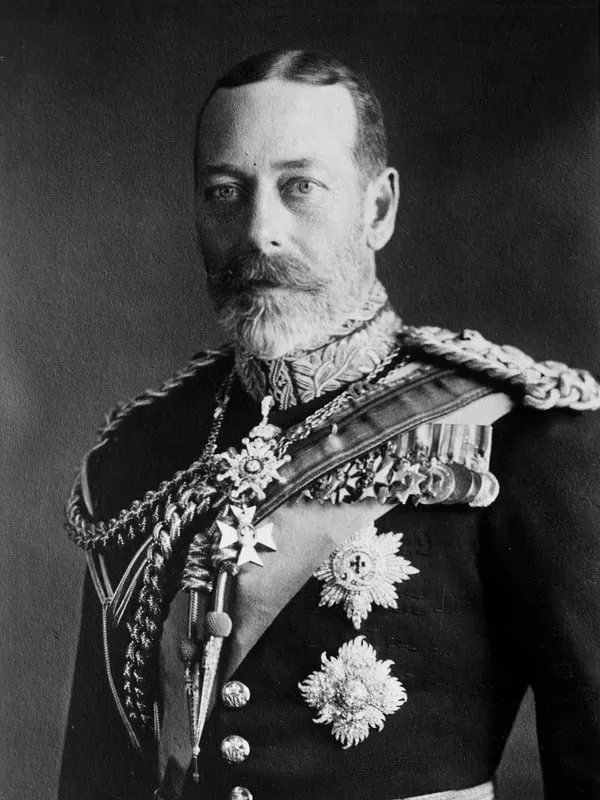
- Born:
- 3 June 1865, London
- Died:
- 20 January 1936, Sandringham (England)
- Author:
- Łukasz Skowroń
- Photo:
- Bassano Ltd, domena publiczna, Wikimedia Commons

George V was a constitutional monarch who did not take the decisions on war and peace, but for four years he was the war’s most visible symbol throughout the British Empire. He visited troops, hospitals, factories and shipyards hundreds of times, handed out thousands of decorations and, as an example, gave up alcohol. He was a cousin of two emperors: the enemy, Wilhelm II, and the ally, Nicholas II. Behind the scenes he corresponded with generals and had a hand in the removal of Field Marshal John French, and in 1917, under the pressure of anti-German feeling, he changed the name of his dynasty to Windsor and prevented the deposed Tsar from coming to England.
Before the war
He was born on 3 June 1865 at Marlborough House in London, the second son of the heir to the throne, the future King Edward VII, and the Danish Princess Alexandra. He was not expected to become king, so at the age of twelve he entered the navy. He sailed round the world in a training ship and commanded a torpedo boat and a gunboat, and the discipline, punctuality and simplicity of habits instilled on board stayed with him all his life. When his elder brother Albert Victor died in 1892, George became second in line to the throne. A year later he married his brother’s fiancée, Princess Mary of Teck.
He became king on 6 May 1910, on his father’s death. Almost at once he was caught up in the constitutional crisis over the powers of the House of Lords, and then in the dispute over Irish Home Rule, which in the spring of 1914 brought the country to the brink of civil war. In July 1914 he summoned a conference of the leaders of all sides to Buckingham Palace, but after four days the talks ended in failure. The European crisis then pushed the Irish question into the background.
His relations with Wilhelm II were cool and correct. In private he called him “William the Fidget”, and after 1914 they never corresponded again. With Tsar Nicholas II, whom he strikingly resembled, he had a warm friendship.
1914
George V had no influence on the decision for war, which was taken by the government of H. H. Asquith. When King Albert of the Belgians appealed to him for diplomatic help, he could only pass the appeal on to his ministers. Late in the evening of 4 August 1914 he held a meeting of the Privy Council, which issued the proclamation of a state of war with Germany. In his diary he wrote that it was a terrible catastrophe, but not Britain’s fault. From then on, at meetings of the Privy Council, he signed one act of economic and political warfare after another: contraband lists, bans on trading with the enemy and the annexation of Cyprus after the declaration of war on Turkey.
The war touched his family at once. At the end of October 1914 a press campaign against Germans forced the resignation of the First Sea Lord, Prince Louis of Battenberg, the husband of a granddaughter of Queen Victoria. The King was deeply moved by this and, as a mark of confidence, appointed him to the Privy Council. He also had reservations about his successor, John Fisher, but the ministers did not listen to him.
The King in wartime
A constitutional monarch could advise, encourage and warn. George V used this right cautiously, but took his representative duties very seriously. According to official tallies he made more than 450 visits to units and more than 300 to hospitals during the war. He went to France and Belgium several times, and at home he reviewed divisions leaving for the front, including the 1st Canadian Division and the first divisions of Kitchener’s New Armies. He also visited the Grand Fleet. Throughout the war he wore almost nothing but uniform, and he introduced economies at the palace.
In the spring of 1915 David Lloyd George, then Chancellor of the Exchequer, argued that drunkenness among workers was threatening munitions production. The King set an example: from 6 April 1915 no wine, spirits or beer were served in his residences until the end of the war. Few followed his lead, and George V himself later regretted the decision. On 28 October 1915, during a review of airmen in France, a mare frightened by the cheering reared up and fell on the King. He broke his pelvis in two places, and on 1 November he was carried across the Channel in a hospital ship. The pain stayed with him for the rest of his life, and the injury at least released him from his pledge of abstinence.
The King and the generals
Formally the King was head of the armed forces and signed appointments. At the beginning of the war he encouraged senior commanders to write to him, directly or through his private secretary, Lord Stamfordham. Most of the letters were simply reports from the front, but some generals used this channel for their own ends. Douglas Haig and William Robertson persuaded the King that John French was unfit to command, and in the autumn of 1915 the King, like many in London, concluded that the field marshal had to go. In December 1915 French resigned and Haig took his place. The historian Ian Beckett considers this the high point of the King’s real influence on military affairs.
From then on George V sided with Haig and Robertson in their disputes with the politicians. At the New Year of 1917 he himself promoted Haig to field marshal, writing that it was “a New Year’s gift from myself and the country”. Lloyd George, who became Prime Minister in December 1916 after a conference called by the King at Buckingham Palace, could not easily get rid of the generals partly because the monarch stood behind them. The limits of royal influence were revealed, however, in February 1918, when Lloyd George removed Robertson. The King protested, but the Prime Minister replied through Stamfordham that in that case the government could not carry on and the King would have to find other ministers. The court gave way. In the spring of 1918 George V in turn talked the Prime Minister out of the idea of taking over the War Office himself, and the post went to Lord Milner.
The war also touched the King’s sons. The heir to the throne, Prince Edward, served on staffs behind the front, although he very much wanted to go to the front line, and Prince Albert, the future King George VI, was in the battleship Collingwood at the Battle of Jutland.
1917: the Romanovs and the Windsors
After the February Revolution the Russian Provisional Government asked whether the deposed Tsar and his family could go to England. In March 1917 Lloyd George’s government cautiously agreed, but Stamfordham raised objections on the King’s behalf from the start, and in April, under pressure from the court, London withdrew the invitation. George V feared that the presence of the Tsar, regarded as a tyrant by the British left, would stir up republican feeling and damage the monarchy. For decades the blame was laid on Lloyd George. The King’s role was confirmed only by Kenneth Rose’s biography of 1983. When news of the Tsar’s murder by the Bolsheviks arrived in the summer of 1918, George V wrote in his diary that it was a “foul murder”.
The same fears lay behind a decision that has lasted to this day. German Gotha bombers were bombing London, the writer H. G. Wells wrote of an “alien and uninspiring court”, and the King is said to have replied that he might be uninspiring, but he was certainly no alien. On 17 July 1917 he proclaimed that his house would henceforth be called Windsor, and renounced all his German titles. His relatives received English surnames and British titles, and the Battenbergs became Mountbattens. In June of the same year the King founded the Order of the British Empire, which also rewarded civilians working for the war effort, women among them.
Victory
In the last year of the war the King was in France more often. On 12 August 1918, just after the Battle of Amiens, he knighted the commander of the Australian Corps, General John Monash, on the steps of the château at Bertangles. On 11 November, after the Armistice of Compiègne, crowds gathered outside Buckingham Palace, and the King and Queen came out on the balcony many times. A few weeks later, in January 1919, his youngest son John, who suffered from epilepsy, died.
After the war
The war, in which nearly a million soldiers of the Empire were killed, made George V a declared opponent of another. On 11 November 1920 he unveiled the Cenotaph in London and followed the coffin of the Unknown Warrior to Westminster Abbey, and in 1922 he made a pilgrimage to the war cemeteries in France and Belgium. In the post-war years he steered the monarchy through the creation of the Irish Free State, the first Labour government in 1924 and the Great Depression. In 1932 he gave the first Christmas broadcast to the Empire by radio. He died on 20 January 1936 at Sandringham. As late as 1935, during the Abyssinian crisis, he said he would not allow a new war.
Assessment
His biographers, from Harold Nicolson to Kenneth Rose and David Cannadine, see George V as a modest, conscientious and not very brilliant monarch who understood his role well. During the war he was a symbol of unity and duty for his subjects, and the change of the dynasty’s name, the reduction of court splendour and countless visits to hospitals and factories helped the monarchy survive a time in which the thrones of his cousins in Berlin and Petrograd fell, as did that of the Habsburgs in Vienna.
His influence on military affairs is judged more critically. Correspondence with the generals allowed them to bypass ministers, and his support for Haig and Robertson made it harder for the government to control strategy. The question of asylum for the Romanovs is the most controversial: for some the King sacrificed his cousin’s family to save his own throne, for others he judged the mood of the country sensibly, and the fate of the Tsar’s family was decided by the Bolsheviks, not by London.
Sources
Spotted a mistake?Report an error
Mentioned in battles
(01)Often appears with
People who appear in the same events.
On the timeline
(33)1914
July
August
- 04
- Great Britain issues an ultimatum to GermanyOn 4 August 1914 London demanded that Germany respect Belgian neutrality by midnight. The chancellor called the treaty a "scrap of paper".
- Key eventBritain declares war on GermanyAt 11 p.m. London time on 4 August 1914 the ultimatum expired. Britain and its whole empire found themselves at war with Germany.