Key event
Lloyd George becomes prime minister
- Category:
- Politics
- Date:
- 7 December 1916
- Author:
- Łukasz Skowroń
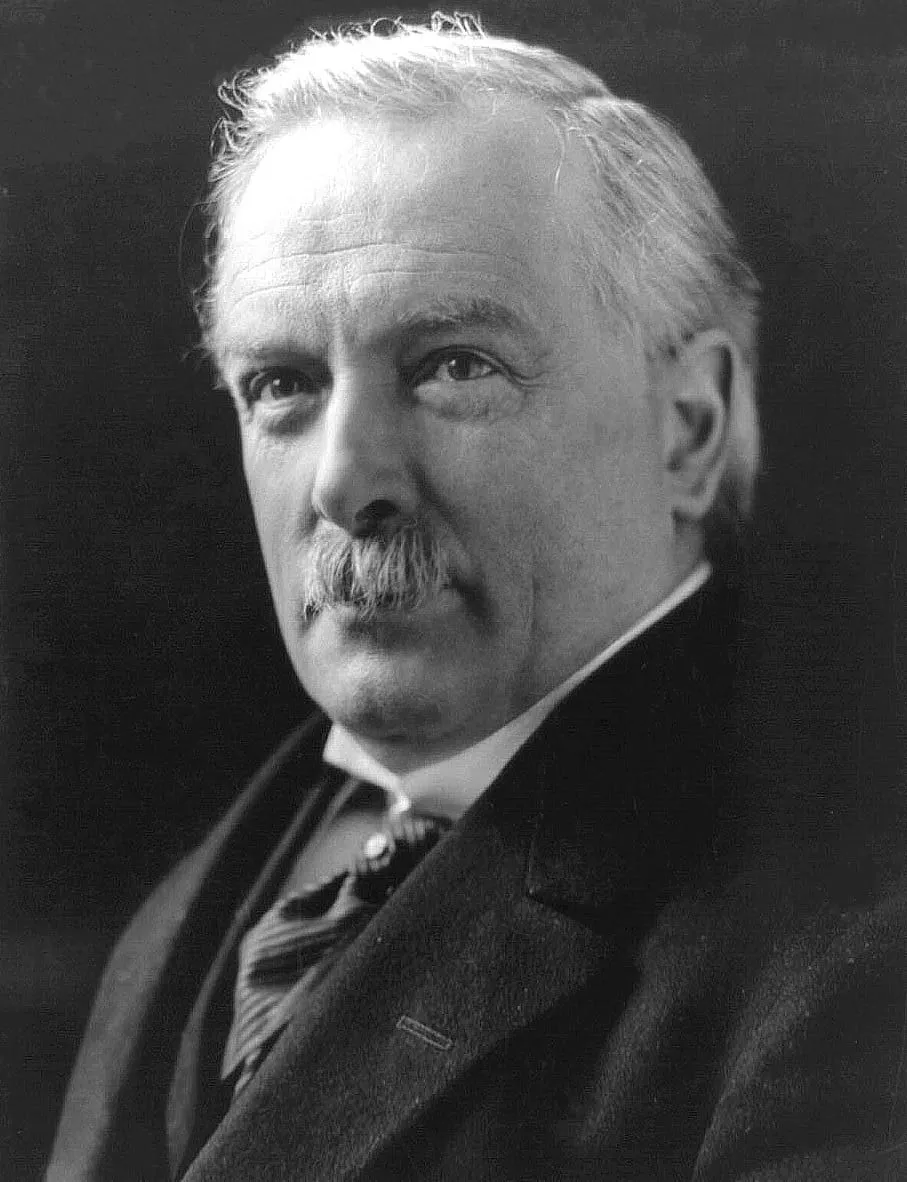
At about 7.30 p.m. on 7 December 1916 David Lloyd George presented himself to King George V and accepted the office of Prime Minister of the United Kingdom. Two days earlier Herbert Henry Asquith had resigned, and Lloyd George was asked to form a government on the evening of 6 December, which is why some studies date his premiership from that day. Forming the cabinet took him a little over a day. He managed it even though almost all the leading Liberals sided with Asquith, and Asquith himself was convinced that his rival would fail.
The conference at the palace
After Asquith’s resignation the King first asked the Conservative leader Andrew Bonar Law to form a government. Law believed that without Asquith he could not form a lasting government, and Asquith did not want to serve under him. On the afternoon of 6 December George V called a conference at Buckingham Palace, attended by Asquith, Lloyd George, Law, Arthur Balfour and the leader of the Labour Party, Arthur Henderson. The King hoped for a compromise, but the conference did not produce one. Asquith, after consulting his Liberal colleagues, finally refused to join a Law government, and Law handed back his commission. In the evening, at about 7 p.m., the King sent for Lloyd George.
Twenty-four hours
Lloyd George needed three pillars: the Conservatives, Labour and at least part of the Liberals. The decisive factor proved to be the position of Balfour, a former prime minister and until then First Lord of the Admiralty, who agreed to take the Foreign Office. The leading Conservative ministers also agreed to join the government: Lord Curzon, Austen Chamberlain and Lord Robert Cecil, who as early as 5 December had announced that they would join a stable Lloyd George government. The Conservatives obtained an assurance that General Douglas Haig would remain commander-in-chief of the British forces in France. Winston Churchill, whom many of them blamed for the Dardanelles disaster, remained outside the government for the time being.
On 7 December Lloyd George met the Labour MPs and the party’s national executive. Only a week earlier Henderson had called Asquith indispensable, but the new prime minister had a great deal to offer Labour. He promised to create ministries of labour and of pensions headed by Labour men, state control of the coal mines and a place for Henderson in the small body directing the war. Labour agreed by a narrow majority. According to Lloyd George’s memoirs it was decided by a single vote; historians rather suppose it was several.
The Liberals were the hardest. Asquith kept the party leadership and almost all its leading politicians. Christopher Addison, however, canvassed MPs on Lloyd George’s behalf. By his count 49 Liberal members were ready to support Lloyd George unconditionally, and another 126 promised support if he became prime minister, together clearly more than half of the roughly 260 Liberals in the House of Commons. In the evening Lloyd George drove to the palace. According to some historians, during this audience he agreed, perhaps under the King’s influence, that Edward Carson should take the Admiralty rather than join the government’s inner body, as had been announced earlier.
A small War Cabinet
The most important change was the way the war was directed. Instead of a cabinet of twenty-odd members and the War Committee subordinate to it, over which Asquith and Lloyd George had quarrelled, the war was to be directed by a five-member War Cabinet headed by the prime minister. It comprised three Conservatives, Curzon, Bonar Law as Chancellor of the Exchequer and Leader of the House of Commons, and Lord Alfred Milner as minister without portfolio, as well as Henderson. Apart from Law none of them headed a ministry, so that they could devote all their time to the war. The War Cabinet met for the first time as early as 9 December, and its secretary was Maurice Hankey, until then secretary of the War Committee. The make-up of the whole coalition government was announced over the following days.
Who the new prime minister was
Lloyd George was 53. He was born in 1863 in Manchester to a Welsh family, and after his father’s death he grew up in the modest home of his uncle, a shoemaker and lay preacher, in the village of Llanystumdwy in North Wales. He was the first Welshman to become prime minister. As a radical Liberal and Chancellor of the Exchequer from 1908 to 1915 he pushed through the famous “People’s Budget” of 1909 and the National Insurance Act of 1911. In 1915 he took charge of the new Ministry of Munitions and won fame as the man who gave the army its shells. In July 1916 he succeeded Kitchener at the War Office, and in September he declared in an interview that Britain would fight to a knockout.
He was a brilliant speaker, a hard-working and impatient organiser, willing to bring in experts from outside politics and the civil service. He was also marked out by close, though not always acknowledged, contacts with the press, especially with Lord Northcliffe, owner of The Times and the Daily Mail. Many Conservatives and generals regarded him as unpredictable, and to the Liberals loyal to Asquith he was simply a usurper.
A prime minister without a party
The new prime minister found himself in an unusual position. He was not the leader of any party, because Asquith remained at the head of the Liberals. On 8 December a meeting of Liberal MPs and peers at the Reform Club confirmed his leadership by acclamation, and Asquith spoke there of a “well-organised conspiracy”. Lloyd George therefore governed thanks to the support of the Conservative Party, Labour and the part of the Liberals that followed him. The split in the Liberal Party proved lasting: the Liberals never again formed a government on their own.
Lloyd George also concentrated more power in his own hands than his predecessors. The War Cabinet met almost daily, and Hankey’s secretariat for the first time in history kept minutes of cabinet meetings and saw that decisions were carried out. The prime minister also created a personal team of advisers at Downing Street. His supporters saw in this a modern way of running the state in wartime; his critics, an almost presidential style.
“The man who won the war”
British public opinion and the Allies for the most part greeted the change with hope that the war would be waged more energetically. Lloyd George, however, failed to bring the generals under his control. Bound by the promise given to the Conservatives and mindful of the press, which backed Haig and the Chief of the Imperial General Staff, General William Robertson, he spent the following months in disputes with them over strategy, and he was unable to prevent the great sacrifices of 1917, above all the Battle of Passchendaele. He did, however, push through state control of shipping, among other things, and pressed the admirals to introduce convoys, which in 1917 helped to defeat the German submarine campaign.
After the victory of 1918 he was hailed as “the man who won the war”. His supporters stressed that it was precisely the change of December 1916 that gave Britain a leadership capable of mobilising all the resources of the state. His opponents, above all the Liberals loyal to Asquith, never forgave him for the way he had come to power.
Remember the articles you have read? Only in this browser; nothing is sent anywhere.How it works
Read ·
A voice from the front
“L. G. arrived an hour late. He looked tired and worn. […] As he left I wished him good luck. He replied, "I shall do my best. The belief of these fellows that I shall fail will be an additional incentive!" He would eat no dinner beyond a plate of soup.”
Spotted a mistake?Report an error
Meanwhile
(03)Elsewhere in the same days.
- 6 December 1916 · Balkan FrontFall of BucharestOn 6 December 1916 Falkenhayn's and Mackensen's troops entered Bucharest unopposed. Ploiești fell the same day, and the cut-off Cerna Group laid down its arms.
- 5 December 1916 · Balkan FrontEnd of the Battle of the ArgeșOn 5 December 1916 King Ferdinand approved a general retreat east. The Romanians declared Bucharest an open city and chose to give it up without a fight.
- 4 December 1916 · War at seaJellicoe becomes First Sea LordIn early December 1916 John Jellicoe replaced Henry Jackson at the head of the Royal Navy and set up an anti-submarine division at the Admiralty.
Related events
(04)The same battle, people or subject.
- 5 December 1916 · PoliticsResignation of AsquithIn early December 1916 a dispute over the War Committee brought down Asquith's government. Beaten by Lloyd George and the Tories, he resigned on 5 December.
- 9 December 1916 · PoliticsThe War CabinetOn 9 December 1916 Lloyd George's five-man War Cabinet met. It replaced Asquith's War Committee and was the first cabinet to keep minutes.
- 11 December 1916 · PoliticsLloyd George's coalition governmentOn 11 December 1916 the press published Lloyd George's government. Grey left the Foreign Office for Balfour, Derby took the War Office and Carson the Admiralty.
- 20 March 1917 · PoliticsFirst meeting of the Imperial War CabinetOn 20 March 1917 the Dominion premiers and India's representatives sat in London with the British War Cabinet. The Imperial War Conference began next day.