United Kingdom · The Entente
Edward Carson
Leader of the Irish Unionists (1910–1921), Attorney General (1915), First Lord of the Admiralty (1916–1917), minister without portfolio in the War Cabinet (1917–1918)
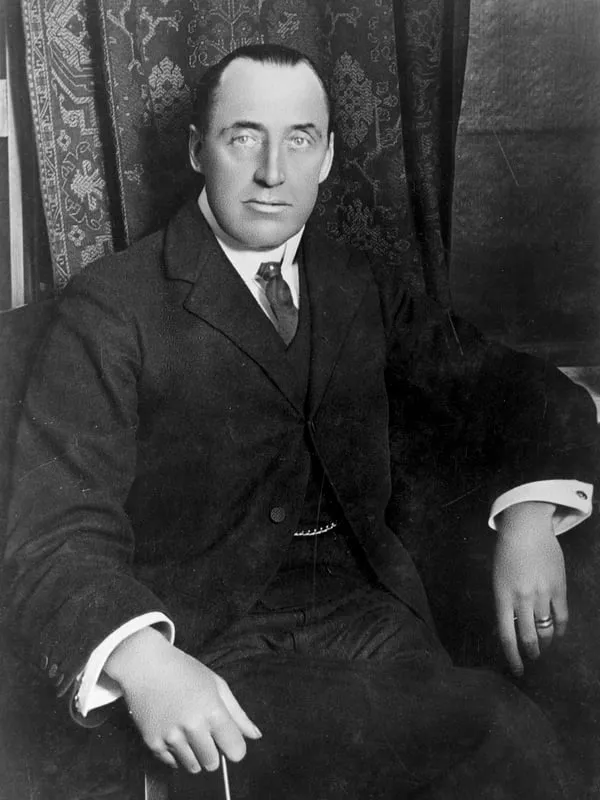
- Born:
- 9 February 1854, Dublin (Ireland)
- Died:
- 22 October 1935, Minster (Kent, England)
- Author:
- Łukasz Skowroń
- Photo:
- J. Beagles & Co., Ltd, domena publiczna, Wikimedia Commons

Edward Carson, a Dublin barrister and leader of the Irish Unionists, entered the war as a man who only a few weeks earlier had headed an armed resistance movement against his own government. The Ulster Volunteers he had organised to fight Irish home rule became in 1914 the 36th (Ulster) Division of the British Army. Carson himself was in turn Attorney General in the coalition government, leader of the unofficial opposition, one of the three politicians who in December 1916 removed H. H. Asquith from power, First Lord of the Admiralty in the darkest months of the submarine war, and a member of the War Cabinet. Yet the cause of Ulster always remained the most important thing for him, and twice it led him out of government.
Before the war
He was born on 9 February 1854 in Dublin, into the prosperous Anglican family of an architect. He read law at Trinity College and quickly gained a reputation as one of the most formidable barristers in Ireland, a master of cross-examination. In 1892 he became Solicitor General for Ireland and member of parliament for Dublin University, which he represented until 1918. From 1893 he practised mainly in London. In 1895, acting for the Marquess of Queensberry, his cross-examination of Oscar Wilde destroyed the libel action the writer had brought, which led to Wilde’s own trial and imprisonment. From 1900 to 1905 he was Solicitor General for England and Wales.
In 1910 he became leader of the Irish Unionists, the opponents of home rule, that is, Irish self-government with a parliament in Dublin. He was not an Ulsterman by birth and wanted to save the Union for the whole island, but his strongest support turned out to be the Protestants of the north. On 28 September 1912 he was the first to sign the Ulster Covenant, whose signatories swore to use “all means which may be found necessary” to defeat home rule. In January 1913 the Ulster Volunteer Force was founded, and in April 1914 some 25,000 rifles bought in Germany were smuggled in for it through Larne. The Unionists also prepared a provisional government of Ulster, which was to take power on the day the act came into force. Carson won the loyal backing of the Conservative leader Andrew Bonar Law. When negotiations on excluding part of Ulster from home rule stalled, and the Irish Volunteers were formed in response to the Unionists’ arming, Ireland in the summer of 1914 stood on the brink of civil war. In July Carson took part in the Buckingham Palace conference called by King George V, which brought no agreement.
The Ulstermen go to war
The outbreak of war in Europe pushed the crisis aside. Carson announced that the Ulster Volunteers would fight for the Empire, and in September 1914 he agreed with Lord Kitchener that they would form a division of their own. So was born the 36th (Ulster) Division, which on 1 July 1916, the first day of the Battle of the Somme, broke deep into the German lines at Thiepval and in two days lost more than 5,000 men. Its sacrifice became for the Unionists proof of Ulster’s loyalty and an argument in the later dispute over its future. He could not, however, prevent the Home Rule Act from reaching the statute book in September 1914, with its operation suspended until the end of the war and a promise of separate provision for Ulster.
Attorney General and opposition leader
In May 1915, when Asquith’s coalition government was formed, Carson became Attorney General with a seat in the cabinet. He lasted there less than five months. In the autumn of 1915, when Bulgaria entered the war and the Serbian army found itself encircled, he demanded immediate and strong help for the Serbs. He concluded that the cabinet was failing an ally, and on 19 October left the government. Since all the major parties sat in the coalition, Carson became the de facto leader of the opposition in the House of Commons, and from early 1916 he chaired the Unionist War Committee, which brought together Conservative MPs outside the government. He called for a more vigorous conduct of the war and for general conscription. In May 1916, at the Unionists’ request, he moved a motion on the conscription of married men.
After the Easter Rising Asquith entrusted Lloyd George with negotiations with Carson and the leader of the Irish Nationalists, John Redmond. Lloyd George proposed the immediate introduction of home rule with the six counties of Ulster excluded. Carson, persuaded by private assurances that the exclusion would be permanent, in June 1916 induced the Ulster Unionist Council to accept the plan, although it meant abandoning the Unionists of the province’s other three counties and of the south of the island. Redmond, on the other hand, was convinced that the exclusion was to be temporary. The plan collapsed in July in the face of opposition from Conservative ministers, and both sides felt deceived.
The December coup
In the autumn of 1916 Carson was the government’s sharpest critic. On 8 November, in a debate on the sale of seized German firms in Nigeria, he attacked the Colonial Secretary, Bonar Law, and carried a large part of the Conservative backbenchers with him. This show of strength convinced Law that he had to act. On 20 November Carson, Law and Lloyd George met at the Hyde Park Hotel and agreed that the war should be directed by a small council headed by Lloyd George. Unlike Law, Carson wanted to be rid of Asquith altogether. He also helped the editor of The Times, Geoffrey Dawson, with the article of 4 December that ridiculed the prime minister and contributed to the breakdown of the compromise. On 5 December Asquith resigned.
First Lord of the Admiralty
Lloyd George wanted Carson in the War Cabinet, but the Conservative ministers objected, and in December 1916 Carson took over the Admiralty in the new government. He had no experience of running a great department and decided to trust the professionals. Admiral John Jellicoe had been First Sea Lord for a few days, and Carson declared that as long as he headed the Admiralty, the sailors would have a free hand. He defended the admirals against politicians and the press, and answered in the House of Commons for losses, for example after the night-time bombardment of Margate and Broadstairs in February 1917.
His tenure coincided with the beginning of unrestricted submarine warfare. From February 1917 shipping losses rose sharply, and in April they reached a record level. The Admiralty long rejected convoys as too risky, and only under pressure from the prime minister and some younger officers, and after the United States entered the war, did it begin to introduce them in the spring of 1917. Carson backed the change once his admirals had come round to it, but Lloyd George judged that he had lacked initiative. Field Marshal Douglas Haig considered him a poor administrator. In July 1917 the prime minister moved him to the War Cabinet and gave the Admiralty to Eric Geddes. Carson accepted the promotion but felt slighted. When in December Geddes dismissed Jellicoe, he publicly defended the admiral.
The War Cabinet and the second departure
As minister without portfolio Carson oversaw British propaganda in the second half of 1917, from which the Ministry of Information soon grew. He was among the opponents of British socialists taking part in the Stockholm conference, and he was sceptical of plans for a league of nations, recalling that all the great powers had guaranteed Belgium’s neutrality and that the guarantee had failed.
Meanwhile the Irish Convention was sitting in Dublin, called by Lloyd George in 1917 so that the Irish could agree among themselves on the island’s future constitution. When a compromise covering the whole of Ireland began to look likely, favoured by some of the Unionists from the south of the island, Carson decided that his commitments to Ulster did not allow him to take part in such decisions. In a letter to the prime minister he wrote that the cabinet should settle Irish matters without him, and in January 1918 he left the government. He nevertheless remained loyal to Lloyd George. During the debate on General Maurice’s letter on 9 May 1918 he urged MPs that it was better to support the government than to bring it down.
After the war
In the December 1918 election Carson exchanged his Dublin seat for the Belfast constituency of Duncairn. When in 1920 the government introduced the bill partitioning Ireland, he advised the Unionists to accept home rule for six counties, a solution he had once rejected. Thus Northern Ireland came into being. In February 1921 he handed the party leadership to James Craig, who became the first prime minister of the new province, and he himself became a Lord of Appeal in Ordinary in the House of Lords as Baron Carson. In December 1921 he fiercely attacked the Anglo-Irish Treaty, saying that he himself, Ulster and Ireland had been mere puppets in the Conservatives’ game for power. In 1929 he retired. He died on 22 October 1935 at his home, Cleve Court, in Kent. After a state funeral he was buried in St Anne’s Cathedral in Belfast, the only person interred there.
Assessment
Carson remains one of the most contested figures in Irish history. For Unionists he is the founding father of Northern Ireland and the defender of the Protestants’ right to remain in the United Kingdom. For Nationalists he is the man who before 1914 first brought armed formations and the threat of violence into Irish politics, and thereby indirectly prepared the ground for the Easter Rising and the partition of the island. His biographer Geoffrey Lewis called him “the man who divided Ireland”, while stressing that Carson himself did not want partition and to the end of his life regarded himself as an Irishman.
Historians assess his wartime career with reserve. In 1915–1916 he was one of the most influential men in the House of Commons and played a great part in the overthrow of Asquith. As head of the Admiralty, however, he proved an ineffective administrator, too passive towards the admirals at a time when the submarine war threatened Britain. Some scholars point out that his trust in the professionals and his loyalty to Jellicoe also had their good sides. They agree, however, that by 1918 Carson was on the margins of British politics rather than at its centre, and that his place in history was defined by the cause of Ulster, not by the war.
Sources
Spotted a mistake?Report an error
Often appears with
People who appear in the same events.