United Kingdom · The Entente
Andrew Bonar Law
Leader of the Conservative Party (1911–1921), Secretary of State for the Colonies (1915–1916), Chancellor of the Exchequer (1916–1919), Prime Minister of the United Kingdom (1922–1923)
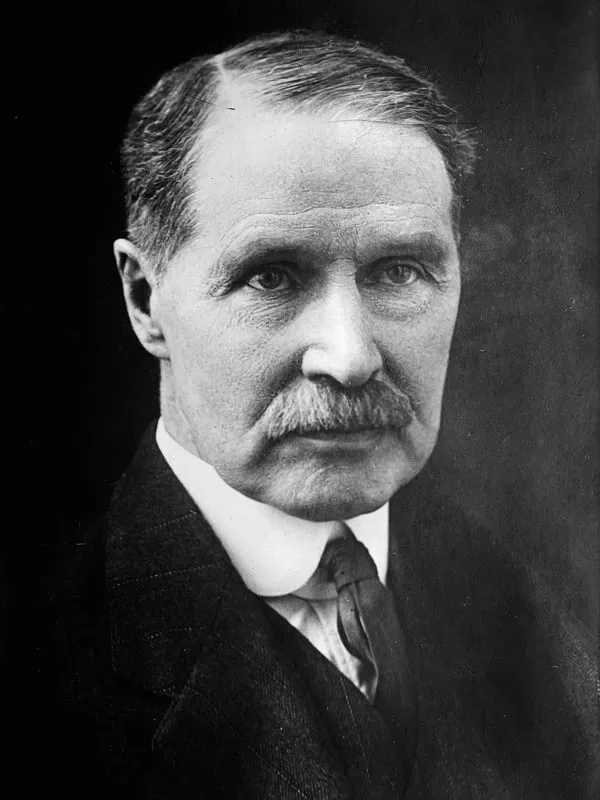
- Born:
- 16 September 1858, Kingston, now Rexton (New Brunswick, Canada)
- Died:
- 30 October 1923, London
- Author:
- Łukasz Skowroń
- Photo:
- Bain News Service, domena publiczna, Wikimedia Commons

Andrew Bonar Law led the British Conservatives throughout the war and was one of the three men on whom it depended who governed Britain. Canadian by birth, a Scottish iron merchant by profession and a Presbyterian by faith, he did not fit a party of landowners and the Church of England, yet he kept it in line through the years of the wartime party truce. In May 1915 he brought the Conservatives into the coalition government of Herbert Henry Asquith, in December 1916 he decided his fall, and then, instead of becoming Prime Minister himself, he handed power to David Lloyd George. As Chancellor of the Exchequer and Leader of the House of Commons he was the second man in the government until the end of the war: he looked after the finances, Parliament and the loyalty of his own party while the Prime Minister ran the war.
Before the war
He was born on 16 September 1858 in the settlement of Kingston (today Rexton) in New Brunswick, then still a separate British colony. He was the son of a Free Church of Scotland minister who came from Ulster and returned there towards the end of his life. His mother died when he was a small child. At the age of twelve he went to live with her relatives, the wealthy Kidstons, in Helensburgh near Glasgow. He left school at sixteen to work in the family bank, and later, thanks to a loan from the Kidstons, became a partner and the de facto manager of an iron-trading firm. Before he was thirty he was a wealthy man. A teetotaller and a very good chess player, he was famous for his exceptional memory.
He entered the House of Commons in 1900 for a Glasgow constituency, and in 1902 became Parliamentary Secretary to the Board of Trade. He stood out in Joseph Chamberlain’s campaign for protective tariffs. When Arthur Balfour stepped down as party leader in November 1911, the two favourites, Walter Long and Austen Chamberlain, withdrew so as not to split it in a close vote, and on 13 November the MPs unanimously elected Law, who had never sat in the Cabinet.
The new leader brought a sharp, aggressive style into politics. His main theme became the fight against home rule, that is, autonomy for Ireland. Together with the Ulster Unionist leader Edward Carson he sided with the Ulster Protestants, who threatened armed resistance. On 27 July 1912, at a rally at Blenheim Palace, he declared that he could imagine no length of resistance by Ulster that he would not support. Critics, then and later, accused Law of playing with civil war. His defenders stress that above all he wanted to force the Liberals into an election on home rule. In July 1914 he took part in the Buckingham Palace conference called by King George V, which failed to agree on the boundaries of an excluded Ulster.
The party truce
The outbreak of war interrupted the dispute. On 2 August 1914 Law and Lord Lansdowne assured Asquith by letter that any hesitation in supporting France and Russia would be fatal to the honour and security of the country, and that the Conservatives would support the government. When in September Asquith put the Home Rule Bill on the statute book, albeit with its operation suspended until the end of the war, Law protested in the House of Commons and then led the whole Conservative party out of the chamber.
Over the following months he struggled to restrain his own MPs, who wanted to attack the government over the shortage of munitions and the incompetence of ministers. In May 1915, after the resignation of Lord Fisher, he decided he could hold them back no longer. On 17 May he went to Lloyd George, and a quarter of an hour’s talk with Asquith was enough for the Liberal government to give way to a coalition. Asquith played the negotiations skilfully, and the Conservative leader got only the Colonial Office, a secondary department in wartime. Law accepted it so as not to endanger the coalition.
In Asquith’s government
As Colonial Secretary he sat on the Dardanelles Committee and, from November 1915, on the War Committee. He was sceptical about sending more divisions to Gallipoli, and in the autumn of 1915 he was among the firmest advocates of evacuating the peninsula. According to his biographer Robert Blake, he even threatened to resign if the Cabinet went on delaying. On 7 December 1915 the decision was taken to abandon Suvla and Anzac. In January 1916 Law steered the conscription bill through committee in the House of Commons and rejected an amendment by the Ulster Unionists, who wanted it extended to Ireland, arguing that more would be lost than gained by it. In June 1916 he represented Britain at the Allies’ Paris Economic Conference.
After the Easter Rising Asquith instructed Lloyd George to negotiate with Carson and John Redmond the immediate introduction of home rule with the six counties of Ulster excluded. Law was ready to accept the plan, but in July 1916 it was killed off by other Conservative ministers, above all Lansdowne and Long. When Lord Kitchener was killed in June, Law could have sought the War Office for himself, but according to the account of his friend Max Aitken he backed Lloyd George’s candidacy with the Prime Minister. It was the beginning of an alliance that was to last until the end of the war.
December 1916
In the autumn of 1916 Law found himself in a difficult position. He still esteemed Asquith and had long distrusted Lloyd George, but he was losing control of his party. On 8 November, in a debate on the sale of seized German firms in Nigeria, Carson attacked him as Colonial Secretary, and a large part of the Conservative MPs voted with Carson. On 20 November Law, Lloyd George and Carson agreed that the war should be directed by a small council chaired by Lloyd George, with Asquith remaining Prime Minister. Law put this plan to Asquith, and on 3 December he took him a resolution of the Conservative ministers demanding a reconstruction of the government. He conveyed it ambiguously, however, and to this day it is disputed whether his colleagues wanted to strengthen Lloyd George or to get rid of him. When Asquith broke off the negotiated compromise, Law sided with Lloyd George and on 5 December the Prime Minister resigned.
That same evening the King invited Law to form a government. Law believed he could not build a lasting Cabinet without Asquith, and Asquith would not serve under him. On 6 December he therefore handed the commission to Lloyd George, who became Prime Minister the next day.
Chancellor of the Exchequer
In the new government Law became Chancellor of the Exchequer, Leader of the House of Commons and a member of the five-man War Cabinet. Lloyd George said that one member of the Cabinet would “stand sentry outside”, defending him in Parliament, and that is exactly what Law did. Their partnership proved one of the most durable double acts in British politics: the impetuous Prime Minister threw out ideas, and the cautious Law checked whether they were workable.
At the Treasury Law had to finance a war that was swallowing millions of pounds a day. In January 1917 he announced the third war loan, at 5 per cent interest, so high that Lloyd George called the rate “penal”. The loan raised over two billion pounds, although mostly through the conversion of earlier bonds, and new money amounted to about 845 million. The excess profits duty rose to 80 per cent in 1917, and income tax was raised too.
As the government’s voice in the House of Commons, Law spoke on many matters of the war. In March 1917 he moved a resolution sending greetings to the Russian Duma after the overthrow of the Tsar, in April he gave assurances that Britain would support an independent and united Poland, and in August he announced that British socialists would not be given passports for the conference in Stockholm. He also sat in the Imperial War Cabinet. On strategy he was more cautious than the Prime Minister. In Lloyd George’s quarrels with the generals, especially in February 1918, when the fate of the Chief of the Imperial General Staff William Robertson hung in the balance, he hesitated for a long time before backing his removal.
The war touched him personally. In April 1917 his son Charles was killed in the Second Battle of Gaza, and in September the aircraft of his eldest son, James, a Royal Flying Corps pilot, was shot down over the Western Front. Law, who was regarded as a melancholic anyway, never fully recovered from these losses.
The Maurice crisis and the election
He faced his hardest test in the spring of 1918. On 23 April, after the defeat of the Fifth Army in the German March offensive, Law assured the House of Commons that the extension of the British front to the south before the attack had been arranged solely by the military commanders. On 7 May General Frederick Maurice, the former Director of Military Operations, accused him and Lloyd George, in a letter to the press, of misleading Parliament. Law proposed that the matter be examined by a “court of honour” of two judges, but Asquith rejected the idea and demanded a parliamentary select committee. In the debate on 9 May the government won the vote by a huge majority, and the split of the Liberals into supporters of Asquith and of Lloyd George became irreversible.
In April 1918 Law wound up the debate on the bill extending conscription, to Ireland as well, and in the summer, together with Lloyd George, he prepared the coalition’s joint campaign in the election. Candidates who supported it received a letter of endorsement signed by both leaders, mockingly called the “coupon”. In the election of 14 December 1918 the coalition won a crushing victory, but within it the most seats were won by Law’s Conservatives. He himself returned to Parliament for a Glasgow constituency.
After the war
In January 1919 he gave up the Treasury, became Lord Privy Seal and remained Leader of the House of Commons. He was a member of the British delegation in Paris and signed the Treaty of Versailles. In March 1921 he resigned all his posts because of ill health. He returned in the autumn of 1922, when the Conservatives, at a meeting at the Carlton Club, decided to break the coalition with Lloyd George. On 23 October 1922 he became Prime Minister and won the election, but as early as May 1923 he was diagnosed with incurable cancer of the throat. He resigned on 20 May after less than seven months in office, the shortest premiership of the 20th century. He died in London on 30 October 1923. His ashes were laid in Westminster Abbey. Asquith remarked spitefully at the time that they had buried “the Unknown Prime Minister” by the side of the Unknown Soldier.
Assessment
Law long remained in the shadow of the more colourful figures of the era, as reflected in the title of the classic biography by Robert Blake, “The Unknown Prime Minister”. Historians rate him more highly today than his contemporaries did. They stress that during the war he was the chief guarantor of stability in British politics: he kept united a party that could have broken into factions, twice agreed to a coalition on terms unfavourable to himself, and at the crucial moment gave up the premiership in favour of a man he considered better fitted to wage the war. Without his support Lloyd George’s government would neither have come into being nor survived.
Critics point to his role before the war. His radical support for Ulster’s resistance in 1912–1914 weakened the authority of Parliament, encouraged both sides of the Irish dispute to arm, and to some extent paved the way for the events that led to the Easter Rising and the partition of the island. He is also accused of lacking a vision of his own: during the war he more often restrained and checked than set the direction. Most scholars agree, however, that precisely this role, less spectacular than that of Prime Minister or War Secretary, was indispensable for Britain in 1916–1918.
Sources
Spotted a mistake?Report an error
Often appears with
People who appear in the same events.