United Kingdom · The Entente
George Curzon
Lord Privy Seal (1915–1916), Lord President of the Council and member of the War Cabinet (1916–1919), Foreign Secretary (1919–1924)
- Born:
- 11 January 1859, Kedleston Hall (Derbyshire, England)
- Died:
- 20 March 1925, London
- Author:
- Natalia
- Photo:
- George Grantham Bain Collection (Library of Congress), domena publiczna, Wikimedia Commons

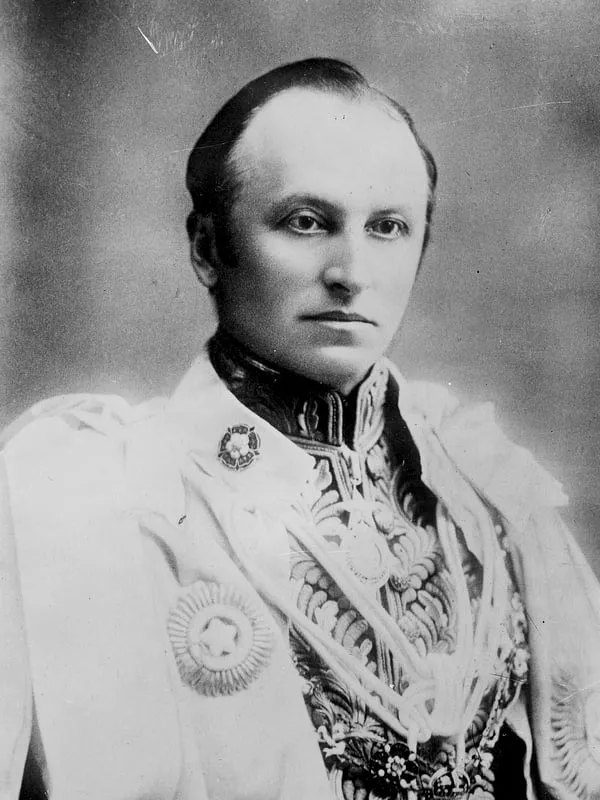
George Nathaniel Curzon, Earl from 1911 and from 1921 Marquess Curzon of Kedleston, was one of the ablest and most disliked British politicians of his age. Before the war he made his name as Viceroy of India; the war brought him back to high politics after ten years on the sidelines. From May 1915 he sat in the coalition government, and from December 1916 he was one of the five members of the War Cabinet that directed the Empire’s war effort until victory. He led the House of Lords and chaired committees on everything from shipping to aviation and the affairs of the Middle East. After the war, as Foreign Secretary, he signed the note of 11 July 1920 through which his name entered Polish history for good as the name of Poland’s eastern border.
Before the war
He was born on 11 January 1859 at the family seat of Kedleston Hall (PL) in Derbyshire, the eldest son of Baron Scarsdale. He was educated at Eton College and at Balliol College, Oxford, where students composed a spiteful rhyme about him, presenting him as “a most superior person”. The label of an arrogant man stuck to him for the rest of his life. In 1886 he entered the House of Commons as a Conservative. In the following years he travelled widely in Central Asia, Persia and the Far East and published substantial books on these countries. In 1891–1892 he was Under-Secretary of State for India, and in 1895–1898 Under-Secretary at the Foreign Office.
In 1898, not yet forty, he was appointed Viceroy of India and took up office at the beginning of 1899. He ruled energetically and on a grand scale: in 1903–1904 he sent Francis Younghusband’s expedition to Lhasa, he staged a great coronation durbar in Delhi, and he had the Taj Mahal restored. His most fateful decision was the partition of Bengal in 1905, which inflamed the Indian national movement and was reversed in 1911. He was also criticised for his response to the famine that killed millions during his rule. His term was cut short by a dispute with the Commander-in-Chief in India, Lord Herbert Kitchener, over control of military affairs. The government in London did not back the Viceroy, and in August 1905 Curzon resigned.
He spent the next ten years on the margins of politics. In 1906 his wife, the American Mary Leiter, with whom he had three daughters, died. In 1907 he became Chancellor of the University of Oxford, in 1908 he entered the House of Lords as an Irish representative peer, and in 1911 he was created an earl. In the House of Lords he led the opponents of votes for women.
In Asquith’s government (1915–1916)
When in May 1915 Herbert Henry Asquith took the Conservatives into a coalition government, Curzon became Lord Privy Seal, an office without a department of its own. He joined the Dardanelles Committee and defended government policy in the House of Lords. On 2 July 1915 he introduced the Munitions of War Act to the peers, calling it “a kind of tripartite treaty between the Government, the employers and the employed”.
As a former viceroy he saw the war through the eyes of a man of the East. He supported the expedition to Mesopotamia, believing that British prestige in the region would deter a German-inspired Muslim rising in India. For the same reason he feared a retreat from Gallipoli. When in November 1915 the War Committee came out in favour of evacuating the peninsula, Curzon asked for time to write a memorandum in which he warned of panic on the beaches at night and “hecatombs of slain”. The cabinet hesitated for several more weeks before it ordered the evacuation. His fears proved unfounded: the evacuation of Gallipoli was carried out almost without loss.
Having no ministry of his own, he was given one committee after another by Asquith. On 27 January 1916 Curzon took the chair of the Shipping Control Committee, which divided the scarce tonnage between the needs of the country, the armed forces and the allies. In May 1916 he became president of the Air Board, which was meant to reconcile the rival Royal Flying Corps and naval air service. In a memorandum he even considered creating an air ministry and an independent air force, but the board was given no executive powers and soon fell into conflict with the Admiralty. His ideas were realised only after he had left the board: in January 1918 an air ministry was created, and in April the Royal Air Force. In July 1916 Curzon became a permanent member of the War Committee, then the most important body directing the war.
The War Cabinet (1916–1919)
In the government crisis at the turn of November and December 1916 Curzon was one of the three most important Conservative ministers, together with Austen Chamberlain and Lord Robert Cecil. All three at first received the plan of David Lloyd George very critically, but on 5 December they told Asquith that they would not join a government without Andrew Bonar Law and Lloyd George. In this way they contributed to the Prime Minister’s resignation. When Lloyd George became Prime Minister, Curzon agreed to join his government.
The new Prime Minister replaced the large cabinet with a five-man War Cabinet. Curzon sat in it as Lord President of the Council and Leader of the House of Lords, alongside Law, Lord Alfred Milner and the Labour leader Arthur Henderson. He was one of the few members who sat in the cabinet for the whole of its existence, until October 1919. He headed no ministry, so that he could give all his time to the war. In January 1917 he married for the second time, Grace Duggan, the widow of the Argentine Alfred Duggan.
In the War Cabinet he dealt above all with the East. He chaired the committee on the administration of Mesopotamia, and in the Imperial War Cabinet in the spring of 1917 he led the sub-committee that drew up the Empire’s territorial peace aims. In May 1917 he argued that Britain should take Palestine and perhaps Syria. He had reservations, however, about the draft declaration on a Jewish national home: in a memorandum of 26 October 1917 he asked what the term meant and what would become of the country’s Arab inhabitants. His doubts and those of Edwin Montagu led to the text of the Balfour Declaration being toned down.
On strategy in the west he usually sided with the soldiers. In 1917 he supported further offensives in France, fearing that otherwise France or Italy would make a separate peace, though his support wavered as losses mounted at Ypres. The Chief of the Imperial General Staff, William Robertson, called him a “gasbag” in private letters, but in February 1918 Curzon was one of the few ministers who defended him. Even so, he did not prevent Robertson’s dismissal.
The war also confronted him with a cause he had defended for years. As president of the National League for Opposing Woman Suffrage he could have led the peers against the act giving British women the vote. On 10 January 1918, however, he declared that he would vote neither for striking out the clause on women nor against it, because the House of Commons would restore it anyway and the House of Lords would lose the dispute. The opponents of votes for women lost the division. After the armistice Curzon helped organise the victory celebrations and the ceremonies in honour of the fallen.
After the war
When at the beginning of 1919 Arthur Balfour left for the peace conference in Paris, Curzon ran the Foreign Office in his place, and on 23 October 1919 he formally became Foreign Secretary. His relations with Lloyd George were bad: the Prime Minister conducted foreign policy on his own account, and Curzon felt sidelined.
For Poland the decisive moment came in July 1920. During Tukhachevsky’s offensive the Prime Minister Władysław Grabski asked the powers at the Spa conference (PL) to mediate and agreed to withdraw his troops to the line laid down by the Supreme Council in December 1919. In the night of 10–11 July a note signed with Curzon’s name was sent to the Soviet Commissar for Foreign Affairs, Georgy Chicherin, proposing an armistice on that line. At the last moment the course of the line in Eastern Galicia was altered so that Lwów and the Drohobych oil basin ended up on the Soviet side. It is still not known whether this was an agreed change, a mistake or a manipulation. Moscow rejected the proposal, and after the Polish victory the Peace of Riga fixed the border far to the east of it. According to historians, Curzon himself was not the author of the project; the main part in drawing it up was played by the Foreign Office expert Lewis Namier. The name of the Curzon Line (PL) nevertheless returned during the Second World War, when Stalin demanded it as the border, and in 1945 it became the basis of Poland’s eastern frontier.
In the autumn of 1922 Curzon, working with the French, helped avert war with Turkey in the crisis over the Straits, and in 1922–1923 he led the conference that ended with the Treaty of Lausanne, regarded as his greatest diplomatic achievement. On 6 March 1923 he dropped the demand for a separate convention on the status of Galicia, which opened the way for the Conference of Ambassadors to recognise Poland’s eastern border. In May 1923, when the ailing Bonar Law stepped down, he was certain that he would become Prime Minister. The King, however, chose Stanley Baldwin (PL), which Curzon, sure of himself, took very painfully. He left the Foreign Office in January 1924, and at the end of that year he again became Lord President of the Council. He died in London on 20 March 1925 and was buried at Kedleston beside his first wife.
Assessment
Curzon is regarded as the last great Victorian proconsul, a man of immense knowledge of Asia and exceptional industry, who was harmed by his haughtiness, his sharp tongue and his sensitivity to criticism. His colleagues valued his competence but found him hard to work with. Lloyd George thought him pompous, although they often agreed on policy. In the war his role was greater than his lack of a department suggests: he belonged to the narrow circle that from December 1916 took the decisions on the conduct of the war, and his voice carried particular weight on the Middle East and India. The Treaty of Lausanne is considered the greatest success of his career. In Poland his name is associated above all with a line that, as historians point out, he did not devise and whose fate in 1920 depended on him only to a small degree.
Sources
Spotted a mistake?Report an error
Mentioned in battles
(01)Often appears with
People who appear in the same events.