United Kingdom · The Entente
Austen Chamberlain
Secretary of State for India (1915–1917), Minister without Portfolio in the War Cabinet (1918–1919), Chancellor of the Exchequer (1919–1921), Foreign Secretary (1924–1929)
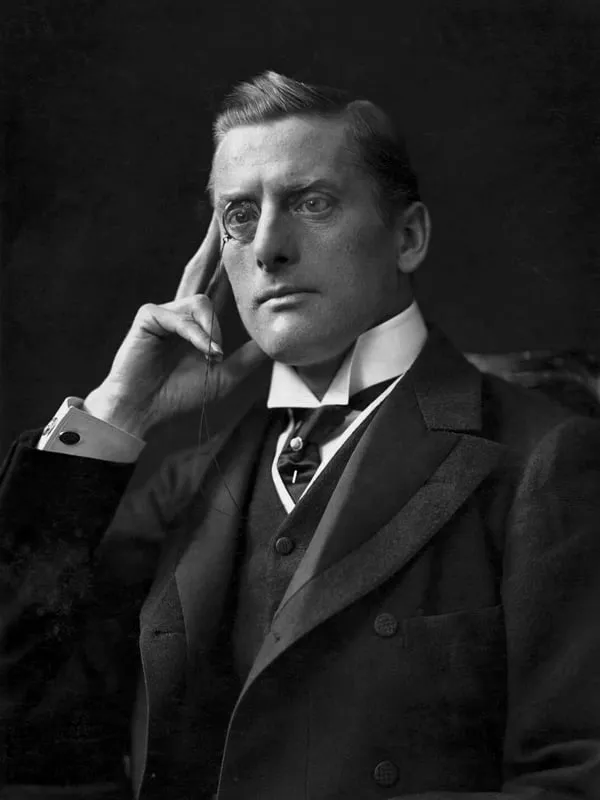
- Born:
- 16 October 1863, Birmingham (England)
- Died:
- 16 March 1937, London
- Author:
- Łukasz Skowroń
- Photo:
- Henry Walter Barnett, domena publiczna, Wikimedia Commons

Joseph Austen Chamberlain was the son of one of the most famous politicians of Victorian England and spent his whole life measuring himself against his father’s shadow. During the Great War he was among the leading Conservatives in the coalition governments. For more than two years, from May 1915 to July 1917, he was Secretary of State for India, and thus the member of the government responsible in London for the campaign in Mesopotamia, which was conducted by the army of British India. The march on Baghdad that he approved ended in surrender at Kut. When a commission of inquiry published its severe report, Chamberlain accepted responsibility and resigned. He returned to the government in April 1918 as a member of the War Cabinet. His greatest success came after the war: as Foreign Secretary he was one of the makers of the Locarno treaties and received the Nobel Peace Prize.
Before the war
He was born on 16 October 1863 in Birmingham, the eldest son of Joseph Chamberlain, manufacturer, Mayor of Birmingham, later Colonial Secretary and champion of imperial tariff protection. His younger half-brother was Neville Chamberlain, the future Prime Minister. His father prepared him for politics from the start: Austen was educated at Rugby School (PL) and Trinity College, Cambridge (PL), and then spent several months at the École des Sciences Politiques in Paris and a year in Berlin. From Germany he brought back a dislike of Prussian arrogance that stayed with him all his life. It was said of him that he did not choose a career, he accepted one.
In 1892, at the age of 29, he entered the House of Commons for East Worcestershire as a Liberal Unionist, a member of his father’s party, which had broken away from the Liberals in protest against Irish Home Rule and allied itself with the Conservatives. His maiden speech was praised by Gladstone himself. In Conservative governments he was in turn Civil Lord of the Admiralty, Financial Secretary to the Treasury and Postmaster General, and in 1903–1905, aged only 40, Chancellor of the Exchequer in the government of Arthur Balfour. The quarrel over tariffs, which split the party at the time, contributed to the fall of the government and the electoral defeat of 1906. Chamberlain nevertheless kept his seat and became one of the leaders of the Unionist opposition. In 1906 he married Ivy Dundas.
In November 1911, after Balfour stepped down, he was one of the two main candidates for the Conservative leadership. So as not to split the party, he withdrew together with his rival, Walter Long, and Andrew Bonar Law became leader. In 1912–1914 Chamberlain fought the government’s Irish Home Rule bill. In July 1914, a few days after the assassination in Sarajevo, his father died. On 14 July Austen took over his seat for Birmingham West, which he held for the rest of his life.
Secretary of State for India (1915–1917)
On 25 May 1915, when Herbert Henry Asquith took the Conservatives into a coalition government, Chamberlain took over the India Office. The office was also the link between the cabinet in London and the Government of India under the Viceroy, Lord Charles Hardinge. As he later explained in the House of Commons, on Mesopotamia the Secretary of State acted as the spokesman of the government, which reserved to itself the right to set the objects and limit the scope of the operations, but the India Office itself was not organised to conduct military operations and never attempted to do so. The war was run by the authorities in India and the general on the spot, John Nixon.
This division of responsibility weighed on the whole campaign. In June 1915, having received no answer from Chamberlain, the authorities in India assumed that London agreed and allowed Nixon to advance up the Euphrates. Chamberlain learned of the advance only on 27 June. On 6 August he agreed to the capture of Kut, but stipulated that there would be no reinforcements. After the first battle of Kut in September the road to Baghdad lay open. On 23 October the cabinet, which after the failure at the Dardanelles was looking for a striking success in the East, authorised Chamberlain to telegraph that Nixon might march on Baghdad if he considered his forces sufficient. He was promised two Indian divisions from France. As early as August Chamberlain had written to the Viceroy that he would like to withdraw the Indian infantry from the Western Front before winter, and in the autumn the Indian Corps left France. The reinforcements did not arrive in time, however. After the battle of Ctesiphon General Charles Townshend’s division fell back to Kut and from December was under siege.
Chamberlain also dealt with other Indian affairs. On 28 July 1915 he informed the House of Commons about the fighting on the North-West Frontier, including the skirmish at Hafiz Kor. At the beginning of 1916 London concluded that the Government of India was not coping with the conduct of the campaign. On 3 February the War Committee accepted the proposal of the Chief of the Imperial General Staff, William Robertson, and Chamberlain passed it on to the Viceroy the same day: the War Office took over the direction of the Mesopotamian campaign. Three relief attempts failed, and on 29 April 1916 Kut surrendered. Earlier, in April, Chamberlain had also sat on the cabinet committee which found that the army had not shown the need for general conscription. The cabinet rejected its report, and soon the House of Commons passed the conscription of married men.
The December crisis and resignation
In the crisis at the turn of November and December 1916 Chamberlain was one of the three most important Conservative ministers, together with Lord George Curzon and Lord Robert Cecil. All three at first received the plans of David Lloyd George very critically, but on 5 December they told Asquith that they would not join a government without Law and Lloyd George, which sealed the Prime Minister’s resignation. Lloyd George became Prime Minister, and Chamberlain was one of four ministers who kept their posts in the new government. In the spring of 1917 he represented India in the Imperial War Cabinet.
In August 1916 the government had set up a commission to investigate the course of the Mesopotamian expedition and the sufferings of its soldiers, especially of the wounded left without medical care. Its report, published in June 1917, severely criticised the authorities in India and Mesopotamia, found the division of responsibility between the India Office and India unworkable, and also censured the minister himself. When the House of Commons decided to refer the cases of those named in the report to a tribunal, Chamberlain concluded that he could not head an office whose conduct was to be investigated. On 12 July 1917 he told the House of Commons that his “final resignation” was in the hands of the Prime Minister. He defended himself against the charge that ministers had gambled with soldiers’ lives for political advantage: he recalled that the march on Baghdad had been recommended by the general on the spot and the Government of India, and that the cabinet had feared a conflagration that could spread from Constantinople to the very frontiers of India. Many members thought his resignation unnecessary, even chivalrous. He was succeeded at the India Office by Edwin Montagu.
The War Cabinet (1918)
Chamberlain did not stay out of the government for long. In April 1918, during the great German offensive and the changes in which Alfred Milner took over the War Office, Chamberlain joined the War Cabinet as Minister without Portfolio. He sat in it until the end of the war, and throughout 1918 he was one of the most important Conservatives in Lloyd George’s coalition.
After the war
On 10 January 1919 Chamberlain became Chancellor of the Exchequer for the second time. He had to deal with the enormous war debt and stabilise the currency. In March 1921, when the ailing Bonar Law withdrew, he became leader of the Conservatives and Leader of the House of Commons, and from April also Lord Privy Seal. In the autumn of 1921 he was one of the British negotiators of the Anglo-Irish Treaty. His loyalty to Lloyd George cost him the leadership: on 19 October 1922 Conservative MPs meeting at the Carlton Club in London decided to leave the coalition, Chamberlain stepped down, and Law became Prime Minister.
In November 1924 Stanley Baldwin gave him the Foreign Office. Chamberlain rejected the Geneva Protocol, but together with Gustav Stresemann and Aristide Briand he prepared the Locarno treaties, initialled on 16 October 1925, his birthday. They guaranteed Germany’s western borders and opened the way for Germany into the League of Nations, but gave no similar guarantees to the borders of Poland and Czechoslovakia. Chamberlain received the Order of the Garter and the Nobel Peace Prize for 1925, which he shared with the American Charles Dawes. He left the Foreign Office in June 1929, and in 1931 he was briefly First Lord of the Admiralty. In the last years of his life he was one of the few MPs who warned early about Hitler and called for rearmament. He died in London on 16 March 1937, a few weeks before Neville became Prime Minister.
Assessment
Chamberlain was a loyal, upright and hard-working politician, but in the eyes of many stiff and old-fashioned. One MP wrote that with his top hat, eyeglass and rotund oratory he seemed almost a survival of a bygone era. The historian Robert Blake called him a “thin echo” of his great father, and Winston Churchill said that Austen “always played the game and always lost it”. David Dutton defends him as a politician of stature in his own right who twice, in 1922 and 1923, came very close to the premiership. His wartime career is judged in two ways. As Secretary of State for India he bore formal responsibility for a campaign in which many decisions were taken in India without his knowledge, and the march on Baghdad itself was approved by the whole cabinet. His resignation of 1917, offered of his own accord though nobody forced it, was seen by many contemporaries as a gesture of honour. Locarno brought him fame, but in Poland it was remembered rather as a settlement that distinguished between Germany’s borders in the west, which were guaranteed, and in the east, which were not.
Sources
Spotted a mistake?Report an error
Mentioned in battles
(02)Often appears with
People who appear in the same events.