United Kingdom · The Entente
Alfred Milner
Member of the British War Cabinet (1916–1918), Secretary of State for War (1918–1919), Colonial Secretary (1919–1921)
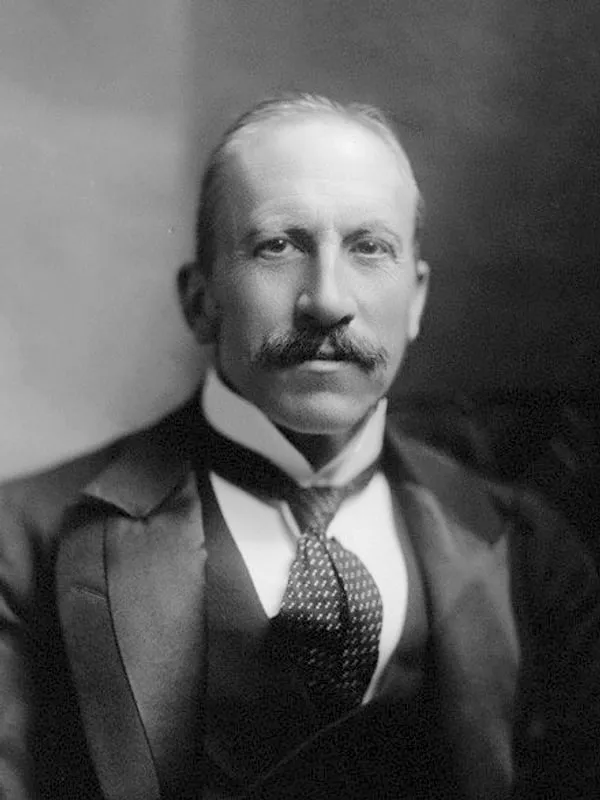
- Born:
- 23 March 1854, Giessen (Grand Duchy of Hesse)
- Died:
- 13 May 1925, Sturry Court near Canterbury
- Author:
- Natalia
- Photo:
- Henry Walter ('H. Walter') Barnett (1862-1934), domena publiczna, Wikimedia Commons

Alfred Milner, Viscount Milner, was one of the most influential and at the same time least visible men of the British war effort. He belonged formally to no party, never sat in the House of Commons and had no voters behind him, and yet from December 1916 he was one of the five members of the War Cabinet and, alongside Andrew Bonar Law, the closest collaborator of David Lloyd George. He led a mission to Tsarist Russia, chaired the work on the empire’s peace aims, revised the text of the Balfour Declaration, and in March 1918 at Doullens he signed on behalf of Britain the agreement that handed the coordination of the Allied armies to General Foch. For the last months of the war he headed the War Office.
Before the war
He was born on 23 March 1854 in Giessen in Hesse, the son of an English doctor who taught English at the University of Tübingen. He spent part of his childhood in Germany, something his opponents still held against him during the war. He read classics at Balliol College, Oxford, where he graduated with distinction. Instead of the bar he chose journalism at the Pall Mall Gazette, and then public service: he was secretary to the Liberal Unionist George Goschen, Under-Secretary for Finance in Egypt and Chairman of the Board of Inland Revenue in London. He was regarded as one of the ablest officials of his generation.
In 1897 the Colonial Secretary Joseph Chamberlain sent him out as Governor of the Cape Colony and High Commissioner for Southern Africa. Milner pursued a hard line towards the Boer republic of the Transvaal under President Paul Kruger, and many historians regard him as one of the main architects of the Second Boer War in 1899. During and after the war he ran the administration of the conquered republics and was also responsible for the camps in which the Boer civilian population was interned. At the negotiations in 1902 he demanded harsher terms than Lord Kitchener, who in the end forced through the milder Peace of Vereeniging. Around Milner gathered a group of young, able Oxford graduates, known as “Milner’s Kindergarten”, which produced many of the empire’s later officials and writers.
He returned to England in 1905. He was a convinced imperialist: he wanted to turn the empire into a lasting union of Britain and the dominions, with common institutions and tariff preferences. He called himself a “British race patriot”. In the House of Lords he fought Lloyd George’s 1909 budget and the curbing of the Lords’ powers, and in 1913–1914 he supported Ulster’s resistance to Irish Home Rule. In July 1914 he was a man without office, though with considerable influence in the Conservative world and in the press.
Critic of the Asquith government
After the outbreak of war Milner quickly became one of the sharpest critics of the government of H. H. Asquith. From 1915 he was one of the leaders of the movement for conscription, linked to the National Service League, and in the House of Lords he called for universal military service. In the autumn of 1915 he was among the first to call publicly for the evacuation of Gallipoli. Together with Leo Amery, the Times editor Geoffrey Dawson and Edward Carson he belonged to an informal circle that met regularly on Monday evenings and criticised the conduct of the war. It was then that he drew closer to Lloyd George. The two were united by their dislike of Asquith, by the conviction that the war had to be waged with all the energy of the state, and by their origins outside the traditional party elite.
In December 1916, when Lloyd George became Prime Minister, he invited Milner into the five-man War Cabinet as minister without portfolio. According to the Cabinet Secretary, Maurice Hankey, its members were to be free of departmental work so that they could devote themselves solely to directing the war. Milner fitted this role better than anyone: he was an administrator, not a party politician, and he had experience of the civilian direction of a war from the Boer years.
In the War Cabinet
Milner’s first big task was the Allied conference in Petrograd at the beginning of 1917. The British delegation sailed from Scotland on 20 January and reached the Russian capital at the end of the month. Milner saw the chaos in the ports and the supply problems, but he came back in February convinced that the rumours of revolution were much exaggerated. A few weeks later the Tsar abdicated. Critics took this as proof that the mission had misjudged Russia’s situation. Milner’s defenders point out that most Western diplomats in Petrograd were of the same opinion.
In the War Cabinet he dealt with matters that called for patient administrative work: agriculture and food production during unrestricted submarine warfare, coal, labour questions. When the Imperial War Cabinet met in London in the spring of 1917, Milner chaired one of its two sub-committees, which drew up the empire’s non-territorial, economic and political peace aims, while Lord Curzon chaired the other, territorial one. For the old champion of imperial unity this was in a sense the fulfilment of long-held dreams.
He took part in the most important strategic decisions. In the summer of 1917, like Lloyd George and Bonar Law, he had doubts about the offensive in Flanders, but the cabinet did not block the plan of Field Marshal Douglas Haig. Towards the end of the year he doubted more and more that a decision could be reached on the Western Front before the Americans arrived. In the autumn of 1917, together with Leo Amery, he gave the Balfour Declaration its final shape: instead of speaking of Palestine as the national home of the Jews he proposed the wording “in Palestine” and added the safeguards for the rights of the non-Jewish communities. From December 1917 he accompanied the Prime Minister to the sessions of the Supreme War Council at Versailles. He also backed the Prime Minister in his disputes with the generals and played an important part in the February crisis that ended with the dismissal of William Robertson: he was Lloyd George’s link with General Henry Wilson, Robertson’s successor.
Doullens
Milner’s finest hour came in the spring of 1918. After the German Operation Michael began on 21 March, the British Fifth Army was falling back on the Somme, and a gap began to open between the British and French armies. On 24 March Lloyd George sent Milner to France, before Haig’s telegram asking him to come had reached London. On 25 March Milner took part in a meeting at Compiègne with President Raymond Poincaré, Prime Minister Georges Clemenceau, General Philippe Pétain and General Ferdinand Foch, but he would not commit himself until he had spoken to Haig.
On 26 March at the Doullens conference Milner spoke first with the British generals and then with Clemenceau. He satisfied himself that Haig would not merely accept coordination by Foch but actually wanted it. The short agreement entrusting Foch with coordinating the action of the Allied armies on the Western Front was signed by Clemenceau and Milner. Milner himself, in later recollections, claimed the main credit, and his associates stressed that it was he who had conducted the talks that made unanimity possible. Historians judge his role more cautiously: agreement on a unified command had been ripening on both sides for several days, and the decision at Doullens was the joint work of politicians and generals. Regardless of this, Milner was the one who accepted responsibility for the step on behalf of the British government. On 14 April he took part in a meeting at Abbeville on the day Foch became commander-in-chief of the Allied armies.
Secretary of State for War
A few days later Lloyd George removed Lord Derby, who had defended the generals, from the War Office, and on 20 April Milner took over the War Office. One of his first matters was the dismissal of General Gough: Milner refused an inquiry, but in a letter he drafted himself he assured the general that he did not consider him unfit to command. As Secretary of State for War he cared above all for cooperation with Foch and Clemenceau, and met them at successive conferences as the German offensives fell on Flanders and the Marne.
In the summer and autumn of 1918 he worried about manpower reserves. In September he warned Haig that if the army were bled white in assaults on the Hindenburg Line, there would be no one to replace its losses the following year. In August, during the London police strike, he and the Prime Minister persuaded General Nevil Macready to take the post of Commissioner of the Metropolitan Police. In October 1918, in a newspaper interview, he warned against treating defeated Germany too harshly, lest it sink into Bolshevism. The Northcliffe press attacked him for this as an advocate of a “soft peace”, and some again brought up his German birth.
After the war
In January 1919 Milner moved to the Colonial Office. In Paris he chaired the commission that prepared the mandate system for the former German colonies, negotiated an agreement with Belgium giving it Ruanda-Urundi, and on 28 June 1919 signed the Treaty of Versailles. He also led a mission to Egypt whose report recommended granting the country limited independence. He left the government at the beginning of 1921 and in the same year married Violet Cecil, widow of Lord Edward Cecil, with whom he had been attached since the time of the Boer War. He died on 13 May 1925 at Sturry Court near Canterbury, shortly after returning from a journey to South Africa. The cause of death was given as sleeping sickness.
Assessment
The verdict on Milner depends largely on whether one looks at him as High Commissioner in South Africa or as a member of the War Cabinet. For the first role he meets sharp criticism: historians of the empire accuse him of deliberately bringing about the Boer War, and his openly racial views and his policy towards the civilian population weigh on his memory. For the second role he earns much better marks. He is regarded as one of the most capable members of Lloyd George’s government, a man who combined loyalty to the Prime Minister with the ability to talk to soldiers and to the French. The British politician George Barnes wrote that the credit for the final push towards unity of command at Doullens belonged to Milner.
Some scholars, however, point out that his influence is easy to overestimate. Milner had no political base of his own, and his position depended entirely on the Prime Minister’s confidence. His biographer Colin Newbury observed that Milner’s reputation exceeded his actual achievements. He remains a contested figure: to some a model of the competent statesman, to others a symbol of the imperialism that the Great War began to undermine.
Sources
Spotted a mistake?Report an error
Mentioned in battles
(03)Often appears with
People who appear in the same events.