United Kingdom · The Entente
Maurice Hankey
Secretary of the Committee of Imperial Defence (1912–1938), of the War Council and its successors (1914–1916) and of the War Cabinet (1916–1919)
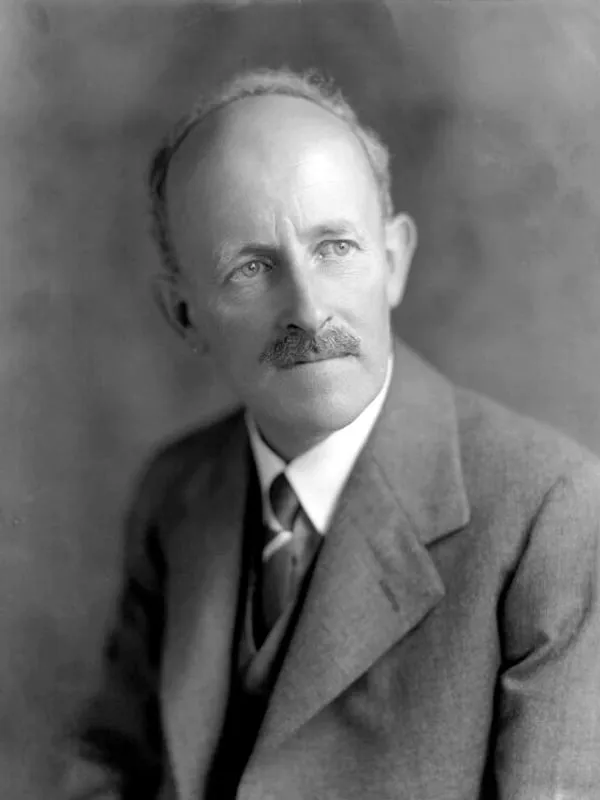
- Born:
- 1 April 1877, Biarritz (France)
- Died:
- 26 January 1963, Redhill (England)
- Author:
- Natalia
- Photo:
- Bassano Ltd, domena publiczna, Wikimedia Commons

Maurice Hankey commanded no army and headed no ministry, and yet few people knew as much as he did about Britain’s conduct of the war. Throughout the war he was secretary of the successive bodies that directed it: the War Council, the Dardanelles Committee, the War Committee and finally the War Cabinet of David Lloyd George. He kept the minutes, drew up the agenda, drafted the resolutions of Allied conferences and made sure that government decisions reached the ministries. The British Cabinet Office grew out of his secretariat. He was also an unofficial adviser to two prime ministers, and ideas ranging from the Dardanelles expedition to tanks and convoys passed through his hands.
Before the war
He was born on 1 April 1877 in Biarritz in France, the son of Robert Hankey, who had made his money sheep farming in Australia and later settled with his family in Brighton. After school at Rugby he joined the Royal Marine Artillery. He served in the Mediterranean on the flagship Ramillies, where on his own initiative he gathered intelligence and attracted the attention of the fleet commander, Admiral John Fisher. In 1902 he joined the Naval Intelligence Department of the Admiralty, where he dealt with coastal defence. He knew several languages and had a reputation as a walking encyclopaedia of defence matters.
In 1908 he became assistant secretary of the Committee of Imperial Defence, a body that brought together politicians, admirals and generals to plan the defence of the Empire, and in 1912 its secretary. Under his direction the so-called War Book was produced before the war, a detailed plan in which every ministry had set out what it was to do on receiving a given signal. When at the end of July 1914 the government declared the precautionary period in the army, the whole administration acted according to this plan.
Secretary of the War Council
In November 1914 Prime Minister Herbert Henry Asquith set up the War Council, a small Cabinet committee directing the war, and Hankey became its secretary. For the first time in the history of British government, ministers’ deliberations were minuted. Previously the Cabinet had kept no records at all, and the only trace of its decisions was the letter the prime minister wrote to the King after each meeting.
Hankey quickly became more than a minute-taker. In the last days of 1914 he wrote a memorandum, named after the day it was written the Boxing Day memorandum. In it he argued that the front in France had become deadlocked and that Germany could most effectively be reached through its allies, above all through Turkey. The memorandum, together with similar ideas of Lloyd George and Winston Churchill, prepared the ground for the decision to attack the Dardanelles. Hankey later recalled that when Churchill presented the plan on 13 January, the idea “caught on at once”. At the end of December 1914 he also passed on to Churchill the ideas of his friend Colonel Ernest Swinton for an armoured tracked vehicle that would cross trenches and barbed wire. Churchill took the matter up, and out of this work the tank later grew.
After the fall of the Liberal government Hankey became secretary of the Dardanelles Committee. In the summer of 1915 the prime minister sent him to Gallipoli to assess the situation on the spot. He was at Suvla Bay in August, during the landing of the new divisions, and saw a beach full of bathing soldiers while the Turks were bringing up reinforcements to the hills. His reports from the peninsula were critical of the way the campaign was being conducted. In November, when the government replaced the Dardanelles Committee with a smaller War Committee, Hankey became its secretary.
He also took part in Allied conferences. He called the proceedings of the first Calais conference in July 1915 chaos, because they were conducted without order and without minutes. From then on he argued that the Allies needed a common secretariat, like the British one. Together with Lord Esher he prepared proposals for closer cooperation for the Paris conference in November 1915 and the draft rules for an inter-Allied war council. Nothing came of it then, but the idea returned two years later. In 1916 he was knighted. In the autumn of that year his youngest brother Donald, author of popular essays on soldiers’ lives, was killed on the Somme.
The War Cabinet
In December 1916 Lloyd George became prime minister and set up a five-member War Cabinet. Hankey became its secretary and wrote the rules for its work himself. The secretariat prepared the agenda and the papers, summoned ministers and experts from outside the Cabinet, kept the minutes, and sent extracts from them to the ministries that were to carry out the decisions. The War Cabinet met almost every day, about three hundred times in 1917. By the end of that year Hankey already had ten assistants. He was also secretary of the Imperial War Cabinet, on which the prime ministers of the Dominions sat, and of the War Policy Committee, which in the summer of 1917 approved the offensive in Flanders.
Lloyd George valued him as an adviser more than many ministers. In February 1917, when German submarines were sinking more and more ships, Hankey wrote the prime minister a memorandum in favour of introducing “scientifically organised convoys”. The idea had been suggested to him by naval officers and shipping officials who could not overcome the resistance of the Admiralty. The memorandum strengthened the prime minister’s pressure on the admirals, which in the spring led to the first trials. At the Calais conference in February 1917, when Lloyd George tried to subordinate Douglas Haig to the French commander-in-chief, it was Hankey, according to many historians, who helped find the compromise formula that prevented an open breach.
His diary is one of the most important sources for the history of the prime minister’s quarrel with the generals. Hankey recorded in it, for example, that in September 1917 Lloyd George wanted to stop the offensive at Ypres but at the last moment did not dare to, and in October that the prime minister let it go on in order to discredit Haig and William Robertson. He accompanied Lloyd George to the Rapallo conference in November 1917, where the Supreme War Council was created, and drafted the resolutions at its first session at Versailles. In January 1918 the prime minister instructed him and Jan Smuts to look discreetly for a possible successor to Haig, and in February he was present at the meeting at which the decision was taken to remove Robertson. After the war he was secretary of the British delegation to the Paris Peace Conference and secretary of the Council of Four, the meetings of the leaders of Britain, France, the United States and Italy.
After the war
When the normal Cabinet was restored in 1919, the secretariat was kept, and Hankey became the first Cabinet Secretary in history. From 1923 he was also Clerk of the Privy Council. He served successive prime ministers, from Lloyd George to Neville Chamberlain, and was secretary of many international conferences, among them the Washington Naval Conference of 1921–1922. He retired in 1938 and a year later was made a baron. In 1939 Chamberlain took him into his War Cabinet as minister without portfolio, but Churchill, with whom Hankey often disagreed, removed him from the government in 1942. In 1961 Hankey published his two-volume memoirs, “The Supreme Command, 1914–1918”, based on his diary. He died on 26 January 1963 in hospital in Redhill, Surrey.
Assessment
Historians agree that Hankey was the creator of the modern British machinery of government. Asquith called him the glue that held all the cabinets together, and Lloyd George wrote that he could not remember a single dispute over the accuracy of his minutes. To his biographer, the naval historian Stephen Roskill, he was the “man of secrets” who knew all the secrets of the war and knew how to keep them.
There is greater disagreement about his influence on strategy. A. J. P. Taylor observed that Hankey yielded to the temptation to go beyond the role of secretary and put forward proposals of his own. As a former marine officer he favoured a maritime strategy and blows on the periphery, which brought him close to Lloyd George. The British historian William Philpott, however, believes that Hankey confirmed the prime minister in views he already held rather than showing him new paths, and that his memorandum of December 1914 diverted attention from Germany, the real centre of gravity of the war. His biographer John Naylor adds that Hankey remained a Victorian imperialist who did not keep pace in every respect with a changing world.
Sources
Spotted a mistake?Report an error
Mentioned in battles
(01)Often appears with
People who appear in the same events.