1915: The Dardanelles
Landing at Suvla Bay
- Dates:
- 6–15 August 1915
- Front:
- Middle East
- Location:
- Suvla Bay and the Suvla plain with the dry Salt Lake, ringed by the Kiretch Tepe and Tekke Tepe ridges and by Chocolate Hill and W Hills (Ismail Oglu Tepe), north of Anzac Cove, west coast of the Gallipoli peninsula, Ottoman Empire (now Turkey)On the battle map →
- Sides:
- United KingdomIan Hamilton, Frederick Stopford, Frederick Hammersley, Bryan MahonOttoman EmpireOtto Liman von Sanders, Wilhelm Willmer, Mustafa Kemal
- Result:
- British failure. IX Corps secured Suvla Bay as a base but did not take the surrounding hills, which the approaching Turkish divisions occupied on 9 August.
- Author:
- Natalia
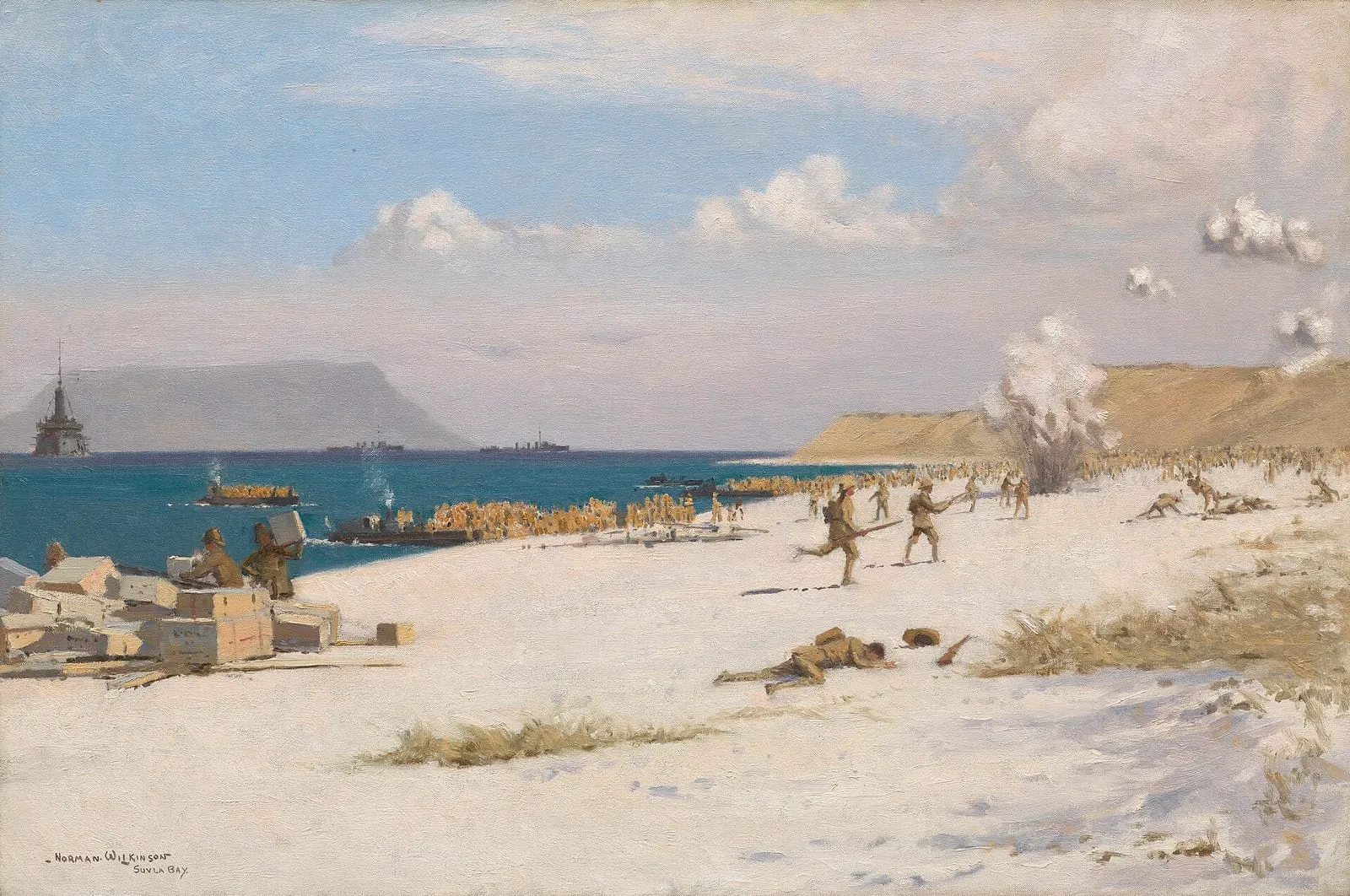
The landing at Suvla Bay was part of the great August offensive with which General Ian Hamilton hoped to break the deadlock on the Gallipoli peninsula. On the night of 6–7 August 1915 the newly formed IX Corps of General Frederick Stopford went ashore at Suvla Bay, a few kilometres north of Anzac Cove. The landing took the Turks completely by surprise; they had only three battalions there. The British had ample time to seize the hills ringing the Suvla plain before Turkish reinforcements arrived. Yet for two days they barely moved. When at dawn on 9 August they finally advanced on the Tekke Tepe ridge, Turkish divisions that had arrived during the night were already on its crest. By 15 August IX Corps had taken none of its main objectives, and Hamilton removed Stopford.
Name and dates
In British historiography the operation is called the Landing at Suvla. The British Battles Nomenclature Committee dates it to 6–15 August 1915, and this page follows that dating. The first troops went ashore on the evening of 6 August, at about 10 p.m., and on 15 August, the day of the last attack on the Kiretch Tepe ridge, Stopford lost his command. Fighting on Kiretch Tepe continued on 16 August. In Turkey the fighting in this sector forms part of the battles of Anafarta (Anafartalar Muharebeleri). The British gave the surrounding hills names of their own: Chocolate Hill is the Turkish Yılgın Burnu, and W Hills is Ismail Oglu Tepe.
Background
After the April landing and the failed attacks at Helles, the Allies were stuck on two small bridgeheads. In June the British government decided to send Hamilton three divisions of the New Army, the volunteer formations of Lord Kitchener, and later two Territorial divisions as well. Hamilton decided to use them in an offensive in the north of the peninsula. The main blow was to come from Anzac Cove against the Sari Bair ridge. Suvla Bay was to become a supply base for the troops in the north, and IX Corps, after taking the surrounding hills, was to help in the attack on Sari Bair. Command of the corps went to the 61-year-old Stopford, who had retired before the war and had never commanded troops in battle. He was chosen mainly for his seniority, because the generals from the Western Front whom Hamilton had asked for were junior to Bryan Mahon, commander of the Irish 10th Division.
The plan was kept so secret that Stopford learned of it only on 22 July. Hamilton wanted Chocolate Hill and W Hills, from which Turkish artillery could shell the rear of the troops attacking Sari Bair, to be taken before dawn, and the Tekke Tepe ridge to be occupied. The IX Corps staff, convinced by experience in France that trenches could not be taken without howitzers, nevertheless forced changes. One brigade was to be put ashore inside the bay itself, although the navy feared uncharted reefs there, and clear orders were replaced by generalities. From order to order, from Hamilton’s headquarters through corps to division and brigades, the objectives became hedged with the proviso “if possible”, and the 11th Division’s order did not mention the Tekke Tepe ridge at all.
The troops of IX Corps assembled on the island of Imbros, in the harbour of Mudros on Lemnos and at Mytilene on Lesbos. The soldiers did not know where they were sailing. To mislead the Turks they were issued maps of the Asian coast. On the Turkish side General Otto Liman von Sanders, commander of the Fifth Army, knew of the concentration of troops on the islands but not where the landing would come. He kept strong reserves at Bulair at the neck of the peninsula and on the Asian shore. The Suvla plain was guarded by the Bavarian Major Wilhelm Willmer with a detachment of three battalions, about 1,500 men, without machine guns and with a few guns.
Course
The night of 6–7 August
On the evening of 6 August, while the attack on Lone Pine was already under way at Anzac, a flotilla of destroyers and motor landing lighters, which the soldiers called “beetles”, approached Suvla with more than 10,000 men of General Frederick Hammersley’s 11th Division on board. At B Beach, south of Nibrunesi Point, everything went to plan. By about 10 p.m. four battalions were ashore without losing a single man. Two companies of the 6th Battalion, Yorkshire Regiment took the knoll of Lala Baba with the bayonet, losing almost all their officers. It was the first attack by a New Army unit in the war.
Things went worse for the 34th Brigade, which was landed inside the bay. In the darkness the destroyers anchored almost a thousand yards (about 900 metres) too far south. Two lighters grounded on a reef and the men waded ashore up to their necks in water under fire from Turkish snipers. The battalions landed in the wrong places and spent a long time searching for the small rise of Hill 10, which nobody could point out. Only the 11th Battalion, Manchester Regiment, advancing along the shore, climbed onto the Kiretch Tepe ridge and by 3 a.m. had taken up a position about two miles east of Suvla Point. Stopford spent the night on the sloop Jonquil in the bay. He did not go ashore and sent Hamilton no report.
7 August
At dawn six battalions of the (Irish) 10th Division from Mytilene entered the bay, followed by three more from Mudros. Instead of being sent together to the left flank as originally intended, they were landed at two different places and split between two divisions. Mahon was left with a few battalions. Hill 10 was taken only after sunrise, once the Turks had abandoned it. Within a few hours 11th Division headquarters issued three mutually contradictory orders, and the brigadiers argued over who was to attack. Only in the evening did the Irish battalions and two battalions of the 33rd Brigade, which had crossed the dry Salt Lake, take Chocolate Hill and the neighbouring Green Hill. The Turkish garrison withdrew to W Hills. On the Kiretch Tepe ridge the Irish battalions reached the line of the 11th Manchesters and halted about 800 metres short of a Turkish strongpoint.
According to the British official history, IX Corps lost about 100 officers and 1,600 men in the first twenty-four hours, more than Willmer’s entire detachment numbered. More than half of the 22 battalions already ashore did not go into action at all. Not a single gun was landed that day, and of the nearly thousand mules due to go ashore, only 50 were landed at Suvla. The soldiers, who had drunk the water in their bottles in the heat, suffered terrible thirst, although there were many wells in the area.
8 August
The next day was quiet. There was not a single Turkish soldier on the northern part of the plain or on the Tekke Tepe ridge, because Willmer had concentrated about 1,100 men on W Hills and the Anafarta spur, leaving only three companies of gendarmerie on Kiretch Tepe. He also withdrew all his guns so that they would not fall into British hands. Stopford, however, decided that the troops needed rest and that fortified positions could not be attacked without artillery. He congratulated the divisional commanders on their success and reported to Hamilton that he now had to “consolidate the positions gained”. Lieutenant-Colonel Cecil Aspinall of the staff and the secretary of the Committee of Imperial Defence, Maurice Hankey, sent by Hamilton, found the bay full of bathing soldiers. Stopford greeted Aspinall by saying that the men had done splendidly. When Aspinall remarked that they had not reached the hills, the general replied: “No, but they are ashore.” Aspinall telegraphed to headquarters that “golden opportunities are being lost”.
Hamilton reached Suvla only in the evening, because his destroyer had a boiler failure. He ordered at least one battalion to be on the Tekke Tepe ridge before dawn. The commander of the 32nd Brigade, however, first had all his battalions assemble at the hamlet of Sulajik. Two of them were already well forward, one on Scimitar Hill, and patrols reported that the ridge was held only by a few groups of sentries. The assembly took half the night. Meanwhile Liman von Sanders, angered by the delay of the Turkish commander of XVI Corps, who had put off his attack until morning, relieved him of command and entrusted the Anafarta sector to Mustafa Kemal, commander of the 19th Division.
9 and 10 August
At dawn on 9 August a company of the 6th Battalion, East Yorkshire Regiment approached the summit of Tekke Tepe just as Turkish battalions of the 12th Division were climbing it from the other side. According to the British official history the race for the ridge was lost by less than half an hour. The Turks drove the 32nd Brigade back onto the plain with heavy losses. The battalion commander was surrounded with a handful of men and, according to the British official history, bayoneted after surrendering. At the same time the 33rd Brigade and the Irish battalions attacked W Hills. Several times they took and lost Scimitar Hill. Shellfire set the scrub alight and wounded men burned in it. The attack cost more than 1,700 men and achieved nothing. On Kiretch Tepe the Irish, suffering from thirst, advanced only a little. The newly landed (Welsh) 53rd Division was thrown in to help. Its battalions went into battle without maps or orders, and on 10 August its attack on Scimitar Hill also broke down.
11–15 August
On 10 August the (East Anglian) 54th Division began to arrive at Suvla. Hamilton wanted to use it to take the Tekke Tepe ridge, but Stopford replied that both Territorial divisions were “sucked oranges”, and the attack was put off from day to day. On 12 August the division’s 163rd Brigade advanced in daylight across the open plain. About 250 men and 15 officers of the 5th Battalion, Norfolk Regiment, whose ranks included a company made up of workers from the royal estate at Sandringham, broke deep into the Turkish positions and vanished without trace. On 13 August Hamilton agreed that IX Corps should not attack for the time being but strengthen its line.
Meanwhile, on 14 August, Stopford, without informing headquarters, ordered Mahon to take the Kiretch Tepe ridge. On the afternoon of 15 August the Irish of the 30th Brigade took the highest point of the ridge with the bayonet, but on the southern slope the attack of the 31st Brigade and the 162nd Brigade stalled below Kidney Hill. That same day a telegram arrived from Lord Kitchener saying that “this is a young man’s war”, and Hamilton removed Stopford. Until General Julian Byng arrived from France, command of IX Corps passed to General Henry de Lisle, until then commander of the 29th Division at Helles. Mahon refused to serve under a general junior to him and gave up his command. On the night of 16–17 August the Irish, after a whole day of fighting with hand bombs, and with stones when the bombs ran out, withdrew to their starting positions.
Losses
The British official history gives no total for IX Corps losses over the whole period. In the first twenty-four hours they amounted to about 1,700 men; on 9 August more than 1,700 in the 33rd Brigade and the battalions attached to it alone; on 12 August at least several hundred in the 163rd Brigade; and in the fighting for Kiretch Tepe on 15–16 August nearly 2,000 killed, wounded and missing. On all three sectors of the August offensive, Helles, Anzac and Suvla, Hamilton lost more than 25,000 men in the first four days. According to the Turkish official history, cited by the British history, the 7th and 12th Divisions lost about 3,500 men between 9 and 13 August, and in the fighting on Kiretch Tepe on 15–16 August the Turks lost nearly 1,700 soldiers.
Significance
The landing at Suvla Bay is regarded as one of the most squandered opportunities of the First World War. The British official history lists many causes: excessive secrecy, which meant that even brigade commanders did not know the plan, the botched landing of the 34th Brigade, the lack of water and guns, and the inexperience of the young soldiers. It considers the most important, however, to be the lack of resolute command, both on the shore and at corps headquarters and Hamilton’s headquarters. Turkish and German accounts agree that 8 August was a day of crisis for the defenders. Liman von Sanders wrote after the war that with such great numerical superiority the British could have achieved complete success.
The loss of the hills around Suvla decided the fate of the whole August offensive. The attack from Anzac Cove on the Sari Bair ridge did not receive the support that had been counted on, and on 10 August the Turks retook the summit of Chunuk Bair. Suvla Bay became the Allies’ third bridgehead on the peninsula, and from the higher hills the Turks could see every corner of it. IX Corps made its last attempt to take these hills on 21 August. Stopford’s removal did not save Hamilton, who was himself stripped of command two months later.
Spotted a mistake?Report an error