Key event
Balfour Declaration
- Category:
- Diplomacy
- Front:
- Middle East
- Date:
- 2 November 1917
- Author:
- Natalia
- Tags:
- Great Britain, Arthur Balfour, Ottoman Empire, Zionism
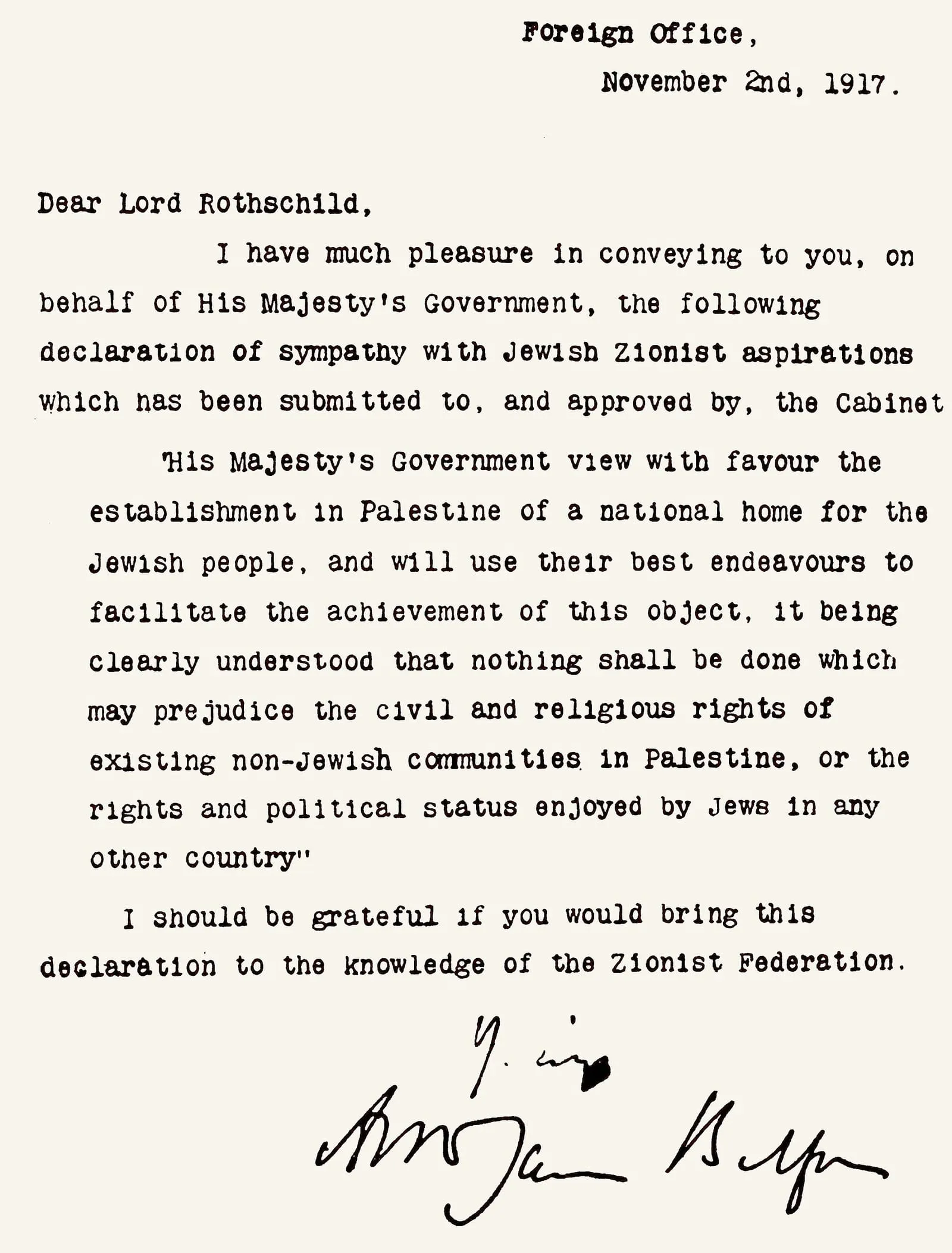
On 2 November 1917 the British Foreign Secretary Arthur Balfour signed a short letter to Lord Rothschild, banker, zoologist and one of the leaders of the Jewish community in Britain. In it he conveyed, on behalf of the government, a “declaration of sympathy with Jewish Zionist aspirations” which had been submitted to and approved by the Cabinet. Its core fitted into a single sentence:
His Majesty’s Government view with favour the establishment in Palestine of a national home for the Jewish people, and will use their best endeavours to facilitate the achievement of this object, it being clearly understood that nothing shall be done which may prejudice the civil and religious rights of existing non-Jewish communities in Palestine, or the rights and political status enjoyed by Jews in any other country.
Balfour asked Rothschild to bring the declaration to the knowledge of the Zionist Federation of Great Britain and Ireland. It was the first public support for Zionism from a great power. It concerned, however, a country that still belonged to the Ottoman Empire and whose inhabitants nobody had asked for their opinion.
The Zionists and the British government
The modern Zionist movement, organised at the end of the 19th century by Theodor Herzl, had from the outset sought the support of one of the powers for Jewish settlement in Palestine. The war with Turkey opened new possibilities for it. As early as January 1915 Herbert Samuel, a minister in Asquith’s government, himself a Jew and a supporter of Zionism, circulated to his colleagues a memorandum on the future of Palestine under British protection. At the time it found few supporters.
In London the most effective campaigner was Chaim Weizmann, a lecturer in chemistry at the University of Manchester, born in Motal near Pinsk. His method of producing acetone, essential for making smokeless powder, proved useful to the British munitions industry and opened politicians’ doors to him. In February 1917 Weizmann became head of the English Zionist Federation. He was supported by Nahum Sokolow, a Warsaw journalist born in Wyszogród on the Vistula and an activist of the World Zionist Organisation, who had moved to Britain at the beginning of the war.
The breakthrough came with the change of government in December 1916. David Lloyd George and his Foreign Secretary Balfour, unlike their predecessors, thought in terms of partitioning the Ottoman lands, and the prime minister wanted Jerusalem taken. On 7 February 1917 the Zionist leaders met Mark Sykes, one of the secretaries of the War Cabinet, responsible for Middle Eastern affairs, the same man who a year earlier had agreed with the French on the partition of Asiatic Turkey. On 19 June Balfour asked Rothschild and Weizmann for a draft declaration. On 18 July Rothschild sent him a short text in which Palestine was to be “reconstituted as the national home of the Jewish people”.
Disputes in the Cabinet
The draft came before the War Cabinet in the autumn. The fiercest opponent was the Secretary of State for India, Edwin Montagu, the only Jew in the government. In a memorandum of late August he called the government’s policy anti-Semitic in its effects: in his view the declaration would brand Jews in their home countries as foreigners and undermine their position as citizens. Lord Curzon also had doubts; in a memorandum of 26 October he asked what the notion of a “national home” contained and what would become of the country’s Arab inhabitants.
These objections changed the text. At the end of August Lord Milner replaced “Palestine” as the national home with the words “in Palestine”, and at the beginning of October he and Leo Amery added two provisos: on the rights of the non-Jewish communities in Palestine and on the position of Jews in other countries. The notion of a “national home” had no precedent in international law and deliberately left open whether a Jewish state was meant. Nor were the borders of Palestine defined.
The government consulted its allies. France had already expressed sympathy for the Zionist cause on 4 June, in a letter to Sokolow from Jules Cambon, head of the political department of its foreign ministry. President Woodrow Wilson, asked on 3 September, replied that the time for a declaration was not yet ripe. In October, when asked again, he accepted the Milner–Amery text, although he endorsed the declaration publicly only in 1918. On 31 October the War Cabinet, after four meetings devoted to the matter, authorised Balfour to issue the declaration.
Why then
The minutes of 31 October leave no doubt that the government counted above all on propaganda benefits. Balfour said that the vast majority of Jews in Russia and America, indeed all over the world, favoured Zionism, and that the declaration would make it possible to carry on “extremely useful propaganda” in both countries. In Russia, where the Provisional Government was struggling to keep the army at the front and many revolutionary activists were Jews, London wanted to win Jewish opinion over to continuing the war. In the United States it wanted the support of the Jewish community there for the war effort. Balfour also warned that Germany was courting the Zionists.
Strategic considerations counted too. A Palestine under British protection would shield the Suez Canal from the east, and support for the Zionists provided an argument against the international administration of the country planned in the Sykes–Picot Agreement. The moment at the front was favourable: on 31 October General Allenby’s troops took Beersheba, and on the night of 1/2 November British infantry attacked the defences of Gaza. Historians still argue over which of these motives weighed most and what part was played by the personal convictions of Balfour and Lloyd George, who had been brought up in the biblical tradition.
Conflicting promises
Before the war about 700,000 people lived in Palestine. Jews made up, by various estimates, from about 6 to 12 per cent, and their number fell during the war. The vast majority were Arab Muslims and Christians, whom the declaration mentioned only as “existing non-Jewish communities”, guaranteeing them civil and religious rights, but not political ones.
At this time Britain was making promises that were hard to reconcile. In the correspondence with the Sharif of Mecca of 1915–1916 the High Commissioner in Egypt, Sir Henry McMahon, promised the Arabs independence, excluding the lands lying west of the “districts” of Damascus, Homs, Hama and Aleppo. The letter did not name Palestine, and the dispute over whether this exclusion covered it continues to this day: the British government later claimed that it did, the Arabs that it did not. The Sykes–Picot Agreement of 1916, for its part, envisaged an international administration for Palestine.
Publication and reactions
The text of the declaration appeared in the press a week later, on 9 November 1917. Among Zionists it aroused enthusiasm: the movement had at last won the official support of a great power, and the number of its supporters, especially in the United States, grew rapidly. The British distributed leaflets with the text of the declaration among Jews in Central and Eastern Europe. The former Russian Pale of Settlement, which also included the Kingdom of Poland, was then home to the largest Jewish community in the world.
The declaration had opponents among Jews as well, especially assimilated ones, who like Montagu feared for their position as citizens of the countries in which they lived. In the Arab world the declaration was seen as a betrayal of the commitments made to Sharif Hussein. The Central Powers responded cautiously, because Germany could not outbid the British without offending its Turkish ally. In December the Grand Vizier Talat Pasha, in an interview with the German Vossische Zeitung, called the declaration a bluff and promised the Jews in Palestine the fulfilment of their “justified wishes” under Ottoman rule.
A little over a month after the declaration, on 9 December, British troops occupied Jerusalem. After the war the San Remo conference of 1920 gave Britain the mandate for Palestine with the obligation to put the declaration into effect, and in 1922 its text was incorporated into the mandate instrument approved by the League of Nations. The Balfour Declaration became one of the founding documents of the future Israel, and at the same time one of the sources of the Israeli–Palestinian conflict.
Remember the articles you have read? Only in this browser; nothing is sent anywhere.How it works
Read ·
A voice from the front
“While the cabinet was in session, approving the final text, I was waiting outside, this time within call. Sykes brought the document out to me, with the exclamation: “Dr. Weizmann, it’s a boy!” Well — I did not like the boy at first. He was not the one I had expected. But I knew that this was a great departure.”
Spotted a mistake?Report an error
Meanwhile
(04)Elsewhere in the same days.
- 1 November 1917 · PoliticsHertling becomes ChancellorOn 1 November 1917 the Kaiser dismissed Georg Michaelis and appointed the 74-year-old Bavarian premier Georg von Hertling, a Centre politician, Chancellor.
- 1 November 1917 · MilitaryMinistry of National Service takes over recruitingOn 1 November 1917 Geddes's Ministry of National Service took over army recruiting from the War Office; civilian medical boards began to examine recruits.
- 1 November 1917 · Western FrontEnd of the Battle of La MalmaisonOn the night of 1–2 November 1917 the Germans quietly left the Chemin des Dames for the Ailette. The French found empty trenches up to Craonne.
- 3 November 1917 · Italian FrontFrench troops in ItalyOn 3 November 1917 the arrival of French troops in Italy was announced. After Caporetto France sent four divisions there at first, and then two more.
Related events
(04)The same battle, people or subject.
- 4 February 1918 · Middle EastBritish assurances to HusseinIn February 1918 London answered King Hussein after the Turks exposed the Sykes–Picot Agreement, assuring him it would keep its pledge to liberate the Arabs.
- 18 February 1918 · MilitaryDismissal of RobertsonAfter a dispute over the general reserve the government removed Gen. William Robertson from the staff. On 19 February 1918 Henry Wilson became CIGS.
- 4 January 1918 · Middle EastThe Hogarth messageIn January 1918 Commander David Hogarth assured King Hussein at Jeddah that Jewish settlement in Palestine would not infringe the freedom of its inhabitants.
- 20 March 1917 · PoliticsFirst meeting of the Imperial War CabinetOn 20 March 1917 the Dominion premiers and India's representatives sat in London with the British War Cabinet. The Imperial War Conference began next day.