Key event
The charge at Beersheba
- Category:
- Military operations
- Front:
- Middle East
- Date:
- 31 October 1917
- Author:
- Łukasz Skowroń
- Battle:
- Battle of Beersheba
- Tags:
- Australia, Ottoman Empire, Great Britain, New Zealand
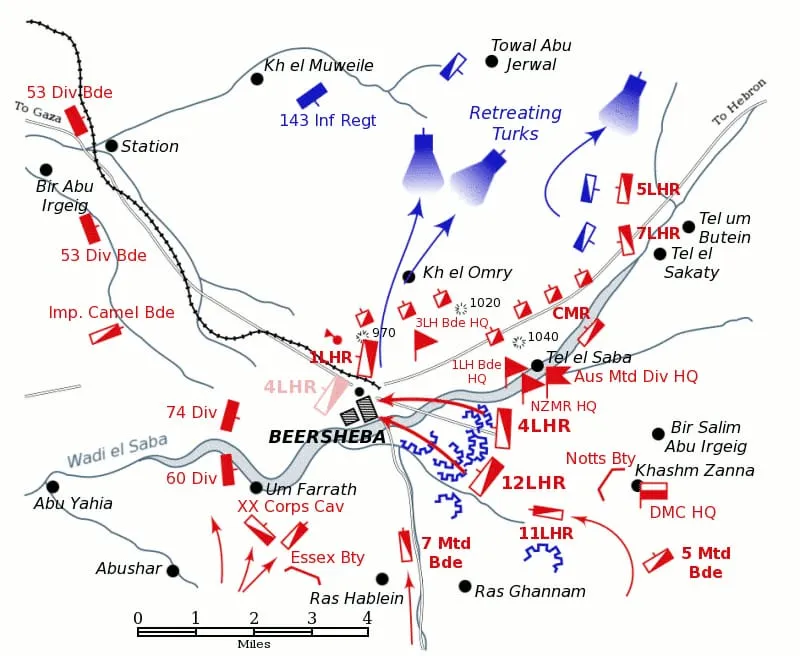
On 31 October 1917, shortly after sunset, according to the most commonly cited estimates about 800 horsemen of the Australian 4th Light Horse Brigade galloped towards Beersheba, an Ottoman town on the edge of the Negev desert. They had no swords, so they held bayonets in their hands. They rode several kilometres across open plain, jumped the Turkish trenches and were in the town less than an hour after the order was given. The Turkish engineers did not manage to blow up the wells, and without them the whole autumn offensive of General Edmund Allenby could have stalled on the very first day. By the evening Beersheba was in British hands, and almost 2,000 Ottoman soldiers had been taken prisoner.
Water and time
Allenby, who had taken command in Egypt in June, decided not to attack Gaza frontally for a third time, but to outflank the Turkish line from the east. The first step was to be the capture of Beersheba, the advanced left wing of that line, and with it the wells, the only ones in the area that could water the horses of his cavalry. The orders of 22 and 23 October stated clearly that the town was to fall before dark on the first day. For four days artillery and warships had been bombarding Gaza to confirm the Turks in their belief that the main blow would fall there. The wider plan of the Third Battle of Gaza depended on this one day.
On the evening of 30 October two mounted divisions of Lieutenant-General Harry Chauvel’s Desert Mounted Corps, the Anzac Mounted Division and the Australian Mounted Division, set out from Asluj and Khalasa, south of Beersheba. They rode all night by the light of an almost full moon over stony hills, and a ban on smoking and loud talk applied to everyone. The Australian official historian Henry Gullett wrote that in the darkness nothing could be heard but the clatter of thousands of shod hooves, and sparks struck from the stones showed the direction of the flank guards. Meanwhile, from the west, the infantry of Lieutenant-General Sir Philip Chetwode’s XX Corps approached its starting positions. The brigades of the 74th Division marched in close squares, and changes of direction were marked with lit lanterns.
Morning: the infantry
At 5.55 a.m. the artillery of XX Corps opened fire on the Turkish trenches west and south-west of the town. Behind the infantry, more than 30 kilometres away, the bombardment of Gaza was still rumbling. The British official history (Cyril Falls) writes that after the summer heat the ground was as dry as powder, and in the still air the Turkish positions vanished in a cloud of dust after an hour. At seven the bombardment was halted to let the dust settle. Some of the wire was still uncut, but the commander of the London 181st Brigade decided that waiting any longer would cost more, and at 8.30 a.m., after ten minutes of intense fire, his battalions took the advanced works on Hill 1070. In a steel observation dugout on the summit the body of an Austrian artillery officer was found.
By then the New Zealanders and Australians were already standing east of the town. The Turks were completely surprised to see them, because they had not believed that large cavalry forces would venture so far from water. İsmet Bey, the future president of Turkey, who commanded the defence, reported at noon to the commander of the Eighth Army, General Friedrich Kress von Kressenstein, that two or three cavalry divisions stood to the east and south. According to a Turkish account Kress replied that these were only two brigades, and then ordered: “Beersheba is to be defended.” He sent no reinforcements.
The heat was rising. At 12.15 p.m. four brigades of the 60th and 74th Divisions moved off for the main assault, partly hidden in smoke and dust, and before 1 p.m. took all their objectives. The Turks held out longest against two battalions of the Royal Welsh Fusiliers, which suffered two-thirds of the losses of the whole corps. Corporal John Collins, who killed fifteen defenders of one post with the bayonet and carried the wounded out under fire, received the Victoria Cross for that day. The infantry could probably have entered the town first, but in accordance with orders it halted on its designated line. Beersheba was to be taken by the cavalry, because it was its horses that needed the water.
Midday: Tel el Saba
In the east the fighting went much more slowly. The way to the town was barred by the hill of Tel el Saba, a flat, boulder-strewn mound above the Wadi es Saba, from which a defending Turkish battalion with machine guns swept the whole plain. The New Zealand Mounted Rifles Brigade attacked it at 9.10 a.m. The Australian 2nd Light Horse Brigade cut the road to Hebron and Jerusalem at the gallop, but further on it was stopped by Turkish cavalry on the hills. The New Zealanders advanced by rushes, from boulder to boulder, helped by two regiments of the Australian 1st Brigade and batteries of horse artillery. German aircraft circled over the battlefield and bombed concentrations of horses. At about 2.30 p.m. a bomb mortally wounded Lieutenant-Colonel Leslie Maygar, commander of the Australian 8th Light Horse Regiment and a holder of the Victoria Cross from the Boer War. He died the next day.
Only at 3 p.m. did the Auckland Mounted Rifles Regiment break onto the summit of Tel el Saba. Less than two hours remained until dark. Chauvel knew he was behind time. Earlier, asked by Allenby’s staff where he would water his horses if the town did not fall, he had replied that in that case he would send them back to the distant wells. Allenby, who was at Chetwode’s headquarters, read this as a sign of retreat and had Chauvel told that he was to take Beersheba that same day. According to Gullett the order for the charge was given before this message reached Chauvel. Chauvel considered using the British yeomanry, which had swords, but chose Brigadier-General William Grant’s 4th Light Horse Brigade, which stood closer to the town. “Put Grant straight at it,” he ordered the commander of the Australian Mounted Division, Henry Hodgson. Grant himself later claimed that the method of attack had been his choice.
The charge
Grant’s regiments, dispersed for protection against bombs, assembled only at about 4.30 p.m. behind a ridge a few kilometres south-east of the town. The horses had not drunk since the previous day. On the right stood Lieutenant-Colonel Murray Bourchier’s 4th (Victorian) Regiment, on the left Lieutenant-Colonel Donald Cameron’s 12th (New South Wales) Regiment. Each was on a one-squadron front, in three waves, with intervals of several metres between the riders. From the ridge they could see Beersheba and the white mosque in its centre, and somewhere on the way, out of sight, the Turkish trenches. From aerial photographs Grant knew only that they were not protected by barbed wire.
The regiments set off at a trot and almost at once broke into a gallop. The Turkish artillery opened fire with shrapnel, but the target was dispersed and fast. When, after several kilometres, machine-gun fire fell on the left wing, a British horse artillery battery silenced it with its very first rounds. According to Gullett the Turkish infantrymen, in the confusion, failed to adjust their sights, and for the last few hundred metres their bullets flew over the riders’ heads. Major Lawson’s squadron of the 4th Regiment jumped a shallow trench, then the main trench, in places three metres deep, and dismounted among tents and dugouts. The Australians jumped into the trench and fought with bayonets until the Turks began to surrender. Most of the 12th Regiment raced through a gap in the Turkish line and galloped straight into the town.
The Turkish command had already issued the order to withdraw and destroy the wells at 4 p.m. The charge caught it just as the withdrawal began. Panic broke out among the defenders, most of the engineers fled without firing their charges, and İsmet Bey slipped away on foot with a handful of men. The Australians overtook fleeing columns and guns. Trooper O’Leary of a machine-gun company rode into the town alone, captured a gun and made the Turkish gunners take it into a side street so that no other regiment would claim it. Trooper Bolton, who had lost his rifle, knocked a German officer fleeing with a gun team out of the saddle with his revolver. Thirty-one horsemen of the two regiments were killed, among them Lieutenant Burton and four men of his section, Gallipoli veterans shot just in front of the trench, and the stretcher-bearer Albert “Tibby” Cotter, one of the most famous Australian cricketers. According to popular Australian accounts about 70 horses also fell.
Evening
By 6 p.m. the Australians and New Zealanders had occupied the town and the surrounding hills, and soon afterwards the British 7th Mounted Brigade arrived from the south-west. The Australian 11th Regiment, following the charging regiments, caught about 400 Turks in the town withdrawing from the western trenches. That day the Desert Mounted Corps took 1,528 prisoners and XX Corps 419. Fifteen guns were captured. During the night the engineers searched for wells and got the pumps working, and the horses, many of which had not drunk for 30 hours, were watered as the water was drawn. Pools of rainwater in the surrounding wadis, left by a storm a few days earlier, also proved a lifesaver.
British losses were small for the scale of the attack: XX Corps lost 136 killed and more than a thousand wounded, the Desert Mounted Corps fewer than 200 men. News of the fall of Beersheba spread along the front within a few hours. Gullett wrote that the whole army realised how close it had come to a defeat that could have wrecked the whole plan. The wells in the town were not enough for all the horses, however, so the next blow against the Turkish flank had to be postponed by several days. The Turks meanwhile, convinced that the British would advance on Hebron and Jerusalem, began moving troops from Gaza to the east.
Remember the articles you have read? Only in this browser; nothing is sent anywhere.How it works
Read ·
A voice from the front
“The plain was covered with fine dust and the spectacle of “lines of troop columns” advancing at the gallop, each with its cloud of “smoke,” as it were, enveloping it and trailing away up into the air as the troop went forward, was a magnificent sight.”
Spotted a mistake?Report an error
Meanwhile
(04)Elsewhere in the same days.
- 1 November 1917 · MilitaryMinistry of National Service takes over recruitingOn 1 November 1917 Geddes's Ministry of National Service took over army recruiting from the War Office; civilian medical boards began to examine recruits.
- 1 November 1917 · PoliticsHertling becomes ChancellorOn 1 November 1917 the Kaiser dismissed Georg Michaelis and appointed the 74-year-old Bavarian premier Georg von Hertling, a Centre politician, Chancellor.
- 29 October 1917 · PoliticsOrlando becomes prime minister of ItalyOn 29 October 1917, during the retreat from Caporetto, Vittorio Emanuele Orlando formed a new Italian government. Sonnino remained foreign minister.
- 2 November 1917 · War at seaKattegat raidOn 2 November 1917 British destroyers broke into the Kattegat and sank the German Q-ship K and the eight or nine trawlers it was escorting.
Related events
(04)The same battle, people or subject.
- 21 February 1918 · Middle EastBritish take JerichoOn 21 February 1918 Australian horsemen rode into Jericho, abandoned by the Turks. The Ottomans withdrew across the Jordan and the British reached the river.
- 16 November 1917 · Middle EastBritish take JaffaOn 16 November 1917 New Zealand mounted riflemen entered Jaffa unopposed. The Turks fell back behind the Yarkon river, and only a handful of residents remained.
- 7 November 1917 · Middle EastBritish take GazaOn 7 November 1917 the British entered Gaza, abandoned by the Turks, and broke their front at Tel esh Sheria. The pursuit northwards began.
- 21 March 1918 · Middle EastCrossing of the JordanOn the night of 21–22 March 1918 London swimmers took ropes across the swollen Jordan at Hajlah. By 23 March the British had built five bridges over the river.