1918: The Allied counter-offensive
Battle of Épehy
- Dates:
- 18 September 1918
- Front:
- Western Front
- Location:
- A front of about 27 km from Holnon, north-west of Saint-Quentin, through Le Verguier, Hargicourt, Ronssoy and Épehy to Gouzeaucourt, on the old British positions of before March 1918, Aisne, Somme and Nord departments (France)On the battle map →
- Sides:
- United Kingdom and AustraliaDouglas Haig, Henry Rawlinson, Julian Byng, John Monash, Richard Butler, Walter BraithwaiteGerman EmpireMax von Boehn, Georg von der Marwitz
- Result:
- British victory. In the centre the Australians took all their objectives; the wings halted short of the final line. More than 9,000 prisoners were taken, and the front came up to the Hindenburg Line.
- Author:
- Natalia
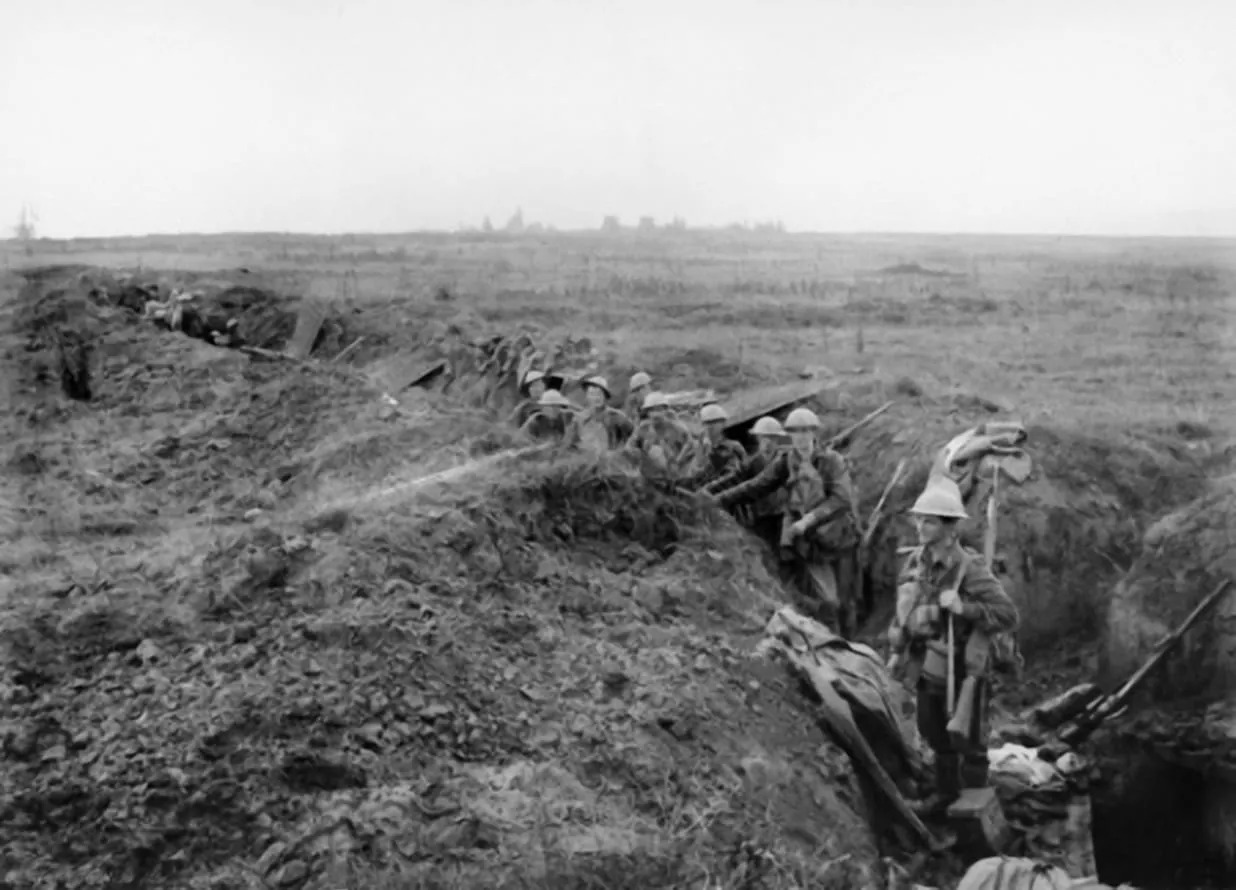
The Battle of Épehy was the second preliminary attack, after the Battle of Havrincourt, before the great assault on the Hindenburg Line. At 5.20 a.m. on 18 September 1918, in rain and mist, three corps of the British Fourth Army of General Henry Rawlinson and V Corps of the Third Army of General Julian Byng attacked on a front about 27 kilometres long, from Holnon near Saint-Quentin to Gouzeaucourt. Their objective was the outer German positions on the ridge in front of the St Quentin Canal, largely old British trenches lost in March at the start of Operation Michael. In the centre two Australian divisions of General John Monash took all their objectives and more than 4,000 prisoners. On the wings, at the fortified villages of Ronssoy and Épehy and in front of Saint-Quentin, fighting went on into the night and the assigned lines were not reached everywhere. Even so, in a single day the British and Australians took more than 9,000 prisoners and came within assaulting distance of the main German position.
Name and dates
The British Battles Nomenclature Committee placed the Battle of Épehy, together with the Battle of Havrincourt of 12 September, among the Battles of the Hindenburg Line, which lasted from 12 September to 9 October. It gave the name Battle of Épehy only to the attack of 18 September. The British official history, written by James Edmonds, describes both actions in a single chapter as preliminary fighting meant to capture the advanced defences of the Hindenburg Line and observation over it before the general attack. Haig in his dispatch spoke of a single “Battle of Havrincourt and Épehy” (12–18 September). Fighting for the last strongpoints in front of the line on the Fourth Army’s sector went on for several more days, until 24–25 September, but the committee gave it no separate name. We describe it briefly in the section on the aftermath. The zero hour of 5.20 is given by the official history. Haig’s dispatch gives 7 o’clock, but divisional war diaries and studies agree on the earlier time.
Background
In early September, after the breaking of the Drocourt–Quéant Line and the end of the Second Battle of the Somme, the Germans fell back to the positions from which they had launched their offensive in March. The main line was the Hindenburg Line (Siegfriedstellung), built in the winter of 1916/1917 and occupied during the retreat in the spring of 1917. Between Saint-Quentin and Gouzeaucourt it ran along the St Quentin Canal, and in front of it lay a wide belt of old defences. In 1917 the British had come right up to the line here, and during the winter of 1917/1918 they had fortified their then outpost line and battle zone. They turned the villages of Ronssoy, Lempire and Épehy into fortresses with barbed wire and deep dugouts. On 21 March 1918 the Germans had taken this belt in the Battle of St Quentin, and now they themselves were defending it as the outworks of the Hindenburg Line. The most important sector for them was the one facing Épehy and Ronssoy. It covered the place where the St Quentin Canal runs for several kilometres through a tunnel at Bellicourt, and above the tunnel tanks could cross without the obstacle that the canal formed elsewhere.
Haig was in no hurry to attack. Since March the British army had lost hundreds of thousands of men, and reinforcements were short. According to some accounts it was only the Third Army’s success at Havrincourt on 12 September that convinced him the Germans were already weaker than they seemed and that Rawlinson could be allowed to attack. Rawlinson discussed the plan with his corps commanders on 12 September, and the Fourth Army’s orders were issued on 13 and 14 September. From 12 to 17 September the corps gained better jumping-off positions. The newly formed IX Corps of General Walter Braithwaite on the right wing advanced more than three and a half kilometres and took Holnon Wood and Maissemy, and the Australians came up to Le Verguier. During the night and morning of 17 September the 6th Division tried once more to win a better start line near Holnon, but the neighbouring French 34th Division did not attack, and the village of Holnon changed hands several times and the British did not hold it.
Plan
According to the British official history, fourteen German divisions faced the Fourth Army, twelve in the line and two in reserve. They belonged mainly to the Second Army of General Georg von der Marwitz and, according to some accounts, on the southern flank also to the Eighteenth Army of General Oskar von Hutier. Their positions lay on a long ridge from Saint-Quentin through Villeret and Ronssoy to Épehy, cut by valleys and spurs. The first objective of the attack was roughly the old British main line, with the fortified villages of Le Verguier, Hargicourt, Ronssoy and Épehy, and the second the old British outpost line. Beyond it lay the advanced position of the Hindenburg Line, which Rawlinson set as the exploitation line, although he did not expect it to be reached on the first day. The trenches and wire were so overgrown with grass and weeds that they were hard to make out from the ground. Only on 15 September did the weather allow aerial photographs, which were distributed to the eight attacking divisions by the evening of 17 September.
As on 8 August at Amiens, Rawlinson relied on surprise. There was no preliminary bombardment. The 1,488 guns were to open fire only at zero hour, lead the infantry with a creeping barrage containing ten per cent smoke shell and engage the German batteries. Tanks were few. Only 20 machines of the 2nd Battalion of the Tank Corps were committed, because the rest were being saved for the assault on the main line. IX Corps got four, the Australian Corps and General Richard Butler’s III Corps eight each. Dummy tanks of canvas on wooden frames were set up near the start line, and the 74th Division, which received no tanks at all, made its own. To the left of the Fourth Army, V Corps of the Third Army was to attack with the 21st, 17th and 38th Divisions, and to the right the French First Army of General Debeney.
Course
The evening of 17 September was fine, and British aircraft bombed the villages behind the front. At about one in the morning, as the infantry was finishing assembling in its jumping-off positions, heavy rain began. At zero hour, 5.20 a.m., it was still raining and thick mist lay in the valleys. It cleared only at about 9.30, but the day remained grey and overcast, so aircraft could do little more than direct artillery fire. The ground became soft and the tanks moved with difficulty. Reports from the front reached divisional headquarters hours late.
Right wing. IX Corps fared worst. The French 34th Division again practically did not attack, so the 6th Division, advancing across open ground towards Saint-Quentin, came under flanking fire from two hills in the French sector, Manchester Hill and Round Hill. A battalion of the Durham Light Infantry fought its way through the village of Holnon but was driven back almost to its start line and lost more men that day than it had numbered at the moment of attack. The assault on the strong trench system known as the Quadrilateral above Fayet stalled. The tanks did not help: two got stuck, a third broke down and a fourth was set on fire. The neighbouring 1st Division reached its second objective on its left, but its right was held up in front of Fresnoy-le-Petit.
Centre. In the centre the Australian 4th Division of General Ewen Sinclair-Maclagan and the 1st Division of General Thomas Glasgow attacked. The battalions were very weak, because reinforcements from Australia had almost stopped arriving: according to the official history they averaged about 360–420 men, and the two divisions put about 6,800 infantrymen into the attack. On top of that, just before the battle, about two hundred married men from each division had left on home leave. Even so, the attack went brilliantly. By 7.35 the whole first objective had been taken, and in fortified Le Verguier alone the Australians took 450 prisoners and 60 machine guns. Sergeant Maurice Buckley of the 13th Battalion knocked out seven German posts there with a Lewis gun, and Private James Woods of the 48th Battalion captured and held a strongpoint with 25 men and six machine guns. Both received the Victoria Cross. At 8.30 the advance moved on. The ruins of Villeret and the maze of trenches around Cologne Farm were taken with the help of tanks, and before 10 the whole second objective was in Australian hands. Monash had not expected much from the exploitation, but the 4th Division broke into the advanced position of the Hindenburg Line and in a night attack at 11 p.m. took the whole exploitation line, capturing more than 300 more prisoners. The 1st Division did not reach it everywhere, but won observation over the canal and the southern entrance of the Bellicourt tunnel. That day the Australian Corps took 4,243 prisoners, 76 guns and more than 300 machine guns, at a cost of 1,260 men.
Left wing. III Corps had the hardest task. According to prisoners’ statements the Germans knew of the attack and did not intend to fall back any further. Butler used all four of his divisions. The 74th (Yeomanry) Division surprised the Germans at Templeux-le-Guérard, where a Suffolk battalion, moved two nights earlier into the Australian sector, struck from the flank and took many prisoners. Its right brigade reached the second objective, but the left was pinned down by machine-gun fire and took it only in the afternoon. The 18th Division stormed Ronssoy, defended by regiments of the 2nd Guard Division. Three tanks helped take the village, but clearing it of Germans hidden in the cellars took a long time, and the 55th Brigade’s attack on the second objective at 5 p.m. ran into the fresh German 121st Division, sent up to counter-attack. At 9 p.m. the British withdrew to the first objective. Épehy, defended by the German Alpine Corps with twelve Jäger battalions, was attacked by the 35th Brigade of the 12th Division, and neighbouring Peizière by the 173rd Brigade of the 58th Division. A tank of the 58th Division lost its way in the mist and fired on men of the 12th Division. The fighting for the ruins lasted all day, and Épehy was reported clear only just before 8 p.m.
V Corps. To the left of the Fourth Army, V Corps of the Third Army attacked without tanks but with well-prepared artillery, gas fired on the German batteries over the three previous nights, and smoke screens. The 21st Division retook Vaucelette Farm, which it had itself defended on 21 March, and the 17th Division took Chapel Hill and Gauche Wood, where the Germans had made a machine-gun nest of four abandoned British tanks left over from the Battle of Cambrai. All the 17th Division’s objectives were taken, and with them 1,069 prisoners. The Welsh 38th Division on the corps’ left fared worse. In the evening the Germans counter-attacked further north, at Havrincourt and Mœuvres, but were repulsed everywhere.
Casualties
According to the British official history, on 18 September the Fourth Army took more than 7,000 prisoners (IX Corps 559, the Australian Corps 4,243, III Corps about 2,300), and V Corps 1,848 prisoners and 24 guns, more than 9,000 in all. Haig stated in his dispatch that in the battles of Havrincourt and Épehy, from 12 to 18 September, fifteen British divisions defeated twenty German ones and took almost 12,000 prisoners and 100 guns. This figure is sometimes attributed to the Battle of Épehy alone. Total British losses in the battle were not published. It is known that the Australians lost 1,260 men, and that some British battalions on the wings, especially in the 6th, 12th, 18th and 74th Divisions, suffered very heavy losses.
Aftermath
Over the following week the Fourth Army’s wings worked their way up to the lines the Australians had taken in the centre on 18 September. On 19 September III Corps took Lempire, and on 21 September it attacked the last defences in front of the Bellicourt tunnel: Quennemont Farm, Guillemont Farm and a hill called the Knoll. The attacks under fire from the main German line failed, and the Germans held these points until the attack on the St Quentin Canal on 29 September, which forced a change of plan and cost the American 27th Division heavy casualties. On the right wing IX Corps and the French attacked again on 24 September and took the Quadrilateral, Fresnoy-le-Petit and Gricourt.
On 21 September there was also the largest refusal to fight in the history of the Australian Imperial Force. The exhausted Australian 1st Battalion, halfway through being relieved, was ordered back into the line to support a neighbouring British unit. Almost the whole of D Company refused, and then some men of other companies as well. According to the Australian War Memorial, the battalion went forward with ten officers and 84 men, while 119 men stayed behind. All were charged not with mutiny but with desertion, which avoided the death penalty, and all but one were convicted. After the armistice Monash did not carry out the sentences. A few days later several Australian battalions refused to obey an order disbanding them, issued for lack of reinforcements.
On the German side, on 22 September Marwitz gave up command of the Second Army and moved to the Fifth Army at Verdun. General Max von Gallwitz in his memoirs linked this change to the failure of the counter-attack of 18 September. On 23–25 September the American 27th and 30th Divisions arrived in the Fourth Army; together with the Australians they were to attack the canal.
Significance
The Battle of Épehy was not a great breakthrough. The wings did not reach their objectives, and no one exploited the Australian success in the centre to help the divisions on the wings. It showed, however, that the Germans could no longer hold even strongly fortified positions they had been ordered to defend. Many of their divisions surrendered more readily than before, and fresh reserves thrown into counter-attacks were repulsed. Edmonds wrote that German resistance in prepared positions could not be compared with that on the Somme in 1916 or at Passchendaele in 1917. On 22 September Haig, impressed by the victories at Saint-Mihiel and Épehy, assured Foch that he was ready to attack the main Hindenburg Line. He did not hide the risk, because the day before the Secretary of State for War, Alfred Milner, had warned him that if the army were bled white there would be no one left to replace its losses the following year. At the end of September the British First, Third and Fourth Armies, together with the French, Americans and Belgians, launched the great offensive in which the Hindenburg Line was broken.
Spotted a mistake?Report an error