1917: The Western Front
German retreat to the Hindenburg Line
- Dates:
- 22 February – 5 April 1917
- Front:
- Western Front
- Location:
- A belt of front from near Arras through Bapaume, Péronne, Roye and Noyon to Laffaux near Soissons, in the Pas-de-Calais, Somme, Oise and Aisne departments (France)On the battle map →
- Sides:
- United Kingdom, Australia and FranceDouglas Haig, Hubert Gough, Henry Rawlinson, Edmund Allenby, Robert Nivelle, Louis Franchet d'Espèrey
- Result:
- German success. The Germans broke contact without significant losses, shortened the front by about 40 km and gained 13–14 reserve divisions. The Allies regained a devastated strip of land.
- Author:
- Łukasz Skowroń
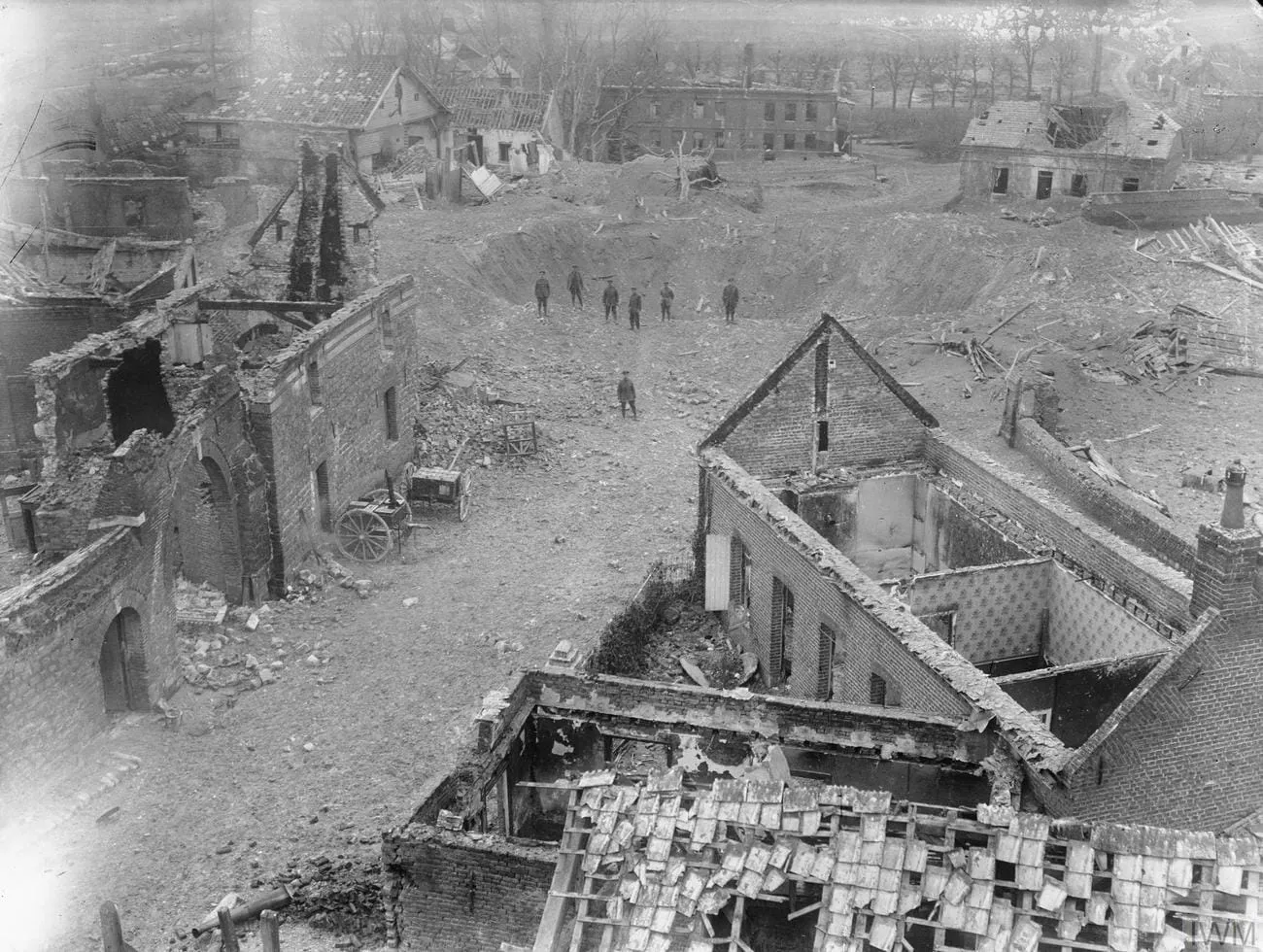
In the spring of 1917 the German army on the Western Front did something that neither side had done since the autumn of 1914: it voluntarily handed the enemy a large stretch of conquered ground. Between the end of February and the beginning of April the troops of several German armies withdrew from the great bulge in the front between Arras and Soissons to a new, carefully prepared position, which the Germans called the Siegfriedstellung and the British the Hindenburg Line. The retreat was preceded and covered by an undertaking code-named “Alberich”: the systematic destruction of the whole belt of land being abandoned. The Germans blew up roads, bridges and railway lines, demolished towns and villages, felled trees, filled in wells and carried off the population. The British and French, who were preparing for a great spring offensive, had to follow them across a wasteland, and part of their plans lost their point.
Name and dates
The German command named the whole undertaking after Alberich, the malicious dwarf who guarded the treasure of the Nibelungs in Germanic legend and in Wagner’s opera. The new position bore the name of another hero of those legends, Siegfried. The British named it after the chief of the German General Staff, Field Marshal Paul von Hindenburg.
The dates of the retreat depend on what is counted as part of it. Under the German plan the destruction and evacuation lasted from 9 February to 15 March, and 16 March was the first of the “marching days” on which the troops were to withdraw to the new position. The main part of the retreat was over by about 19–20 March. After the war the British Battles Nomenclature Committee adopted the name “German retreat to the Hindenburg Line” and the dates 14 March – 5 April 1917, from the first signs of the Germans pulling back in front of the British Fourth Army to the capture of the last forward villages before the new position. The retreat had begun earlier, however, on the Ancre: on the night of 22/23 February the German First Army withdrew there by several kilometres, and the British discovered this on 24–25 February. We therefore take the dates 22 February to 5 April 1917. The main source for this page is the British official history (Cyril Falls, Military Operations France and Belgium 1917, volume I), supplemented by the despatch of Douglas Haig of 31 May 1917.
Background
The Battle of the Somme had cost the German army hundreds of thousands of men. When Hindenburg and General Erich Ludendorff took over the Supreme Command at the end of August 1916, they decided to build several new defensive lines far behind the Western Front, in case the existing positions could not be held. The most important of them, the Siegfriedstellung, was to cut off at its base the great salient of the front that thrust deep into France between Arras and the Aisne valley, with Noyon at its furthest point. It ran from near Arras through Quéant, Saint-Quentin and La Fère to Laffaux near Soissons. Construction began at the end of September 1916.
The new position was not a single line of trenches but a belt of fortifications several kilometres deep: with an outpost zone in front, a battle zone with concrete machine-gun nests arranged in a chequerboard pattern, and a rear position. Wherever possible the trenches were sited on the reverse slopes of hills, out of the enemy’s sight, with the artillery observation posts behind them. In front of the trenches there were usually three belts of wire, each 10–15 yards deep, laid in zigzags so that machine guns could sweep them from the flank. Falls writes that this was mass production applied to fortification: concrete shelters and timber components were made to a single pattern, by the thousand. According to the British official history an average of about 65,000 men worked on the construction every day. Much of the labour was done by Russian prisoners of war, although the Hague Conventions forbade the use of prisoners for work connected with military operations, and also by forcibly employed Belgian civilians, German soldiers and the workers of German construction firms. Between mid-October and mid-March about 1,250 trains of materials arrived.
For a long time it was not settled whether the Germans would fall back to the new position at all. Ludendorff at first hoped that shortening the front would allow him to gather forces for an offensive, for instance in Italy, but the calculations showed that there would not be enough troops for one. The Supreme Command was also unwilling to give up ground without a fight. The winter decided the matter. The German divisions on the Somme were exhausted, their trenches on the Ancre had turned into flooded shell holes, and the censorship of letters reported weariness and low morale. In January the British Fifth Army of General Hubert Gough resumed its attacks in the Ancre valley, pushing the Germans step by step out of one trench after another. On 28 January the commander of the army group on that sector, Crown Prince Rupprecht of Bavaria, demanded permission to retreat. Ludendorff refused as late as 29 January, but on 4 February Kaiser Wilhelm II signed the order. The decision was taken in the same days as the Germans began unrestricted submarine warfare. On land they were to stand on the defensive and wait for the U-boats to force Britain to make peace.
The Alberich plan
The plan for the retreat was drawn up by the staff of Rupprecht’s army group, headed by General Hermann von Kuhl, in as much detail as a mobilisation plan. Thirty-five days, from 9 February to 15 March, were allowed for removing material and guns and for the demolitions. After that the troops were to withdraw over two to four marching days, depending on their distance from the new position.
The whole belt between the old front and the Siegfriedstellung was to be turned into a desert. The order said that the enemy was to find “a completely sucked-dry country”. The Germans dismantled and carried off everything that might be of use, tore up railway lines, blew up bridges and blasted huge craters at crossroads. Towns and villages, and as far as possible every house, were to be burnt or blown up. Trees, even fruit trees, were felled or ringed so that they would wither. Wells were filled in or fouled, though not poisoned. Booby traps were left in abandoned houses and dugouts, often with fuses delayed by many days. The civilian population was carried off. Between ten and twenty thousand people, mostly children, mothers and the elderly, were left in a few spared localities such as Nesle, Ham and Noyon. Falls notes that this was done not out of pity but to get rid of “useless mouths”. About ten times as many people, practically everyone able to work, were taken behind the new line in harsh conditions.
Rupprecht opposed destruction on such a scale. He believed it would give Germany a bad name throughout the world and, instead of hindering the enemy, would give him rubble for mending roads. He also feared for the discipline of the troops. He even considered resigning but was talked out of it, since it would have looked like a rift between Bavaria and the Reich. His fears proved justified: besides the ordered demolitions there was looting and wanton destruction of property. Devastation on so vast a scale, an example of scorched-earth tactics, became one of the main arguments of Allied propaganda.
Course: the Ancre, 22 February – 13 March
The first stage of the retreat was not part of the original plan. On 17 and 18 February the British attacked on both banks of the Ancre near Miraumont. They gained little, but Rupprecht concluded that his exhausted First Army, commanded by General Fritz von Below, would not survive another month of such fighting. On 18 February he ordered it to fall back several kilometres to the first of the intermediate positions, Riegel I, between Essarts and Le Transloy. The infantry withdrew on the night of 22/23 February, leaving only a few posts on the old line.
The British had a warning: on 20 and 21 February they intercepted messages ordering German wireless stations behind the front to prepare to move. The information did not, however, reach the troops. The retreat was discovered by patrols. On the afternoon of 22 February Lieutenant F. L. Lucas of a West Kent battalion of the 18th Division found that there were no Germans on the ridge in front of Petit Miraumont. On the morning of 24 February patrols from a Manchester battalion of the 7th Division went as far as beyond Serre without meeting a living soul. In the evening Gough and the corps commanders ordered the troops forward. On 25 February the British occupied Pys, Serre, the area around Miraumont and Warlencourt. According to Haig’s despatch, by the evening of that day the whole of the first German position from Gueudecourt to Serre was in their hands. Australians of I ANZAC Corps tried to take Malt Trench in front of Riegel I off the march, but without artillery support they were bloodily repulsed.
Over the next two weeks the Fifth Army edged towards the new German line, taking the forward positions of the German rearguards: Le Barque and Thilloy, which the Australians had occupied by 2 March; Puisieux, taken on 27 February after a fight in the church; and Gommecourt, abandoned by the Germans. The pursuit was hampered by mud. On the shell-torn battlefield of the Somme the roads could barely be made out, and guns had to be dragged along wooden troughs or carried on light railways. On 10 March the 2nd and 18th Divisions, in a carefully prepared attack, took Irles and Grévillers Trench, capturing almost 370 prisoners. Gough was preparing to storm Riegel I around 13 March, but the Germans forestalled him again: on the night of 11/12 March they abandoned the central sector of that position and fell back to Riegel II. The British noticed this only the following evening. A hasty night attack on Bucquoy on 14 March, carried out against the protests of the divisional commanders, broke down on uncut wire and cost more than 570 killed, wounded and missing.
Course: the great retreat, 14–20 March
On 14 March the British saw fires in St Pierre Vaast Wood, in front of the Fourth Army of General Henry Rawlinson, and it soon became clear that the Germans were abandoning their trenches there. On 16 March, as planned, the marching days began. Before dawn on 17 March British patrols found that the Germans had gone along the whole front of the Fifth Army and on the right wing of the Third Army of General Edmund Allenby. Haig ordered a general advance from the Roye road to the area of Arras.
On 17 March the Australians entered Bapaume, the coveted objective of the Battle of the Somme, now burnt out and full of blazing houses. That same evening a company from a Royal Warwickshire battalion of the 48th Division crossed the canal on pontoons and was the first to enter Péronne, where the façades of almost all the old houses had been blown out. Haig’s despatch states that Péronne was occupied at 7 a.m. on 18 March, and most accounts accept that date. In Péronne the Germans left a sign: “Nicht ärgern, nur wundern!” (“Don’t be angry, just wonder!”). South of the British, the French Third Army of General Georges Humbert took Roye on 17 March, where it was greeted by some 800 inhabitants whom the Germans had not had time to remove, and the First Army of General Émile Fayolle entered Noyon on 18 March. That day French and British cavalry met at Nesle. On 18 March the retreat also extended to the sector north of Soissons.
The pursuit proved much more difficult than it had seemed in the first hours of rejoicing. The Germans had blown up all the bridges over the Somme and the canals from Offoy to Péronne, and had breached the causeways across the marshes of the Somme valley so that the water spread far and wide. Deep craters were left in the roads, the wells were filled in, and the only material for repairs was the rubble of demolished villages. British sappers hastily built pontoon bridges and makeshift crossings, but the artillery, ammunition and supplies trailed far behind the infantry. The retreat was covered by strong rearguards with machine guns, cavalry and cyclists, which halted in chosen villages and withdrew only under pressure. By 19–20 March the main German forces had reached the Siegfriedstellung.
Course: the fighting for the outposts, 20 March – 5 April
The Germans did not give up the last few kilometres without a fight. They turned the villages lying just in front of the new position into outposts that were to keep the enemy at a distance until work on the line itself was finished. On 20 March the Australians attacked Noreuil without success, losing more than 300 men. On 22 March the Germans struck at French cavalry and cyclists who had crossed the Crozat Canal and drove them back with heavy losses. In the last days of March British cavalry and armoured cars occupied one village after another, such as Villers-Faucon and the surrounding area. On the night of 25/26 March a delayed-action mine hidden by the Germans in the town hall of Bapaume, which had been judged safe, exploded. Many sleeping soldiers were killed, mostly Australians, along with two French deputies. On 27 March German sappers blew up the medieval keep of the castle at Coucy, one of the largest defensive structures in Europe, which Rupprecht particularly regretted.
At the beginning of April the British took the last outposts in front of the Hindenburg Line. The Australians had already taken Lagnicourt on 26 March, and on 2 April a whole chain of villages on the northern sector fell, among them Noreuil, Doignies and Croisilles. Metz-en-Couture fell on 4 April and Lempire on 5 April. With that the British official history ends the retreat. Along the whole length from Arras to the Aisne the Allies stood before the new German position, which they could not attack without bringing heavy artillery up across the wasteland.
Losses
No one has compiled the losses of the whole retreat. Both sides avoided major fighting, and most of the clashes were skirmishes between advanced guards and rearguards. The Allies suffered their heaviest losses in a few failed or hasty attacks: the 2nd Australian Division lost about 170 men at Malt Trench on 25 February, two British brigades more than 570 at Bucquoy on 14 March, and the Australians more than 300 at Noreuil on 20 March. Those who suffered most were the civilians, carried off from their homes or left in the ruins, and the land itself: hundreds of villages, several towns and whole orchards vanished.
Significance
The Germans shortened the front by about 40 kilometres and eliminated two salients, between Arras and Bapaume and the much larger one between Péronne and the Aisne. According to Falls they thereby saved 13–14 divisions, which they could hold in reserve. The British official history calls the conduct of the retreat a “masterpiece of organisation” by Rupprecht and Kuhl. According to some historians the Allies regained more French territory than they had won in fighting since the autumn of 1914, but it was devastated land, and the inhabitants who returned found only ashes and ruins.
The retreat struck at the plan of General Robert Nivelle, who had commanded the French armies since December. The main French attack was to go in on the Aisne and the British one at Arras, that is, against the base of the salient that had just been abandoned. The French Northern Army Group under General Louis Franchet d’Espèrey was to strike between the Oise and the Avre, but its objective had vanished. As early as 4 March Franchet d’Espèrey had proposed attacking the Germans while they were preparing to retreat. Nivelle refused and as late as 7 March wrote that he saw no certain signs that the retreat would extend to that sector. Falls believes that this prohibition may have cost the French a great success. Despite the changed situation Nivelle did not substantially alter his plan. On 9 April the British attacked at Arras, and a week later the Nivelle Offensive began on the Aisne, ending in a heavy defeat.
From then on the Hindenburg Line was of great importance. The British attacked it in 1917 at Bullecourt and Cambrai, and broke through it only in September 1918, in the last great offensive of the war.
Spotted a mistake?Report an error
On the timeline
(06)1917
February
March
- 17
- British take BapaumeOn 17 March 1917 the Australians entered burning Bapaume, goal of the Somme battle. The Germans gave it up without a fight, falling back to the Hindenburg Line.
- French take RoyeOn 17 March 1917 the French advance guard entered Roye, ruined by the Germans. About 800 inhabitants whom the occupiers had not deported awaited the troops.