Key event
Germany declares unrestricted submarine warfare
- Category:
- Military
- Front:
- War at sea
- Date:
- 31 January 1917
- Author:
- Łukasz Skowroń
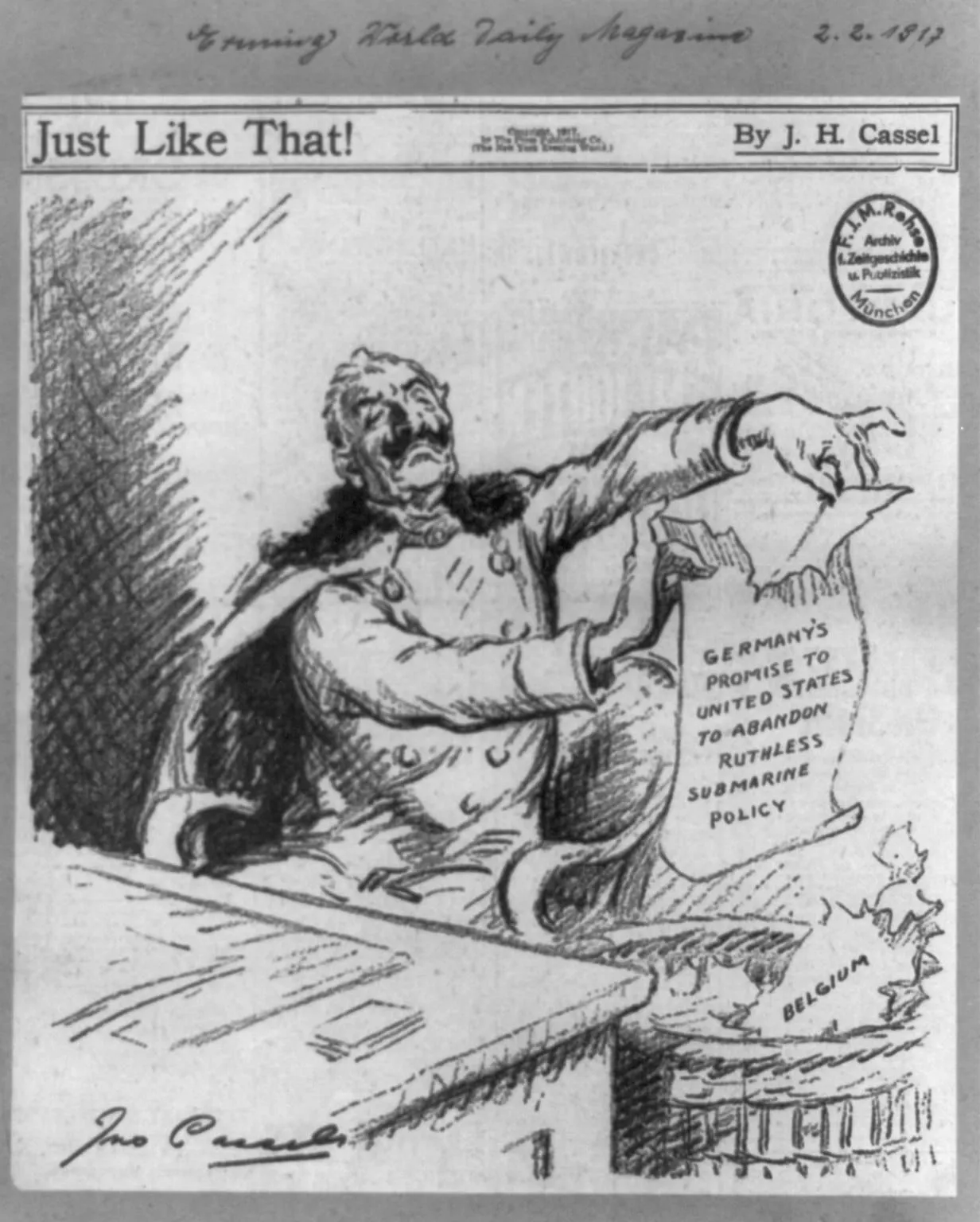
On the afternoon of 31 January 1917 the German Ambassador in Washington, Count Johann Heinrich von Bernstorff, handed Secretary of State Robert Lansing a note from his government with two memoranda. In it Germany announced that from 1 February, in zones around Great Britain, France and Italy and in the eastern Mediterranean, it would stop “with every available weapon” all shipping, including that of neutral states. Every ship met in these zones was to be sunk without warning. On the same day the American Ambassador in Berlin, James W. Gerard, received an identical message, and Austria-Hungary announced a similar blockade zone around Italy. Germany was abandoning, at a few hours’ notice, the undertakings it had given after the crisis caused by the sinking of the Sussex. Unrestricted submarine warfare was beginning, as the German navy had demanded for two years and the Supreme Army Command for half a year.
The last card
The advocates of unrestricted submarine warfare had lost the argument in March 1916, when the Kaiser agreed only to a limited campaign, and again after the sinking of the Sussex, when Germany pledged to the United States that it would not sink merchant ships without warning. In the autumn of 1916 their position grew stronger. The new heads of the army, Paul von Hindenburg and Erich Ludendorff, no longer believed in victory on land after the bloody battles of Verdun and the Somme. On 22 December the Chief of the Admiralty Staff, Admiral Henning von Holtzendorff, sent Hindenburg a lengthy memorandum. In it he calculated that Great Britain was supplied by about 10.75 million tons of British and neutral shipping. If U-boats sank 600,000 tons a month without restriction, and at least two-fifths of neutral shipowners stopped sailing to England out of fear, British sea trade would shrink by 39 per cent after five months. According to the admiral, the worldwide failure of the 1916 grain harvest offered an exceptional opportunity. The conclusion was clear: unrestricted submarine warfare, begun in good time, would force Great Britain to make peace before the harvest, that is before 1 August 1917, and the risk of a break with America had to be accepted “because we have no other choice”.
The Chancellor, Theobald von Bethmann Hollweg, asked for a delay at least until the Entente had replied to the German peace offer. The Vice-Chancellor, Karl Helfferich, regarded the Admiralty’s calculations as pure speculation, especially as they left America’s resources out of account entirely. Hindenburg, however, let the Chancellor understand that in military matters he would do what he thought right, even against the Chancellor’s view. The Entente rejected the offer on 30 December, and the Chancellor promised to come to headquarters at Pless.
On 8 January Hindenburg, Ludendorff and Holtzendorff discussed what to do if the Chancellor did not agree. According to the minutes, Hindenburg said: “We are reckoning with the possibility of war with the United States and have made every preparation. Things cannot be worse than they are now. The war must be ended as quickly as possible by every means.” The next morning Bethmann Hollweg spent about an hour trying in vain to persuade the generals, and on the evening of 9 January, at a conference with Kaiser Wilhelm II in the castle at Pless, he no longer put up a real fight. According to the minutes, he said that the prospects of unrestricted submarine warfare were very favourable but could not be proved. “The submarine war is the last card. We are taking a very grave decision, but if the military authorities consider it necessary, I am not in a position to oppose them.” The Chief of the Naval Cabinet, Admiral Georg Alexander von Müller, noted that this was not consent but acceptance of the facts. The Kaiser ordered unrestricted submarine warfare to begin on 1 February with full force. The Chancellor considered resigning but stayed in office. He later wrote that, given the unity of the Kaiser, the army and the navy, his departure would have changed nothing.
Three weeks
The decision was kept secret. On 16 January Bernstorff received instructions to announce it only on the eve of the campaign. The Zimmermann Telegram, with its offer of an alliance to Mexico, was attached to the same dispatch. Austria-Hungary learned of the decision only on 20 January, when Holtzendorff and the Foreign Secretary, Arthur Zimmermann, came to Vienna. Emperor Charles I and the Foreign Minister, Ottokar Czernin, had doubts, but faced with a fait accompli Vienna agreed, and without the Austro-Hungarian bases on the Adriatic a campaign in the Mediterranean would have been impossible.
In Washington President Woodrow Wilson still believed in peace. After the Entente’s terms were announced, on 22 January he gave his “peace without victory” speech in the Senate. A few days later his adviser, Colonel Edward Mandell House, told Bernstorff that the President was officially and confidentially offering mediation and asking Germany to state its peace terms. On 27 January Bernstorff begged Berlin for a delay: if submarine warfare began at once, Wilson would take it as a slap in the face, and war with the United States would become inevitable. The answer came only on the eve of the deadline. On 31 January Bernstorff confidentially passed House the German peace terms, among them a frontier meant to protect Germany and Poland against Russia, and “guarantees” in Belgium. He added that the government would gladly have postponed the submarine blockade, but the preparations could no longer be cancelled. That same afternoon the ambassador handed Lansing the note.
The note and the zones
The note opened with a courteous reference to Wilson’s speech and assurances that Germany shared many of his principles, such as the freedom of the seas and the equal rights of nations. The Reich government then accused Great Britain of having tried for two and a half years to starve Germany into submission, and the Entente of wanting, after rejecting the peace offer, to dismember and humiliate the Central Powers. Germany was therefore regaining the freedom of action it had reserved for itself in its note of 4 May 1916. The northern zone covered the waters from the coast of the Netherlands and the island of Terschelling to Norway and the Faroe Islands, and the whole belt of the Atlantic west of Ireland and France as far as the northern coast of Spain. In the Mediterranean only the waters off the Spanish coast and a narrow corridor to Greece were left to neutrals. Neutral ships that were in ports within the zone on 1 February could leave them safely until 5 February, and those already under way were promised a certain period of grace.
One exception was made for America, which Washington regarded as humiliating. Regular American passenger ships could continue to sail, but only one a week in each direction and only to Falmouth in Cornwall, on a set course past the Scilly Isles. They had to arrive on Sunday and leave on Wednesday, carry on their hulls and superstructures three vertical stripes a metre wide, alternately white and red, and fly chequered red-and-white flags on their masts. The United States government was to guarantee that they carried no contraband as defined by the German list.
Two days earlier, on 29 January, Germany had informed the British and French governments, through the American and Spanish embassies, that the Allies were using hospital ships to carry troops and munitions. From then on no hospital ship would be tolerated in the waters between a line from Flamborough Head to Terschelling and a line from Ushant (PL) to Land’s End, that is in the North Sea and the English Channel, through which the wounded were carried from France.
The Chancellor’s speech
Also on 31 January Bethmann Hollweg explained the decision to a Reichstag committee. In his view responsibility for continuing the war fell solely on the enemy, who had rejected negotiations and announced terms that only a completely defeated nation could accept. He recalled that as early as March 1916 he had said: “Once the most ruthless methods are considered the best means of leading us to victory, and a swift victory, they must be used.” “That moment has now come,” he declared. In the autumn the time had not yet been ripe. Now Germany had far more U-boats than in the spring, while Great Britain, France and Italy were suffering from poor harvests and shortages of coal and tonnage. The Chancellor also quoted Hindenburg, according to whom the front was holding firm and the military situation allowed Germany to accept all the consequences of unrestricted submarine warfare. “We are staking everything on one card, and we shall win,” he said.
According to the British official history of the war at sea, in February 1917 Germany had 111 operational U-boats: 49 in the North Sea ports, 33 in Flanders, 24 at Pola on the Adriatic, two at Constantinople and three in the Baltic. About a third of them were at sea at any one time. Since October 1916, still waging a restricted campaign, they had been sinking a little over 300,000 tons a month. Now they were to sink twice as much.
What came next
Wilson did not hesitate long. On 3 February he told Congress that the United States was breaking off diplomatic relations with Germany, and Bernstorff was handed his passports. The President still hoped that Germany would not go as far as sinking American ships. In the first months, however, more was sunk than Holtzendorff had promised: over 500,000 tons in February and over 860,000 in April, the most of the whole war. At the end of February the British passed the Zimmermann Telegram to the Americans, and in March U-boats sank several American ships. On 6 April 1917 the United States declared war on Germany.
Great Britain did not capitulate before the harvest. In the spring of 1917 its position was dangerous, but the introduction of the convoy system brought losses down, and American shipyards built new ships. Unrestricted submarine warfare did not bring Germany victory; instead it brought the United States Army to the Western Front. Bethmann Hollweg lost office in July 1917.
Remember the articles you have read? Only in this browser; nothing is sent anywhere.How it works
Read ·
A voice from the front
“On 31 January at 5 o'clock in the afternoon I made Mr Lansing the prescribed communication about unrestricted U-boat warfare. It was my last political conversation in America. We both knew that the end had come, but we did not say so to each other. The Secretary of State contented himself with replying that he would lay my communication before the President.”
Translated · Original (de)
Am 31. Januar nachmittags 5 Uhr machte ich Herrn Lansing die vorgeschriebene Mitteilung über den uneingeschränkten U-Bootkrieg. Es war meine letzte politische Unterredung in Amerika. Wir wußten beide, daß das Ende gekommen sei, aber wir sagten es uns nicht. Der Staatssekretär begnügte sich damit zu antworten, daß er dem Präsidenten meine Mitteilung unterbreiten werde.
Spotted a mistake?Report an error
Meanwhile
(04)Elsewhere in the same days.
- 1 February 1917 · DiplomacyPetrograd ConferenceOn 1 February 1917 a conference of Russia, Britain, France and Italy met in Petrograd. It was to agree the 1917 offensives and arms deliveries to Russia.
- 2 February 1917 · Western FrontPortuguese land in FranceOn 2 February 1917 the 1st Brigade of the Portuguese Expeditionary Corps landed at Brest. The Portuguese went on to Flanders to train under British guidance.
- 3 February 1917 · DiplomacyUS breaks off relations with GermanyOn 3 February 1917 Wilson told Congress that the United States was breaking off diplomatic relations with Germany. Ambassador Bernstorff got his passports.
- 3 February 1917 · Middle EastFighting in the Siwa OasisOn 3 February 1917 British armoured cars attacked the Senussi camp at Girba. Sayyid Ahmad escaped, and on 5 February the British entered Siwa.
Related events
(04)The same battle, people or subject.
- 19 January 1917 · DiplomacyThe Zimmermann TelegramOn 19 January 1917 the German embassy in Washington passed a secret offer of an alliance against the US to Mexico. The British had been reading it for two days.
- 6 April 1917 · DiplomacyUnited States declares war on GermanyOn 6 April 1917 the House of Representatives passed the war resolution and Wilson signed it. The United States was at war with Germany.
- 8 April 1917 · DiplomacyAustria-Hungary breaks off relations with the USOn 8 April 1917 in Vienna Czernin handed the American chargé d'affaires his passports. As Germany's ally, Austria-Hungary broke off relations with the US.
- 11 January 1917 · DiplomacyCentral Powers' note on responsibility for the warOn 11 January 1917 Germany and Austria-Hungary answered the Entente's refusal in notes to the neutrals, blaming their enemies for the continuing war.