United States · The Entente
Robert Lansing
Counselor of the State Department (1914–1915), United States Secretary of State (1915–1920)
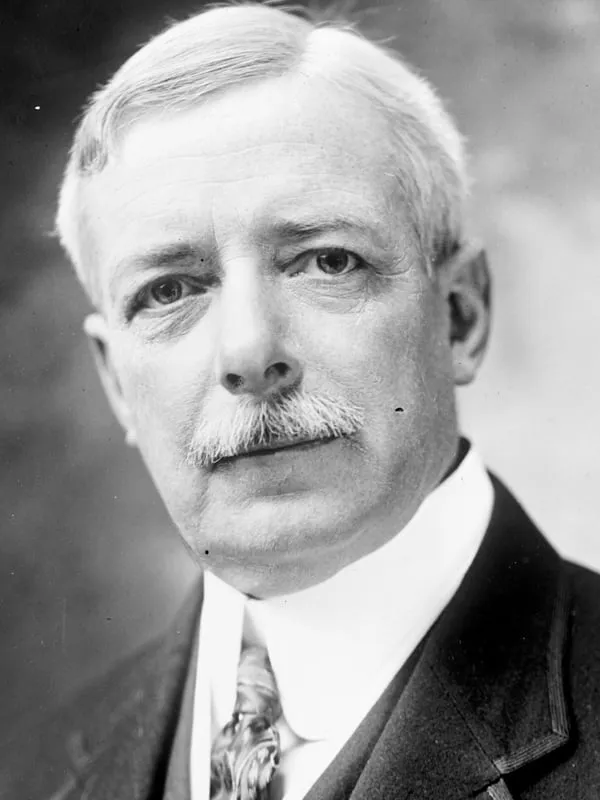
- Born:
- 17 October 1864, Watertown (New York, United States)
- Died:
- 30 October 1928, Washington, D.C.
- Author:
- Natalia
- Photo:
- National Photo Company Collection, domena publiczna, Wikimedia Commons

Robert Lansing directed American diplomacy for almost the whole war, from June 1915 to February 1920, but he was never its real author. Foreign policy was conducted by President Woodrow Wilson himself and, alongside him, by his trusted adviser, Colonel Edward House. Lansing was a lawyer, a specialist in international law, and the author and signatory of dozens of notes in which the United States argued with Germany over submarine warfare and with Britain over the blockade, and in which in October 1918 it passed on the armistice terms to Germany. Privately he was convinced from 1915 that America ought to side with the Entente, and he did a great deal to bring that about. In Paris in 1919 he did not believe in the League of Nations or in national self-determination, which in the end cost him his post.
Before the war
He was born on 17 October 1864 in Watertown, New York, into a family of lawyers with long roots in the state. He graduated from Amherst College in 1886 and from 1889 worked in the family law firm in Watertown. In 1890 he married Eleanor Foster, daughter of John W. Foster, Secretary of State under Benjamin Harrison, who introduced his son-in-law to the world of diplomacy. His nephews by marriage were the Dulles brothers, of whom John Foster Dulles became Secretary of State years later and Allen head of intelligence.
Lansing specialised in international disputes settled by arbitration. He represented the United States in the Bering Sea fur-seal arbitration in 1892–1893, before the tribunal that fixed the Alaska boundary in 1903, and at The Hague in the North Atlantic fisheries dispute in 1909–1910. He co-founded the American Society of International Law and its journal. He was a conservative Democrat, a pedantic, reserved and taciturn man who in his spare time drew caricatures and wrote poems. In April 1914 he became Counselor of the State Department, the second man in the department, then headed by the pacifist William Jennings Bryan.
Counselor: the neutrality disputes
Bryan knew nothing of international law and was often away, so the drafting of notes on neutrality fell to Lansing. In the autumn of 1914, as acting Secretary of State, he conducted the dispute with London over the rules of naval warfare. On 22 October he withdrew the American proposal that the belligerents apply the Declaration of London of 1909 and announced that the United States would defend its rights case by case. Soon, however, he began to see the war differently from his superior. When an American was killed in the spring of 1915 on the sunken Falaba, he argued for a firm protest to Germany. After the sinking of the Lusitania on 7 May 1915 he came, as he later wrote, to the conviction that America would ultimately become Britain’s ally.
Secretary of State
In June 1915 Bryan refused to sign the second, sharp Lusitania note and resigned. Lansing sent it on 9 June as acting secretary, and on 23 June Wilson appointed him Secretary of State. The choice was not accidental. Lansing had no political following of his own, and House advised the President to pick someone who did not have “too many ideas of his own”. Wilson intended in practice to be his own foreign minister and often treated Lansing as a clerk for drafting notes. He typed important texts himself and handed them to the Secretary of State to send.
Within these limits, however, Lansing had considerable influence. He made sure that the dispute with London over the blockade did not go beyond an exchange of notes, while every German offence became a public matter. After the sinking of the Arabic in August 1915 it was to him that the German ambassador Johann Heinrich von Bernstorff gave on 1 September a written assurance that submarines would not sink liners without warning. In September, when secret operations in American factories came to light, Lansing demanded the recall of the Austro-Hungarian ambassador Konstantin Dumba, and in December that of the German attachés Karl Boy-Ed and Franz von Papen. After the sinking of the Italian liner Ancona by a submarine flying the Austro-Hungarian flag he sent a sharp note to Vienna. In September 1915 he argued to the President that without credits for the Entente American exports would collapse, and Wilson stopped opposing large bank loans to London and Paris.
Not all of Lansing’s ideas succeeded. In January 1916 he proposed a compromise to the Allies under which merchant ships would give up their armament in exchange for submarines observing the rules of cruiser warfare. The British regarded it as a concession to Germany, and Berlin announced that it would treat armed merchant ships as warships, that is, sink them without warning. On 15 February Lansing had to declare that the United States would not change the existing rules of maritime law during the war, which meant abandoning his idea, and a fierce dispute broke out in Congress over whether to warn Americans against travelling on armed ships. After the torpedoing of the ferry Sussex Lansing argued for an immediate break in relations with Germany, but Wilson chose an ultimatum, which the Secretary of State sent on 18 April 1916. On 4 August 1916 he signed with the Danish minister a treaty for the purchase of the Danish West Indies, which the United States, fearing their seizure by Germany, took over in March 1917 as the Virgin Islands.
The break and the war
In December 1916 it was Lansing who circulated Wilson’s peace note. He did not believe in it and soon nearly buried it. On 21 December he told journalists that the United States was “drawing nearer the verge of war”, which Europe read as a sign that neutrality was being abandoned, and on the same day he had to explain away his words. When Germany announced unrestricted submarine warfare, he urged the President from the first moment to break relations. According to his notes, at the cabinet meeting of 2 February 1917 he argued that a lasting peace required the democratisation of all nations and that an Allied victory was in America’s interest. The next day the United States broke off relations with Germany, and on 6 April it entered the war.
As Secretary of State of a belligerent country, Lansing handled matters that Wilson left to him more willingly. In March 1917 he recognised the Russian Provisional Government, the first foreign government to do so. In September he made public intercepted telegrams of German diplomats, including the Bernstorff telegram asking for money to influence Congress. On 2 November 1917 he concluded with the Japanese envoy Kikujirō Ishii an agreement on China, in which Washington recognised Japan’s “special interests” in China and Tokyo reaffirmed the Open Door principle. Each side understood it in its own way. On 10 November 1917 Lansing instructed the ambassador in Paris to recognise the Polish National Committee as an official Polish organisation. In June 1918 he announced that all the Slav peoples should be completely freed from German and Austrian rule, and this Lansing declaration in practice ended American support for preserving the Habsburg monarchy. In September he recognised the Czechoslovak National Council as a de facto government. Towards the Bolsheviks he was implacable. He regarded them as a threat to the social order of the whole world and opposed their recognition.
In the autumn of 1918 the whole exchange of notes with Germany passed through Lansing’s hands. It was he who handed the Swiss chargé d’affaires the President’s first, second and third replies, and on 5 November the last note, which conveyed the Allies’ reservations on the Fourteen Points and directed the German plenipotentiaries to Marshal Ferdinand Foch.
Paris
Lansing went to the peace conference as one of the five American plenipotentiaries, but it quickly became clear that Wilson did not take his views into account. The Secretary of State did not believe that the League of Nations in the form proposed by the President could work, and he proposed a more modest organisation based on courts of arbitration. He was sceptical of the principle of self-determination. In private notes of December 1918 he wrote that the phrase was “loaded with dynamite” and would raise hopes that could never be realised. He chaired the commission on responsibility for the war and, together with the other American delegate, opposed bringing Kaiser Wilhelm II before an international tribunal, because in his view there was no law that allowed it. He also judged the finished Treaty of Versailles critically, considering it too harsh and contrary to the promises made, but he did not leave the delegation.
In September 1919 his scepticism came to light. A former member of the delegation, William Bullitt, testified before the Senate Foreign Relations Committee that Lansing had told him the League was “entirely useless”, and that if the Senate and the people understood the treaty they would reject it. Wilson, who was then fighting for ratification, regarded this as disloyalty.
Dismissal
On 2 October 1919 the President suffered a severe stroke. Lansing then summoned the President’s doctor and his secretary to explain whether Wilson could perform his duties, and reportedly wondered whether Vice President Thomas Marshall should take them over. Over the following months he called cabinet meetings so that the government could work without the President. In February 1920 Wilson, increasingly suspicious, asked him in a letter whether it was true that he had been calling the cabinet without his knowledge. Lansing replied that he had done so in good faith, and on 12 February he resigned; the resignation was accepted the next day. Public opinion rather took his side, and the manner of his dismissal damaged the President. Lansing’s successor was Bainbridge Colby.
After the war
Lansing returned to legal practice in Washington. In 1921 he published two books on the peace conference, “The Peace Negotiations” and “The Big Four and Others of the Peace Conference”, in which he explained his differences with Wilson. He died in Washington on 30 October 1928 and was buried in his family’s home town of Watertown. His war memoirs were published posthumously in 1935.
Assessment
Historians differ in their assessment of Lansing’s role. To some he was merely an efficient official in the shadow of the President and House; to others he was one of the men who pushed the United States towards war. The latter point out that as Counselor and Secretary of State he consistently softened disputes with London and sharpened disputes with Berlin, and that as early as the summer of 1915 he regarded a German victory as a threat to America. The German historian Gerhard Ritter called him the coolest head among Wilson’s advisers, the least constrained by moral considerations. Wilson’s biographer John Milton Cooper, on the other hand, judged that appointing Lansing and treating him as a clerk was one of the President’s worst mistakes, because the offended Secretary of State in time began to act behind his back. His scepticism about the League of Nations and self-determination, criticised by Wilson’s supporters, has been seen by some later scholars as a sober warning against hopes that the Versailles order failed to fulfil.
Sources
Spotted a mistake?Report an error
Often appears with
People who appear in the same events.
On the timeline
(79)1914
1915
1916
1917
January
February
March
April
May
June
August
September
- 21
- The Bernstorff affairOn 21 September 1917 Lansing released a cable in which Ambassador Bernstorff asked Berlin for $50,000 to influence Congress. Washington was in uproar.
- Costa Rica breaks off relations with GermanyOn 21 September 1917 Federico Tinoco's government, not recognised by Washington, broke off relations with Germany, hoping to win over Wilson.
October
November
December
1918
January
March
April
May
June
August
September
- 15
- Austrian peace noteIn mid-September 1918 Austria-Hungary invited all the belligerents to confidential talks on peace. Wilson rejected the proposal in under half an hour.
- German peace offer to BelgiumOn 15 September 1918 news spread that Germany had offered Belgium peace. The government in Le Havre rejected it, and Berlin denied any offer had been made.
October
- 04
- Key eventPeace notes to WilsonOn 4 October 1918 Germany and Austria-Hungary sent President Wilson notes asking for an armistice and peace talks on the basis of the Fourteen Points.
- Haller becomes commander-in-chiefOn 4 October 1918 the Polish National Committee appointed Gen. Józef Haller commander-in-chief of the Polish Army. On 6 October he took the oath at the front.
- 14
- Wilson's second noteOn 14 October 1918 Wilson demanded guarantees of Allied superiority, an end to attacks on passenger ships and a change of rule. Berlin gave way on 20 October.
- Turkish peace noteOn 14 October 1918 President Wilson received, via Spain, an Ottoman government note asking for an armistice and peace on the basis of the Fourteen Points.
- 18
- Wilson's reply to Austria-HungaryIn October 1918 Wilson rejected Austria-Hungary's request for an armistice. Autonomy for its peoples was no longer enough; they were to decide their own fate.
- The Washington DeclarationOn 18 October 1918 Masaryk handed in Czechoslovakia's declaration of independence in Washington. It proclaimed a republic and broke with the Habsburgs.