Germany · The Central Powers
Johann Heinrich von Bernstorff
German ambassador to the United States (1908–1917) and to the Ottoman Empire (1917–1918)
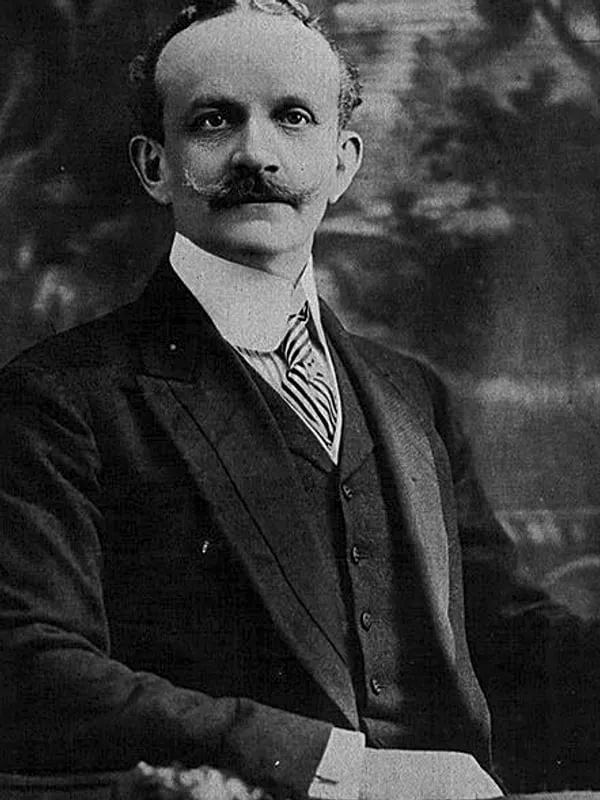
- Born:
- 14 November 1862, London (United Kingdom)
- Died:
- 6 October 1939, Geneva
- Author:
- Łukasz Skowroń
- Photo:
- autor nieznany, domena publiczna, Wikimedia Commons

Count Johann Heinrich von Bernstorff was, during the Great War, Germany’s most important diplomat in a neutral country. As ambassador in Washington he fought a long duel over submarine warfare with Woodrow Wilson and his secretaries of state: after the sinking of the Lusitania, the Arabic and the Sussex he each time averted the threat of a break in relations, often going beyond his instructions from Berlin. He argued to his government that war with America meant Germany’s defeat, and until the last moment he hoped for a peace mediated by Wilson. At the same time his embassy shielded and financed propaganda, espionage and sabotage in the United States. In America he became a symbol of German duplicity, and in Germany, for the right, a symbol of defeatism. Historians today see him above all as a diplomat who accurately foresaw the consequences of decisions he was unable to prevent.
Before the war
He was born on 14 November 1862 in London, where his father, Albrecht von Bernstorff, a former Prussian foreign minister, was envoy and later ambassador. He spent the first ten years of his life in England, and English became his second mother tongue. After his father’s death in 1873 the family returned to Germany. His father had been an opponent of Bismarck, and the feud between the two families closed the path to diplomacy to the son for several years, so Bernstorff served for eight years as an officer in the Guards artillery in Berlin. In 1887 he married Jeanne Luckemeyer, the New York-born daughter of a wealthy merchant of German origin.
When relations with the Bismarcks improved, he began his diplomatic career. He worked in Constantinople, Belgrade, Dresden, St Petersburg and Munich, was counsellor of the embassy in London from 1902 to 1906, and then consul general in Cairo. Everywhere he advocated an understanding with Britain, and he considered the policy of Wilhelm II reckless. In 1908 he became ambassador in Washington. He maintained that Berlin underestimated the United States, which his superiors treated as a second-rate power, but he failed to convince them.
1914–1915: propaganda, sabotage and the Lusitania
The outbreak of war found Bernstorff on leave in Germany. In Berlin he was instructed to explain the German point of view to the Americans. He returned to New York on 23 August 1914, and with him came Bernhard Dernburg, who was to run propaganda and seek loans, and Heinrich Albert, who was to buy goods in America for Germany. The embassy soon became the centre of extensive activity. The military attaché Franz von Papen and the naval attaché Karl Boy-Ed organised supplies for German ships, forged passports for reservists, and later also attacks on Canadian railway lines and American munitions factories. Bernstorff later claimed that the orders to the agents had come from Berlin, bypassing him. Historians do not fully believe this: he knew enough to try to know as little as possible, and according to documents published in 1916 some of the money for Papen’s office passed through the embassy.
Submarine warfare proved the most serious challenge. Bernstorff considered it legally dubious and contrary to the interests of Germany, which needed American neutrality more than anything else. The embassy’s notice warning travellers against voyages into the war zone appeared in the New York press on the day the Lusitania sailed on her last voyage. After she was sunk on 7 May 1915, with the loss of more than a hundred Americans, Bernstorff urged Berlin to accept responsibility for the deaths of neutral citizens. When in August a U-boat sank the British liner Arabic and more Americans died, the ambassador on 1 September gave Secretary of State Robert Lansing a written assurance that submarines would not sink liners without warning and without ensuring the safety of passengers. In America it was regarded as a success for Wilson. In this and later matters Bernstorff more than once went beyond his instructions from Berlin and was sometimes reprimanded for it.
In the autumn scandals came thick and fast. In September the Americans demanded the recall of the Austro-Hungarian ambassador Konstantin Dumba, caught planning to incite workers in munitions factories, and in December Lansing demanded the recall of Boy-Ed and Papen. Bernstorff asked that the announcement should make clear that he himself was not involved in the affair, and on 10 December he gave notice that the Kaiser had recalled them both.
1916: the Sussex and the hope of mediation
At the beginning of 1916 Bernstorff conducted difficult negotiations with Lansing over compensation for the Lusitania. In February the German government agreed to express regret and to pay, but at the same time announced that armed merchant ships would be treated as warships, and the agreement stalled. When in March a U-boat torpedoed the ferry Sussex and Wilson threatened in a sharp note to break off relations, Bernstorff warned Berlin that without a quick concession war with America was certain. Chancellor Theobald von Bethmann Hollweg then forced through, against the admiralty, the so-called Sussex pledge: submarines were to observe the rules of the law of the sea. In the disputes over submarine warfare the ambassador was one of the chancellor’s most important allies against the advocates of unrestricted submarine warfare, headed by Alfred von Tirpitz.
Bernstorff saw the only way out of the war in a compromise peace mediated by Wilson. He kept in close touch with his adviser, Colonel Edward House, and assured Berlin that after the election in November 1916 the president would come forward with a peace initiative. When in the autumn U-53 put into Newport and sank several ships off the American coast, Wilson made it clear to him that such an incident must not be repeated. Berlin did not wait for Wilson and on 12 December announced its own peace offer. A few days later the president issued a note asking both sides to state their terms. Germany replied evasively.
1917: the break
In January 1917 Bernstorff learned that the decision for unrestricted submarine warfare from 1 February had already been taken in Germany. He also forwarded to the legation in Mexico the Zimmermann Telegram, in which the state secretary proposed to Mexico an alliance against the United States. At the same time Wilson, in a speech to the Senate, called for “peace without victory”, and House passed the ambassador a confidential offer of mediation and a request for the German terms. On 22 January Bernstorff asked Berlin for money to influence Congress, and on 27 January he begged for the submarine campaign to be postponed: if it began at once, Wilson would regard it as a slap in the face and war with America would become inevitable. The reply changed nothing. On 31 January the ambassador had to hand Lansing the note announcing unrestricted submarine warfare, and the same day he passed to House the German peace terms, which had come too late.
On 3 February Wilson broke off diplomatic relations with Germany, and Bernstorff was handed his passports. On 14 February he sailed from New York on the Danish ship Frederik VIII. The British stopped him at Halifax and searched the ship thoroughly, and he reached Germany via Norway and Denmark. Years later he argued that America’s entry into the war had been decided not by the Zimmermann Telegram but by the resumption of unrestricted submarine warfare. On 6 April the United States declared war on Germany. In September Lansing published his January dispatch about $50,000 for influencing Congress, and in October further documents linking the embassy with sabotage plans. Several American universities withdrew the honorary doctorates they had earlier conferred on him.
Constantinople
In Berlin Bernstorff talked with Reichstag deputies, among them Matthias Erzberger, and maintained his conviction that Wilson could still mediate, which may have influenced the July Reichstag peace resolution. According to some historians, Bethmann Hollweg, on stepping down in July 1917, proposed him as his successor, but the Kaiser and Erich Ludendorff considered him a democrat. Opponents in Pan-German circles and in the Supreme Army Command had him removed from Berlin: in the summer of 1917 he became ambassador in Constantinople.
There he came face to face with the consequences of the Armenian genocide. On Berlin’s instructions he protested against the persecution and demanded the return of the deportees, without result. In his memoirs he quoted the words of the interior minister, from 1917 Grand Vizier, Talaat Pasha, who in reply to his insistence said with a smile that the matter was settled, because “there are no more Armenians”. Some historians, however, accuse him of rather avoiding the subject in his talks with the Turks. In the spring of 1918 he warned the Turks against the march into Transcaucasia, which violated the provisions of the Treaty of Brest-Litovsk. He also favoured plans for Jewish settlement in Palestine and, according to German scholars, helped to prevent the deportations of Jews that some Young Turk leaders were considering.
After the war
In October 1918 he declined the post of state secretary for foreign affairs in the government of Prince Max of Baden, but returned to Berlin and helped prepare the peace negotiations. In 1919 he turned down the foreign ministry of the Republic and left diplomacy. He was one of the founders of the liberal German Democratic Party, sat in the Reichstag from 1921 to 1928, and as president of the German League for the League of Nations and a delegate to the disarmament talks in Geneva he was one of the best-known German advocates of international cooperation. In 1920 he published his memoirs of America. Hitler named him among those guilty of Germany’s defeat. After the Nazis came to power Bernstorff settled in Geneva, and died there on 6 October 1939.
Assessment
In the United States of 1915–1917 Bernstorff was one of the most hated men, the embodiment of the German conspiracy. Only years later did American writers too concede that, had Berlin heeded his advice, history might have taken a different course. More recent historians see in him a diplomat who judged America’s power and the importance of its neutrality more accurately than anyone in Berlin, and who repeatedly saved relations between the two countries at the risk of his own position.
The same assessment, however, has another side. Bernstorff tolerated, and in part financed, activities that were illegal in a neutral country and that, when they came to light, undid his own efforts. As historians write, he moved in a “twilight” and knew it well. Nor could he overcome the fact that in Berlin the decisions were made by admirals and generals for whom America was an opponent who could be disregarded.
Sources
Spotted a mistake?Report an error
Often appears with
People who appear in the same events.