Key event
The Zimmermann Telegram
- Category:
- Diplomacy
- Date:
- 19 January 1917
- Author:
- Natalia
- Tags:
- Germany, United States, Great Britain, intelligence
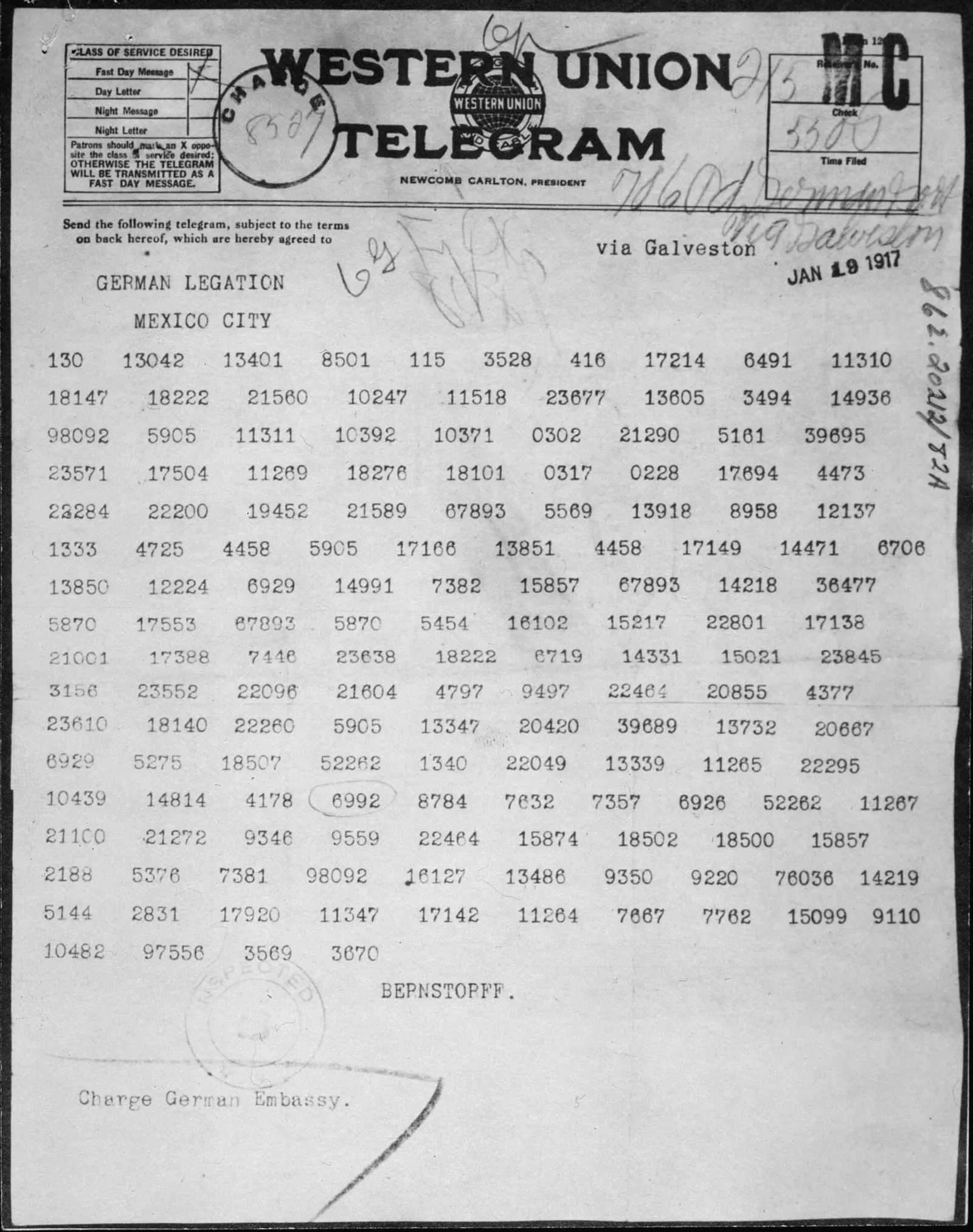
On 19 January 1917, at the German embassy in Washington, seven cipher clerks spent many hours decoding a long dispatch from Berlin. Telegram no. 157, consisting of 856 groups of figures, contained the chancellor’s instructions on submarine warfare. Attached to it was a shorter telegram, no. 158, intended for the German minister in Mexico, Heinrich von Eckardt. That same day two officials re-encoded it in an older code known to the legation in Mexico, and the ambassador, Count Johann Heinrich von Bernstorff, sent it by ordinary telegraph to Mexico City. The dispatch arrived there the same day. It was signed by the state secretary of the Foreign Office, Arthur Zimmermann, who had headed German diplomacy since November. In it he proposed to Mexico an alliance against the United States.
For this reason several dates for the telegram appear in the literature. Zimmermann approved its text on 13 January, it was sent from Berlin on 16 January, which is the date most often regarded as the date of the telegram, and on 19 January Bernstorff forwarded it to Mexico. Some sources, among them the memoirs of the American secretary of state Robert Lansing, state that the dispatch had reached the German embassy in Washington as early as 18 January. According to the files of the German Foreign Office it was received on 19 January. There was one thing the Germans did not know: British naval intelligence had intercepted the dispatch as early as 16 January, and by the following morning knew its meaning.
The text
The telegram, in the version sent to Mexico, read in translation as follows:
“We intend to begin unrestricted submarine warfare on 1 February. We shall endeavour in spite of this to keep America neutral. In the event of this not succeeding, we propose to Mexico an alliance on the following basis: make war together, make peace together, generous financial support and an understanding on our part that Mexico is to reconquer the lost territory in Texas, New Mexico and Arizona. The settlement in detail is left to Your Excellency. Your Excellency will inform the President of the above most secretly as soon as the outbreak of war with the United States is certain, and add the suggestion that he should, on his own initiative, invite Japan to immediate adherence and at the same time mediate between us and Japan. Please call the President’s attention to the fact that the ruthless employment of our submarines now offers the prospect of compelling England to make peace within a few months. Acknowledge receipt. Zimmermann.”
Texas, New Mexico and Arizona had once belonged to Mexico. Texas broke away in 1836 and nine years later joined the United States, and Mexico lost the rest of these lands after its defeat in the war with the United States of 1846–1848. In the margin of the draft, officials added two notes which were not sent: that Germany guaranteed Mexico nothing, and that California should be left for Japan.
An idea from Pless
The telegram was the fruit of a decision taken on 9 January at headquarters in Pless. The Kaiser, under pressure from the Supreme Army Command of Paul von Hindenburg and Erich Ludendorff and from the Admiralty, decided then that from 1 February submarines would sink without warning all ships, neutral ones included, in the waters around the British Isles, off the coast of France and in the Mediterranean. Berlin knew this might mean war with the United States. Zimmermann, who before Pless had supported the chancellor, Theobald von Bethmann Hollweg, and had thereby fallen foul of Ludendorff, now wanted to show the generals that he was thinking ahead and preparing for America’s entry into the war.
The author of the idea was most probably Hans Arthur von Kemnitz, the Foreign Office’s specialist on Latin America and East Asia. He himself admitted it after the war, and the chancellor’s secretary Kurt Riezler wrote in his diary in March 1917: “Kemnitz did it, that fantastic idiot.” According to the historian Thomas Boghardt, who studied the German files, Kemnitz presented the draft on 11 January; the next day it was signed, despite his reservations, by the desk officer for Mexico and North America, Count Adolf von Montgelas, and on 13 January Zimmermann approved the final text. Many historians believe that Zimmermann did not consult the chancellor, although formally he should have.
In Berlin Mexico seemed a natural partner. Since 1910 the country had been mired in revolution and civil war, and relations with its northern neighbour were dreadful. In March 1916 a band led by Pancho Villa raided the small town of Columbus in New Mexico, and General John Pershing pursued him in vain for almost a year with an American expeditionary force in northern Mexico, which inflamed Mexican feeling. The government of President Venustiano Carranza had itself sounded out the Germans in 1916 about closer cooperation. Japan had indeed been fighting on the side of the Entente since 1914, but Berlin hoped it could be won over, since Japanese–American relations were strained. The plan assumed that Mexico and Japan would tie the Americans down on their own borders before they could help Europe.
The dispatch’s route
At first the text was to be sent to America aboard the merchant submarine Deutschland, which in November 1916 had brought a new code for the embassy to the United States. The voyage was due to begin in mid-January, but it was cancelled. The Germans had no telegraph link of their own with America, because in the first days of the war the British had cut their transatlantic cables. President Woodrow Wilson, who was keen on peace talks, nevertheless allowed them to send encrypted dispatches through American diplomatic channels. So at three in the afternoon on 16 January the American embassy in Berlin received the encrypted telegrams nos. 157 and 158 from the Foreign Office and forwarded them via the legation in Copenhagen to the State Department, which delivered them to the German embassy. The Americans did not know the German code and did not know what they were transmitting.
For decades it was written that the Germans, to be safe, had sent the telegram by three routes: by the American cable, through the Swedish missions in Stockholm and Buenos Aires, and by radio from Nauen to the station at Sayville near New York. This is how it was presented, among others, by Barbara Tuchman in her well-known book on the telegram. More recent research in the German telegram logs, however, indicates that the telegram went to Washington exclusively by the American diplomatic route. The versions about the Swedish and radio routes may have originated with the British themselves, who wanted to conceal that they were reading the correspondence of neutral America.
Room 40
All the transatlantic cables passed through Britain, and the dispatches sent over them ended up in the Admiralty’s decryption unit, called Room 40 after the number of its room. Since 1914 it had been reading German naval correspondence, thanks among other things to the signal book from the cruiser Magdeburg, and in time diplomatic traffic as well. The telegram went to two cryptologists, Nigel de Grey and Dilly Knox. At about half past ten on the morning of 17 January de Grey brought the director of naval intelligence, Captain William Reginald Hall, a first, incomplete decryption. Many words were missing from it, among them the names of the three states, but the meaning was clear: Germany would begin unrestricted submarine warfare on 1 February and was proposing an alliance to Mexico, and wanted to draw Japan into the plot.
Hall immediately understood that he held a document which could bring America into the war. He decided, however, not to show it to anyone for the time being, not even the Foreign Office. Revealing the telegram would have betrayed to the Germans that their codes had been broken, and to the Americans that the British were reading their diplomatic dispatches. Washington would also have to be convinced that the text was not a British provocation. The solution was suggested by the version of 19 January: Bernstorff had encoded it in the older code 13040, which Room 40 knew better, and sent it by ordinary telegraph to Mexico. If a copy could be obtained from the Mexican telegraph office, it could be claimed that the text had been stolen in Mexico, and the Americans could check its authenticity in their own telegraph archives.
What came next
Hall passed the news to the Foreign Office only on 5 February, two days after the United States had broken off relations with Germany. Meanwhile the British legation in Mexico obtained a copy of the telegram sent by Bernstorff, and on 19 February Hall had its full text in his hands. On 23 February the foreign secretary, Arthur Balfour, formally handed it to the American ambassador in London, Walter Hines Page. Balfour later called it one of the most dramatic moments of his life. Wilson received the text the following day, and on 1 March the telegram was published in the American press. Many Americans took it for a British forgery, but on 3 March Zimmermann himself admitted to journalists that the dispatch was genuine. The Japanese embassy in Washington called the German idea monstrous, and Carranza, after consulting his generals, did not accept the alliance, and Mexico remained neutral.
The telegram is regarded as one of the greatest intelligence successes in history. It outraged American public opinion, especially in the West and South of the country, which until then had regarded the war in Europe as someone else’s business. After the war, however, Bernstorff argued that it was not the dispatch to Mexico but the resumption of unrestricted submarine warfare that had made war with America inevitable. On 6 April 1917 the United States declared war on Germany.
Remember the articles you have read? Only in this browser; nothing is sent anywhere.How it works
Read ·
A voice from the front
“I was never concerned with the Mexico dispatch, which took me completely by surprise. It was addressed in the usual way directly to the legation in Mexico and passed through the Washington embassy on the same day on which I received the notification that unrestricted U-boat warfare would be declared. I had neither the right nor the duty to hold up the dispatch, although I disapproved of its contents.”
Translated · Original (de)
Ich bin mit der Mexiko-Depesche, die mich völlig überraschte, niemals befaßt worden. Sie war in der üblichen Weise direkt an die Gesandtschaft in Mexiko adressiert und ging durch die Washingtoner Botschaft an demselben Tage, an welchem ich die Mitteilung erhielt, daß der uneingeschränkte U-Bootkrieg erklärt werden würde. Ich hatte weder das Recht noch die Pflicht, die Depesche anzuhalten, obgleich ich deren Inhalt mißbilligte.
Spotted a mistake?Report an error
Related events
(04)The same battle, people or subject.
- 6 April 1917 · DiplomacyUnited States declares war on GermanyOn 6 April 1917 the House of Representatives passed the war resolution and Wilson signed it. The United States was at war with Germany.
- 31 January 1917 · War at seaGermany declares unrestricted submarine warfareOn 31 January 1917 Germany told the USA that from the next day its U-boats would sink all ships around the British Isles without warning.
- 3 February 1917 · DiplomacyUS breaks off relations with GermanyOn 3 February 1917 Wilson told Congress that the United States was breaking off diplomatic relations with Germany. Ambassador Bernstorff got his passports.
- 28 February 1917 · DiplomacyPublication of the Zimmermann TelegramOn the evening of 28 February 1917 the State Department gave the AP the text of the Zimmermann Telegram. Next day Germany's offer to Mexico was front-page news.