Germany · The Central Powers
Arthur Zimmermann
Under-Secretary of State (1911–1916) and State Secretary of the Foreign Office of the German Empire (1916–1917)
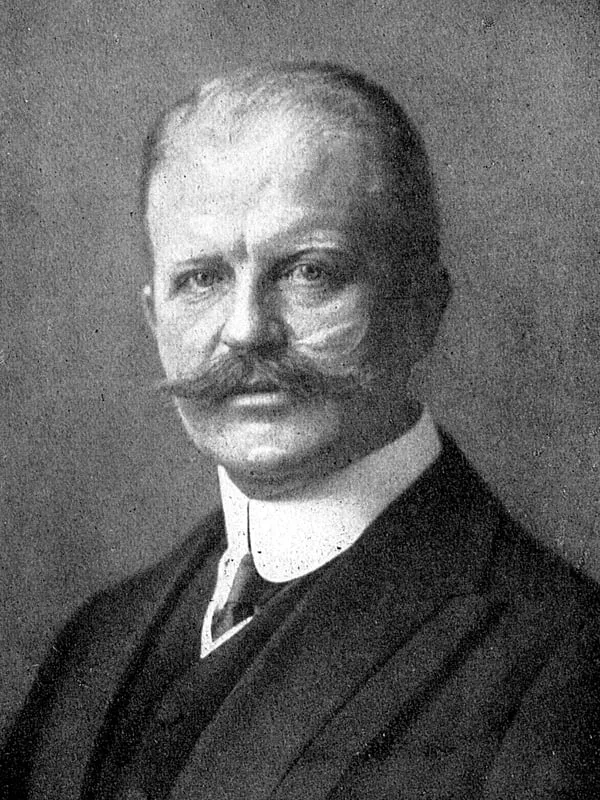
- Born:
- 5 October 1864, Marggrabowa, now Olecko (East Prussia, now Poland)
- Died:
- 6 June 1940, Berlin
- Author:
- Natalia
- Photo:
- autor nieznany, domena publiczna, Wikimedia Commons

Arthur Zimmermann headed German diplomacy for less than nine months, from November 1916 to August 1917, but his name is known to anyone who has read about America’s entry into the war. In January 1917 he signed a telegram proposing to Mexico an alliance against the United States and the recovery of Texas, New Mexico and Arizona. British intelligence intercepted and decoded it, and when the Americans published it, Zimmermann himself confirmed that it was genuine. Earlier, as Under-Secretary of State, he had for years been the real driving force of the Foreign Office: in July 1914 he assured the Austrians of German support, and during the war he backed plans to stir up revolts and revolutions behind the enemy’s lines, from Ireland to Russia. He was the first man in the history of the Reich without noble origins to head its diplomacy.
Before the war
He was born on 5 October 1864 in Marggrabowa, today’s Olecko in Masuria, into a well-off middle-class family. He attended gymnasia in Lyck and Königsberg and studied law in Königsberg and Leipzig. After his legal training and a doctorate in law he entered the foreign service in 1893, not in diplomacy, which was staffed by the aristocracy, but in the less prestigious consular service. He spent several years in China as vice-consul and consul in Shanghai, Canton and Tientsin, where he was caught by the Boxer Rebellion. In 1902 he moved to headquarters in Berlin. He travelled back by way of the United States, and according to some biographers he later liked to cite this journey as proof that he knew America.
In Berlin he was promoted quickly. In 1910 he became a director in the political department, and in 1911 Under-Secretary of State, that is deputy head of the office. From January 1913 his superior was Gottlieb von Jagow, a slight, sickly aristocrat who shunned parliament and disliked representative duties. Many conversations with foreign diplomats and Reichstag deputies were therefore conducted by Zimmermann. He was easy-going, talkative and well liked, but also hot-tempered and prone to hasty judgements.
July 1914
When Vienna’s envoy, Count Alexander Hoyos, came to Berlin after the Sarajevo assassination, Jagow was on his honeymoon and Zimmermann was in charge of the office. On 5 July 1914 he spoke with Hoyos, and the next day, together with the Chancellor, Theobald von Bethmann Hollweg, he confirmed to the Austrians what Kaiser Wilhelm II had promised at Potsdam: Germany would support Austria-Hungary against Serbia even if this threatened war with Russia.
Revolution as a weapon
During the war Zimmermann was among the most ardent supporters of the so-called policy of revolutionising, that is inciting against the Entente the nations and movements that had reasons to hate it. The Foreign Office supported the preaching of jihad in the Muslim world, Indian conspirators and Irish nationalists. Zimmermann’s main interlocutor in this last matter was Roger Casement, who came to Germany in the autumn of 1914. In November the German government announced at his request that if German troops landed in Ireland they would come as friends of Irish freedom, and on 27 December Casement and Zimmermann signed an agreement on forming an Irish Brigade from prisoners of war. The General Staff, however, would not agree to a landing, and only a few dozen men volunteered for the brigade. In April 1916 the Germans sent to Ireland only a ship with arms, which was scuttled by its own crew when the Royal Navy intercepted it, and Casement was arrested immediately after landing.
Zimmermann misunderstood the Americans. When in 1915, after the sinking of the Lusitania, the United States ambassador James W. Gerard warned of the consequences of submarine warfare, Zimmermann is said to have threatened him that half a million German reservists in America would take up arms. The same Gerard later judged that Jagow read the American mood more accurately than his deputy.
State Secretary
On 22 November 1916 Jagow, an opponent of unrestricted submarine warfare, left office, and Zimmermann took his place. The Chancellor gave assurances that this meant continuity of policy, but the new State Secretary was regarded as closer to the Supreme Army Command of Paul von Hindenburg and Erich Ludendorff. He began with a peace initiative. On 12 December the Central Powers announced a peace offer that stated no terms, and on 26 December Zimmermann handed Gerard the reply to Wilson’s note. Once again Berlin did not reveal what it wanted, because the war aims agreed confidentially with Vienna included annexations that the Entente could not accept. When the Entente rejected the offer, Zimmermann stopped defending the Chancellor’s position and sided with the Admiralty. At the conference at Pless on 9 January 1917 the Kaiser decided that from 1 February submarines would sink without warning all ships in the waters around the British Isles.
The telegram
The State Secretary knew that this might mean war with America and wanted to show the generals that he was prepared for it. According to research by Thomas Boghardt, the idea of an alliance with Mexico came from an official, Hans Arthur von Kemnitz, but on 13 January Zimmermann approved the text and signed it with his own name. Under the Zimmermann Telegram, the minister in Mexico was to offer President Venustiano Carranza an alliance, money and the recovery of the lands lost to the United States if America entered the war, and also to persuade Japan to change sides. On 16 January the telegram went to Washington, and over American diplomatic lines at that, which President Woodrow Wilson had made available to the Germans for peace talks. Ambassador Johann Heinrich von Bernstorff forwarded it to Mexico. The British cryptological unit Room 40 intercepted and decoded it as early as the next day. On 20 January Zimmermann went to Vienna with the Chief of the Admiralty Staff, Henning von Holtzendorff, to win the ally over to a decision that Berlin had taken alone.
On 3 February the United States broke off relations with Germany. That evening Zimmermann and the Chancellor, not yet knowing of Washington’s decision, questioned Gerard at length about the American mood. On 23 February the Foreign Secretary, Arthur Balfour, handed the text of the telegram to the American ambassador in London, and on 1 March the American press published it. Many Americans took the telegram for a British forgery, but on 3 March Zimmermann himself admitted that it was authentic. Historians still wonder why he did it. The most common supposition is that he considered the offer a legitimate preparation in case of war, since it was to take effect only once war had been declared, and that he thought denial pointless. That was also how he defended himself in the Reichstag, on 5 March at a secret session of the budget committee and on 29 March in a plenary session. The socialist Oskar Cohn replied that he had given Wilson an excellent argument for uniting Americans. On 6 April 1917 the United States declared war on Germany, and Mexico remained neutral.
Lenin and Russia
The February Revolution in Russia gave Zimmermann a chance of a success that would offset the defeat in America. On 23 March 1917 he wrote to the Supreme Army Command that prominent Russian revolutionaries living in Switzerland wished to return home through Germany, and added that since Germany had an interest in the radical wing gaining the upper hand in Russia, it was worth letting them do so. The generals agreed, and in April Vladimir Lenin and his comrades travelled across Germany in a sealed carriage. Zimmermann also supported sounding out the Russian Provisional Government about a separate peace. At the end of June, together with the Chancellor, he talked in Berlin with the nuncio Eugenio Pacelli, the future Pope Pius XII, about the terms on which Germany might make peace. These talks later gave rise to Benedict XV’s peace note, but when the Pope published it in August, neither of the nuncio’s German interlocutors was still in the government.
Resignation
By the summer of 1917 Zimmermann’s position was weak. He was burdened by the telegram, by the optimism with which he had brushed aside the threat of war with America, and by the embarrassment in Norway, where in June a courier carrying a German diplomatic passport and explosives for sabotage had been arrested. At the beginning of July the Centre Party deputy Matthias Erzberger attacked in the Reichstag not only submarine warfare but also the diplomacy that had brought America down on Germany. After the fall of Bethmann Hollweg on 13 July, Zimmermann, like all the state secretaries, placed his office at the disposal of the new Chancellor, Georg Michaelis, and no longer had any chance of staying on. He formally left office on 5 August, when a successor had been found, the ambassador in Constantinople, Richard von Kühlmann. Some sources give the date as 6 August.
After the war
He never returned to politics. He lived in Berlin, where for many years he gathered around him former members of the student fraternities of Königsberg and Leipzig. He died in Berlin on 6 June 1940, when Germany was again at war with France and Britain.
Assessment
For historians Zimmermann is above all the author of one of the most famous diplomatic blunders of the 20th century. Barbara Tuchman, in her 1958 book “The Zimmermann Telegram”, presented the telegram as the direct cause of America’s entry into the war and its author as a man who did not understand the world beyond Europe. More recent research, including that of Thomas Boghardt and the German historian Martin Nassua, softens this picture. It points out that the war was decided above all by unrestricted submarine warfare, as Bernstorff had in fact already argued, and that the telegram merely heightened American indignation and allowed Wilson to win over the waverers. It also notes that Zimmermann did not invent the offer to Mexico, although he adopted it and was responsible for it, and that his office worked in the shadow of the Supreme Army Command, which he wanted to please.
At the same time it is hard to find a better example of the policy pursued by the German leadership in 1916–1917: risky, based on illusions about the enemy and on the belief that revolutions and uprisings behind his lines would decide the war. In Russia this calculation briefly paid off. In America and in Ireland it brought Germany nothing but harm.
Sources
Spotted a mistake?Report an error
Often appears with
People who appear in the same events.