United Kingdom · The Entente
Roger Casement
Irish independence activist, emissary in Germany (1914–1916), formerly a British consul
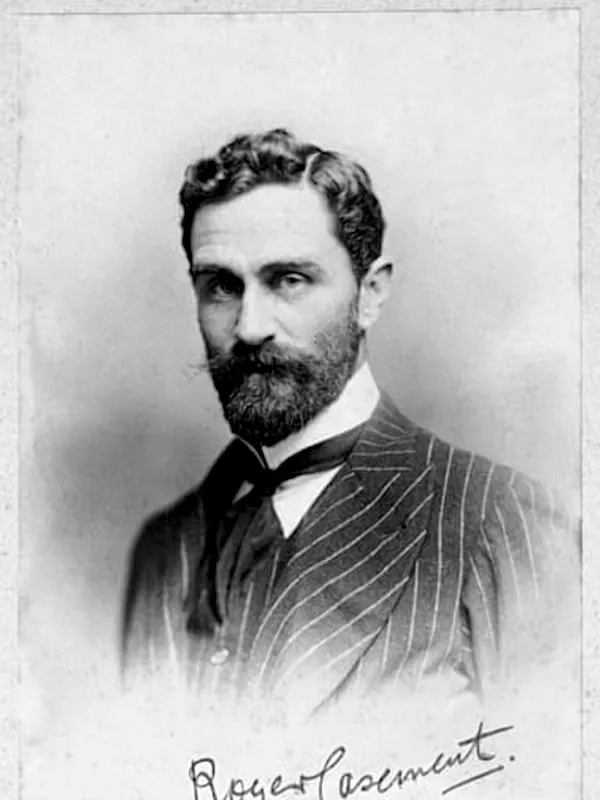
- Born:
- 1 September 1864, Sandycove near Dublin (Ireland)
- Died:
- 3 August 1916, London (Pentonville Prison)
- Author:
- Natalia
- Photo:
- National Library of Ireland on The Commons, No restrictions, Wikimedia Commons

Sir Roger Casement travelled a road that no other figure of the First World War travelled: from a British consul, knighted for exposing the crimes committed against Africans and Indians, to a prisoner sentenced to death for high treason. An Irishman raised in Ulster in a Protestant family, in the last years before the war he became a supporter of full Irish independence. In the autumn of 1914 he made his way to Germany to seek German help for an Irish rising and to recruit Irish prisoners of war for a brigade that would fight the British. His mission ended in failure, and he himself, put ashore from a German submarine on the Irish coast three days before the Easter Rising, ended his life on the gallows in London.
Consul and defender of indigenous peoples
He was born on 1 September 1864 in Sandycove near Dublin. His father was a former dragoon officer, and his mother, a Catholic, according to his biographers secretly had him baptised a Catholic as a child. Orphaned early, he was brought up by his father’s relatives in County Antrim in Ulster, as a Protestant. At sixteen he became a clerk with a Liverpool shipping firm, and in 1884 he left for Africa, where he worked in the Congo for enterprises linked to King Leopold II of the Belgians, among other things on surveys for a railway. From the early 1890s he served in the British colonial and consular administration in Africa.
In 1903, as British consul in the Congo Free State, on the instructions of Balfour’s government he toured the country and gathered evidence of the atrocities by which Leopold’s men forced the inhabitants to collect rubber: beatings, mutilations, hostage-taking and killings. His report, published in 1904, caused an international scandal and helped bring about Belgium’s taking this private colony away from the king in 1908. From 1906 to 1913 he was a consul in Brazil. In 1910 and 1911, commissioned by the government, he investigated the condition of Indians forced into slave labour by the British-registered Peruvian Amazon Company in the Putumayo basin. He concluded that the crimes there exceeded even what he had seen in the Congo. For this work he was knighted in 1911.
The road to Irish nationalism
His experiences in Africa, and also the Boer War, changed his attitude to the empire. In letters he wrote that in the forests of the Congo he had understood what foreign rule over a nation meant, and had found in himself an “incorrigible Irishman”. From 1904 he was active in the Gaelic League, which was reviving the Irish language, and drew close to Arthur Griffith’s Sinn Féin. In 1913 he retired from the consular service because of ill health. In October of that year he spoke in Ballymoney at a meeting of Ulster Protestants who opposed Edward Carson’s campaign against Irish Home Rule. In November he joined the provisional committee of the Irish Volunteers, the nationalist answer to the arming of the Ulster unionists. He helped raise money for the arms smuggled by yacht into Howth near Dublin in the summer of 1914.
In July 1914 he went to the United States to raise funds for the Volunteers among Irish Americans. There he made contact with the leaders of the secret organisation Clan na Gael, above all John Devoy. After the outbreak of war the two met the German ambassador Johann Heinrich von Bernstorff in New York and proposed a deal: Germany would give the Irish arms and officers, and the Irish would launch a rising that would draw British forces away from the front.
Mission in Germany
In October 1914 Casement sailed with a false passport via Norway to Germany. In Christiania (Oslo) his Norwegian companion Adler Christensen made contact with the British minister Mansfeldt Findlay, who according to Christensen’s account offered a reward for handing Casement over. Casement later publicised the affair as proof that British diplomacy was plotting against his life. In Berlin his main interlocutor was the Under-Secretary of State at the Foreign Office, Arthur Zimmermann. In November 1914, at his request, the German government issued a declaration that if its troops ever landed in Ireland, they would come not as invaders but as friends of Irish freedom. On 27 December Casement signed an agreement with Zimmermann on forming an Irish Brigade of prisoners of war, which was to fight for Irish independence and, should there be no chance of fighting in Ireland, even against the British in Egypt.
Recruitment proved a fiasco. The Germans gathered Irish prisoners in a camp at Limburg, but of more than two thousand soldiers, most of them regulars, little more than fifty volunteered for the brigade. Many prisoners received Casement with hostility. The Germans grew less and less interested in his plans, and he himself, ill and depressed, spent much of 1915 in Bavaria. In the spring of 1915 one of the future leaders of the rising, Joseph Plunkett, came to Berlin, and together they prepared a memorandum on a German landing in Ireland, which the Germans, however, had no intention of carrying out.
At the beginning of 1916 the leaders of the Irish Republican Brotherhood informed the Germans that the rising would break out at Easter. The Germans promised one ship with arms, about 20,000 captured Russian rifles, but no officers or men. Casement concluded that such help condemned the rising to defeat, and decided to reach Ireland in order, according to the accounts of his companions, to stop it. He did not take members of the brigade with him, apart from two companions, Robert Monteith and Daniel Bailey.
Banna Strand
The first submarine assigned, U-20, broke down, so in mid-April Casement sailed on U-19. The arms ship, disguised as the Norwegian Aud, waited in vain in Tralee Bay for anyone from the shore and on 22 April was scuttled by her own crew at the entrance to the harbour at Queenstown. Casement and his companions reached the beach of Banna Strand in County Kerry in a folding boat in the early hours of 21 April. Weakened by malaria, he hid in the ruins of an old ring fort near Ardfert, where a few hours later the police arrested him. The Kerry Volunteers did not try to rescue him, because they had orders from Dublin not to fire a single shot before the rising began. Casement was taken to London, where he was interrogated by the head of Scotland Yard’s Criminal Investigation Department, Basil Thomson, and the Director of Naval Intelligence, Captain Reginald Hall. On 24 April, when he was already in British custody, the rising broke out in Dublin. According to many historians, the Germans deliberately timed the battlecruiser raid on Lowestoft and Yarmouth to coincide with it.
Trial and execution
Unlike the leaders of the rising, who in May were shot in Dublin after secret trials by courts martial, Casement stood before an ordinary court in London. The treason trial took place from 26 to 29 June 1916 before three judges presided over by Lord Reading. The prosecution was led by the Attorney General, Frederick Edwin Smith, before the war one of the loudest opponents of Irish Home Rule. The defence argued that the medieval treason statute did not cover acts committed abroad, but the court read its unpunctuated text differently, which led Casement to remark that he would be “hanged on a comma”. After the verdict he made a speech from the dock in which he denied an English court the right to try an Irishman and defended Ireland’s right to freedom. It became one of the most important texts of the Irish independence movement.
His appeal was dismissed. Pleas for clemency came from, among others, Arthur Conan Doyle, George Bernard Shaw and a Dublin committee including Douglas Hyde, and on 29 July the United States Senate passed a resolution calling for clemency for Irish political prisoners. Working against the condemned man, however, were typescripts of the so-called Black Diaries, describing his homosexual life, which the authorities showed to influential people and journalists. Herbert Henry Asquith’s government rejected all the appeals. On the day of his execution Casement, at his own request, was received into the Catholic Church. On 3 August 1916 he was hanged in Pentonville Prison. He was the sixteenth and last man executed in connection with the Easter Rising.
Memory
Casement’s body was buried in quicklime within the prison grounds. For almost half a century British governments refused to release his remains, until in 1965 they were taken to Dublin and, after a state funeral, laid to rest in Glasnevin Cemetery, in the presence of President Éamon de Valera. Casement was not buried, as he had wished, by Murlough Bay in County Antrim, because it lies in Northern Ireland.
The dispute over the authenticity of the Black Diaries continues to this day. The originals, opened to researchers in 1959, are held by the British National Archives. A handwriting examination carried out in 2002 for the BBC and the Irish broadcaster RTÉ found them authentic. Its method was, however, criticised by other experts, and some biographers, notably Angus Mitchell, still regard the diaries as a forgery by British intelligence. However this dispute ends, there is no doubt that in 1916 the authorities deliberately used them to strip the condemned man of support.
Assessment
Casement is a figure over whom different memories still clash. For the Irish he is a martyr of the national cause, one of the sixteen executed in 1916. For human rights defenders he is a pioneer whose reports from the Congo and the Putumayo for the first time gave the victims of colonial exploitation a voice in official documents. In Britain he was long remembered above all as a traitor who sought help from the enemy in wartime.
Historians judge his wartime mission harshly. Casement overestimated Germany’s interest in the Irish cause and his own ability to recruit among the prisoners, and in Berlin he was an increasingly isolated figure. His presence in Germany nevertheless helped British propaganda and gave arguments to a government that portrayed the rising as a German plot. The aim of his last journey is also disputed. In an official statement after the execution the British government rejected the claim that he had wanted to stop the rising, but the accounts of his companions and most biographers confirm that he considered it doomed to defeat without German support.
Sources
Spotted a mistake?Report an error
Often appears with
People who appear in the same events.
On the timeline
(06)1915
1916
April
- 20
- Sinking of the AudOn 20 April 1916 the Libau, disguised as the Norwegian Aud, brought arms for Irish rebels. The British intercepted her, and on 22 April her crew scuttled her.
- Arrest of Roger CasementOn 21 April 1916 the German U-19 landed Roger Casement on Banna Strand, a beach in Ireland. A few hours later he was detained by the police.