Germany · The Central Powers
Alfred von Tirpitz
State Secretary of the Imperial Naval Office (1897–1916), grand admiral
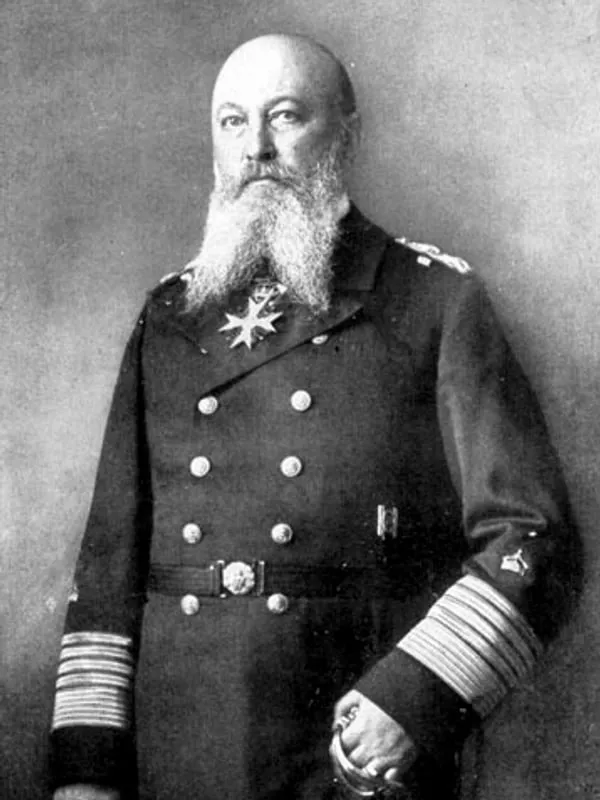
- Born:
- 19 March 1849, Küstrin (Prussia, now Kostrzyn in Poland)
- Died:
- 6 March 1930, Ebenhausen near Munich
- Author:
- Łukasz Skowroń
- Photo:
- autor nieznany, domena publiczna, Wikimedia Commons

For almost twenty years Alfred von Tirpitz headed the Imperial Naval Office and built the second-largest navy in the world. His battleship programme was meant to force Britain to reckon with Germany, but in reality it pushed Britain towards an understanding with France and Russia. When war broke out, it turned out that his fleet could not threaten the Royal Navy’s command of the sea. Tirpitz, who as an official did not command any ships, then became the loudest advocate of ruthless submarine warfare. In March 1916 he lost this dispute with the chancellor and left office, and a year later he became leader of the nationalist German Fatherland Party, which fought against a compromise peace.
Before the war
He was born on 19 March 1849 in Küstrin and grew up in Frankfurt an der Oder, where his father was a lawyer and judge. In 1865, aged sixteen, he joined the Prussian navy, then still small. He served on ships that often called at British ports, and all his life he spoke good English; he later sent his daughters to school in England. He spent the war with France of 1870–1871 on an ironclad which, because of the superiority of the French fleet, lay at anchor.
His first fame came from the torpedo. From the late 1870s he directed its development, devised torpedo-boat tactics and worked with the chief of the Admiralty, his distant relative Leo von Caprivi. In 1888 he became the youngest captain in the navy. In the early 1890s he caught the attention of the young Emperor Wilhelm II when, asked about the future of the fleet, he answered that battleships had to be built. As chief of staff of the Navy High Command he formulated in 1894 the principle that the fleet should fight in line, in compact squadrons of battleships, rather than scatter its strength on cruisers. In 1896, when his ideas had not yet won acceptance, he was transferred to the Far East as commander of the cruiser squadron. There he was to find a base for German warships. Among the places he considered was Kiautschou Bay with the port of Tsingtao, occupied by the Germans at the end of 1897.
In June 1897 Wilhelm II appointed him State Secretary of the Imperial Naval Office (Reichsmarineamt). Within a few months Tirpitz prepared the first Navy Law, passed in the spring of 1898, and in 1900 a second one, which doubled the number of battleships. The laws set out the construction programme many years ahead and limited the Reichstag’s right to decide on naval spending each year. To push them through, Tirpitz set up a press office in the ministry, courted industrialists and professors, and the mass German Navy League had more than a million members before the war. In 1900 he was ennobled, in 1903 he became an admiral, and in 1911 he received the title of grand admiral.
The programme rested on the so-called risk theory. The German fleet did not need to equal the British one. It was to be strong enough that a battle with it would endanger Britain’s command of the seas, so that London would prefer to give way rather than risk war. Britain, however, reacted differently. It brought ships home from distant stations to the North Sea, drew closer to Japan, France and Russia, and in 1906 built the battleship Dreadnought, which devalued all older battleships. Tirpitz took up the challenge and accelerated construction with successive amendments in 1906, 1908 and 1912. When the British Secretary of State for War Richard Haldane came to Berlin in 1912, Tirpitz refused to accept a clear limit on naval construction, and the talks came to nothing. From then on his dispute with Chancellor Theobald von Bethmann Hollweg, who was seeking an understanding with London, lasted until the admiral’s departure.
1914: the fleet in harbour
In July 1914 Tirpitz was on leave, and in Berlin he was represented by his colleague Admiral Eduard von Capelle. The admiral himself believed that the war had come too early, because the naval programme had been planned to run for years. It also quickly became clear that the British Royal Navy had no intention of blockading German ports at close range, where the High Seas Fleet could attack it. It chose a distant blockade, closing the exits from the North Sea.
Tirpitz had no power of command. The Imperial Naval Office was responsible for shipbuilding, the budget and legislation, while the use of the fleet was decided by the emperor, the Admiralty Staff and the fleet commander. The admiral pressed in vain for a unified command of the whole navy. He demanded active use of the fleet before the British could build up superiority. After the defeat in the Battle of Heligoland Bight on 28 August 1914, in which his son Wolfgang was taken prisoner, the emperor nevertheless forbade exposing the fleet to risk without his consent. Tirpitz called this putting a muzzle on the fleet. After the bombardment of Scarborough and Hartlepool in December 1914 he wrote bitterly that the fleet commander, Admiral Friedrich von Ingenohl, had held Germany’s fate in his hands that day, because he had turned back without knowing that only part of the British forces stood before him.
Submarine warfare
In November 1914 Tirpitz gave an interview to the American journalist Karl von Wiegand. In it he suggested that Germany could answer the blockade by cutting Britain off from its supplies with submarines. The interview appeared in the American press at the end of December and was the world’s first announcement of submarine warfare. Paradoxically, before the war Tirpitz had not attached much importance to building U-boats, because all the money went on battleships.
When at the beginning of February 1915 Germany declared a war zone around the British Isles, the decision was taken over Tirpitz’s head. The admiral even advised limiting it, out of regard for the United States, to the waters around the mouth of the Thames. From then on, however, he became the loudest opponent of any concessions. After the sinking of the Lusitania in May 1915 and of the Arabic in August, the chancellor and the Foreign Office imposed ever stricter restrictions on submarine commanders. Tirpitz and the chief of the Admiralty Staff, Gustav Bachmann, opposed them. When in September Germany gave way to the Americans, Tirpitz asked to be relieved. The emperor did not accept his resignation, but replaced Bachmann with Admiral Henning von Holtzendorff, who was closer to the chancellor.
In the summer of 1915 Tirpitz also opposed the fleet’s expedition into the Gulf of Riga, regarding an independent raid without the army’s participation as a risk with no prospect of success. The dispute was settled by the emperor, who approved the operation.
Dismissal
At the turn of 1915 and 1916 Tirpitz, together with the Chief of the General Staff Erich von Falkenhayn, argued that unrestricted submarine warfare would force Britain to make peace within a few months. Bethmann Hollweg agreed only to a campaign against armed merchant ships, and according to Tirpitz’s memoirs on 6 March 1916 the emperor postponed unrestricted submarine warfare indefinitely. The naval state secretary had not been summoned to this conference. Tirpitz took it as an affront, reported sick and on 12 March sent in a request to be relieved. According to some historians he expected that the emperor would again refuse it, but this time Wilhelm II, who did not want to dismiss his old collaborator himself, left the matter to the chancellor. The resignation was announced in mid-March, and his successor was Capelle, who was bound to loyalty towards Bethmann. Tirpitz was very popular at home, and his departure caused a storm in the press and in the Reichstag.
Bethmann Hollweg enjoyed his victory only briefly. As early as 24 March a U-boat torpedoed the Sussex, and ten months later, in January 1917, Germany declared unrestricted submarine warfare, for which Tirpitz had fought. The United States soon entered the war. The fleet he had built fought the Battle of Jutland in May 1916, but it did not change Germany’s position at sea.
The Fatherland Party
Tirpitz never returned to service, but he did not withdraw from politics. He demanded war regardless of the diplomatic and economic consequences, and annexations in the west, especially of the Belgian ports of Zeebrugge and Ostend, which were to serve the continued struggle against Britain. With Russia he was ready to conclude a separate peace. When in July 1917 the Reichstag passed its peace resolution, the opponents of a negotiated peace founded the German Fatherland Party at the beginning of September. Tirpitz became its chairman, and his deputy was the East Prussian official Wolfgang Kapp. The party, backed by the Pan-German League and heavy industry, had at its peak in the summer of 1918, according to the most commonly cited figures, about 1.25 million members. It fought the parliamentary majority, and in its circles there was talk of a military dictatorship headed by Paul von Hindenburg and Erich Ludendorff. After Germany’s defeat the party fell apart.
After the war
After the outbreak of the November Revolution Tirpitz hid for a time in Pomerania and finished his memoirs, published in 1919. In them he defended his policy and blamed the chancellor, the emperor and the fleet commanders for the defeat at sea. Later he published a collection of documents on the “policy of impotence” during the war. From 1924 to 1928 he sat in the Reichstag for the German National People’s Party. He hoped for the chancellorship but did not get it. In 1925 he was among those who persuaded Hindenburg to stand for President of the Reich. He died on 6 March 1930 in Ebenhausen, in the municipality of Schäftlarn near Munich. His son-in-law was the diplomat Ulrich von Hassell, executed in 1944 for his part in the plot against Hitler.
Assessment
During his lifetime and long after his death Tirpitz was regarded in Germany as a brilliant organiser who within a dozen or so years had created out of a small coastal navy a modern fleet, superbly trained and built of ships that proved very resilient at Jutland. He presented himself as the victim of politicians who had not allowed the fleet and the submarines to be used when they could still have decided the war.
Since the 1960s historians have judged him much more severely. The German historian Volker Berghahn described the “Tirpitz Plan” as an undertaking not only military but also domestic-political: the navy laws were meant to make the navy independent of the Reichstag, and the vision of sea power to unite the middle classes around the monarchy against social democracy. Most scholars agree that the risk theory had already failed before the war. Instead of forcing Britain into concessions, it drew it closer to France and Russia, and the naval arms race was one of the main causes of hostility between the two countries. Critics also point out that the enormous spending on the fleet came at the expense of the army, that the admiral himself had no plan in case the British chose a distant blockade, and that he neglected the building of the submarines that he later demanded so vehemently. Some authors, such as Michael Epkenhans, appreciate his organisational and political talent but regard him as the chief architect of the failure of German naval policy, a man who lacked the capacity for self-criticism. The debate today concerns mainly whether Tirpitz really believed in peaceful pressure on London or reckoned from the start with a war against Britain.
Sources
Spotted a mistake?Report an error
Mentioned in battles
(02)Often appears with
People who appear in the same events.