1914: The war at sea
Battle of Heligoland Bight
- Dates:
- 28 August 1914
- Front:
- War at sea
- Location:
- Heligoland Bight, North Sea, near the island of HeligolandOn the battle map →
- Sides:
- United KingdomDavid Beatty, Reginald Tyrwhitt, Roger Keyes, William GoodenoughGerman EmpireLeberecht Maass, Franz von Hipper
- Result:
- British victory. The Germans lost three light cruisers and a torpedo boat, the British not a single ship.
- Author:
- Natalia
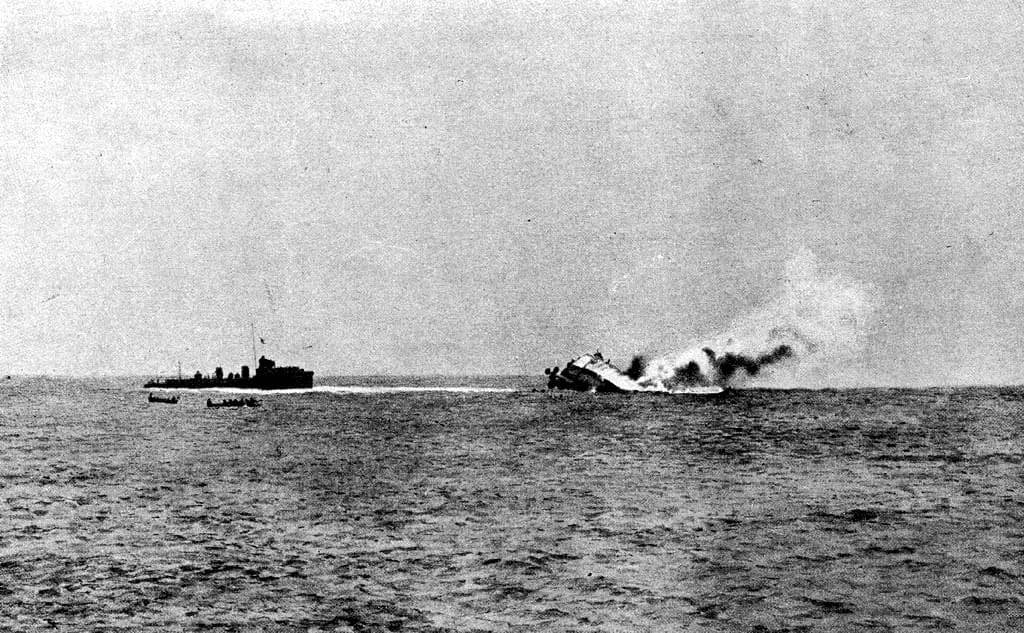
The Battle of Heligoland Bight, also called the First Battle of Heligoland, was fought on 28 August 1914 off the north-west coast of Germany. It was the first major clash of the British Royal Navy and the German Kaiserliche Marine in the First World War. The British sank three German light cruisers and a torpedo boat without losing a single ship themselves.
A war without a battle
Before the war both sides expected command of the sea to be decided by a great battle of the battle fleets in the North Sea. That did not happen. The British Grand Fleet closed the exits from the North Sea and maintained a distant blockade, while the German High Seas Fleet stayed in its bases, waiting for a chance to wear down its opponent. The waters off the German ports, the Heligoland Bight, were patrolled by torpedo boats supported by light cruisers. The fortified island of Heligoland guarded the approaches to the mouths of the Elbe, the Weser and the Jade, where the main body of the fleet lay.
The plan
British submarines, which had been watching the bight since the first days of the war, noticed that German torpedo boats went out on night patrols and returned to port in the morning. Commodore Roger Keyes, commander of the submarines, and Commodore Reginald Tyrwhitt, commander of the destroyers based at Harwich, proposed an ambush. The submarines were to lure the Germans out to sea, while Tyrwhitt’s destroyers, led by light cruisers, were to get between them and the coast and destroy the patrol. The First Lord of the Admiralty, Winston Churchill, backed this bold idea.
The commander of the Grand Fleet, Admiral John Jellicoe, judged that the operation needed stronger cover and obtained permission to send support: the battlecruisers of Vice-Admiral David Beatty and the light cruiser squadron of Commodore William Goodenough. Keyes and Tyrwhitt, who were already at sea, were not informed of this in time. In all, according to the most commonly cited figures, five battlecruisers, eight light cruisers, more than 30 destroyers and eight submarines took part in the operation on the British side.
Course of the battle
On the morning of 28 August the bight was shrouded in mist and visibility was poor. At about 7 a.m. Tyrwhitt’s destroyers came upon German torpedo boats and gave chase towards Heligoland. The Germans sent the light cruisers SMS Stettin and SMS Frauenlob to help. Tyrwhitt’s flagship, the brand-new cruiser HMS Arethusa, only just commissioned, with an untrained crew and jamming guns, was badly damaged in a duel with Frauenlob. The British destroyers cornered and sank the torpedo boat V187 and then lowered boats to rescue survivors. When a German cruiser approached they had to withdraw, and the submarine E4 took on board some of the British sailors together with German survivors.
In the chaos of fighting in the mist there were dangerous mistakes. Keyes, not informed of the presence of Goodenough’s ships, took them for German cruisers and called for help. One of the British submarines fired a torpedo at Goodenough’s cruiser, which tried to ram it. Luckily for the British, there were no losses.
The German light cruisers came out of port one at a time and headed straight for the fighting. Around noon the position of Tyrwhitt’s ships became dangerous. Called to help, Beatty decided to take his battlecruisers deep into the bight, despite the risk of running into mines and submarines. It was a bold decision, but a decisive one. Meanwhile Goodenough’s ships and the destroyers crippled and sank the cruiser SMS Mainz. Many of her crew were picked up by British destroyers, among them Keyes’s ship.
Shortly after 12.30 p.m. Beatty’s battlecruisers emerged from the mist, led by the flagship HMS Lion. Their heavy guns wrecked SMS Cöln, which carried Rear-Admiral Leberecht Maass, commander of the German torpedo boats. The old cruiser SMS Ariadne also came under fire; she burst into flames and sank at about 3 p.m. Cöln went down with almost her entire crew. Maass was killed, and of several hundred sailors only one was saved, pulled from the sea after many hours. At about 1.10 p.m. Beatty ordered a withdrawal.
The German heavy ships could not come to the rescue, because until the afternoon high tide they were unable to cross the bar at the mouth of the Jade. Rear-Admiral Franz von Hipper, commander of the battlecruisers, brought out SMS Moltke and SMS Von der Tann, but by the time he reached the scene of the battle the British had gone. The damaged Arethusa was towed home.
Losses
Figures for the losses vary by source. According to the most frequently cited estimates the Germans lost about 700 killed and more than 150 wounded, and about 336 sailors were taken prisoner. Among the prisoners was Wolfgang von Tirpitz, son of Grand Admiral Alfred von Tirpitz, the creator of the German fleet. Besides the three sunk cruisers and the torpedo boat, three other light cruisers and several torpedo boats were damaged.
The British lost 35 killed, and the number of wounded ranges from 40 to 55 in different sources. Arethusa and three destroyers, Laurel, Liberty and Laertes, were badly damaged. All of them returned to port.
Significance
The Battle of Heligoland Bight brought the British a clear victory, although they owed much of it to luck and to Beatty’s boldness. The operation had been badly planned in terms of communications, and because of mistakes British ships several times nearly attacked their own. At home, however, it was received with immense joy, because the news from France and Belgium at the time was mainly of retreat.
The consequences on the German side were even greater. Kaiser Wilhelm II, who treated the fleet as a personal treasure, resolved to protect it. He ordered the High Seas Fleet to avoid actions that might lead to heavier losses, and from then on its commander had to obtain the Kaiser’s consent before engaging in a decisive battle. Tirpitz considered this policy a mistake and called it muzzling the fleet. For months afterwards German surface ships rarely ventured into the North Sea, and the burden of the war at sea passed to mines and submarines. As early as 22 September the German submarine U-9 sank three British armoured cruisers within an hour, showing how dangerous a weapon it could become.
Spotted a mistake?Report an error