German Empire · The Central Powers
Franz von Hipper
Commander of the I Scouting Group (1913–1918) and the High Seas Fleet (1918), admiral
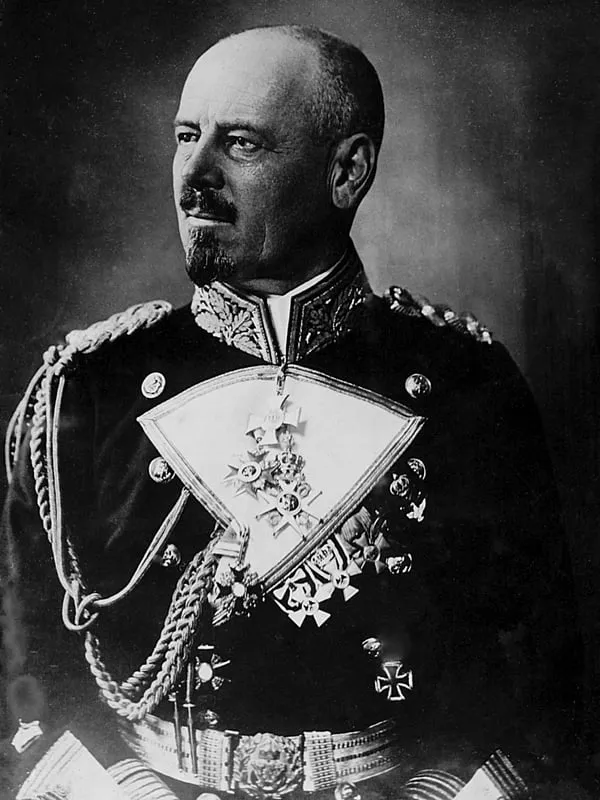
- Born:
- 13 September 1863, Weilheim (Bavaria)
- Died:
- 25 May 1932, Hamburg-Othmarschen
- Author:
- Natalia
- Photo:
- Ferdinand Urbahns, domena publiczna, Wikimedia Commons

Franz Hipper, from 1916 Ritter von Hipper, commanded the German battlecruisers throughout the war, the fastest and most frequently engaged heavy ships of the Imperial Navy. His squadron shelled English towns, for which the British press called him a “baby-killer”; in January 1915 it escaped from a trap at Dogger Bank at the cost of the cruiser Blücher, and at Jutland it sank three British battlecruisers. He was regarded as one of the best naval commanders of the war, respected by his enemies as well. In August 1918 he took command of the High Seas Fleet, but his last plan, a great sortie by the fleet a few days before the armistice, ended in a mutiny of the sailors.
Before the war
He was born on 13 September 1863 in Weilheim in Upper Bavaria, into a family of brewers and innkeepers. His father, an ironmonger, died when Franz was three. The boy went to school in Munich and, after a short spell as a volunteer in the army, decided to become a sailor. In April 1881 he joined the Kaiserliche Marine as a cadet, and in 1884 he was commissioned. He never married.
For many years he served in torpedo boats, commanding divisions and flotillas of them, and for almost three years he was navigating officer of the imperial yacht Hohenzollern. From 1906 he commanded the armoured cruiser Friedrich Carl, whose crew won the Kaiser’s prize for the best gunnery in the fleet in 1907. Admiral Hugo von Pohl then rated him one of the best cruiser captains. He then spent three years in charge of training most of the German torpedo boats. In 1912 he was promoted to rear admiral and became deputy commander of the scouting forces, and on 1 October 1913 he took command of the I Scouting Group, the battlecruiser squadron of the High Seas Fleet. His closest associate on his staff was Erich Raeder, later a grand admiral.
1914: raids on the English coast
On 28 August 1914, when British battlecruisers attacked German patrols in the Heligoland Bight, Hipper led his ships out of the Jade, but because of the low tide they could cross the bar only after several hours. By the time he reached the scene of the battle, the British had gone. After this defeat the Kaiser, Wilhelm II, forbade any risking of the fleet, and the battlecruisers became the only force the command was willing to send against the British coast.
Hipper himself proposed the first such raid. On 3 November his squadron shelled the coast near Yarmouth and laid mines, and on the way back the armoured cruiser Yorck strayed in fog into a German minefield and sank with most of her crew. On 16 December Hipper’s battlecruisers shelled Scarborough, Hartlepool and Whitby. More than a hundred people were killed, most of them civilians, and Britain seethed with anger. This time the main body of the fleet followed Hipper, but the fleet commander, Admiral Friedrich von Ingenohl, convinced that he had run into the entire Grand Fleet, turned for home without warning him. British squadrons lay in wait for Hipper on his way back, but thanks to poor visibility and errors in British signalling he managed to slip past them.
Dogger Bank
On 23 January 1915 Hipper put to sea to destroy British patrols and fishing boats on the Dogger Bank. British cryptographers in Room 40 had read the German signals, and on the morning of 24 January the battlecruisers of Vice-Admiral David Beatty were waiting for him. Seeing that he faced a stronger enemy, Hipper turned for home, but his squadron could steam only at the speed of its slowest ship, the old armoured cruiser Blücher. In the Battle of Dogger Bank a shell from one of Beatty’s ships pierced the aft barbette of the flagship Seydlitz, and both aft turrets went up in flames. The ship was saved by the flooding of the magazines. When the badly hit Blücher fell behind, Hipper decided that trying to save her would endanger the rest of the squadron and left her to her fate. The cruiser sank with most of her crew. The remaining ships escaped because, owing to a signalling mistake, the British battlecruisers concentrated their fire on Blücher.
The blame for the defeat fell not on Hipper but on Ingenohl, who at the beginning of February was replaced by Admiral Hugo von Pohl. The fire on Seydlitz proved a valuable lesson, too. The Germans changed their rules for storing and handling propellant charges, which according to many writers saved several of their ships at Jutland from the fate of the British battlecruisers. In 1915 Hipper was promoted to vice admiral. In August that year his battlecruisers and dreadnoughts covered the German attack on the Gulf of Riga from the open sea, and the British submarine E1 then torpedoed the battlecruiser Moltke.
After almost two years in the post Hipper was exhausted. In March 1916 he asked for sick leave and spent several weeks at a spa. The new fleet commander, Admiral Reinhard Scheer, even wanted to retire him, but the Chief of the Admiralty Staff objected. As a result the April bombardment of Lowestoft and Yarmouth was led by his deputy, Rear Admiral Friedrich Bödicker. Hipper returned in May and hoisted his flag in the new battlecruiser Lützow.
Jutland
Scheer wanted to lure part of the Grand Fleet out of its bases and defeat it with superior forces. In the Battle of Jutland Hipper, with five battlecruisers, steamed several dozen miles ahead of Scheer’s battleships. On the afternoon of 31 May 1916 he ran into Beatty’s battlecruisers and, as planned, turned south to draw them under the guns of the main body. In this duel the British battlecruisers Indefatigable and Queen Mary blew up and sank. When Beatty turned north, Hipper in turn allowed himself to be led under the guns of the battleships of Admiral John Jellicoe.
In the evening Lützow and Derfflinger sank the battlecruiser Invincible with Rear Admiral Horace Hood, but Lützow took hits in the bow that sealed her fate. Hipper transferred under fire to a torpedo boat and for an hour and a half searched for a ship from which he could exercise command, since the other battlecruisers were badly damaged. Meanwhile his squadron, led by the captain of Derfflinger, covered the fleet’s retreat with a daring charge at the British line. Only late in the evening did the admiral board Moltke. Lützow sank during the night, and the other battlecruisers returned to port heavily damaged.
After the battle the Kaiser awarded Hipper the Pour le Mérite, and the King of Bavaria, Ludwig III, conferred on him the Knight’s Cross of the Military Order of Max Joseph, which carried personal nobility and the title Ritter von Hipper. In the following months the fleet rarely put to sea. In November 1916 Hipper led a force that tried to rescue two U-boats stranded off the Danish coast. One was pulled free, the other had to be blown up, and on the way a British submarine torpedoed two of the force’s battleships.
Fleet commander
In August 1918 Scheer became head of the new Supreme Naval Command, and Hipper succeeded him at the head of the High Seas Fleet and was promoted to admiral. The war was already lost. At the end of October Scheer and Hipper prepared Operations Order No. 19: the fleet was to strike at shipping off the Flanders coast and in the Thames estuary and then give battle to the Grand Fleet. Hipper wrote in his notes that a battle for the fleet’s honour, even if it were to be its last, would become the foundation of a new German fleet, and that there would be no such fleet after a dishonourable peace. The government of Prince Max of Baden, which was just then seeking an armistice, was not informed of the plan.
The sailors had no intention of dying a few days before the end of the war. On the night of 29–30 October there were refusals to obey orders on several battleships, and Hipper called off the operation. The fleet’s squadrons were separated to calm the situation, but the III Squadron, which returned to Kiel, became the spark of the mutiny that began the revolution in Germany. Hipper still tried to address the sailors, without success. After the armistice, when the British admiral Beatty summoned him to send a flag officer to discuss the internment, he sent Rear Admiral Hugo Meurer, who sailed into the Firth of Forth aboard the cruiser Königsberg. He himself refused to lead the fleet into internment, and the task was taken over by Rear Admiral Ludwig von Reuter. Hipper watched the departing ships from the shore and wrote that his heart was breaking and that his command had ended without glory. On 13 December 1918 he retired.
After the war
In the first months of the revolution Hipper, fearing the radicals, hid under an assumed name and frequently changed his whereabouts. When in June 1919 the crews scuttled the interned ships at Scapa Flow, he expressed his approval of the act in a letter. He settled in Othmarschen near Hamburg and lived in seclusion. Unlike Scheer, he wrote no memoirs, and his war diary remained in manuscript. He died on 25 May 1932 after a long illness, and the urn with his ashes was buried in his native Weilheim. Beatty, his old adversary, said after his death that he was bidding farewell to a gallant officer and a great seaman. The heavy cruiser Admiral Hipper, which entered service with the Kriegsmarine in 1939, was named after him.
Assessment
In the literature, British included, Hipper is regarded as one of the ablest admirals of the First World War. He is praised for his calm under fire, his tactical sense and the training of his squadron, whose gunnery in the first phase of the Battle of Jutland proved more effective than the British. Most writers believe that in the first phase of the Battle of Jutland he carried out his task almost faultlessly. It is also stressed that for four years he commanded the most heavily burdened squadron in the fleet, and that his exhaustion in the spring of 1916 was the result of constant readiness to put to sea.
Opinions are not unanimous, however. The German historian Walther Hubatsch wrote that Hipper was a cool-headed tactician ready to take personal risks, but without outstanding operational talent or particular gifts of leadership on a broader scale. It is debated whether at Dogger Bank he was right to abandon Blücher, and whether so slow a ship should ever have been included in a battlecruiser squadron at all. The raids on English towns, although planned as military operations, cost civilian lives and gave British propaganda an argument that outlasted the war. The greatest shadow over his command, however, is cast by the plan of October 1918. Many historians believe that the fleet’s last battle, prepared behind the government’s back at the moment of armistice negotiations, had no chance of success and was dictated mainly by concern for the honour and future of the navy.
Sources
Spotted a mistake?Report an error
Commanded in battles
(04)Mentioned in battles
(01)Often appears with
People who appear in the same events.