Key event
Start of the Battle of Jutland
- Category:
- Military operations
- Front:
- War at sea
- Date:
- 31 May 1916
- Author:
- Łukasz Skowroń
- Battle:
- Battle of Jutland
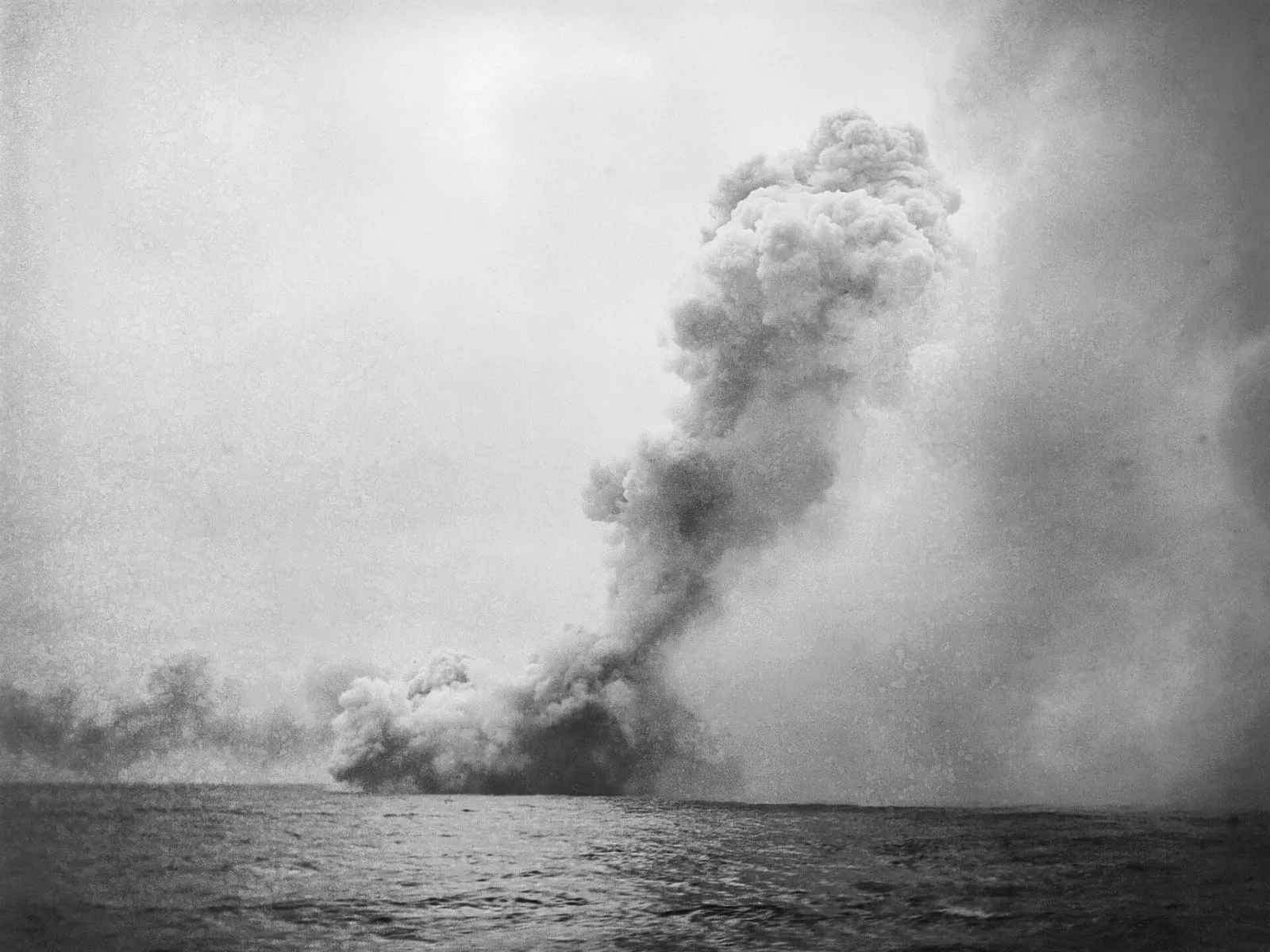
On 31 May 1916, in the North Sea about a hundred kilometres west of the coast of the Jutland peninsula, the largest naval battle of the First World War began. Admiral John Jellicoe’s British Grand Fleet and Admiral Reinhard Scheer’s German High Seas Fleet together put to sea some 250 ships: according to the most commonly cited figures, 151 British and 99 German. Throughout the afternoon and evening there was first a duel of the battlecruisers and then a clash of the main forces of both fleets. By nightfall the British had lost three battlecruisers and an armoured cruiser, and more than four thousand sailors had died in their explosions. Even so, in the evening the Grand Fleet stood between the Germans and their bases. Times are given in Greenwich Mean Time, as in the British official history. German accounts give later times.
Scheer’s plan and the alarm at the Admiralty
After the raid on Lowestoft and Yarmouth Scheer was preparing a bolder operation. His battlecruisers were to bombard the port of Sunderland and lure Vice-Admiral David Beatty’s battlecruisers out of Rosyth straight into an ambush of submarines and German battleships. From mid-May more than a dozen U-boats were waiting on station off the British bases. For such a sortie, however, Scheer needed reconnaissance by airships, and for many days these could not take off because of the wind. When the U-boats began to run short of fuel, the admiral gave up on Sunderland. He chose an alternative plan: Vice-Admiral Franz von Hipper with the battlecruisers was to show himself off the coast of Norway and in the Skagerrak, and Scheer with the battleships was to follow some tens of miles behind him.
The British knew that something was afoot. The cryptanalysts of Room 40 were intercepting German signals, and on the afternoon of 30 May it became clear that the whole High Seas Fleet had received an important operational order. The Admiralty ordered the Grand Fleet to sea. In the evening Jellicoe left Scapa Flow with two battle squadrons and the three battlecruisers of Rear-Admiral Horace Hood; the 2nd Battle Squadron sailed from Cromarty, and from Rosyth came Beatty with six battlecruisers and the four fast Queen Elizabeth-class battleships of Rear-Admiral Hugh Evan-Thomas. The Grand Fleet was thus at sea before the Germans were. Hipper’s force left the Jade roads only after midnight, and Scheer’s battleships somewhat later.
Around noon on 31 May, however, the Admiralty made a mistake. Asked where the call sign of the German flagship was located, the Operations Division learned that it was transmitting from Wilhelmshaven, and passed on to Jellicoe that Scheer’s flagship was still in harbour. No one took into account that when going to sea the Germans transferred this call sign to a shore station. Jellicoe therefore believed he was facing at most another cruiser sortie, and did not hurry, saving his destroyers’ fuel.
First contact
In the early afternoon Beatty’s force, steaming about 65 miles south of Jellicoe’s battleships, was just turning north to meet them. Hipper’s force was at the same time about 50 miles further east. The two sides might have missed each other, but chance decided otherwise. Between them sailed the Danish steamer N.J. Fjord. The German torpedo boats that stopped her for inspection were sighted by the British light cruiser Galatea. At 2.20 p.m. she hoisted the signal “enemy in sight”, and at 2.28 p.m. the first shots of the battle were fired. Beatty at once turned south-east to cut off the Germans’ way back. His flag signal, however, did not reach Evan-Thomas, and the battleships fell more than 10 miles behind.
Soon afterwards a Short 184 seaplane from the seaplane carrier Engadine, piloted by Flight Lieutenant Frederick Rutland, took to the air. His observer reported German light cruisers and torpedo boats. This flight is regarded as the first reconnaissance of an enemy fleet by an aircraft during a naval battle. Its practical effect, however, was slight: after less than half an hour in the air a fuel pipe broke, the machine had to come down on the water, and the reports from Engadine did not reach Beatty. The German airships that took off that day never found the British fleet at all.
The run to the south
At about 3.30 p.m. the battlecruisers of both sides sighted each other. Hipper turned south-east to lead the British under the guns of Scheer’s battleships, of whose presence Beatty was unaware. At about 3.48 p.m. both forces opened fire, at a shorter range than the British wanted, as their guns had the greater reach. The German ships were lost in the haze lying to the east, while the British ones stood out clearly against the bright western sky, so the Germans quickly found the range. In addition, some of the British ships mistook their targets, so that one of the German battlecruisers was not fired on at all for several minutes.
Shortly after 4 p.m. a heavy shell pierced Q turret on Beatty’s flagship, Lion. The mortally wounded turret commander, Major Francis Harvey of the Royal Marines, managed to order the magazines closed and flooded, which saved the ship; he was posthumously awarded the Victoria Cross. A few minutes later salvoes from the battlecruiser Von der Tann hit Indefatigable. The fire reached a magazine, and the ship blew up and capsized. More than a thousand men died; only two survived. At 4.26 p.m. the same fate befell Queen Mary, under fire from Derfflinger and Seydlitz. A huge explosion tore the ship apart and she sank quickly, with more than 1,200 sailors. Sources give between nine and twenty survivors. According to the later memoirs of Lion’s flag captain, Ernle Chatfield, Beatty commented: “Chatfield, there seems to be something wrong with our bloody ships today.”
Meanwhile Evan-Thomas’s battleships came into action, and their accurate long-range fire surprised the Germans. Between the lines a fierce fight of destroyers and torpedo boats took place. The British lost the destroyers Nestor and Nomad, and their crews, including Nestor’s commander Edward Bingham, were picked up by the Germans. The Germans lost the torpedo boats V 27 and V 29. A torpedo from the destroyer Petard hit Seydlitz, which nevertheless kept her place in the line.
The run to the north
At 4.33 p.m. Commodore William Goodenough, steaming ahead of Beatty with the 2nd Light Cruiser Squadron, reported that he could see battleships. It was the whole High Seas Fleet. Goodenough closed to within a dozen or so kilometres of it to establish its composition and course precisely, and turned away only under fire. At 4.40 p.m. Beatty turned north, this time to lead the Germans onto Jellicoe’s battleships, of whose presence they in turn were unaware. Evan-Thomas’s battleships again turned late and for more than half an hour, covering the battlecruisers, took the fire of Scheer’s leading ships. Barham and Malaya suffered most. The Germans, convinced that they faced only part of the British fleet, pursued them at full speed.
The Grand Fleet enters the fight
Jellicoe was steaming south at full speed, but still did not know exactly where the enemy was. The dead-reckoning positions of Lion and of his own flagship, Iron Duke, differed in all by about 11 miles, and the reports were scanty and contradictory. Meanwhile, on the eastern wing, Hood’s three battlecruisers ran into German light cruisers. The new British light cruiser Chester was badly mauled. The mortally wounded sixteen-year-old sailor Jack Cornwell stayed at his gun until the end of the action and was posthumously awarded the Victoria Cross. Hood’s fire, however, disabled the German cruiser Wiesbaden. The destroyer Shark, which threw herself at the German light cruisers and torpedo boats, was disabled and, at about 7 p.m., sunk. Her commander, Loftus Jones, also received a posthumous Victoria Cross. The appearance of Hood’s ships from the east convinced Hipper that he had run into the British main force, and led him to fall back on Scheer’s battleships.
Only at 6.14 p.m. did Lion report that German battleships were in sight. Jellicoe had to decide within moments in which direction to deploy his 24 dreadnoughts, steaming in six columns, from cruising order into line of battle. At 6.15 p.m. he ordered deployment to port, towards the east, on the side further from the enemy. Most historians consider this decision right: it placed the British line across the Germans’ course and cut off their way home. The deployment, however, took more than ten minutes, and the waters ahead of the fleet filled with cruisers and destroyers crossing one another’s courses. The British called the spot “Windy Corner”.
It was there that Rear-Admiral Robert Arbuthnot’s 1st Cruiser Squadron met its end. His armoured cruisers Defence and Warrior, chasing the burning Wiesbaden, crossed Lion’s course and found themselves a few kilometres from the German battlecruisers and battleships. At about 6.20 p.m. Defence blew up, with the admiral and her entire crew of about 900 men. The badly damaged Warrior survived only because the battleship Warspite, whose rudder had jammed, appeared nearby. Warspite made a full circle under the fire of several German battleships, drawing it onto herself. In the evening Warrior was taken in tow by Engadine, but the next morning she had to be abandoned.
At about 6.30 p.m. Hood’s three battlecruisers, steaming at the head of the British line, were duelling with Hipper’s force at a range of about 8 kilometres and inflicting heavy damage on it. Hipper’s flagship, Lützow, then received the hits that sealed her fate during the night. For a moment, however, Hood’s flagship, Invincible, emerged from the haze. Salvoes from Lützow and Derfflinger struck a turret, the fire reached the magazines and the ship broke in two. More than a thousand men died, Admiral Hood among them. Six survived.
Scheer’s turns
At the sight of a long line of British dreadnoughts stretching across the whole visible horizon, Scheer understood that he faced the entire Grand Fleet. The British had “crossed his T”, that is, placed themselves across his course, so that they could fire full broadsides, while the Germans could fire only from their forward turrets. At 6.35 p.m. Scheer gave the order for the previously rehearsed Gefechtskehrtwendung manoeuvre, a simultaneous 180-degree turn by all ships, under the cover of torpedo boats and a smokescreen. The High Seas Fleet vanished into the haze. Jellicoe did not follow directly, for fear of torpedoes and mines, but turned south to remain between the Germans and their bases.
Less than half an hour later Scheer turned back east, perhaps hoping to slip past astern of the British line. At about 7.10 p.m. his leading ships again came under the fire of almost the whole Grand Fleet. Scheer repeated the turn, and to cover it he sent the remains of his battlecruisers into the attack with orders to charge the enemy regardless of losses. The Germans called it the “death ride”. At the same time the torpedo boats fired a salvo of torpedoes. Jellicoe, in accordance with accepted tactics, turned his battleships away from them. The torpedoes missed, but the British fleet lost contact with the enemy. Many critics later regarded this turn as a waste of the greatest opportunity of the day.
The sun set at about 8.07 p.m. At about 8.20 p.m. there was one more exchange of fire between Beatty’s battlecruisers and the German battlecruisers and old battleships that covered their retreat. Then Scheer turned away from the enemy for the third time. Jellicoe, who did not want to risk a battle in the dark, turned the fleet south at about 9 p.m., and at 9.17 p.m. ordered it into night cruising order. He placed the destroyers astern of the battleships. He hoped that at dawn he would again have the Germans in front of him.
The day’s balance
By nightfall the British had lost three battlecruisers, the armoured cruiser Defence and three destroyers, while Warrior and several other ships were badly damaged. The Germans had lost four torpedo boats. Wiesbaden was a burning wreck, and Lützow, Seydlitz and Derfflinger had taken a heavy beating. From Scheer’s point of view his plan had achieved more than he could have hoped: he had drawn part of the British fleet into a trap and destroyed it. But he had himself nearly lost his whole fleet, and in the evening he had to fight his way home through forces much stronger than his own.
The night was to bring the decision. In the darkness the High Seas Fleet crossed the wake of the Grand Fleet and towards morning on 1 June reached the Horns Reef, while in the night actions both sides lost more ships. In all, according to the most commonly cited figures, the battle cost the British about 6,100 killed and the Germans about 2,550. Both sides claimed victory, and the dispute over who really won at Jutland continues to this day.
Remember the articles you have read? Only in this browser; nothing is sent anywhere.How it works
Read ·
A voice from the front
“My first and natural impulse was to form on the starboard wing column in order to bring the Fleet into action at the earliest possible moment, but it became increasingly apparent, both from the sound of gunfire and the reports from the Lion and the Barham, that the High Sea Fleet was in such close proximity and on such a bearing as to create obvious disadvantages in such a movement.”
Spotted a mistake?Report an error
Meanwhile
(04)Elsewhere in the same days.
- 31 May 1916 · Balkan FrontEntente protest over Fort RupelAt the turn of May and June 1916 France and her allies took the surrender of Fort Rupel as the end of Greek benevolent neutrality and warned of consequences.
- 2 June 1916 · Western FrontBattle of Mount Sorrel beginsOn 2 June 1916, after a hurricane bombardment, Württembergers took Mount Sorrel and Tor Top near Ypres. Gen. Mercer of the 3rd Canadian Division was killed.
- 2 June 1916 · Western FrontGermans take Fort VauxOn 2 June 1916 the Germans broke into Fort Vaux at Verdun. Major Raynal's garrison held out underground until 7 June, when the water ran out.
- 3 June 1916 · Italian FrontEnd of the Trentino offensiveOn 3 June 1916 the Austrians took Monte Cengio, but Cadorna said he would stop them in the mountains. The attack faded, though assaults went on two more weeks.
Related events
(04)The same battle, people or subject.
- 1 June 1916 · War at seaEnd of the Battle of JutlandOn 1 June 1916 the High Seas Fleet slipped home past Horns Reef, and Jellicoe turned back after a fruitless search. Both sides claimed victory.
- 4 May 1916 · War at seaDestruction of airship L 7On 4 May 1916 off the coast of Schleswig the British cruisers Galatea and Phaeton shot down the airship L 7. The submarine E31 picked up seven surviving airmen.
- 19 August 1916 · War at seaSinking of HMS Falmouth and HMS NottinghamOn 19 August 1916 Scheer's fleet sailed for Sunderland and the Grand Fleet put out to meet it. No battle followed, but U-boats torpedoed two cruisers.
- 25 April 1916 · War at seaBombardment of Lowestoft and YarmouthAt dawn on 25 April 1916 German battlecruisers shelled Lowestoft, destroying about 200 houses, and hit the cruiser Conquest of Tyrwhitt's force.