United Kingdom · The Entente
Reginald Tyrwhitt
Commander of the Royal Navy forces at Harwich (Harwich Force, 1914–1919), commodore, from January 1918 rear-admiral
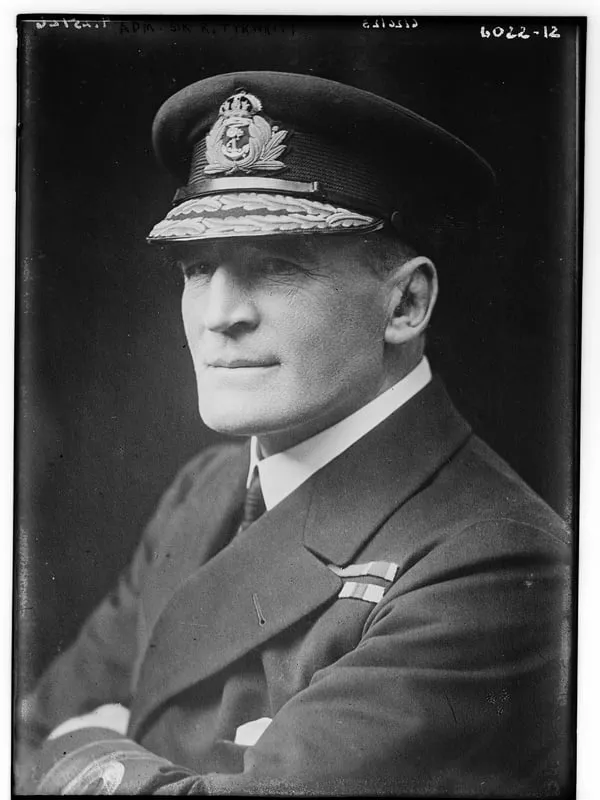
- Born:
- 10 May 1870, Oxford
- Died:
- 30 May 1951, Sandhurst (Kent)
- Author:
- Łukasz Skowroń
- Photo:
- Bain News Service, domena publiczna, Wikimedia Commons

Reginald Tyrwhitt commanded the light forces of the Royal Navy at Harwich on England’s east coast throughout the war, a squadron of light cruisers and destroyers that went down in history as the Harwich Force. Of all the British commanders in the North Sea, he was the closest to the Germans: his ships were the first to sail on news of enemy movements, they covered raids on the German coast and guarded the southern part of the sea, through which ships passed between England and the Netherlands. He fought in the battles of the Heligoland Bight and the Dogger Bank, chased German cruisers off Lowestoft and torpedo boats off the Netherlands. After the armistice it was he who took the surrender of the German submarines at Harwich.
Before the war
He was born on 10 May 1870 in Oxford, the son of a clergyman, the Reverend Richard St John Tyrwhitt, and Caroline, née Yorke. In July 1883, as a thirteen-year-old cadet, he joined the training ship HMS Britannia at Dartmouth, the forerunner of the Britannia Royal Naval College (PL). He served in battleships and cruisers in the Mediterranean and North America, became a lieutenant in 1892, and in 1896 received his first command, the destroyer HMS Hart. He remained faithful to destroyers for his whole career. In 1903 he was promoted to commander and married Angela Corbally, with whom he had a son and two daughters.
He spent the following years commanding the destroyer Waveney and the fast scout cruisers Attentive and Skirmisher, built precisely to lead destroyer flotillas. In 1908 he became a captain, and the next year he took over the 4th Destroyer Flotilla. After two years as flag captain of a cruiser squadron in the Mediterranean he returned to destroyers in 1912 as commander of the 2nd Flotilla, and in December 1913 he became commodore commanding all the destroyers of the First Fleet. At the start of the war he was 44 and had a reputation as one of the most experienced destroyer officers in the navy.
Harwich, 1914–1915
In August 1914 Tyrwhitt, as “Commodore (T)”, that is commander of the torpedo forces, took over the 1st and 3rd Destroyer Flotillas at Harwich. He first hoisted his commodore’s pendant in the old cruiser Amethyst. As early as 5 August the ships of the 3rd Flotilla, led by the cruiser Amphion, sank the German minelayer Königin Luise, and the next day Amphion struck her mines and sank. Soon Tyrwhitt moved to the new, just commissioned light cruiser Arethusa. Harwich was also the base of the submarines of Commodore Roger Keyes, with whom Tyrwhitt worked closely.
It was Keyes and Tyrwhitt who proposed an ambush of the German patrols near Heligoland, which was backed by the First Lord of the Admiralty, Winston Churchill. The Battle of Heligoland Bight on 28 August 1914 nearly ended in disaster for them. Arethusa, with an untrained crew and jamming guns, was badly damaged in a duel with the cruiser Frauenlob, and Tyrwhitt’s ships were in danger as more German cruisers came up from the Jade estuary. They were saved by the battlecruisers of Vice-Admiral David Beatty, which sank three German cruisers. At home the battle was hailed as a great victory, and in October Tyrwhitt received the Order of the Bath.
In December 1914 the Harwich forces were sent out against the battlecruisers that had shelled Scarborough and Hartlepool, and on Christmas Day Tyrwhitt covered the seaplane carriers in the Cuxhaven Raid, the first attempt to attack German bases from the air from the sea. At the Battle of the Dogger Bank on 24 January 1915 he again acted alongside Beatty: he led three light cruisers and 35 destroyers out of Harwich, his Aurora was the first to run into the German cruiser Kolberg, and at the end of the battle Arethusa’s torpedoes finished off the armoured cruiser Blücher.
Harwich, 1916–1917
The Harwich Force changed during the war. It usually numbered between four and eight light cruisers, several flotilla leaders and thirty to forty destroyers, but the Admiralty constantly borrowed its ships for other tasks, especially to reinforce the forces at Dover. On 11 February 1916 Tyrwhitt lost his flagship: Arethusa, returning from a needless sortie, struck a mine laid by a small submarine of the Flanders Flotilla and was wrecked on a sandbank off Harwich.
He made his most independent decision on 25 April 1916, when German battlecruisers shelled Lowestoft and Yarmouth. He had orders to go out to the open sea and draw the Germans into a submarine ambush, but when he learned where the enemy ships were heading, he turned straight towards them on his own responsibility with three light cruisers and a dozen or so destroyers. His cruiser Conquest was hit by heavy shells, but the Germans soon turned for home.
At the greatest naval battle of the war Tyrwhitt was only a spectator. When news came on 31 May 1916 of the clash between the Grand Fleet and the High Seas Fleet off Jutland, he asked the Admiralty for instructions and, receiving none, put to sea at 5.12 p.m. so as to be ready to act. Less than half an hour later the Admiralty ordered him back to harbour to await orders, as it feared a German attack on the coast. He received permission to join John Jellicoe only after three in the morning of 1 June, when the Battle of Jutland was already over. A few days later he was awarded the Distinguished Service Order.
On 19 August 1916, when Reinhard Scheer’s fleet sailed for Sunderland, Tyrwhitt sighted it at about six in the evening, but could not attack before the full moon rose. On the night of 22–23 January 1917, forewarned by the cryptologists of Room 40, he tried to intercept a German torpedo-boat flotilla bound for Zeebrugge. Despite overwhelming superiority most of the Germans got through, and the British lost the destroyer Simoom. The British official history called the result “exceptionally disappointing” and blamed the chaos of the night action and the lack of clear orders for when the cruisers ran into the enemy. In July 1917 Tyrwhitt was nevertheless made a Knight Commander of the Order of the Bath, with the title “Sir”.
Less spectacular but constant was the protection of shipping. From 1916 the Harwich ships escorted convoys between the Thames estuary and the Netherlands, which carried food and cargo from the neutral country. According to a local tally they shepherded more than a thousand ships in both directions, and over the whole war they captured or sank 24 German merchant ships.
1918
In January 1918 Tyrwhitt was given the acting rank of rear-admiral, which was noted in the House of Commons as the only case of flag rank being granted out of the order of seniority. A week later, on the night of 14 January, he went out in vain after German destroyers that had shelled Yarmouth. On St George’s night, 23 April, his cruisers and destroyers covered the raid on Zeebrugge and Ostend from the north against German ships coming out of the Heligoland Bight.
On 11 August 1918, during an expedition near the island of Terschelling, Lieutenant Stuart Culley took off in a fighter from a lighter towed by one of Tyrwhitt’s destroyers and shot down the airship L 53. The same day, however, the force lost all six of its fast torpedo boats, which were attacked by German aircraft without air cover.
After the Armistice of Compiègne Tyrwhitt took part in some of the talks with Rear-Admiral Hugo Meurer on the surrender of the German fleet. It was agreed that all U-boats were to surrender at Harwich. On 20 November the first group arrived, twenty submarines, and by April 1919 about 176 in all. Tyrwhitt strictly forbade any show of triumph: the crews of his ships were to pass the surrendering Germans in complete silence. The British official history notes that both Beatty and Tyrwhitt treated the surrender of the German fleet, with the internment of the surface ships a day later, as an administrative matter, not worth a fuller description.
After the war
In 1919 he was made a baronet “of Terschelling and of Oxford”, commemorating the waters on which he had fought and his home town. He was then Senior Naval Officer at Gibraltar, commander of a light cruiser squadron in the Mediterranean and Commander-in-Chief, Coast of Scotland. In 1926–1928, as a vice-admiral, he commanded the China Station during a time of unrest and tension with the Nationalist government. In 1929 he became a full admiral, and his last post was the command at the Nore, at the mouth of the Thames. When he hauled down his flag there in May 1933, he was the last British admiral of the Great War still on active service. In 1934 he was promoted to Admiral of the Fleet (PL). During the Second World War, despite his advanced age, he served briefly in the Home Guard. He died on 30 May 1951 at Sandhurst (PL) in Kent.
Assessment
Tyrwhitt was the archetypal flotilla commander: quick to decide, ready to take responsibility and happiest at sea. The Royal Museums Greenwich write that he performed so well in his post that he kept it for the whole war. The British official naval history appreciated the spirit he instilled in his crews, and considered the loss of Arethusa particularly painful precisely because Tyrwhitt and his men had brought the name a fame worthy of its earlier bearers. At the same time his record also includes nights when the enemy escaped despite British superiority, as in January 1917, and failures that stemmed from unclear orders.
Historians point out that the Harwich Force was more an instrument of the Admiralty than an independent force. London kept it on a short leash, called it out to cover Dover and the Thames estuary, and in May 1916 held it in port on the day of Jutland. Tyrwhitt often objected to this, and off Lowestoft he acted against the letter of his orders. His full biography, “Tyrwhitt of the Harwich Force”, was written in 1973 by Alfred Temple Patterson. Mount Tyrwhitt in the Canadian Rockies bears the admiral’s name, given to it as early as 1918.
Sources
Spotted a mistake?Report an error
Commanded in battles
(03)Often appears with
People who appear in the same events.