Key event
Zeebrugge raid
- Category:
- Military operations
- Front:
- War at sea
- Date:
- 23 April 1918
- Author:
- Łukasz Skowroń
- Tags:
- Royal Navy, Kaiserliche Marine, Belgium, submarines
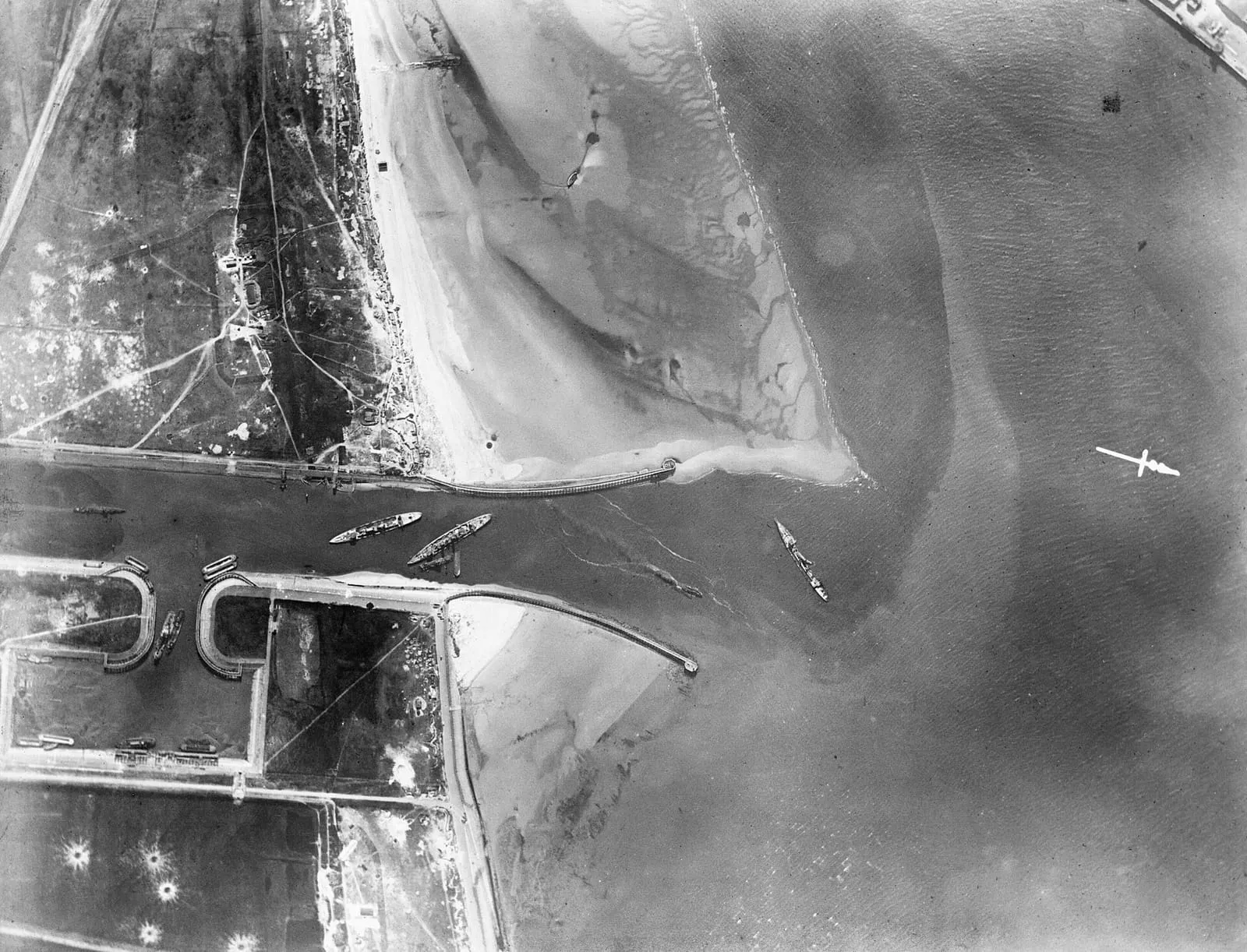
Just after midnight on 23 April 1918, on St George’s Day, the feast of England’s patron saint, ships of the British Dover Patrol attacked two German-occupied ports on the Belgian coast, Zeebrugge and Ostend. The aim of the operation, planned by Vice-Admiral Roger Keyes, was to sink old cruisers filled with concrete in the entrances to the canals, so that German submarines and torpedo boats could not put to sea from their base at Bruges. At Zeebrugge the old cruiser Vindictive came alongside the great mole and landed a storming party, a submarine blew up the viaduct linking the mole to the shore, and two blockships sank in the canal. Off Ostend the blockships missed the harbour entrance and ran aground. Within a few hours the British lost more than 600 killed, wounded and missing. Eight Victoria Crosses were awarded for that night.
Bruges and its two exits
From the autumn of 1914 the inland port of Bruges was the main base of German warships in Flanders. It was home to the submarines of the Flanders Flotilla, which from here had the shortest route to the English Channel and the shipping lanes off the English coast, and to torpedo boats, which raided British patrols in the Strait of Dover at night. Two canals led from Bruges to the sea: a longer and shallower one to Ostend, and the main one, with locks, to Zeebrugge. Its entrance was sheltered by a curved mole, more than two kilometres long including the viaduct, with a battery of guns at its end, joined to the shore by a steel viaduct about 300 metres long.
The Admiralty had been considering plans to attack these ports since 1916. They were rejected many times, and a bombardment of the Zeebrugge locks by monitors in May 1917 had no lasting effect. Keyes, who as head of the Admiralty’s Plans Division had put forward a plan to block both ports with old cruisers, took over the Dover command on 1 January 1918 and set about carrying it out himself. The old protected cruiser Vindictive, armed with howitzers, flamethrowers and machine guns and fitted with more than a dozen gangways, was to go alongside the Zeebrugge mole, together with two Mersey ferries, Iris and Daffodil. A landing party of sailors and a battalion of Royal Marines was to seize the battery at the end of the mole and divert the Germans’ attention. Meanwhile three blockships, Thetis, Intrepid and Iphigenia, were to enter the canal and sink across the fairway, and off Ostend Brilliant and Sirius were to do the same. Volunteers were drawn from the Grand Fleet. Success depended on a dense smoke screen, devised by Wing Commander Frank Brock, and therefore on the wind, which had to blow from the sea.
The first two attempts failed. On 11 April a force of 74 vessels was turned back less than 30 kilometres from Zeebrugge when the wind suddenly changed direction. That night one of the coastal motor boats was lost. According to Henry Newbolt’s British official history of the war at sea, documents concerning the attack on Ostend then fell into German hands. A few days later wind and swell turned the expedition back again. Only on 22 April was the weather good, with the night high tide falling at a convenient time.
St George’s night
The ships left their anchorages throughout the afternoon of 22 April. Keyes sailed in the destroyer Warwick. According to accounts, before entering the battle zone he signalled “St George for England”, and the commander of Vindictive, Commander Alfred Carpenter, replied that they would “twist the dragon’s tail”. To the north the expedition was covered by light cruisers and destroyers of the Harwich Force under Admiral Reginald Tyrwhitt. At about 11.10 p.m. monitors began shelling the German coastal batteries. Drizzle prevented the planned bombing raid, and motor launches began laying the smoke screen. At the last moment the wind changed again and began to carry the smoke out to sea.
When Vindictive emerged from the smoke, the Germans lit her up with star shells and opened fire at close range. Before the ship touched the mole, the commander of the naval storming party, Captain Halahan, and the commander of the marines, Lieutenant-Colonel Elliot, had been killed. Shells destroyed the howitzers, the flamethrowers and most of the gangways. Shortly after midnight Vindictive came alongside the mole, but about 300 metres too far along, away from the battery she was to capture. The tide was pushing her off the wall, and only Daffodil, which thrust her bow into her side and held her against the mole throughout the fight, allowed the storming party to go ashore by the two surviving gangways. The crew of Iris could not secure to the mole with grapnels. Two officers who climbed the wall to fix them were killed. On the mole the sailors and marines, under machine-gun fire and fire from a German torpedo boat lying alongside the mole, could not break through to the battery. Lieutenant-Commander Arthur Harrison, who led the attack, was killed, as was Brock, who had gone onto the mole to examine a German rangefinder.
About a quarter of an hour after midnight Lieutenant Richard Sandford took the old submarine C3, packed with explosives, straight under the viaduct. He could have left the boat under automatic steering, but preferred to take her to the target himself. The six men of the crew got away in a skiff under fire from the viaduct, and when they were less than 200 metres away the explosion destroyed about 30 metres of the structure. The mole was cut off from the shore. The second submarine, C1, had broken her tow and arrived too late.
The German gunners concentrated their fire on the blockships. Thetis, badly hit, fouled her propellers in a net barrier and sank before the canal entrance, but showed the way to the others. Intrepid and Iphigenia entered the canal and sank at its narrowest point. Their crews were taken off under fire by the motor launches ML 526 and ML 282. Lieutenant Percy Dean’s ML 282, together with the boat she was towing, carried 101 men. When the blockships had sunk, Daffodil’s siren gave the signal to withdraw. Vindictive waited more than twenty minutes for stragglers and at about 1.10 a.m. cast off from the mole after roughly an hour’s fighting. During the withdrawal shells struck Iris, mortally wounding her commander and killing many men on board. A German battery also sank the destroyer North Star.
Off Ostend, where Commodore Hubert Lynes was in command, the wind also carried away the smoke, and the buoy at the Stroom Bank, from which the blockships were to take their course for the harbour, had been moved about a mile to the east. Brilliant and Sirius ran aground east of the entrance and sank under fire from the batteries, and their crews were taken off by motor launches. A few hours later the German High Seas Fleet sailed north from the Heligoland Bight to strike at the British convoys to Norway. This sortie, however, had nothing to do with the action in Flanders.
Losses
According to Keyes’s report, 176 men were killed, 412 wounded and 49 missing. Later studies, counting those who died of wounds, give about 227 killed and 356 wounded. Besides the five blockships and C3, the British lost the destroyer North Star and two motor launches. German losses on the mole were small, according to various figures 8 to 11 killed and 16 to 24 wounded.
Consequences
Aerial photographs taken on 23 April showed Intrepid and Iphigenia lying aslant in the canal, and in London Zeebrugge was considered blocked. The commander of the German Marine Corps in Flanders, Admiral Ludwig von Schröder, reported to Berlin, however, that the canal was “not completely closed” and that small torpedo boats were already passing the wrecks on the west side. For two days the submarines used Ostend, and as early as 25 April the first of them again went out through Zeebrugge. The Germans removed two sections of the canal’s western bank and dredged a channel past the wrecks, which could be used at high tide. Newbolt calculated that in the week after the raid 11 submarines left and returned to the Flanders bases, as many as before, and that traffic fell only in June. He admitted, however, that Zeebrugge ceased to be usable as a base for fast night sorties by German torpedo boats.
The raid’s real significance lay elsewhere. It came at a time when, on the Lys, the Germans were pushing the British ever closer to the Channel ports, and the news that the navy had broken into heavily defended German harbours caused enormous enthusiasm in Britain and the Entente countries. As early as 24 April Keyes was made a Knight Commander of the Order of the Bath, and Carpenter, Sandford, Dean, Harrison and Bradford of Iris, the last two posthumously, as well as three other participants, received the Victoria Cross. Some of them, Carpenter’s among them, were awarded, as the statutes of the decoration allowed, by ballot among those who had taken part in the fighting. A second attempt to block Ostend, using Vindictive herself, was made on the night of 9/10 May.
Remember the articles you have read? Only in this browser; nothing is sent anywhere.How it works
Read ·
A voice from the front
“Barely three hundred yards distant, dead ahead of us, appeared a long low dark object which was immediately recognised as the Mole itself with the lighthouse at its extremity. […] It was truly a wonderful sight. The noise was terrific and the flashes of the Mole guns seemed to be within arm's length.”
Spotted a mistake?Report an error
Meanwhile
(04)Elsewhere in the same days.
- 23 April 1918 · Asia and the PacificMotono resignsOn 23 April 1918 Japan's ailing foreign minister Ichirō Motono resigned. He was replaced by Shinpei Gotō, also a supporter of intervention in Siberia.
- 24 April 1918 · Western FrontFighting at Villers-BretonneuxOn 24 April 1918 the Germans took Villers-Bretonneux with tanks, and at Cachy tanks fought tanks for the first time. That night the Australians retook the town.
- 25 April 1918 · Western FrontGermans take Mount KemmelOn 25 April 1918, after a gas bombardment, the Alpenkorps took the French-held Kemmelberg in just over an hour. The British held the flank at Ypres.
- 21 April 1918 · Italian FrontItalian–Czechoslovak conventionOn 21 April 1918 Orlando and Štefánik signed in Rome a convention creating a Czechoslovak army in Italy under the authority of the national council.
Related events
(04)The same battle, people or subject.
- 9 May 1918 · War at seaSecond Ostend raidOn the night of 9/10 May 1918 the British scuttled the old cruiser Vindictive in the entrance to Ostend harbour. The wreck blocked only part of the channel.
- 15 February 1918 · War at seaGerman destroyer raid in the Strait of DoverOn the night of 14/15 February 1918 German torpedo boats fell on the British barrage in the Strait of Dover. They sank 7 drifters and a trawler; 89 men died.
- 20 November 1918 · War at seaSurrender of the U-boatsOn 20 November 1918 the first 20 German submarines surrendered off Harwich to Rear-Admiral Tyrwhitt's force. By the spring of 1919, 176 had been handed over.
- 11 August 1918 · War at seaDestruction of L 53On 11 August 1918 off Terschelling a Camel launched from a lighter towed by a destroyer shot down L 53, the last Zeppelin shot down in the war.