1918: The German Spring Offensive
Battle of the Lys
- Dates:
- 9–29 April 1918
- Front:
- Western Front
- Location:
- The valley of the river Lys (Leie) from the La Bassée Canal at Givenchy to Armentières, the Messines Ridge and the Flanders hills from Bailleul to Kemmel and Ypres, the Nord and Pas-de-Calais departments (France) and West Flanders (Belgium)On the battle map →
- Sides:
- United Kingdom (with Australia, New Zealand, Canada and the Union of South Africa), Portugal, France and BelgiumDouglas Haig, Herbert Plumer, Henry Horne, Ferdinand Foch, Antoine de Mitry, Manuel Gomes da CostaGerman EmpireErich Ludendorff, Rupprecht, Crown Prince of Bavaria, Ferdinand von Quast, Friedrich Sixt von Armin
- Result:
- A German tactical victory but a strategic failure. The Germans destroyed the Portuguese 2nd Division, took Armentières, Bailleul and Mount Kemmel and forced the British to give up the Passchendaele Ridge, but did not take Hazebrouck or reach the Channel ports. Each side lost about 100,000–120,000 men.
- Author:
- Łukasz Skowroń
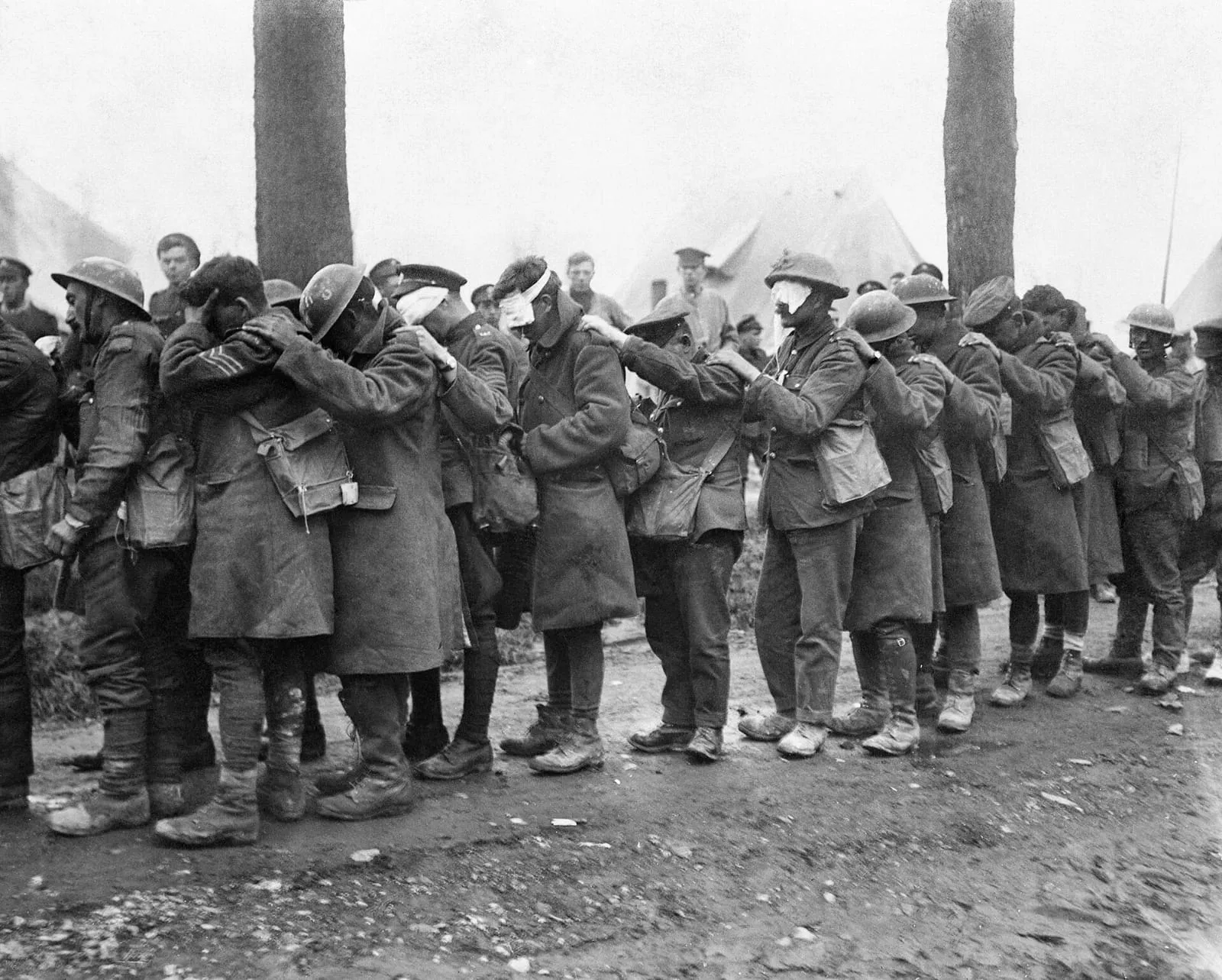
The Battle of the Lys was the second of the great German offensives of the spring of 1918. Four days after Erich Ludendorff called off Operation Michael before Amiens, on 9 April 1918 the German Sixth Army struck in French Flanders, in the marshy valley of the river Leie (Lys), against a sector held by exhausted British troops and the weak Portuguese Expeditionary Corps. Within a few hours it had routed the Portuguese 2nd Division, and the next day the Fourth Army joined the attack at Messines. For three weeks the Germans pushed deep into the British defences. They took Armentières, Merville and Bailleul, recovered the Messines Ridge and forced the British to give up without a fight the Passchendaele Ridge, won in the autumn of 1917 at the cost of hundreds of thousands of casualties, and on 25 April they took Mount Kemmelberg. They did not achieve their strategic aim: the railway junction at Hazebrouck stayed in Allied hands, the British did not have to fall back towards the ports on the English Channel, and on 29 April the worn-out German armies broke off the attack. During the battle Field Marshal Douglas Haig issued his most famous order, calling on his soldiers to fight “with our backs to the wall”.
Name and dates
The British Battles Nomenclature Committee named the fighting in Flanders in April 1918 the “Battles of the Lys” and divided it into eight battles: Estaires (9–11 April), Messines (10–11 April), Hazebrouck (12–15 April), Bailleul (13–15 April), the First Battle of Kemmel Ridge (17–19 April), the Battle of Béthune (18 April), the Second Battle of Kemmel Ridge (25–26 April) and the Battle of the Scherpenberg (29 April). The Germans conducted it under the code name “Georgette”, a diminutive of “Georg” (George), because it was a cut-down version of a much larger plan for an offensive in Flanders. In Germany it is also called the Fourth Battle of Flanders, in Britain and Belgium sometimes the Fourth Battle of Ypres, and the Portuguese call it the Battle of La Lys. Like the British committee, we date it to 9–29 April 1918. The British official history counts losses up to 30 April, and some studies begin the battle as early as 7 April, with the gas bombardment of Armentières. Facts and times are given after the British official history (James Edmonds, Military Operations France and Belgium 1918, vol. II, 1937), supplemented by German and Portuguese accounts.
Background
An attack in Flanders was the German staff’s first idea. In the autumn of 1917 General Hermann von Kuhl, chief of staff of the army group of the Bavarian Crown Prince Rupprecht, proposed a main blow between the La Bassée Canal and Armentières towards Bailleul and Hazebrouck. Ludendorff admitted that it might succeed, but feared that in the marshy valley of the Lys the attack would depend on the weather and, in a wet spring, could not start until May, which would be too late. On 21 January 1918 he chose “Michael” on the Somme, but ordered Rupprecht to go on preparing Operation “George”. When at the end of March it became clear that “Michael” would not bring a decision, and the attack at Arras on 28 March had collapsed within a single day, Ludendorff returned to Flanders. He no longer had the strength for the full operation, so a reduced version of it was prepared. The date was set for 8 April and, at Kuhl’s request, moved to 9 April, because the Sixth Army would not have been ready in time. Ludendorff later wrote that the sooner the attack began, the greater the chance of surprising the Portuguese on the plain of the Lys.
The British knew that Flanders was the most dangerous place on their front. There they were less than 80 kilometres from the coast, and behind the front were crowded the ports, depots, airfields and hospitals of the whole army, as well as the part of the Pas-de-Calais coalfield not yet occupied by the Germans. In April the ground here was usually too waterlogged for a great offensive, but the spring of 1918 was exceptionally dry. Haig, however, had nothing with which to reinforce the north. During the March battle he had sent his best divisions from there to the Somme and replaced them with divisions withdrawn from the fighting, which were given only a few days to fill their ranks with young recruits from home. On 6, 7 and 8 April he asked General Ferdinand Foch, coordinator of Allied operations since the Doullens Conference, for the French to take over part of the British front or to place a reserve behind Arras. Foch, convinced that the most important thing was to bar the road to Amiens, refused and promised only a reserve of four infantry divisions and three cavalry divisions west of Amiens.
The weakest point of the front was the Portuguese sector. Since the autumn of 1917 the Portuguese Expeditionary Corps had been holding flat, marshy ground near Neuve-Chapelle and Laventie, where in 1915 the British had fought the Battle of Neuve Chapelle and where in June 1917 the Portuguese had first beaten off German attacks. For months the corps had received no reinforcements, because British ships were carrying Americans across the Atlantic, and the new government of Sidónio Pais in Lisbon was in no hurry to take part in the war. The commander of the British First Army, General Henry Horne, had warned as early as December 1917 that the Portuguese would not withstand a German attack. In March and early April the corps was reorganised: the 1st Division was withdrawn to the rear, and the reinforced 2nd Division of General Manuel Gomes da Costa was left in the line. It numbered about 21,000 men, was short of almost 6,000 soldiers and well over a hundred officers, and its morale was very low. On 8 April it was decided to replace it with two British brigades. The relief was to begin on the night of 9/10 April.
Plan and forces
In the final plan General Ferdinand von Quast’s Sixth Army was to break through the Portuguese front, widen the breach northwards towards Armentières and push the British back across the Lys, and then turn its main effort on Hazebrouck, covering itself on the south along the La Bassée Canal. A day later General Friedrich Sixt von Armin’s Fourth Army was to strike at the Messines Ridge. Armentières, outflanked on both sides, was to fall without a direct assault. The further objective was the Flanders hills, stretching from Kemmel through Mont Noir and Mont des Cats to Cassel. Whoever held them dominated the plain. The Germans hoped that once these were lost the British would have to abandon the Ypres salient and fall back towards the coast.
Seventeen divisions were allotted to the Sixth Army’s attack, eleven of them brought in specially for the purpose, together with heavy artillery, mortars and aircraft released from the Arras front. In all it had 195 field batteries and 230 heavy and super-heavy batteries, which according to the British official history gave it at least a fourfold superiority in artillery. The bombardment was again planned by Lieutenant-Colonel Georg Bruchmüller, but this time he had only nine days to prepare instead of the seven weeks before 21 March. On the first day eight divisions attacked in the first line and six in the second, none of which had fought in March. Facing them were two corps of the First Army: General Richard Haking’s XI Corps, with the 55th Division at Givenchy, the Portuguese 2nd Division and the 51st Division in reserve, and XV Corps, with the 40th and 34th Divisions in the line and the 50th Division in reserve. Every British division except the 55th had been through the March battle on the Somme. The Portuguese held about 9 kilometres of front. Further north, from Armentières to Ypres, stood General Herbert Plumer’s Second Army, also made up largely of divisions mauled in March.
Course: the breakthrough on the Lys (9–11 April)
On 9 April at 4.15 a.m., in darkness and thick fog, a gas and high-explosive bombardment began, aimed first at batteries, roads and command posts, and from 8 a.m. at the trenches. At 8.45 a.m. the German infantry assaulted the Portuguese lines. The Portuguese, shelled and without communications, for the most part abandoned their positions, and by about 11 a.m. the Portuguese 2nd Division had ceased to exist as an organised force. Some posts, among them at Neuve-Chapelle, nevertheless held out until late morning. In the south the 55th (West Lancashire) Division held Givenchy and Festubert, took over 600 prisoners and bent back its flank along the boundary of the Portuguese sector. In the north the 40th Division, attacked in the flank, was pushed back towards the Lys. British reserves were hurried into the gap: XI Corps cyclists, the cavalrymen of King Edward’s Horse and brigades of the 51st and 50th Divisions. By evening the Germans had cut a pocket in the front about 16 kilometres wide and almost 9 kilometres deep and had reached the rivers Lawe and Lys, which they crossed at Bac-Saint-Maur.
On 10 April the Fourth Army attacked north of Armentières against the British IX Corps and took Messines and part of the ridge for which the British had fought in June 1917. The Sixth Army crossed the Lys at Estaires. The British abandoned Armentières, which was threatened with encirclement, in the afternoon of the same day, and on 11 April the Germans entered it. A German communiqué announced the capture of more than 3,000 of its defenders, which the British official history took as evidence of Ludendorff’s disappointment, since the town had been evacuated rather than taken. On 11 April the Germans approached Merville, which they occupied on the night of 11/12 April. The British had no reserves left, and the First Army staff was gathering engineers, schools and auxiliary units for the fighting. That day Haig signed a special order of the day to all ranks: “There is no other course open to us but to fight it out. Every position must be held to the last man: there must be no retirement. With our backs to the wall and believing in the justice of our cause each one of us must fight on to the end.”
Course: Hazebrouck and Bailleul (12–16 April)
On 12 April the Sixth Army attacked towards Hazebrouck. In front of the town stood the depleted 29th and 31st Divisions, including the 4th Guards Brigade, which on 12–13 April, on a front almost four kilometres long, beat off the heaviest attacks. Haig later wrote that there had been no more brilliant feat since the start of the German offensive. This defence gave time for the 1st Australian Division, brought up from Amiens, to detrain at Hazebrouck, while to the south, in the Forest of Nieppe, the British 5th Division, just arrived from Italy, took up position. On 13 April the attack on Hazebrouck stalled a few kilometres short of the town. Further north the Germans attacked Bailleul and the Ravelsberg ridge. On 15 April they took the ridge, and on the night of 15/16 April the British abandoned Bailleul, wrecked by shellfire. On 16 April Meteren and Wijtschate (PL) fell.
The loss of the Messines Ridge and Bailleul threatened the rear of the British troops in the Ypres salient. As early as March Haig had ordered Plumer to prepare a shortening of the front, and now Plumer decided to carry it out. On the night of 15/16 April his troops quietly abandoned the Passchendaele Ridge and fell back to a line just outside Ypres. The Germans noticed only in the afternoon of 16 April and occupied without a fight ground that had been fought over for more than three months during the Third Battle of Ypres. In this way the British gained several divisions for their reserve.
Meanwhile the Allies began to act together. On 14 April Foch became Commander-in-Chief of the Allied Armies in France. He still believed that the British had to hold out on their own and that the French reserves had to be husbanded, but from 12 April he gradually moved them north. First came General Robillot’s II Cavalry Corps and the 133rd Division, and on 17 April the French troops in Flanders, five infantry divisions and a cavalry corps, were formed into the Army Detachment of the North (Détachement d’armée du Nord) under General Antoine de Mitry.
Course: Kemmel and Béthune (17–19 April)
On 17 April the Fourth Army attacked Mount Kemmel and the Wijtschate–Kemmel line, but was repulsed. The same day the Belgian army threw back a German attack at Merkem, north of Ypres. On 18 April the Sixth Army struck at the southern flank of the salient, from Givenchy to Robecq on the La Bassée Canal, against the British 1st, 3rd and 4th Divisions. The attack by six German divisions collapsed, and Béthune remained in British hands. The British official history notes that on that day the Germans had meant to take Givenchy, Festubert, Béthune and Kemmel at once and to throw back the Belgians, and that all these plans had failed. On 18–21 April the French took over the sector around Kemmel from the British IX Corps. Until 24 April the front was relatively quiet, broken by shelling and local fighting.
Course: the loss of Kemmel and the end of the battle (25–29 April)
On the morning of 25 April, after a night gas bombardment and in thick fog, the Fourth Army attacked on the front from Bailleul to the Ypres–Comines Canal. The German Alpenkorps and other divisions took Mount Kemmel, defended by the French 28th Division, within a few hours. The Germans announced the capture of 6,500 prisoners, most of them French. The British divisions on the left flank, though badly mauled, stopped the attack in front of Ypres. On 26 April French and British counter-attacks at Loker (Locre) did not retake the hill, but the Germans were unable to advance further, towards Poperinge. On 29 April the Fourth Army made a last attempt: after a gas bombardment its divisions attacked the Scherpenberg, Mont Rouge and Voormezeele. They ran into a defence organised in depth and heavy fire from artillery they had not detected beforehand. In the evening the Fourth Army’s chief of staff, General Fritz von Loßberg, advised Ludendorff to halt the attack, and Ludendorff agreed. The next day Loßberg declared that the whole of Operation “Georgette” was over, because the Fourth and Sixth Armies had exhausted their strength for attack.
Losses
The losses of the two sides were similar and, as usual, are disputed. The British official history gives for 9–30 April 82,040 British killed, wounded and missing, including 31,881 missing, and about 76,300 after deducting the missing who returned. French losses are estimated at about 30,000–35,000. On 9 April the Portuguese lost about 7,000 men, including about 6,000 prisoners. Older Portuguese studies gave much higher figures, while more recent research speaks of a few hundred killed. The Belgians lost about 600 men at Merkem. Studies estimate German losses at between 86,000 (David Zabecki) and 109,300 (Michael Marix Evans), and the British official history considers them roughly equal to the British. According to German figures quoted in that history, from 21 March to 30 April the German army lost about 348,000 men in the west. In the same period the British lost about 240,000 and the French about 92,000.
Significance
On the map the Battle of the Lys looked like another great German success. The Germans drove a wedge more than ten kilometres deep into the British front, destroyed a Portuguese division and in three weeks recovered everything the British had won in Flanders in 1917. The British army went through its second crisis in a month, in which, as Haig wrote, there was no longer any room for retreat. Strategically, however, “Georgette” failed, and faster than “Michael”. Hazebrouck, Béthune and the hills from Mont Noir to Cassel remained in Allied hands, the Germans got no nearer to the Channel ports, and the Ypres salient, though shortened, survived. As the British official history observed, Ludendorff improvised this second operation in haste and on too small a scale after the first had failed to break the British front. The Germans again lost their best assault divisions and, instead of better positions, gained a projecting, flat wedge overlooked and shelled by the Allies from the hills.
The battle also had consequences for the coalition. The British official history rejects the legends according to which Hazebrouck was saved by the French or the Australians. It stresses that the main burden of the defence was borne by the British, and that Kemmel was lost by a French division. At the same time the crisis on the Lys forced Foch, newly appointed Commander-in-Chief, to send French divisions to the British front and, in the following weeks, to exchange tired British divisions for French ones. In Portugal the defeat of 9 April long dominated the memory of the country’s part in the war. As a fighting force the Portuguese corps practically ceased to exist. Ludendorff did not give up on Flanders. On 29 April, the day of the last attack, the German Supreme Army Command decided first to strike at the French, to draw their reserves away from the north, and then to return to the offensive against the British. The attack on the Aisne began on 27 May, but a new offensive in Flanders never came. In the summer of 1918, during the Hundred Days Offensive, the Germans abandoned the Lys salient, and with it Mount Kemmel.
Spotted a mistake?Report an error
Battles and phases
(08)- 9–11 April 1918Battle of EstairesOn 9–11 April 1918 the Germans smashed the Portuguese 2nd Division in fog and crossed the Lawe and Lys, taking Estaires and Merville. The British held Givenchy.
- 10–11 April 1918Battle of Messines (1918)On 10–11 April 1918 the German 4th Army attacked in fog north of Armentières, took Messines, Ploegsteert and Hill 63 and drove the British off the ridge.
- 12–15 April 1918Battle of HazebrouckOn 12–15 April 1918 the German Sixth Army drove on the Hazebrouck rail junction. The 4th Guards Brigade and the Australians stopped it before Nieppe Forest.
- 13–15 April 1918Battle of BailleulOn 13–15 April 1918 the Germans attacked the hills near Bailleul. In three days they took Neuve-Église and the Ravelsberg, and the British gave up the town.
- 17–19 April 1918First Battle of Kemmel RidgeOn 17–19 April 1918 the Germans attacked the Flanders hills, Kemmelberg included, and the Belgians at Merkem. All attacks failed; the French took over Kemmel.
- 18 April 1918Battle of BéthuneOn 18 April 1918 the German 6th Army attacked Givenchy, Festubert and the La Bassée Canal to close on Béthune. The British 1st, 3rd and 4th Divisions held.
- 25–26 April 1918Second Battle of Kemmel RidgeOn 25–26 April 1918 the Germans stormed Kemmelberg, held by the French. The counter-attack of 26 April failed, but the Germans got no further.
- 29 April 1918Battle of the ScherpenbergOn 29 April 1918 the Germans struck in Flanders for the last time, at the Scherpenberg and Mont Rouge. The Allies held, and Ludendorff ended "Georgette".