Portugal · The Entente
Sidónio Pais
Portuguese envoy in Berlin (1912–1916), prime minister (1917–1918) and President of Portugal (1917–1918)
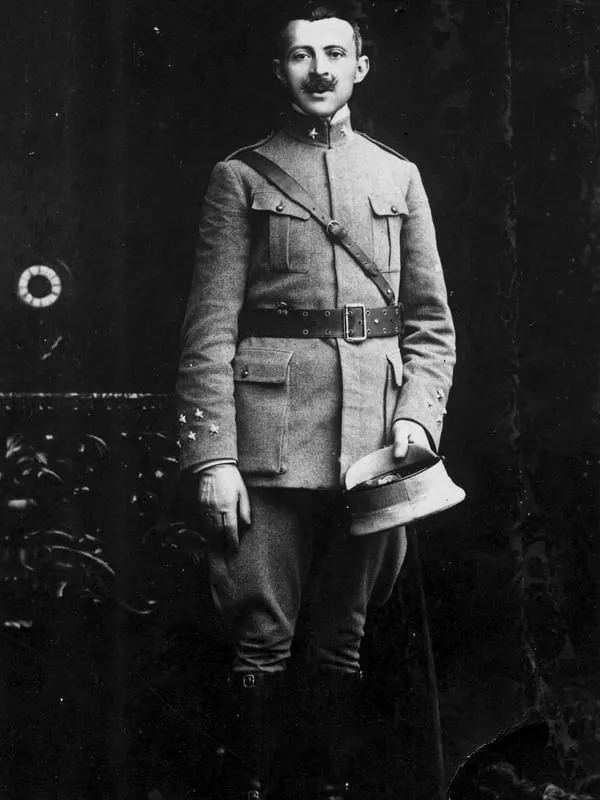
- Born:
- 1 May 1872, Caminha (Portugal)
- Died:
- 14 December 1918, Lisbon
- Author:
- Natalia
- Photo:
- Octávio Bobone, domena publiczna, Wikimedia Commons

Sidónio Bernardino Cardoso da Silva Pais ruled Portugal for less than a year, from a coup d’état in December 1917 until his death at an assassin’s hand in December 1918. It was the year in which Portuguese troops suffered in Flanders one of the heaviest defeats in their history, and the country, exhausted by high prices, strikes and epidemics, stood on the brink of civil war. Pais came to power as an opponent of the government that had drawn Portugal into the war on the side of the Entente, and many considered him a Germanophile. Yet he did not take Portugal out of the war. Instead he built Portugal’s first presidential system, in which he was himself both head of state and head of government, and his supporters surrounded him with a cult. To some he was the saviour of the fatherland and a martyr, to others a dictator and a harbinger of Salazar’s authoritarian state.
Before the war
He was born on 1 May 1872 in Caminha in northern Portugal, the eldest of seven children of a notary, who died when Sidónio was eleven. He chose a military career and graduated with distinction from the artillery course of the Army School, and he studied mathematics at the University of Coimbra, where he took his doctorate in 1898. He became professor of differential and integral calculus there, while remaining an officer and slowly rising in rank, up to major in 1916. Already in Coimbra he was a committed republican.
After the overthrow of the monarchy in October 1910 the new authorities appointed him vice-rector of the university. In 1911 he was elected to the Constituent Assembly, which adopted the constitution of the First Republic, and he was then briefly minister of public works and minister of finance in moderate republican governments. In August 1912 he went to Berlin as Portugal’s envoy. It was a difficult post. Britain and Germany were then conducting confidential negotiations on dividing spheres of influence in the Portuguese colonies, Angola and Mozambique, and the republican government in Lisbon feared for its empire. Pais tried to improve the image of the young republic and to ease tensions.
Envoy in Berlin
After the outbreak of war Portugal remained formally neutral, but it assured Britain of its loyalty to the old alliance, and in Angola and Mozambique there were clashes with the Germans. In Berlin Pais tried to reconcile the increasingly pro-war policy of Afonso Costa’s government and the Democratic Party with his own conviction that the country could not afford a war with Germany. In time he came to be regarded as more and more pro-German. When in February 1916 Portugal, at Britain’s request, seized the German ships lying in its ports, Germany declared war on it, and Pais had to leave Berlin.
After returning home he drew close to Manuel de Brito Camacho’s opposition Republican Union and became the natural leader of those opposed to taking part in the fighting on the Western Front. At the beginning of 1917 the first units of the Portuguese Expeditionary Corps sailed for France, while at home prices rose, food was short and discontent grew. Costa’s government, formed for the third time in April 1917, responded with censorship and the suspension of liberties.
Coup d’état
On 5 December 1917 Pais led a revolt by part of the Lisbon garrison and the cadets of the military school. He took advantage of the moment when Prime Minister Costa was at the inter-Allied conference in Paris. After three days of street fighting, in which the navy and the Republican National Guard stood against the rebels and armed civilians on their side, on 8 December the government capitulated, and power passed to a Revolutionary Junta headed by Pais. A few days later the junta removed President Bernardino Machado from office and exiled him, and on 11 December Pais became prime minister, minister of war and minister of foreign affairs. On 27 December he also took over the functions of president, breaking the constitution he had himself helped to write six years earlier.
For the Allies the coup was worrying news. The overthrown government had been the most faithful supporter of Portugal’s participation in the war, and the new leader was suspected of sympathy for Germany. Pais, however, gave assurances that Portugal would honour its commitments. France and Britain officially recognised his government only in May 1918.
The New Republic
Pais built a regime that his supporters called the “New Republic”. He ruled by decree, without parliament. He changed the anticlerical law on the separation of Church and state and restored relations with the Holy See, which won him the Catholics and the rural population. A decree of 11 March 1918 gave the vote to all adult men, including the illiterate, and another decree introduced the direct election of the president. On 28 April he was the only candidate, because the main republican parties boycotted the vote, and he received 470,831 votes. On 9 May he was proclaimed president. A few days later the office of prime minister was abolished, and the members of the government, now called secretaries of state, answered only to him. Pais almost always appeared in uniform, toured the country and addressed crowds, building a leader cult around himself. His base consisted of conservative republicans, Catholics and monarchists.
Defeat in Flanders
The heaviest blow of his rule was the war. The Portuguese corps, two divisions strong, had held a sector of the British front in Artois, near Laventie, since 1917. From the autumn of 1917 it received almost no replacements and hardly any leave for its soldiers. The British ships that had earlier carried the Portuguese were now carrying Americans across the Atlantic, and the new government in Lisbon was in no hurry to send more men to the front. Morale fell sharply. On the morning of 9 April 1918, just as the exhausted units were about to be relieved, the Germans struck the Portuguese sector, opening the Battle of the Lys. The Portuguese 2nd Division ceased to exist within a few hours, and thousands of its soldiers were taken prisoner.
After the defeat the remnants of the corps were split up among British units and used mainly for work behind the lines. Pais’s opponents, especially Costa’s Democrats, accused him of having abandoned the soldiers to their fate out of dislike of the war and sympathy for Germany, and of having caused the disaster by his policy. His defenders pointed out that the corps had already been neglected under the previous government, and that transport was decided by the British. Historians agree that both sides were to blame, but the defeat on the Lys long weighed on the memory of Pais’s rule.
Fall and death
From the summer of 1918 the situation in the country deteriorated rapidly. High prices, food shortages, strikes and, in the autumn, the Spanish flu and typhus, which killed tens of thousands of people in Portugal, eroded his support. Plots and attempted revolts multiplied, and on 13 October the government declared a state of siege and dealt harshly with the opposition. At the same time the garrison officers, mostly monarchists, formed “military juntas” that paid less and less heed to the president. The end of the war and the armistice of 11 November changed little. Portugal did not even have the ships to bring its soldiers home from France.
On 5 December 1918 Pais escaped a first assassination attempt. Nine days later, on 14 December, at Lisbon’s Rossio station, as he was going to the night train to Porto, he was shot by a former sergeant, José Júlio da Costa, who was linked to the radical left. The president died in hospital the same night. He was 46. Tens of thousands of people came to his funeral. He was buried in Lisbon’s Jerónimos Monastery, and in 1966 his remains were moved to the National Pantheon. Two days after the assassination Congress elected as president Admiral João do Canto e Castro. Without Pais his camp quickly fell apart. In January 1919 the monarchists proclaimed the restoration of the monarchy in Porto, and after that attempt failed, the old republican parties returned to power.
Assessment
Pais remains one of the most contested figures in Portuguese history. The poet Fernando Pessoa called him the “President-King” in a poem of 1920, and the name stuck to him for good. Among conservative Catholics he became a martyr, and flowers and votive offerings are still left on his tomb today. For the republican left he remained a dictator who had trampled on the constitution. Many historians see in the “New Republic”, with its leader cult, rule by decree and reliance on the Church and the army, a forerunner of the authoritarian Estado Novo of António de Oliveira Salazar, and some even an early form of fascism. Others stress that he was above all a charismatic populist who tried to lead the country out of the chaos of the First Republic, and that the introduction of universal male suffrage was a step towards democracy.
His role in the war is no less contested. The charge of Germanophilia followed him throughout his rule, but Pais neither took Portugal out of the war nor sought an understanding with Germany, and after the armistice his country took its seat in Paris among the victors. Historians do agree, however, that his government neglected the corps in Flanders, and the destruction of the Portuguese divisions on the Lys became a symbol of the senselessness of the sacrifices the war cost Portugal. His assassination closed a brief experiment in one-man rule and opened the last and most chaotic years of the First Republic, which fell in a military coup in 1926.
Sources
Spotted a mistake?Report an error
Mentioned in battles
(01)Often appears with
People who appear in the same events.