Portugal · The Entente
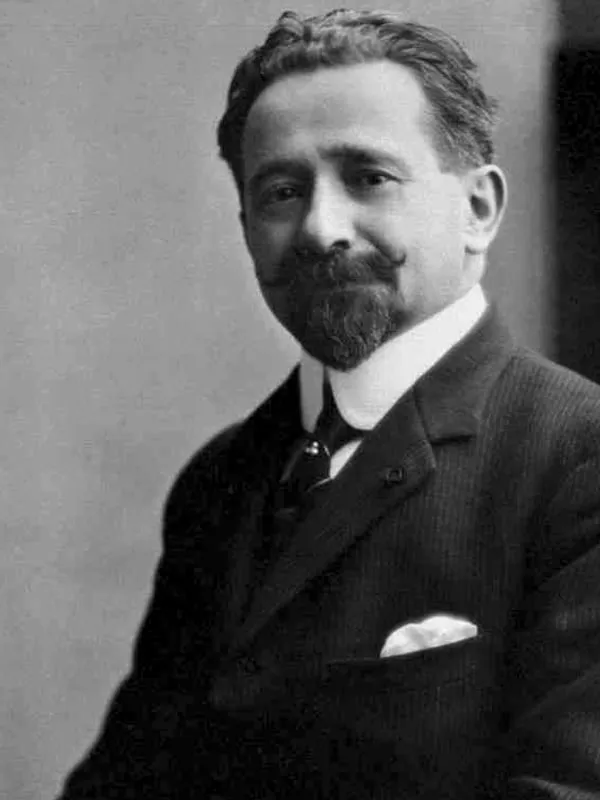
Afonso Costa
Leader of the Democratic Party, Prime Minister of Portugal (1913–1914, 1915–1916, 1917) and minister of finance (1916–1917)
- Born:
- 6 March 1871, Seia (Portugal)
- Died:
- 11 May 1937, Paris
- Author:
- Natalia
- Photo:
- autor nieznany, domena publiczna, Wikimedia Commons

Afonso Costa was the most influential and the most hated politician of the Portuguese First Republic. A lawyer and professor from Coimbra, author of the laws that separated Church and State, and leader of the radical Democratic Party, during the Great War he became the face of Portuguese interventionism. He believed that a small country with great colonies had to fight at Great Britain’s side if it wanted to save its possessions in Africa and strengthen the young republic. It was his government that in February 1916 seized the German ships, for which Germany declared war on Portugal, and his efforts in London that put a Portuguese division on the Western Front. But the war he forced through brought about his downfall. In December 1917 he was overthrown by the coup of Sidónio Pais, and Costa, although after the war he signed the Treaty of Versailles on his country’s behalf, never governed Portugal again.
Before the war
He was born on 6 March 1871 at Seia in central Portugal. He was baptised as a foundling, under the name Afonso Maria de Ligório. His parents, a local official, Sebastião Fernandes da Costa, and Ana Augusta Pereira, acknowledged him only years later, and married in 1885. He studied law at the University of Coimbra, where in 1895 he defended a doctoral thesis, “The Church and the Social Question”, a polemic against Leo XIII’s encyclical Rerum novarum. He became a lecturer at the university and a sought-after lawyer, and his fame as a jurist helped his career in the Portuguese Republican Party.
In 1899 he was elected deputy for Porto, at the time a rare success for the republicans. In the Chamber of Deputies he made his name as one of the opposition’s fiercest speakers: in 1900, shouted down by the monarchy’s deputies, he warned the ministers that “he laughs best who laughs last”. He hesitated between parliamentary struggle and conspiracy, for which, as his biographer Filipe Ribeiro de Meneses writes, he was not cut out. After a failed attempt at a rising in January 1908 he was imprisoned. He was freed after the murder of King Carlos I and the heir to the throne on 1 February 1908.
After the revolution of 5 October 1910 Costa became minister of justice in the provisional government of Teófilo Braga. His decrees expelled the Jesuits (PL) from the country and dissolved the religious orders, introduced divorce and compulsory civil registration, and the law on the separation of Church and State, published in April 1911, became a touchstone for republicans: whoever defended it was a “true” republican. Catholics called Costa “mata-frades”, the “friar-killer”. The moderate republicans, however, did not give him full power. In August 1911 they elected his opponent Manuel de Arriaga president, and in 1912 the republican party split and Costa took the lead of its radical wing, the Democratic Party.
He led his first government from 9 January 1913 to 9 February 1914, keeping the ministry of finance for himself. He achieved something extraordinary in Portugal: he balanced the budget, and according to Portuguese calculations even closed it with a surplus. He fell when President Arriaga demanded that elections be held by a neutral government. He was replaced by the non-party cabinet of Bernardino Machado.
War and the struggle for power (1914–1915)
When war broke out, Portugal declared neither neutrality nor entry into the fighting, because Great Britain asked it to hold back. Costa’s Democrats wanted from the start to take part in the war on the side of the old ally. They hoped that fighting at the side of the British would protect the colonies from the designs of the great powers and strengthen the republic at home. In the autumn of 1914 there were clashes with the Germans in Angola, and on 23 November Congress authorised the government to intervene militarily. When the Machado cabinet fell in December, opponents said that the next government, that of Azevedo Coutinho, was being run from the back seat by Costa himself.
The Democrats’ policy provoked opposition in the army. Officers accused them of bringing party politics into the army and of dragging the country into the war in Europe. In January 1915 the president entrusted the government to General Pimenta de Castro, who ruled without parliament. The dictatorship was overthrown by the rising of 14 May 1915, prepared by men linked to Costa’s party. In the June elections the Democrats won about two thirds of the seats. Costa was the natural candidate for prime minister, but on 3 July a short circuit caused an explosion on a Lisbon tram. Taking it for an assassination attempt, he jumped from the moving car and fractured his skull. For several months he was recovering, abroad as well, and in the meantime the country was governed by the José de Castro cabinet, made up of men close to the Democrats. In August Congress, dominated by his party, elected as president Bernardino Machado, whom he supported.
War prime minister (1915–1917)
On 29 November 1915 Machado entrusted Costa with forming a government. The cabinet, made up entirely of Democrats, had one main aim: to bring Portugal into the war. London long remained cool towards the idea, and Costa, as Meneses judges, held his nerve in the face of the ally’s seeming indifference. The breakthrough came in February 1916. At the British request the government requisitioned some 70 German ships that had lain in Portuguese ports since 1914. Costa presented it as an ordinary requisition in the economy’s interest, but Berlin regarded it as a hostile act and on 9 March declared war on Portugal. Costa declared in parliament that the country would fulfil all the obligations arising from the alliance with Great Britain.
Immediately afterwards he stepped down to make possible a coalition with the Evolutionists of his former adversary António José de Almeida. In the “Sacred Union” government, appointed on 15 March 1916, Costa as minister of finance remained the strongest figure. In June he travelled with the foreign minister, Augusto Soares, to the Allied economic conference in Paris, and then to London. There the two of them secured credits for the war effort and a place for Portuguese soldiers on the Western Front, in exchange for leasing most of the seized ships to the British. At Costa’s request the British government issued a formal invitation, which the parliament in Lisbon accepted in August 1916. In January 1917 a military convention was signed, and from February transports of the Portuguese Expeditionary Corps sailed for France. The “Sacred Union” governments also sent further expeditions to Mozambique, where the Portuguese fought the forces of Paul von Lettow-Vorbeck.
In April 1917, while Costa was abroad, the Democratic deputies voted together with the opposition and brought down the Almeida government. Many observers did not believe they had done so without their leader’s knowledge. On 25 April Costa became prime minister for the third time, again with the finance portfolio. The country was already exhausted. Bread was short, in May food riots swept Lisbon, and the government suspended constitutional guarantees and introduced censorship. Some of his own deputies accused him of being a “false radical”. From 8 to 25 October Costa and President Machado visited the Portuguese soldiers in Flanders, and at the end of November the prime minister was in Paris at the great inter-Allied conference.
Downfall
Major Sidónio Pais, the leader of the opponents of sending troops to France, took advantage of this. On 5 December 1917 part of the Lisbon garrison rose in revolt. After three days of fighting the government resigned in the night of 7–8 December, and Costa, who was returning from abroad, was detained in Porto. The ease with which his government was overthrown showed how far his popularity had fallen. On 18 December he was taken to the fort at Elvas near the Spanish border. He was never charged. He was released on 30 March 1918 and left for Paris, which became his home for the rest of his life. Ten days later the Portuguese in Flanders received the German blow that opened the Battle of the Lys. The Democrats later accused Pais of abandoning the soldiers to their fate, and his supporters replied that it was Costa who had sent them to the front.
After the war
After Pais’s murder in December 1918 Costa returned to high politics, but abroad. From March 1919 he replaced Egas Moniz at the head of the Portuguese delegation to the peace conference, and on 28 June 1919 he signed the Treaty of Versailles on his country’s behalf. The results were meagre. Portugal’s only territorial gain proved to be the Kionga triangle on the Mozambique border. Costa represented the country at the first assembly of the League of Nations, and in 1926 he presided over its Assembly.
At home he was still regarded as a providential man who could unite the republicans, but he never returned to government. In November 1923 he came to Lisbon to form a grand coalition, and failed. In his absence the Democratic Party was torn by quarrels that contributed to the fall of the republic. After the military coup of 28 May 1926 he went from emigrant to exile. In 1927 he co-founded in Paris the League for the Defence of the Republic and was named in plots against the dictatorship, and later against Salazar. All of them failed. He died suddenly on 11 May 1937 in the Paris Hotel Vernet, where he had lived for years. In 1971 his remains were moved to the family grave in Seia.
Assessment
Meneses writes that Costa’s name is indelibly attached to Portuguese interventionism. He, more than anyone else, brought Portugal into the war in Europe, and he was held to account for its consequences: for the defeat on the Lys, for hunger and high prices, for the splitting of the country into supporters and opponents of the war. The Treaty of Versailles did not confirm the interventionists’ foresight and could not become a springboard for his comeback. His supporters stress, however, that Costa was an outstanding administrator, one of the few finance ministers in the country’s history who managed to balance the budget, and that he saw the war as a way of defending the colonies, which the great powers really did covet at the time.
His anticlericalism divided the Portuguese even more. For republicans he was the father of the secular state, for Catholics a persecutor of the Church, and his intransigence alienated a large part of society from the republic. Historians see in him a politician of great abilities and equally great flaws: a brilliant speaker and party organiser who could not build consensus and left the country more divided than he had found it.
Sources
Spotted a mistake?Report an error
Often appears with
People who appear in the same events.