1918: The German Spring Offensive
Battle of Estaires
- Dates:
- 9–11 April 1918
- Front:
- Western Front
- Location:
- The Lys plain in French Flanders, from Givenchy on the La Bassée Canal through Neuve-Chapelle, Laventie and Fleurbaix to Armentières, and in depth to Estaires, Lestrem and Merville, Pas-de-Calais and Nord departments (France)On the battle map →
- Sides:
- United Kingdom and PortugalDouglas Haig, Henry Horne, Richard Haking, John Du Cane, Manuel Gomes da CostaGerman EmpireErich Ludendorff, Rupprecht, Crown Prince of Bavaria, Ferdinand von Quast
- Result:
- German tactical victory. The 6th Army destroyed the Portuguese 2nd Division, crossed the Lawe and Lys, took Estaires, Armentières and Merville and broke in more than ten kilometres deep, but did not break through the front. The 55th Division held Givenchy and Festubert, and arriving British reserves closed the gap.
- Author:
- Natalia
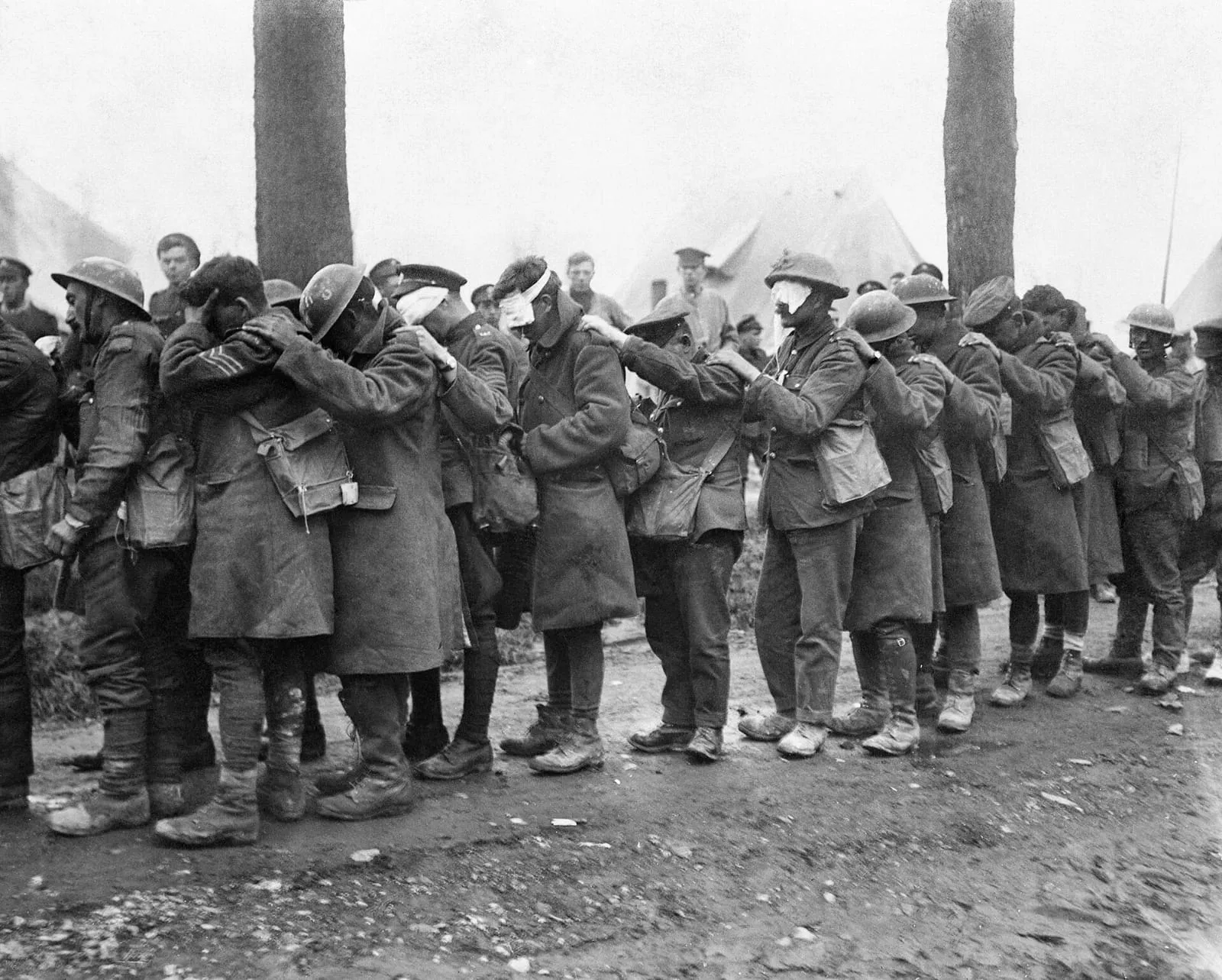
The Battle of Estaires opened the second great German offensive of spring 1918, Operation “Georgette”, which the British call the Battles of the Lys. On the morning of 9 April 1918, after four and a half hours of hurricane bombardment, General Ferdinand von Quast’s 6th Army attacked in thick fog against a flat, waterlogged stretch of front between the La Bassée Canal and Armentières, in French Flanders. The main blow fell on the 2nd Division of the Portuguese Expeditionary Corps, which was exhausted, under strength and due to leave the line that very night. Within a few hours the division ceased to exist as an organised force, and the Germans broke in several kilometres, as far as the rivers Lawe and Leie (Lys). On the southern flank of the breach, however, the Lancashire 55th Division defended the ruins of Givenchy, and on the northern flank British troops hastily built a new line along the rivers. Over the next two days the Germans crossed the Lys and took Estaires, Armentières, abandoned by the British, and Merville, but they could not break the thin, constantly retreating line of defence.
Name and dates
The name “Battle of Estaires” and the dates 9–11 April 1918 were given after the war by the British Battles Nomenclature Committee. It covers the fighting of the British First Army, more precisely its XI and XV Corps, south of Armentières. The parallel fighting of the Second Army north of the town, from 10 April, the committee named the Battle of Messines. Both belong to the group of eight “Battles of the Lys”, which lasted until 29 April. In Portugal the whole is called the Battle of La Lys (Batalha de La Lys) and is associated almost exclusively with 9 April; in Germany people speak of the Fourth Battle of Flanders (Vierte Flandernschlacht) or the Battle of Armentières, and in France sometimes also of the Battle of Estaires. We give the course and times according to the British official history (James Edmonds, Military Operations. France and Belgium 1918, vol. II, 1937), which also draws on German studies. Portuguese accounts give different times, for example the start of the assault at 7 a.m. instead of 8.45, and figures for Portuguese losses differ very widely between sources.
Background
The plan for an attack in Flanders was older than Operation Michael. In autumn 1917 General Hermann von Kuhl, chief of staff of the army group of the heir to the Bavarian throne, Rupprecht, proposed the main spring offensive precisely between the La Bassée Canal and Armentières, towards Hazebrouck, the railway junction through which the supplies of the British Second Army at Ypres passed. The plan bore the code name “St George” (George). Erich Ludendorff, however, judged that in the Lys valley an attack depended on the weather and in a wet spring could not start until May, and he chose to strike on the Somme. When Operation Michael stalled before Amiens and the attack at Arras collapsed on 28 March, the Flanders plan was revived in reduced form under the name “Georgette”. The 6th Army received a dozen or so additional divisions for the attack and heavy artillery released from Arras. Ludendorff later wrote that the earlier he struck, “the more easily he would surprise the Portuguese on the Lys plain”. The date was set for 8 April and, at Kuhl’s request, put back by a day. The day after the 6th Army, the 4th Army was to attack north of Armentières.
The spring of 1918 was exceptionally dry, and the ground in the Lys valley, in a normal year impassable until May, dried out quickly. The front here had run almost unchanged since the winter of 1914–1915, through places known from the Battle of Neuve Chapelle and the fighting at Festubert. The water table was so high that instead of trenches breastworks of sandbags were built. It was a quiet sector, regarded as safe. Since November 1917 its centre, about 9–10 km from Festubert to near Laventie, had been held by the Portuguese Expeditionary Corps, which had arrived in France in February 1917.
The Portuguese were in a bad state. Since Sidónio Pais’s coup in December 1917 Lisbon had lost interest in the war, replacements did not arrive, and some officers went home on leave and did not return. The soldiers had spent a hard winter in wet trenches without relief. The commander of the British First Army, General Henry Horne, had warned as early as December 1917 that the corps would not withstand a German attack, and Douglas Haig admitted that in the event of an attack the Germans would take part or all of the Portuguese sector. It was expected, however, that the neighbouring British corps would then build a defence behind the Lawe and Lys. In March a reorganisation began: the 1st Division, with two weakened brigades, was withdrawn to the rear, towards the Channel, and the 2nd Division remained in the line, reinforced to four brigades and commanded by General Manuel Gomes da Costa. According to the British official history it numbered about 21,000 men, including 17,000 in fighting units, and was short of nearly 6,000 soldiers and 139 officers. The three brigades in the front line held about 9 km of front, more than any of the neighbouring British divisions.
General Richard Haking, commander of XI Corps, to which the Portuguese had been subordinated since 6 April, demanded immediate relief. On 8 April it was decided that on the night of 9–10 April the Portuguese division would be replaced by the British 50th Division and a brigade of the 55th Division. On the right flank of XI Corps, at Givenchy and Festubert, stood General Hugh Jeudwine’s 55th (West Lancashire) Division, rested after the Battle of Cambrai. The 51st (Highland) Division was in corps reserve. To the left of the Portuguese the front was held by General John Du Cane’s XV Corps with the 40th and 34th Divisions, with the 50th Division in reserve. All these divisions except the 55th had only just come out of the March fighting on the Somme: the battalions had been filled up with recruits from England who knew neither their commanders nor the ground, and the 34th and 40th Divisions did not even have their own artillery. Warnings came in from 6 April: airmen saw movement on the roads behind the German lines, on the night of 7–8 April the Germans fired 30,000–40,000 gas shells on Armentières, including mustard gas, and on 8 April Horne reported to Haig that everything pointed to an attack the next day.
Course
9 April. At 4.15 a.m., in darkness and fog that limited visibility to a few dozen metres, the bombardment began, prepared by the artillery specialist Lieutenant-Colonel Georg Bruchmüller, creator of the fire of 21 March. The 6th Army had 195 field batteries and 230 heavy and super-heavy batteries, by British calculations at least four times as much artillery as the defenders. First the batteries, roads and headquarters were shelled, also with phosgene shells; one of the first shells hit Gomes da Costa’s headquarters at Lestrem. Telephone communication with the Portuguese front line was cut within ten minutes. From 8 a.m. the fire was shifted onto the trenches, and at 8.45 the German infantry went in behind a creeping barrage. Along the whole front of attack eight divisions attacked in the first line and six in the second, four of them, from LV and XIX Corps, against the three Portuguese brigades.
Some German patrols infiltrated the Portuguese lines even before the assault, and by about 7.30 the neighbouring British divisions could see Portuguese troops falling back. According to German regimental accounts the front line surrendered after weak resistance, but some strongpoints, among others at Neuve-Chapelle and Richebourg-l’Avoué, held out until about 11, and on the right flank a battalion of the Portuguese 10th Infantry Regiment fought until mortar fire had killed most of the defenders. The Portuguese reserve brigade, which was to counter-attack, mostly abandoned its positions when men fleeing from the front line began to pass through them. At about 11 a.m. the 2nd Division, together with most of its field artillery, vanished from the battlefield. The only Portuguese left in place as organised units were the gunners manning British heavy guns and a tunnelling company, while small groups gathered by officers fought on alongside the British. Portuguese tradition has particularly preserved the figure of Private Aníbal Milhais, who is said to have covered his comrades’ retreat with a Lewis gun and was later decorated with the Order of the Tower and Sword, the highest Portuguese military decoration. The British official history, generally severe on the Portuguese, concedes that their retreat after a bombardment in fog, after an exhausting winter, among foreigners whose language they did not understand and with the promise that the British would man the rear, “is not altogether incomprehensible”. It attributes the defeat above all to the failure to relieve the division in time.
The speed of the Portuguese retreat upset British plans for such an eventuality. The exception was the 55th Division at Givenchy. Its Lancashire men had well-prepared strongpoints, a tunnel for two battalions under the ruins of the village and rehearsed counter-attacks, and the reserve 166th Brigade had formed a defensive flank facing north, along the boundary with the Portuguese, by about 7 a.m. At about 10 a.m. the Germans reached the ruins of the church in Givenchy, but counter-attack platoons drove them back, and when the fog lifted it turned out that two German groups which had broken in north and south of the village had been cut off. More than six hundred of them were taken prisoner, together with two battalion commanders, more than a hundred machine guns and a band that was to lead the regiment into Béthune. Two junior officers of the division were killed in this fighting and were posthumously awarded the Victoria Cross. By evening the 55th Division held its entire line and a long flank from Festubert to the Lawe.
Into the gap left by the Portuguese Haking threw everything he had to hand: the 11th Cyclist Battalion and the mounted infantry regiment King Edward’s Horse, which at 7.30 took up positions between Lacouture and Bout Deville, about 5 km behind the old front line. The brigades of the 51st Division were late, because by mistake their lorries had been sent to the wrong place, and reached the Lawe only at noon. The cyclists and cavalrymen, who lost half their strength, held out until 6 p.m. and only then withdrew behind the river. According to the British official history it was their resistance that prevented the rout of the Portuguese from turning into a complete breakthrough and gave the 51st and 50th Divisions time to reach the Lawe and Lys. Things were worse on the northern flank. Soldiers of the 40th Division, who had first seen the greenish Portuguese uniforms a few days earlier, mistook Germans for Portuguese in the fog and held their fire. The Germans turned their flank, surrounded and destroyed two battalions, and the division, falling back through Fleurbaix, formed a front facing south. Durham battalions of the 50th Division defended bridgeheads at the bridges at Estaires, Lestrem and Sailly-sur-la-Lys. The Germans shelled the area around the bridges so as not to destroy them, and many demolition charges failed to go off because shells had cut the leads. At about 4 p.m. the German 10th Ersatz Division crossed by a surviving temporary bridge to the north bank of the Lys at Bac-Saint-Maur. A counter-attack by the British 74th Brigade retook the village of Croix-du-Bac during the night but did not push the Germans back across the river.
By evening the Germans had a pocket in the British front about 16 km wide and about 9 km deep. The British had used up all their reserves but closed it with a thin line running, apart from a few bridgeheads, along the Lawe and Lys. The British official history describes the night on the rivers, with Armentières, Estaires and Merville burning, guns pulling out of their positions, civilians fleeing and soldiers looking for their units. That same day Ferdinand Foch, regarding the attack in Flanders as a diversion, refused Haig’s request to take over part of the British front and agreed only to keep four divisions ready near Amiens. Haig had to bring up reserves from the Second Army of General Herbert Plumer, which sent the 29th and 49th Divisions. Rupprecht, encouraged by the first reports, ordered the 6th Army to cross the Lys that same night, but later reports were more modest: a crossing had succeeded only at Bac-Saint-Maur, and the artillery could not be dragged across the sodden, shell-torn ground behind the old Portuguese line.
10 April. At Givenchy and Festubert the 55th Division repulsed further attacks, in which the Germans used captured Portuguese guns, and gave up almost nothing. On the Lawe, however, the Germans crossed the river at Pont Riqueul, in the evening won a bridgehead at Fosse and broke into part of Lestrem, and the 51st Division fell back to a new line about one and a half kilometres behind the river. The most important events took place on the Lys. In the morning, in fog, troops of the German 35th Division crossed at Estaires by a partly destroyed drawbridge which, through a misunderstanding, no one had guarded during the night. Young soldiers of the British 149th Brigade recaptured two-thirds of the little town in street fighting, but in the afternoon, after an artillery bombardment, the Germans drove them out of Estaires and crossed the river in greater strength. At Sailly the 150th Brigade, whose route to the bridge was still defended by two companies of Scottish fusiliers, held out until 4 p.m. and then fell back to a line a kilometre from the river. From the bridgehead at Bac-Saint-Maur the Germans advanced north towards Steenwerck and broke up a counter-attack by the 74th Brigade. That day the 4th Army also attacked north of Armentières, and Armentières, wedged in a sharp salient between the two breaches, was in danger of encirclement. In the morning the First Army ordered it to be evacuated. The 34th Division left the town in the afternoon and evening, passing under fire through the ruins to the north bank of the Lys; the last battalions crossed by the road bridge, mistaken by the Germans in the darkness for their own troops.
11 April. The Germans began their attack as early as 4.30 a.m., again in fog, and this time tried to exploit their success towards Hazebrouck. At Givenchy and Festubert they still made no progress. On the Lawe the bridgehead at Vieille-Chapelle held out, according to German accounts, until the afternoon, “to the last man killed, wounded or taken prisoner”, and the exhausted brigades of the 51st Division, breaking up into a chain of small groups, fell back about 2–2.5 km until their left flank rested on Merville. They were saved from complete defeat by the first battalions of the arriving 61st Division. North of the Lys the 50th Division, after almost three days of fighting effectively shattered, fell back together with brigades of the 29th Division, which lost whole companies in counter-attacks. In the evening, at about 7.30 p.m., the Germans entered the northern part of Merville. Sappers blew the bridges over the Lys, the last at midnight, when Germans were already crossing it. On the northern flank the Germans, meeting no resistance, occupied the abandoned Armentières. A German Supreme Army Command communiqué announced that the British garrison, “over 3,000 men”, had laid down its arms, which the British official history firmly rejects: the town had been evacuated, and only a handful of stragglers were taken prisoner. The 34th Division, with three attached brigades, withdrew during the night from the exposed salient at Nieppe to a line near Steenwerck station. That day Haig signed his famous “Backs to the Wall” order of the day, and the French Tenth Army, which Foch had finally agreed the previous evening to move north, set off towards the Somme near Amiens. During the night the British 4th Guards Brigade of the 31st Division moved into the gap on the road to Hazebrouck.
Losses
The losses of the Battle of Estaires alone cannot be precisely separated from the fighting on the Lys, which continued without a break until the end of April. The Portuguese figures are the most disputed. Older Portuguese tallies spoke of more than a thousand killed and in total well over ten thousand killed, wounded, missing and prisoners. More recent research gives about 300–400 killed and about 6,000 prisoners, and total losses are usually estimated at about 7,000–7,500 men, according to some studies including about 300 officers. The Germans announced the capture of 6,000 Portuguese prisoners. The British divisions that took the blow in the gap lost very many men: the 11th Cyclist Battalion, about 500 strong in the morning, lost 239, and after three days the 50th and 51st Divisions had a few hundred rifles per brigade in the line. On 9 April XI Corps lost almost all of the heavy artillery supporting the Portuguese, 21 of 24 guns. The Germans, according to prisoners’ statements and British observation, suffered heavy losses especially at Givenchy, where the British artillery barrage hit second-wave units crowded in the trenches.
Significance
The Battle of Estaires was the greatest German success in the first days of Operation Georgette. In three days the 6th Army broke through a position on which the front had stood since 1914, crossed the Lawe and Lys and threatened Hazebrouck. After the first day alone, according to the British official history, the front of the British First Army lengthened from about 26 to about 47 km, and in the following days its line was often only a chain of small posts. Ludendorff was nevertheless disappointed: he admitted that some divisions “showed no inclination to attack” on the Lys plain, and the infantry waited for artillery that could not be brought across the sodden ground. The stubborn defence of Givenchy blocked the southern flank of the attack and protected Béthune and the Pas-de-Calais coalfield, and fresh British, Australian and soon French divisions appeared on the road to Hazebrouck. The fighting passed into the Battle of Hazebrouck, fought from 12 April.
For Portugal 9 April became a national trauma and one of the most important sites of memory of the First World War. The destruction of the 2nd Division effectively ended the Portuguese Expeditionary Corps’ part in front-line fighting. Its remnants were thereafter used mainly for labour in the rear, and only in the autumn did a few reorganised Portuguese battalions return to the front and take part in the last battles of the war. The dispute over the causes of the defeat, over the guilt of the government in Lisbon, which did not send replacements, and over the British negligence that left the division waiting for relief one night too long, lasted in Portugal for decades. Gomes da Costa described the battle in his book A Batalha do Lys (1920), and in 1926 he was one of the leaders of the coup that overthrew the First Portuguese Republic.
Spotted a mistake?Report an error