1914–1915: Winter offensives on the Western Front
Battle of Neuve Chapelle
- Dates:
- 10–13 March 1915
- Front:
- Western Front
- Location:
- Neuve-Chapelle and its surroundings, between Richebourg and Fauquissart, west of Aubers Ridge, French Flanders (Pas-de-Calais), FranceOn the battle map →
- Sides:
- United Kingdom and British IndiaJohn French, Douglas Haig, Henry Rawlinson, James WillcocksGerman EmpireRupprecht, Crown Prince of Bavaria, Eberhard von Claer
- Result:
- Inconclusive. The British and Indians took Neuve-Chapelle and eliminated the German salient, but did not reach Aubers Ridge or break through the front.
- Author:
- Łukasz Skowroń
The Battle of Neuve-Chapelle was the first offensive that the British army carefully planned and carried out on the Western Front after the onset of trench warfare. On 10 March 1915 four divisions of General Douglas Haig’s First Army, two British and two Indian, after a short but very heavy artillery bombardment, attacked the German salient around the village of Neuve-Chapelle in French Flanders. Within a few hours they had taken the village and broken into the German lines on a frontage of about two kilometres. Then the attack stalled. For the next two days the British and Indians tried in vain to reach the low Aubers Ridge, while the Germans had time to bring up reinforcements and build a new line of defence. The battle cost each side more than ten thousand men and did not change the situation at the front, but for a long time it set the pattern by which the British planned their later offensives.
Name and dates
On this page we adopt the dates 10–13 March 1915. This is how the battle was defined by the British Battles Nomenclature Committee set up after the war, and how it is dated by the British chronology of the war on which our timeline is based, as well as by the greatwar.co.uk and The Long, Long Trail websites and the English Wikipedia. On the morning of 10 March the attack began; on the night of 12/13 March Haig, on the commander-in-chief’s orders, halted further attacks; and on 13 March the troops were already consolidating the ground they had won.
Some sources end the battle a day earlier. Field Marshal John French himself, the commander of the British Expeditionary Force, wrote in his dispatch of 5 April 1915 that the battle was fought on 10, 11 and 12 March, and the German Wikipedia dates it similarly. On the other hand, French took the final decision to abandon the offensive only on 15 March, when it became clear that there was not enough ammunition for the field guns.
Background
By the end of 1914 the British Expeditionary Force had grown so much that at the end of December it was divided into two armies. Haig’s First Army held the southern sector of the British front, from the area of the La Bassée Canal northwards, on a flat, marshy plain criss-crossed by drainage ditches. The front here ran as it had settled in the autumn, after the Battle of La Bassée. At the end of October the Germans had taken Neuve-Chapelle, and since then the village had sat in a small salient driven into the British line. A few kilometres behind it rose Aubers Ridge, barely a dozen or so metres higher than the surrounding plain, but giving a good view over the area and screening the road to Lille.
In the winter General Joseph Joffre was conducting an offensive in Champagne and urged the British to attack together with him. Originally the attack was to consist of two blows: a British one against Aubers Ridge and one by the French Tenth Army against Vimy Ridge in Artois, which together would threaten the road and rail junctions around La Bassée. The French, however, wanted the British first to relieve their IX Corps north of Ypres. French hoped to do this with fresh divisions from home, including the 29th Division, but the Secretary of State for War, Lord Kitchener, was keeping it in England with the Dardanelles in mind. When the relief proved impossible, the French withdrew from the attack and promised only the support of heavy artillery. French decided to attack alone. He wanted to show the allies that his army could attack, to help the Russians by tying the Germans down in the west, and to raise the spirits of the soldiers after a hard winter in flooded trenches. He issued his instructions to Haig in a secret memorandum of 19 February.
Plan and preparations
Haig chose a sector where the Germans were weak. Facing Neuve-Chapelle stood units of the Westphalian VII Corps of General Eberhard von Claer, part of the German Sixth Army of Crown Prince Rupprecht of Bavaria. The German trenches were shallow; in the waterlogged ground they were built rather as breastworks of sandbags, and behind the front line there was no properly prepared second position. In the attack sector itself the British had a manifold numerical superiority.
The attack was to be made by two corps. On the left, from the north-west, General Henry Rawlinson’s IV Corps attacked with the 8th and 7th Divisions, and on the right, from the south, General James Willcocks’s Indian Corps with the Meerut and Lahore Divisions. Some 40,000 soldiers took part in the attack, although some accounts, counting all the troops concentrated for the battle, give as many as 60,000. A cavalry division was held in reserve, ready to exploit a breakthrough.
The preparations were made with an attention to detail that the British army had not known before. Despite bad weather, airmen of the Royal Flying Corps photographed the German positions from the air. On the basis of these aerial photographs, accurate maps of the German trenches to a depth of roughly one and a half kilometres were drawn up for the first time and handed out to officers in hundreds of copies. The guns were brought into position at night and concealed, and their fire was planned to the minute. More than 340 guns and howitzers, including heavy batteries, were prepared for the bombardment, while the First Army as a whole had about 530. Each battery received a list of targets and a fire timetable: first a short, violent bombardment of the German front line and wire, then a lift onto the village, and finally a curtain of fire cutting the battlefield off from the German reserves. On neighbouring sectors of the front, among others at Givenchy and in the Fleurbaix area, where the newly arrived 1st Canadian Division stood, diversionary fire and attacks were planned. Secrecy was maintained: the Germans did not expect an attack.
Course of the battle
10 March. The night was wet, with passing snow, and in the morning a damp mist hung over the plain. At 7.30 a.m. the British artillery opened fire. According to most sources the bombardment of the German front line lasted 35 minutes. Along most of the front it destroyed the wire and smashed the shallow German breastworks, and the defenders who survived were stunned. At 8.05 a.m. the artillery lifted onto the village and the infantry went over the top.
In the centre the British 25th Brigade of the 8th Division and the Indian Garhwal Brigade of the Meerut Division ran across no man’s land almost without loss, took the German trenches and broke into the ruins of Neuve-Chapelle. On the right flank the 1st Battalion of the 39th Garhwal Rifles lost its direction and ran into a stretch of the German line that had not been shelled, where it suffered heavy losses. Rifleman Gabbar Singh Negi of the 2nd Battalion of the same regiment, who cleared German trenches with bayonet and grenades, was killed that day and posthumously awarded the Victoria Cross. On the left flank the 23rd Brigade was held up in front of uncut wire, because two batteries of heavy howitzers had reached their positions only the day before the attack and had not had time to register. The 2nd Battalion Middlesex Regiment and the 2nd Battalion Scottish Rifles lost hundreds of men here within a few minutes. Only when the 25th Brigade outflanked this position from the village side, and the artillery shelled it again, did the 23rd Brigade move forward. According to French’s dispatch the whole village was in British hands by 11 a.m. Several hundred Germans were taken prisoner.
Then came several hours of delay. After the fighting in the trenches and ruins the units were intermingled, German fire had cut the telephone lines, and reports and orders took hours to travel between the front and the headquarters. Command also feared German pockets of resistance on the flanks of the breach, including an orchard north of the village that the Germans were believed to hold. Meanwhile small groups of German defenders, among them men of the 11th Jäger Battalion, held out for many hours in individual trenches and houses, and the Germans, following rules prepared in advance, secured the flanks of the breach and began bringing up reserves. The renewed advance of IV Corps began only at about 3.30 p.m. The brigades of the 7th and 8th Divisions were stopped by machine-gun fire in the area of Moulin du Piètre, and the Dehra Dun Brigade of the Meerut Division, supported by the Jullundur Brigade of the Lahore Division, got as far as the Bois du Biez but was held up at the Layes brook under fire from a fortified bridge. When darkness fell, the troops began to consolidate the ground they had taken.
11 March. Both sides prepared to attack. Thick mist made air observation impossible, and telephone communication between the artillery observers and the batteries was largely cut. The British guns were unable to bombard effectively the new German line, hidden in houses, ditches and on the edge of the Bois du Biez, and successive attacks by the 7th and 8th Divisions and the Indian Corps broke down under machine-gun fire. The Germans meanwhile brought up reinforcements, above all the 6th Bavarian Reserve Division. Their own counter-attack, planned for 11 March, had to be postponed because some units did not arrive in time.
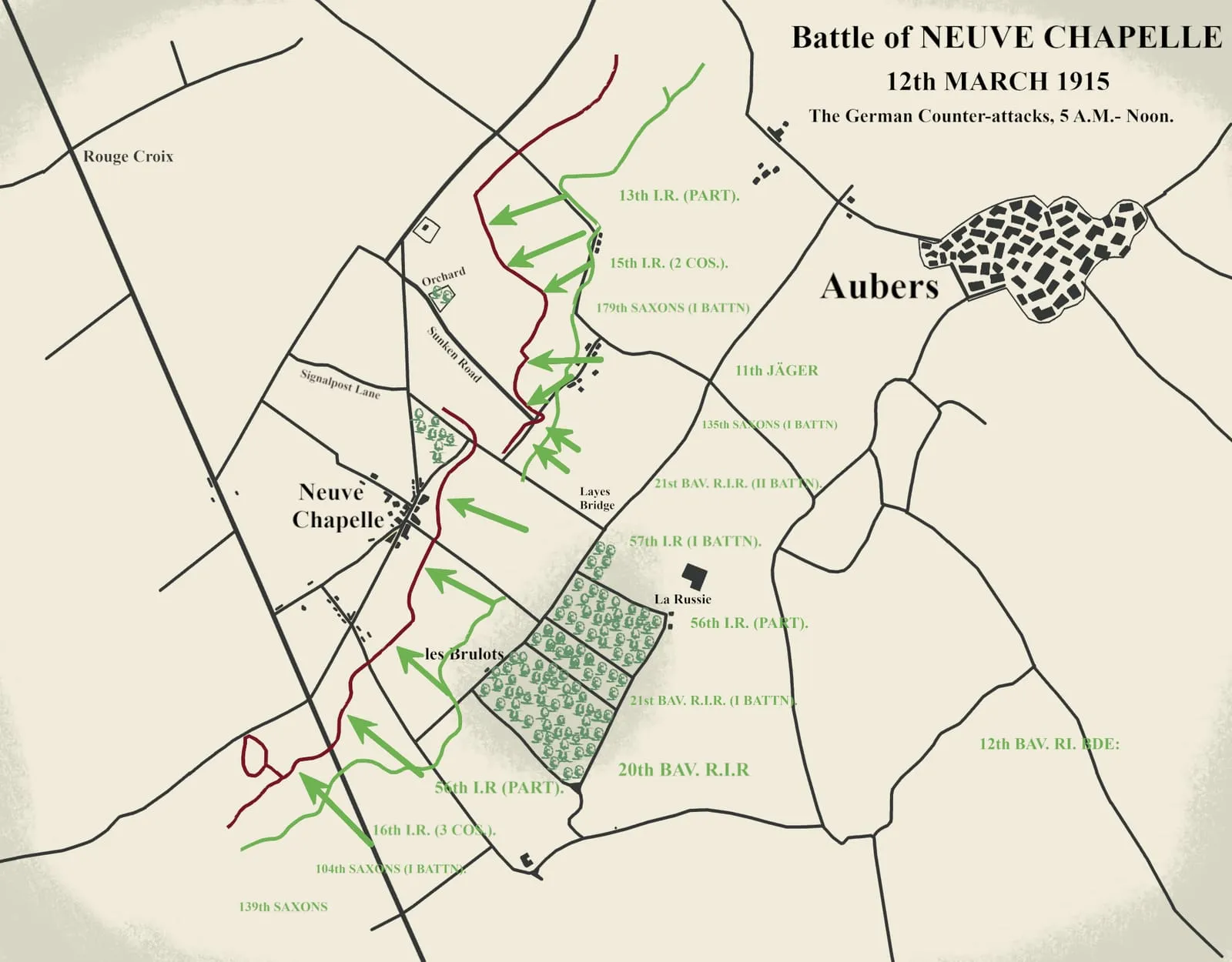
12 March. At dawn, in the mist, after a short artillery bombardment, the Germans attacked along the whole front of the breach with about 20 battalions. The British and Indians had, however, had time to dig in, and the counter-attack broke down with heavy losses for the attackers. British units counter-attacked, and during the day Haig, believing the Germans to be exhausted, ordered the attack on Aubers Ridge and the Bois du Biez to be renewed. The attacks of the 7th and 8th Divisions, and in the afternoon of brigades of the Lahore Division, brought only small gains. That day soldiers won several Victoria Crosses, most of them for bombing fights in German trenches. Company Sergeant-Major Harry Daniels and Acting Corporal Cecil Noble of the 2nd Battalion Rifle Brigade cut the wire in front of their battalion under fire. Noble died of his wounds. The cavalry, ready for the pursuit, found no use. During the night French instructed Haig to halt the attack and consolidate the ground won.
13 March. Haig called off further attacks. The troops consolidated the new line, which now ran a few hundred metres east of the ruins of Neuve-Chapelle, while in front of it the Germans were building their own. According to some accounts, one more local attack by the 7th Division ended in a costly failure. On 15 March French finally abandoned the offensive, because there was now only enough field-gun ammunition for defence.
Casualties
According to the British official history, the four divisions that took part in the attack lost 544 officers and 11,108 other ranks, a total of 11,652 killed, wounded and missing. French’s dispatch of April 1915 gave a somewhat higher figure for the three days of fighting, about 12,800, and some more recent works speak of about 12,600. The heaviest losses fell on the 8th Division, which lost nearly 4,800 men. The losses of the Indian Corps came to about 4,200.
German losses are less certain. The German official history gave nearly 10,000 men, while more recent research, based on Sixth Army documents and the diary of Crown Prince Rupprecht, estimates them at about 8,500. The British took 30 officers and 1,657 men prisoner. The heaviest losses fell on the 6th Bavarian Reserve Division, which lost more than 6,000 men in the fighting from 11 to 13 March.
Significance
At Neuve-Chapelle the British showed that a carefully prepared surprise attack could break through the first line of trenches. A short and violent bombardment, an artillery fire plan timed to the minute, maps drawn from aerial photographs and an infantry assault close behind the fire became the model for later offensives. But the battle also showed how hard it was to exploit a break-in. When telephone communication failed, commanders did not know what was happening at the front, and the defender managed to close the breach faster than the attacker could bring up reserves. Reinforcements were sent where the attack had stalled rather than where it had succeeded. A few German machine guns in surviving houses could stop whole brigades.
The battle changed the opinion that allies and enemies held of the British. The French became convinced that the British army was capable of an offensive of its own, and the Germans, who until then had kept the smallest possible forces facing it, hastily strengthened the trenches and garrison of this sector. Joffre, according to accounts cited by historians, praised the first day but dismissed the battle as a whole as a success without a future.
The most serious consequences came from the shortage of ammunition. On the first day the First Army’s artillery used up nearly a third of its stock of field-gun shells. French explained the halting of the offensive by the exhaustion of the soldiers and the lack of shells. When similar trouble struck the British at Aubers in May, the matter reached the press and caused the shell crisis in Britain. As a result, the Prime Minister, Herbert Henry Asquith, formed a coalition government, and David Lloyd George took over the new Ministry of Munitions.
For the Indian Corps this was the first great offensive on the Western Front. The memory that its soldiers had fought here in the spring of 1915 meant that it was near Neuve-Chapelle that a memorial was erected after the war to more than 4,700 Indian soldiers and labourers who fell on the Western Front and have no known grave. It was unveiled in 1927, and in 2023 it was inscribed on the UNESCO World Heritage List together with other First World War memorial sites.
Spotted a mistake?Report an error