Key event
The Battle of Neuve Chapelle begins
- Category:
- Military operations
- Front:
- Western Front
- Date:
- 10 March 1915
- Author:
- Łukasz Skowroń
- Battle:
- Battle of Neuve Chapelle
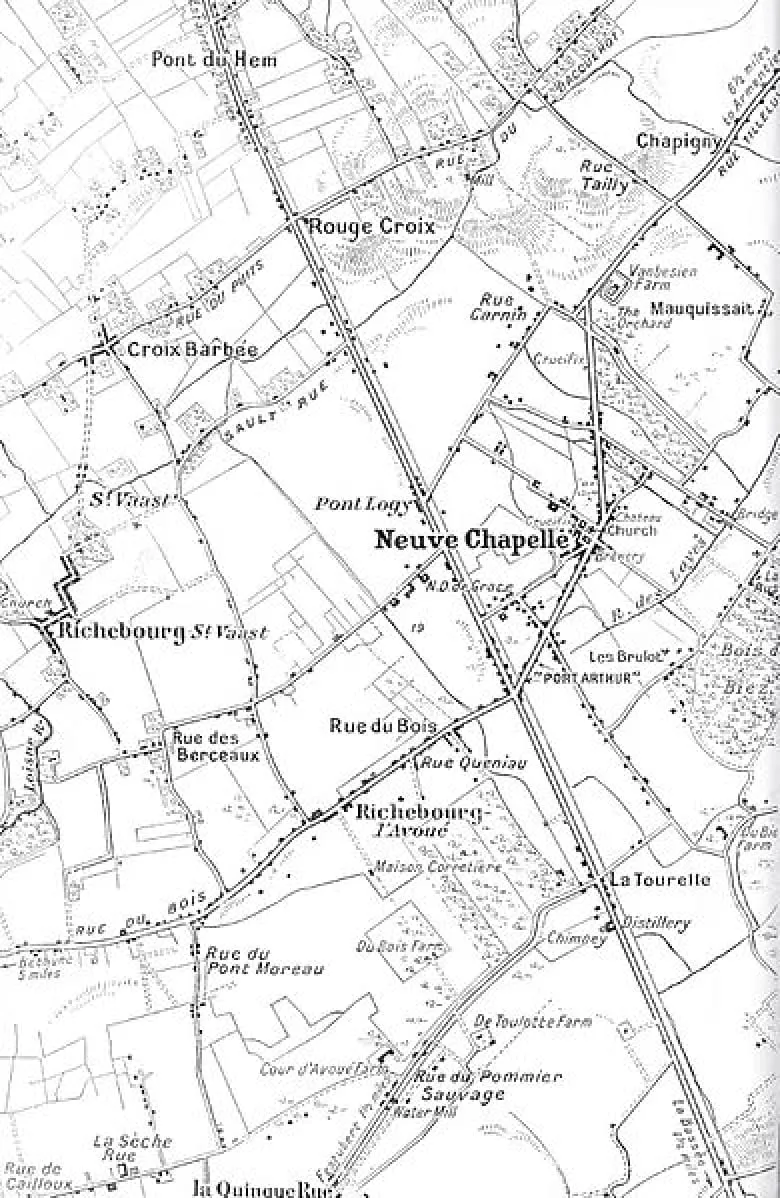
At 7.30 a.m. on 10 March 1915 the British artillery opened fire on the German trenches around the village of Neuve Chapelle in French Flanders. Half an hour later the infantry of General Douglas Haig’s First Army, British and Indian, went into the attack. It was the first offensive that the British Expeditionary Force had planned and carried out on its own since the Western Front had congealed into trenches. In the morning everything went to plan: before noon the village was in British hands and the German line was broken on a front of about two kilometres. In the afternoon, however, the attack began to bog down.
The objective
The Germans had taken Neuve Chapelle at the end of October 1914, and since then the village had sat in a small salient pushed into the British line. Behind it, beyond the Bois du Biez, rose the Aubers Ridge, barely a dozen or so metres higher than the flat, waterlogged plain, but screening the way on towards Lille. Haig wanted to eliminate the salient, take the village and then, if the defence cracked, push on to the ridge. Behind the infantry the cavalry waited, ready to move into the breach.
The attack was originally to have been part of a joint offensive with the French, but they withdrew when the British were unable to relieve their troops at Ypres. Field Marshal John French decided to attack alone. He wanted to support his allies and to prove that his army could attack and not merely hold on in the trenches.
Two corps were assigned to the attack. IV Corps under General Henry Rawlinson, with the 8th and 7th Divisions, was to strike from the north-west, and the Indian Corps under General James Willcocks, with the Meerut and Lahore Divisions, from the south. For the Indian Corps it was the first major offensive since December, when it had barely held the front at Givenchy. Facing them were thin detachments of the Westphalian VII Corps of the German Sixth Army, in shallow trenches and behind sandbag breastworks.
New methods
The preparations were more thorough than for any previous British attack. Airmen of the Royal Flying Corps photographed the German positions from the air, and on the basis of the aerial photographs accurate maps of the German trenches were drawn for the first time and then issued to officers. More than 340 guns and howitzers were brought up to their positions by night and concealed, and every battery received a list of targets and a fire timetable down to the minute. The troops moved into their assembly positions at night, and by 4.30 a.m. everyone was in place. The Germans expected nothing.
Bombardment and assault
The night was wet, with passing snow, and in the morning mist hung over the plain. At 7.30 the bombardment began. According to most sources, for 35 minutes the field guns cut the wire while the howitzers pounded the German breastworks. Soldiers in the British trenches later recalled a roar so tremendous that they could not hear their own voices. At 8.05 the artillery lifted its fire onto the village and the infantry left the trenches.
In the centre the British 25th Brigade and the Indian Garhwal Brigade crossed no man’s land almost without loss. The stunned German survivors of the bombardment mostly surrendered. The soldiers broke into the ruins of the village and cleared them house by house. On the right flank, however, one of the battalions of the 39th Garhwal Rifles lost its direction and ran into an unbombarded stretch of the German trenches, where it suffered heavy losses. Rifleman Gabbar Singh Negi of the regiment’s second battalion led the attack along a German trench, forcing the defenders to surrender. He was killed that day and was posthumously awarded the Victoria Cross.
On the left flank the 23rd Brigade came up against intact wire. The two batteries of heavy howitzers that were to have destroyed it had reached their positions only on the eve of the attack and had not had time to register. The 2nd Battalion of the Middlesex Regiment and the 2nd Battalion of the Scottish Rifles lost hundreds of men here in a short time, and the commanding officer of the Scots, Lieutenant-Colonel Wilfred Bliss, was killed. Only when a neighbouring brigade took this position in the flank from the direction of the village, and the artillery shelled it again, did the attack move on. According to French’s report, by 11 o’clock the whole village was in British hands.
A lost opportunity
Then the attack lost momentum. After the fighting in the trenches and ruins the units were intermingled and had to be sorted out. German fire cut the telephone lines, so reports from the front and orders from the staffs took hours to get through. IV Corps headquarters was unable to bring the reserve brigades forward quickly, and some commanders waited for orders instead of pressing on. Meanwhile the Germans secured the flanks of the breach, and isolated groups, among them men of the 11th Jäger Battalion, held out for many hours in trenches and houses on its edges.
The renewed advance began only at about 3.30 p.m. The brigades of the 7th and 8th Divisions were stopped by machine-gun fire around Moulin du Piètre, and the Dehra Dun Brigade, supported by the Jullundur Brigade of the Lahore Division, was held up on the way to the Bois du Biez at the Layes brook, under fire from a fortified bridge. At dusk the troops began to consolidate the ground they had won. That same day Lord Kitchener at last agreed to send to the Dardanelles the 29th Division, on which French had been counting in France.
What came next
On the evening of 10 March the British and Indians held Neuve Chapelle and a strip of captured ground up to a kilometre deep, and several hundred Germans had been taken prisoner. Behind these gains, however, stood a new German line, and during the night German reinforcements were coming up. For the next two days Haig tried to break through to the Aubers Ridge, and on 12 March the Germans launched a strong counter-attack. The battle ended on 13 March. The Aubers Ridge remained in German hands, and the first day of the attack went down in history as proof that a trench front could be broken, and at the same time as a warning of how hard it was to exploit such a breakthrough.
Remember the articles you have read? Only in this browser; nothing is sent anywhere.How it works
Read ·
A voice from the front
“As a Sikh native officer said to me on the day preceding the battle, “Sahib, we shall have a chance of proving that the Indian Army can fight and not only do sentry-go in the khandak (trenches). We shall again be able to cry, Fateh (victory).””
Spotted a mistake?Report an error
Meanwhile
(04)Elsewhere in the same days.
- 9 March 1915 · PoliticsDimitrios Gounaris becomes prime minister of GreeceOn 9 March 1915 King Constantine I appointed Dimitrios Gounaris prime minister of Greece. He was an opponent of Venizelos and a supporter of neutrality.
- 9 March 1915 · War at seaBombardment of Smyrna endsOn 9 March 1915 an envoy of the governor of Smyrna came to the British admiral. The shelling stopped and a truce was agreed until the morning of 11 March.
- 12 March 1915 · DiplomacyNetherlands warns against misuse of its flagOn 12 March 1915 the Netherlands announced that foreign ships passing themselves off as Dutch in its ports and waters, e.g. under its flag, would be held there.
- 12 March 1915 · DiplomacyLondon agrees to a Russian ConstantinopleOn 12 March 1915 Britain agreed that Russia would get Constantinople and the Straits after the war. In return it wanted, inter alia, Persia's neutral zone.
Related events
(04)The same battle, people or subject.
- 13 March 1915 · Western FrontEnd of the battle of Neuve ChapelleOn 13 March 1915 Haig halted the attack at Neuve Chapelle. The British held the village but did not reach Aubers Ridge. Shells had also run short.
- 15 May 1915 · Western FrontStart of the Battle of FestubertAt 11.30 p.m. on 15 May 1915 the British 2nd Division and the Garhwal Brigade attacked the Germans at Festubert, the first British night attack of the war.
- 21 October 1914 · Western FrontBattle of Langemarck beginsOn 21 October 1914 the British I Corps advanced from Ypres towards Bruges. It ran into new German reserve corps and went over to the defensive that same day.
- 19 October 1914 · Western FrontFirst Battle of Ypres beginsOn 19 October 1914 a British attack on Menin ran into new German corps. This was how the First Battle of Ypres began.