1914–1915: Winter offensives on the Western Front
Defence of Givenchy
- Dates:
- 20–21 December 1914
- Front:
- Western Front
- Location:
- Givenchy-lès-la-Bassée and Festubert, north of the La Bassée canal, French Flanders (Pas-de-Calais), FranceOn the battle map →
- Sides:
- United Kingdom and British IndiaJames Willcocks, Henry Watkis, Charles Anderson, Douglas Haig, Richard HakingGerman EmpireRupprecht, Crown Prince of Bavaria, Eberhard von Claer
- Result:
- Inconclusive. The Germans broke through the Indian Corps' line, but counter-attacks retook Givenchy and most of the trenches. In front of Festubert some ground remained in German hands.
- Author:
- Natalia
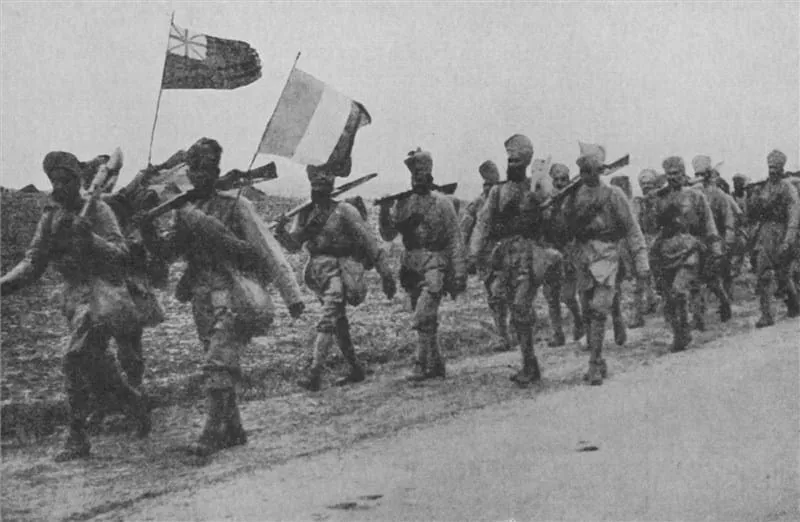
The Defence of Givenchy was the heaviest battle fought by the Indian Corps in the first winter of the war. On 20 December 1914, after several days of unsuccessful British and Indian attacks, the Germans struck along the whole front of the corps between the La Bassée canal and Neuve-Chapelle. They blew a series of mines under the trenches and then attacked with infantry armed with hand grenades. They took the village of Givenchy and broke into the line several hundred metres deep, as far as Festubert. For two days and nights exhausted Indian and British battalions, supported by French territorials, held on in successive lines, and the Manchesters twice fought for the village itself. The situation was brought under control only by fresh brigades of the British I Corps, after which the Indian Corps was relieved and sent to rest.
Name and dates
On this page we adopt the dates 20–21 December 1914. This is how the British Battles Nomenclature Committee defined the action it named the “Defence of Givenchy”, classed among the winter operations of 1914–1915. On 20 December the Germans began their attack, and on the evening of 21 December the brigades of I Corps retook Givenchy. Fighting for the lost trenches at the so-called Orchard, north-east of Festubert, continued, however, on 22 December, and the complete relief of the Indian Corps was not finished until 27 December.
Some studies call the whole the Battle of Givenchy and count it from 18 or 19 December, that is, from the local attacks of the Indian Corps that preceded the German blow. In German historiography this fighting is part of the so-called December battle in Flanders (Dezemberschlacht in Flandern), covering the whole front from Arras to the neighbourhood of Ypres.
Background
General James Willcocks’s Indian Corps had held the front on the plain between Givenchy and Neuve-Chapelle since the end of October, when it took over the trenches of the bled-white British II Corps. Its two divisions, General Henry Watkis’s Lahore and General Charles Anderson’s Meerut, had for nearly two months been sitting in flooded ditches, in cold and rain for which the soldiers of the British Indian Army were not prepared. They lacked winter clothing, grenades and engineering equipment. On 7 December General Brunker’s Sirhind Brigade, the last missing brigade of the Lahore Division, at last arrived from Egypt, and on 11 and 12 December the corps took over from the French Givenchy and the sector south of the canal, around Cuinchy.
Givenchy lay on a small rise just north of the La Bassée canal. On the flat, marshy plain even so low a ridge gave a good view of the surroundings, and in the village the British and French lines met. To the right of the Indians stood the French XXI Corps, which had, moreover, placed two territorial battalions of the 142nd Regiment at the disposal of the Lahore Division.
In mid-December General Joseph Joffre began a series of attacks on the Western Front, reckoning that the Germans had weakened it by moving troops to the east. Field Marshal John French agreed to support the French. On 14 December the British II Corps attacked at Wytschaete, and the remaining corps, including the Indian, were to carry out local operations that would pin the Germans in place. An order of the evening of 17 December called for “a vigorous offensive along the whole front” on 18 December, and at the same time merely for “demonstrating” and seizing opportunities to capture German trenches. Willcocks later wrote bitterly that one cannot attack vigorously and at the same time only pretend to attack. Each 18-pounder field gun was allotted 40 rounds for the attack.
Local attacks, 16–19 December
On 16 December two companies of the 129th Baluchis of the Ferozepore Brigade captured at Givenchy two German saps approaching the British trenches, but were driven by grenades out of most of the ground they had taken. The Baluchis alone lost over 120 men.
On 19 December the Lahore Division attacked on a sector of about 300 metres north-east of Givenchy. Companies of the 1st Battalion, Highland Light Infantry and the 1st Battalion, 4th Gurkha Rifles of the Sirhind Brigade set off before dawn, after a very short artillery bombardment. They took two lines of trenches and over 70 prisoners. On their right the 59th Scinde Rifles, which had only just arrived in the sector, lost direction in the rain and darkness and seized only two saps. The captured trenches turned out to be enfiladed, and it proved impossible to connect them with the British line. In the evening the men withdrew to their starting positions. Lieutenant William Bruce of the 59th, who despite a wound urged his men on throughout the day, was killed and posthumously awarded the Victoria Cross.
On the same day the Meerut Division took a stretch of German trenches in the area of the Orchard, north-east of Festubert. The attack was led by the British 2nd Battalion, Leicestershire Regiment with half of the 2nd Battalion, 3rd Gurkha Rifles. The Leicesters captured two German machine guns, but under a hail of grenades and trench-mortar bombs gave up most of their gains. In the evening the Germans smothered the Orchard itself with fire. The 2nd Battalion, 2nd Gurkha Rifles had to fall back several dozen metres to the west, to a hastily prepared line. Airmen reported German troops massing in front of the corps.
Course
20 December, morning. The Germans had long been preparing a blow at Givenchy, and the coincidence with the Indian attacks was accidental. According to a report of the German VII Corps captured later, the attack was carried out by two battalions of the 57th Infantry Regiment of the 14th Division and four companies of pioneers on a sector of about 900 metres, supported by heavy howitzers and numerous trench mortars. During the night there had been torrential rain. In the trenches stood mud and icy water up to the knees, in places up to the waist, and many rifles jammed. At dawn artillery and mortar fire fell on the whole front of the corps. At about 9 a.m. the Germans blew ten small mines, each of 50 kilograms of explosive, laid at the ends of saps under the parapets of the Sirhind Brigade’s trenches. One double company of the 4th Gurkhas and half a company of the Highland Light Infantry were killed in the explosions or buried. At the same time a mine explosion and a storm of fire fell on the Orchard.
Immediately after the explosions the German infantry advanced along the saps and across the open field. The attackers had a great many grenades, the defenders very few, and those improvised ones which in the rain often failed to explode. At about 1 p.m. the Sirhind Brigade, driven out of its trenches, fell back as far as the road to Festubert. Lieutenant Stewart of the Highland Light Infantry, with a few dozen men and two machine guns, held out in a support trench for nearly a day and a night, although he was almost cut off. In the north the Germans drove the 2nd Battalion, 2nd Gurkha Rifles out of its trenches and attacked the Seaforth Highlanders of the Dehra Dun Brigade, who found themselves under fire from both flanks. They lost some trenches, but with grenades regained several traverses and held their position.
20 December, afternoon. After 1 p.m. the Baluchis fell back on the right flank, and the Germans broke into Givenchy. Watkis threw into the fight General Carnegy’s Jullundur Brigade. Shortly after 3 p.m. Colonel Strickland’s 1st Battalion, Manchester Regiment, supported by a company of the 4th Battalion, Suffolk Regiment of the volunteer Territorial Force, attacked the village. The fighting went on for every house, and by nightfall the Manchesters had cleared Givenchy and regained some of the trenches to its north-east. East of the village Wilde’s 57th Rifles, with a company of the 9th Bhopal Infantry and French territorials, for the most part held their trenches, keeping contact with the Connaught Rangers south of the canal and with the French. At 2.30 p.m. British headquarters sent to the aid of the Indian Corps a brigade from General Douglas Haig’s I Corps, which was in army reserve, and at 3.17 p.m. another.
Night of 20–21 December. The Sirhind Brigade’s trenches were to be retaken by General Macbean’s composite group, made up of the dismounted Secunderabad Cavalry Brigade, the 47th Sikhs and the 2nd Battalion, 8th Gurkha Rifles. After long delays the 7th Dragoon Guards and the 47th Sikhs attacked only after midnight. In the darkness, in knee-deep mud and on ground cut by ditches that was completely unknown to them, they failed to find the right trenches. The commander of the dragoons, Lieutenant-Colonel Lempriere, was killed. A second attack, at about 5 a.m., reached the flooded trenches, in which two Gurkhas drowned, but under fire from both flanks it had to withdraw to Festubert at dawn.
21 December. At 6.30 a.m. the Manchesters attacked the trenches north of Givenchy, but came under murderous fire. At 11 a.m., after three-quarters of an hour of bombardment, the Germans struck at the village. When the French territorials on the Manchesters’ left flank were driven out, the battalion had to fall back. Strickland once more retook the old trenches at about 2 p.m., but after 3 p.m. the Germans attacked from the front and flank, and the Manchesters, almost surrounded, withdrew towards the canal. The battalion lost about 240 killed, wounded and missing.
Meanwhile the brigades of the British 1st Division were approaching; it had recently come under the command of General Richard Haking. The 1st (Guards) Brigade, with the London Scottish battalion, reached Béthune at 3 a.m., and the 3rd Brigade in the morning. After a short rest both went into the attack in the afternoon, the first on Givenchy, the second on the breach at Festubert. The 2nd Brigade, brought up by bus, was to retake the Orchard. The brigades got bogged down in the sodden ground and under machine-gun fire. They reached Givenchy only after dark, just after the Manchesters had left, and with the help of a company of the French 142nd Territorial Regiment retook the village. The 3rd Brigade was unable to reach the Sirhind Brigade’s old trenches, and the 2nd Brigade took the support trenches behind the Orchard in the evening, but the Orchard itself, churned up by explosions, could no longer be occupied.
22 December. In the morning the Germans drove a battalion of the Loyal North Lancashire with grenades out of some of the trenches by the Orchard, but by midday the line had been restored. At 1 p.m. Haig took over command of the whole sector from Willcocks. On the night of 22–23 December the Lahore Division was withdrawn, while the Meerut Division remained in the line under the orders of I Corps until 27 December. According to German sources the fighting on the Givenchy–Festubert sector between 21 and 23 December was among the heaviest on the entire Western Front that winter.
Losses
The sources do not give exact losses for the whole battle. According to the British official history the 1st Division lost 1,682 men in the fighting to recover the line. Willcocks wrote that over 4,000 British and Indian soldiers of his corps fell in the whole of the fighting. The Sirhind Brigade suffered particularly heavily. The 1st Battalion, Highland Light Infantry lost about 400 men between 19 and 22 December, roughly half of those who went into action, and most of the missing turned out to have been killed. The 1st Battalion, 4th Gurkha Rifles lost 302 men on 19 and 20 December, including 17 British and Gurkha officers, and the 1st Battalion, 1st Gurkha Rifles over 200 on 20 December alone.
According to the report of the German VII Corps, the attackers took 19 officers and 815 other ranks prisoner on 20 December. The same sources give the German losses: 250 killed, 462 wounded in hospital and 459 lightly wounded who remained with their units.
Significance
The Defence of Givenchy was the last major battle on the British front in 1914. In response to the Allies’ December attacks the Germans struck at the weakest point of the British line and dented it painfully, but did not break through the front. Givenchy remained in British hands, and in front of Festubert the Germans kept only a small strip of the ground they had won.
The battle ended the first period of the Indian Corps’ service in France. The British official history attributed its failure to unfamiliarity with trench warfare and grenade fighting, a lack of sappers and equipment, heavy losses and the conditions of the Flanders winter, to which soldiers from a hot climate were not accustomed. From its arrival at the front to the end of December the corps lost 9,579 men. At Christmas it was in reserve, and from 26 December, after the division of the British Expeditionary Force into two armies, it formed part of Haig’s First Army. After several weeks of rest and reinforcement the corps returned to the front, and in March 1915 its soldiers fought at the Battle of Neuve-Chapelle.
The battle showed how much the war on the Western Front had changed. Saps and mines, hand grenades and trench mortars, in which the Germans had a clear advantage, became an everyday matter from then on. The small ridge of Givenchy remained one of the most fiercely defended points of the British line. Fighting for it broke out many times in the following years, up to the spring of 1918, and underground both sides waged a mine war here for many months.
Spotted a mistake?Report an error