Key event
Defence of Givenchy
- Category:
- Military operations
- Front:
- Western Front
- Date:
- 20 December 1914
- Author:
- Łukasz Skowroń
- Battle:
- Defence of Givenchy
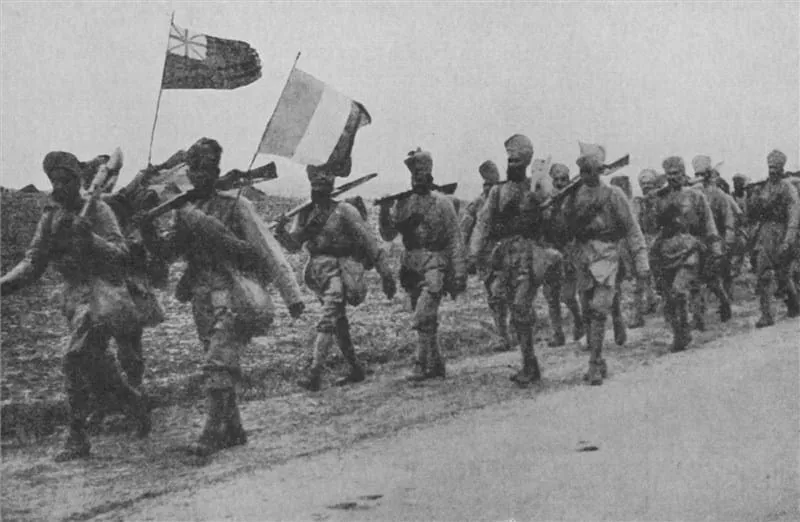
On 20 December 1914, the same day that the French began their offensive in Champagne, the Germans attacked the Indian Corps in French Flanders. At dawn heavy artillery and trench-mortar fire fell on its whole front, from the La Bassée canal to Neuve-Chapelle. At about 9 a.m. German mines exploded under the trenches east and north of the village of Givenchy, and immediately afterwards infantry armed with grenades went in to the attack. By noon the Germans had smashed one of the Indian brigades, taken Givenchy and broken into the line as far as Festubert. The British chronology of the war records this day as the start of the Defence of Givenchy, which lasted until 21 December.
After a week of attacks
The blow fell on troops who were utterly exhausted. Since mid-December, at General Joffre’s request, the British army had been making local attacks along the whole front, intended to pin the Germans in place. On 14 December II Corps attacked at Wytschaete, and on 19 December both Indian divisions, the Lahore and the Meerut, attacked the German trenches at Givenchy and at the so-called Orchard north-east of Festubert. They took sections of German trench, more than 70 prisoners and two machine guns, but in the evening gave up almost everything. The Germans replied with furious shelling, and airmen reported troops massing in front of the corps.
According to German prisoners, the attack had long been planned for 20 December, and its coinciding with the Indian attacks was accidental. German sappers had quietly driven saps right under the British trenches. Facing them were the men of the Sirhind Brigade, who had arrived from Egypt less than two weeks earlier and had taken part in the attack the previous day. During the night there was a downpour. The trenches filled with mud and icy water up to the knees and in places up to the waist. The washed-away fire-steps made it impossible to fire over the parapet, and the mud-clogged rifles jammed.
Mines and grenades
The German mines were small, about 50 kilograms of explosive each, but they went off right under the parapets, at the ends of saps the defenders knew nothing about. According to the British official history ten were blown. On the right of the Sirhind Brigade’s sector, one double company of the 1st Battalion, 4th Gurkha Rifles and half a company of the Scottish 1st Battalion, Highland Light Infantry were killed in the explosions or buried in their trenches. A handful of survivors fought on until they were taken prisoner. On the left, similar explosions destroyed several stretches of trench together with their defenders.
The Germans came through the saps and across the open field in waves, throwing hand grenades. The defenders had few, and those they had were improvised on the spot and in the rain often would not light. The Gurkhas and the Scots fought hand to hand. Captain Rundall of the 4th Gurkhas was killed leading a grenade counter-attack, a day after his younger brother had fallen in the failed attack. Major Bliss of the 1st Gurkhas was killed leading a bayonet charge. At about 1 p.m. the remnants of the Sirhind Brigade fell back as far as the Festubert road. Lieutenant Stewart of the Highland Light Infantry remained in a support trench with a few dozen men and two machine guns, almost cut off from his own side. He held out there for nearly twenty-four hours.
In the north the Germans drove the 2nd Battalion, 2nd Gurkha Rifles out of the trenches at the Orchard and attacked the Scottish Seaforth Highlanders battalion from both flanks. The Scots lost some of their trenches, but by bombing the Germans with grenades they regained several traverses and stopped the attack.
Givenchy
The corps commander, General James Willcocks, was that morning at Vieille-Chapelle, welcoming a newly arrived battalion of Scottish volunteers. He was just explaining to them how they would gradually learn trench warfare when a runner brought news of the German attack. The battalion marched straight into the second-line trenches.
After 1 p.m. the left-hand battalion of the Ferozepore Brigade, the 129th Baluchis, also fell back, and the Germans broke into Givenchy. The village was the key to the defence: it stood on a slight rise commanding the plain, and next to it the British line joined the French. The commander of the Lahore Division, General Watkis, sent there the British 1st Battalion, Manchester Regiment under Colonel Strickland, with a company of volunteers from the 4th Battalion, Suffolk Regiment. Shortly after 3 p.m. the Manchesters entered the village. The Germans defended it house by house, and the fighting was done with the bayonet. By nightfall Givenchy was again in British hands. Only a dozen or so prisoners were taken in the heavy fighting. Three British artillery officers emerged from a cellar, where they had hidden when the Germans took the village.
East of Givenchy most of the trenches of the 57th Wilde’s Rifles and of a company of the 9th Bhopal Infantry held, supported by French soldiers of the 142nd Territorial Regiment. Thanks to them, the link with the Connaught Rangers battalion south of the canal, and through it with the French, was not broken.
Calling for reinforcements
Willcocks knew that his corps, which had been in the trenches without a break for two months, would not stand a long fight. He demanded reinforcements. At 2.30 p.m. British General Headquarters sent him a brigade from the I Corps of General Douglas Haig, which was in reserve, and at 3.17 p.m. a second. Before they arrived, Willcocks threw in everything he had: the dismounted Secunderabad Cavalry Brigade, the 47th Sikhs and the 2nd Battalion, 8th Gurkha Rifles. After midnight British dragoons and Sikhs set off in darkness and pouring rain across unknown ground to retake the Sirhind Brigade’s trenches. The attack stuck in the mud and ditches under fire from both flanks, and the commanding officer of the 7th Dragoon Guards, Lieutenant-Colonel Lempriere, was killed.
The next day the Germans again drove the Manchesters out of Givenchy. Fresh brigades of the British 1st Division retook the village on the evening of 21 December, and on 22 December Haig took over the whole sector from Willcocks. For the Indian Corps the Defence of Givenchy was the hardest trial of the first winter of the war. The battalions of the Sirhind Brigade alone lost hundreds of men in a few days, and according to a German report more than 800 British and Indian soldiers were taken prisoner on 20 December.
Remember the articles you have read? Only in this browser; nothing is sent anywhere.How it works
Read ·
Spotted a mistake?Report an error
Meanwhile
(04)Elsewhere in the same days.
- 19 December 1914 · DiplomacyBritain recognises the Treaty of FezOn 19 December 1914 Britain recognised the 1912 French protectorate over Morocco. In return France recognised the British protectorate over Egypt.
- 19 December 1914 · Middle EastDeposition of Abbas II HilmiOn 19 December 1914 the British announced the deposition of Khedive Abbas II Hilmi. His uncle Hussein Kamel became ruler of Egypt with the title of sultan.
- 21 December 1914 · AfricaBritish take JasinAt the end of December 1914 Gen. Michael Tighe's troops cleared the Germans from the British East Africa border and took Jasin on the Umba river.
- 18 December 1914 · Eastern FrontFighting begins on the Rawka and the BzuraOn 18 December 1914 the Germans attacked new Russian positions on the Rawka and the Bzura, opening fighting that became trench warfare lasting until July 1915.
Related events
(04)The same battle, people or subject.
- 10 March 1915 · Western FrontThe Battle of Neuve Chapelle beginsOn 10 March 1915, after a 35-minute bombardment, the British First Army attacked at Neuve Chapelle. It took the village in hours but could go no further.
- 9 May 1915 · Western FrontBritish attack Aubers RidgeOn 9 May 1915 the British First Army attacked Aubers Ridge to support the French in Artois. Machine-gun fire stopped the attack in no man's land.
- 15 May 1915 · Western FrontStart of the Battle of FestubertAt 11.30 p.m. on 15 May 1915 the British 2nd Division and the Garhwal Brigade attacked the Germans at Festubert, the first British night attack of the war.
- 11 November 1914 · Western FrontPrussian Guard attack at Nonne BosschenOn 11 November 1914 the Prussian Guard broke into the British line at Ypres. Gunners and an Oxfordshire counter-attack stopped the last great German attack.