United Kingdom · The Entente
Roger Keyes
Chief of staff of the fleet at the Dardanelles (1915), commander of the Dover Patrol (1918), vice-admiral
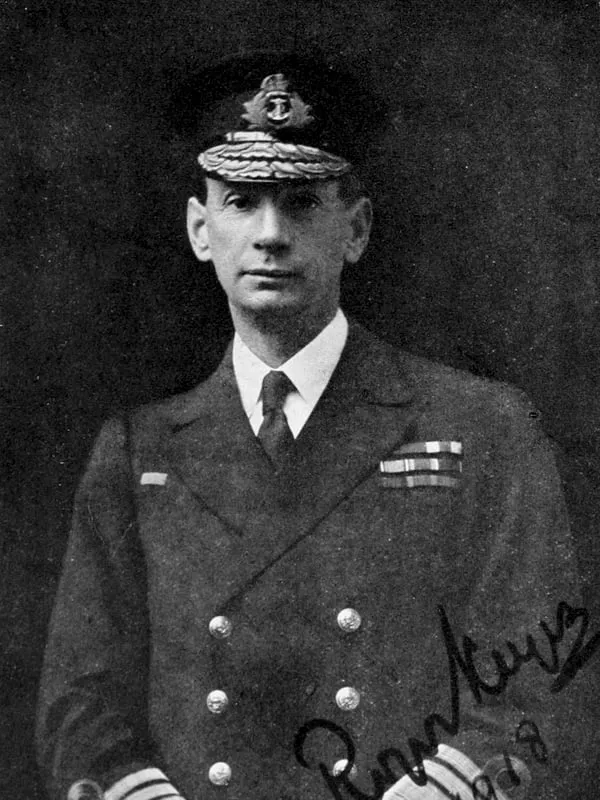
- Born:
- 4 October 1872, Tundiani, Punjab (British India)
- Died:
- 26 December 1945, Tingewick (England)
- Author:
- Łukasz Skowroń
- Photo:
- Russell, domena publiczna, Wikimedia Commons

Sir Roger Keyes was the most pugnacious of the British admirals of the First World War. He was always looking for a fight, always proposing the bolder course, and could not bear waiting. In August 1914 he helped devise the plan for the Royal Navy’s first victory, in the Heligoland Bight; in 1915, as chief of staff of the fleet at the Dardanelles, he argued to the end that the ships could force the straits; and in 1918, as commander of the Dover Patrol, he led the Zeebrugge Raid, the most famous action of the British navy in this war. To his contemporaries he was a hero in the spirit of Nelson. Historians value his courage and energy, but point out that his plans often promised more than they could deliver.
Before the war
He was born on 4 October 1872 at Fort Tundiani in the Punjab, the second son of General Charles Keyes of the Indian Army. From childhood he said he would become an admiral. In 1885 he joined the navy as a cadet. He served in the Indian Ocean, where his corvette hunted slave traders’ vessels off the coast of Zanzibar, and in the Pacific, and at 25 he received his first command, a destroyer. He made his name in China. During the Boxer Rebellion in June 1900, with his destroyer Fame, he captured four Chinese destroyers by boarding on the Peiho river, then blew up the guns and a powder magazine in one of the forts, and in August he was among the first to scale the walls of Peking to relieve the besieged legations. For this he was promoted to commander.
He then served as an intelligence officer at the Admiralty, as naval attaché in Rome and as commander of a cruiser. In 1905 he was promoted to captain. In 1910, though not a submariner, he became Inspecting Captain of Submarines, and in 1912 commodore and head of the whole British submarine service. He introduced competition between shipyards, which until then had supplied submarines almost exclusively from one firm, Vickers. He usually went to sea in a destroyer, because almost nothing could be seen from the early submarines.
1914: the Heligoland Bight
In August 1914 Keyes commanded the submarines at Harwich, which from the first days of the war watched the exits from the German bases. They noticed that German torpedo boats went out on patrol every evening and returned in the morning. Together with Commodore Reginald Tyrwhitt, commander of the Harwich destroyers, Keyes proposed an ambush, which was backed by the First Lord of the Admiralty, Winston Churchill. On 28 August Keyes was aboard the destroyer Lurcher. In the confusion of the fight in the mist, not having been warned that Commodore Goodenough’s light cruisers had also put to sea, he took them for German ships and called for help. The battle was decided by the entry into the bight of the battlecruisers of Admiral David Beatty. The Germans lost three light cruisers and a torpedo boat. Lurcher came alongside the sinking cruiser Mainz and took off about 220 survivors.
In December Keyes’s submarines waited off the German coast, ready to rescue airmen in the Cuxhaven Raid, the first attack by aircraft launched from ships.
The Dardanelles
In February 1915 Keyes became chief of staff to Vice-Admiral Sackville Carden, who was to force the Dardanelles with the fleet. The bombardment of the forts went slowly, and the minesweepers, converted fishing trawlers with civilian crews, could not clear the minefields under the fire of mobile batteries. In March Keyes personally led one of the night minesweeping attempts, covered by the cruiser Amethyst, which ended with heavy damage to the ships and loss of life. On 18 March three battleships sank on Turkish mines, and the new commander, Vice-Admiral John de Robeck, broke off the attack. For the rest of his life Keyes was convinced that the fleet had then been a step from victory, because the Turks were running out of ammunition. He believed it would have been enough to give the navy proper minesweepers and try again. De Robeck, however, decided that the straits had first to be taken from the land, and from then on the fleet supported the army of General Ian Hamilton.
In the autumn, as the decision to evacuate the peninsula was maturing in London, Keyes prepared a new plan. Several old battleships were to pass through the minefields and the Narrows at dawn, under cover of smoke screens, and then cut off the Ottoman troops on Gallipoli from their supplies. De Robeck was opposed, but Vice-Admiral Rosslyn Wemyss supported him. On 28 October Keyes arrived in London and won over the First Lord of the Admiralty, Arthur Balfour, with his enthusiasm. At a meeting of the War Committee his plan confirmed Lord Kitchener in his reluctance to evacuate. Kitchener talked with him as late as 4 November before leaving for the Dardanelles, but the government decided that it would agree to a naval attack only together with a new attack by the land forces, and for that there were no longer enough soldiers. In December Keyes and Wemyss still wanted to try when the order to evacuate Suvla and Anzac came. They accepted it only in the case of Cape Helles, judging that Helles alone was not worth the losses. The evacuation succeeded, and for the rest of his life Keyes regarded the abandonment of the Dardanelles as a lost triumph.
The Grand Fleet and the Admiralty
In June 1916 he took command of the battleship Centurion in the Grand Fleet. In April 1917 he was promoted to rear-admiral and became second-in-command of the 4th Battle Squadron. In autumn 1917 the new First Lord of the Admiralty, Eric Geddes, put him at the head of a new plans division. Keyes returned to the old idea of closing the German bases in Flanders, from which the submarines and torpedo boats of the Flanders Flotilla went to sea from Bruges through the canals to Zeebrugge and Ostend. He proposed sinking old cruisers filled with concrete in their entrances. Together with Wemyss he also believed, on the basis of intelligence, that German submarines were passing almost unhindered through Admiral Reginald Bacon’s barrage in the Strait of Dover. The dispute over this contributed to the dismissal of Admiral Jellicoe. Bacon was recalled, and on 1 January 1918 Keyes took command at Dover as a vice-admiral.
The Dover Patrol
Keyes changed the way the strait was defended. Some sixty drifters kept watch every night over a new, deep minefield, and trawlers and searchlights lit up the sea, forcing submarines to dive into the trap. In the first weeks several German submarines were lost in the strait, though part of the credit was still due to mines laid in Bacon’s time. The patrols, standing in full view, were however an easy target. On the night of 14–15 February German torpedo boats fell upon the barrage and sank seven drifters and a trawler, and for a long time no one at Dover understood what was happening. Keyes convened a court of inquiry and, according to some accounts, afterwards removed several commanders.
At the same time he was preparing the attack on the ports. The first two attempts in April were called off because of the wind. On St George’s night, 23 April 1918, the ships of the Dover Patrol attacked both ports. Keyes sailed in the destroyer Warwick, and according to accounts signalled “St George for England” before the action. At Zeebrugge the cruiser Vindictive came alongside the mole and landed a storming party, a submarine blew up the viaduct linking the mole to the shore, and two blockships sank in the canal. At Ostend the blockships missed the entrance and ran aground. According to Keyes’s report 176 men were killed and 412 wounded. The news that the navy had broken into a heavily defended German port came in the darkest days of the spring, when on the Lys the Germans were pressing towards the Channel ports, and caused enormous enthusiasm at home. On 24 April Keyes was already made a Knight Commander of the Order of the Bath. Within a few days the Germans dredged a passage past the wrecks, and on 25 April the first submarine again went out through Zeebrugge.
Keyes did not give up. On the night of 9–10 May he attacked Ostend a second time, this time with Vindictive herself as the blockship. The ship sank between the piers, but at an angle to the axis of the channel. The Admiralty announced a success, while Keyes reported that the wreck blocked at most a third of the fairway and protested against the exaggerated communiqué. No third attempt was made. Until the autumn the Dover Patrol covered the cross-Channel traffic, harassed the Flanders coast with monitor bombardments and supported the left wing of the Allies. In September Keyes had the burning monitor Glatton torpedoed in Dover harbour so that her magazines would not blow up the town. On 17 October, when the Germans left Ostend, he was the first to enter it from the sea, and the same day he brought King Albert I of the Belgians and Queen Elisabeth there in a destroyer.
After the war
In 1919 he commanded the battlecruisers, and was made a baronet and granted £10,000 by Parliament. From 1925 to 1928 he was Commander-in-Chief of the Mediterranean Fleet, and in 1930 he became Admiral of the Fleet, but a scandal aboard the battleship Royal Oak, which the Admiralty considered badly handled, probably closed his way to the post of First Sea Lord. In 1934 he entered the House of Commons as Conservative member for Portsmouth. Together with Churchill he opposed the Munich Agreement. On 7 May 1940, in the uniform of an Admiral of the Fleet, he made a speech in the debate on the defeat in Norway that contributed to the fall of Neville Chamberlain’s government. Churchill made him the first head of Combined Operations, which trained commandos, but in October 1941 removed him for his difficult character and unrealistic ideas. A month later his son Geoffrey was killed leading the commando raid on Rommel’s headquarters, and was posthumously awarded the Victoria Cross. In 1943 Keyes was created Baron Keyes of Zeebrugge and Dover. He died on 26 December 1945 at Tingewick and was buried at Dover, beside those killed in the Zeebrugge Raid.
Assessment
To his contemporaries Keyes embodied the offensive spirit that the Royal Navy lacked in a war full of caution and disappointment. His supporters stress that at Dover he took over a sluggish command and breathed new energy into it, and that the Zeebrugge Raid, whatever its practical effects, raised the country’s morale at a critical moment of the war.
Critics point out that Keyes often overrated what could be achieved by daring. The British official history by Henry Newbolt admits that in the week after the raid as many submarines left the Flanders bases as before, and some naval historians believe that the tighter barrage in the strait achieved more than the blockships. The dispute over the Dardanelles continues to this day. Some historians agree with Keyes that the Turks were in a difficult position after 18 March; others point out that the untouched minefields and mobile batteries would also have stopped a second attack, and that even a successful passage by the fleet would not have ensured the fall of Constantinople. No one, however, denies his personal courage, or that in both wars he remained true to Nelson’s conviction, which he quoted in the House of Commons in 1940: the boldest measures are the safest.
Sources
Spotted a mistake?Report an error
Commanded in battles
(02)Mentioned in battles
(01)Often appears with
People who appear in the same events.