United Kingdom · The Entente
Eric Geddes
Deputy Director-General of Munitions Supply at the Ministry of Munitions (1915–1916), Director-General of Transportation in France (1916–1917), First Lord of the Admiralty (1917–1919)
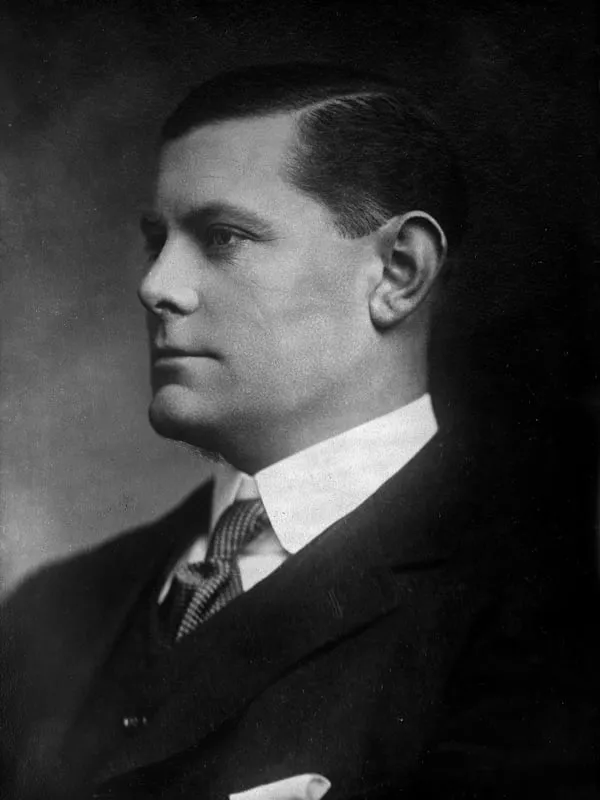
- Born:
- 26 September 1875, Agra (British India)
- Died:
- 22 June 1937, Albourne Place near Hassocks (Sussex)
- Author:
- Łukasz Skowroń
- Photo:
- Bain, domena publiczna, Wikimedia Commons

Sir Eric Geddes was the best known of the “men of push and go” whom David Lloyd George brought from business into public service during the war. He was neither a soldier, nor a sailor, nor a politician, but a railwayman and manager, and yet within three years he held the honorary ranks of major-general and vice-admiral, sorted out the rear services of the British Army in France and stood at the head of the Admiralty at the most difficult stage of the submarine war. His name, however, is associated above all with two controversies: the unceremonious removal of Admiral Jellicoe on Christmas Eve 1917, and the slogan that Germany should be “squeezed like a lemon”.
Before the war
He was born on 26 September 1875 in Agra in India, into the Scottish family of an engineer. His younger brother was Auckland Geddes, a doctor and professor of anatomy, and during the war Minister of National Service. Eric did poorly at school and as a teenager went to the United States, where he took on all kinds of work, from lumbering to a job on the Baltimore and Ohio railroad. He then worked in India on the building and running of narrow-gauge railways, and in 1904 returned to England and joined the North Eastern Railway. He rose quickly, and by 1911 was already its deputy general manager. He was regarded as an expert in statistics, organisation and efficiency, cool, energetic and impatient with bureaucracy.
Munitions and railways
In 1915 Lloyd George, setting up the Ministry of Munitions, was looking for people from outside the civil service. The North Eastern Railway lent him Geddes, who became Deputy Director-General of Munitions Supply. He was responsible first for small arms: he drew up production programmes for rifles and machine guns that soon exceeded the army’s orders. He then took on shell filling and the national filling factories. He worked with a team of managers and statisticians, many of them from his own railway.
In the summer of 1916, when Lloyd George became Secretary of State for War, the rear of the Western Front was overloaded. The ports, railways and roads could not keep up with supplies for the Somme. At the minister’s urging, General Douglas Haig invited Geddes to France for a short inspection, which stretched to a month. In the autumn Geddes became Director-General of Transportation at Haig’s headquarters, and at the same time Director-General of Military Railways at the War Office, with the honorary rank of major-general. Transport was taken out of the hands of the army’s quartermaster-general and placed under a civilian expert, which caused resentment among some officers. Geddes expanded the ports, the standard-gauge railway network and above all the narrow-gauge light railways that carried ammunition right up to the front. At the Calais conference in February 1917 he was one of the British transport experts. Haig, who usually looked on civilians with distrust, thought highly of him and remained his ally.
The Admiralty
In February 1917 Germany declared unrestricted submarine warfare, and British shipping losses rose dramatically. In May Lloyd George moved Geddes to the Admiralty to the new post of Controller, responsible for the building of warships and merchant ships, with the honorary rank of vice-admiral. For a time, therefore, he was both a general and an admiral. Geddes quickly concluded that the Admiralty lacked energy and organisation. He wrote to Haig about it, and in June, together with the field marshal, urged the prime minister to change the navy’s leadership.
In July 1917 Lloyd George moved Edward Carson to the War Cabinet, and Geddes became First Lord of the Admiralty, the political head of the Royal Navy. According to the “London Gazette” he was sworn in on 20 July. Since the minister had to sit in Parliament, on 25 July he was returned unopposed as member for Cambridge. He accepted the office on condition that the First Sea Lord, Admiral John Jellicoe, would not be dismissed straight away.
Geddes found the navy in the middle of a turning point. The convoy (PL) system, introduced from the spring and summer, was beginning to take effect, and shipping losses were slowly falling. The new First Lord reorganised the Admiralty on the model of a large business. He created the post of Deputy First Sea Lord, which went to Admiral Rosslyn Wemyss, set up a Plans Division headed by Rear-Admiral Roger Keyes, separated operational from administrative matters, and entrusted merchant shipbuilding to industrialists. He also brought scientists into the Admiralty to work on detecting submarines.
Cooperation with Jellicoe went badly. Geddes regarded him as a pessimist and a man unable to delegate responsibility, and in the autumn the dispute also concerned the defence of the Strait of Dover, through which, according to intelligence, German submarines were passing almost unhindered. After the Germans destroyed a Norwegian convoy in December, Geddes ordered an inquiry over the heads of Jellicoe and the commander of the Grand Fleet, Admiral David Beatty. On 24 December 1917 he handed Jellicoe a letter in which, without giving reasons, he deemed his departure desirable. Wemyss became his successor, and the Dover command passed from Admiral Reginald Bacon to Keyes, who in April 1918 carried out the raid on Zeebrugge and Ostend. The way the victor of Jutland had been treated outraged the Sea Lords and part of public opinion. In March 1918 Geddes apologised in the House of Commons if he had hurt the admiral’s feelings, and the debate revealed that he had acted on the prime minister’s behalf.
In 1918 Geddes represented Britain on the Allied Naval Council, set up in November 1917 to coordinate the operations of the allied fleets. Under his direction the Admiralty extended convoys, including in coastal waters, and protected the shipping of American troops across the Atlantic, which cost relatively small losses.
After the war
In the campaign before the December 1918 election Geddes spoke in Cambridge and declared that Germany would pay for the war and that he himself would squeeze everything out of her, like a lemon, “until the pips squeak”. These words became a symbol of the mood that later hampered the British delegation at the peace conference. In January 1919 he left the Admiralty, was for a few months a minister without portfolio, and in May became the first ever Minister of Transport. In 1921 he chaired the committee on national expenditure, whose drastic cuts, including in the army, the navy and education, went down in history as the “Geddes Axe”. In 1922 he left politics and returned to business: he became chairman of the Dunlop Rubber company, and from 1924 chaired the board of the new Imperial Airways. He died on 22 June 1937 at his home, Albourne Place near Hassocks in Sussex, after a long illness.
Assessment
Lloyd George called him one of the most remarkable men the state had called to its aid during the war, and regarded his career as proof that war had to be waged by the methods of modern business. Historians generally agree that Geddes was an outstanding organiser. His work on munitions and on transport in France ranks among the less spectacular but real successes of the British war effort, and the reform of the naval staff gave the Admiralty tools it had previously lacked.
Opinions on his role at the Admiralty are more divided. Critics, especially naval historians sympathetic to Jellicoe, accuse him of ignorance of naval affairs and brutality in his treatment of people. The journalist Archibald Hurd wrote that there had never been two men more ignorant of naval matters than Lloyd George and Geddes. They also point out that the turn in the submarine war was brought about by convoys introduced before he arrived. His defenders reply that it was during his tenure that the new methods became a system and the Admiralty began to work more efficiently. The political episode of his life, from “squeezing the lemon” to the “Geddes Axe”, showed, on the other hand, that a manager who had excelled in wartime felt out of place in post-war politics.
Sources
Spotted a mistake?Report an error
Often appears with
People who appear in the same events.